
Quick answer
A creature with toxic N gives a player N poison counters when it deals combat damage to that player, in addition to the damage's other results. Toxic values add together, power does not set the poison amount, and the normal Commander poison loss threshold is ten.
A toxic hit deals damage and adds fixed poison
Toxic gives a combat connection a second consequence. A 4/4 creature with toxic 1 that deals four combat damage to a player ordinarily makes that player lose four life and get one poison counter. The poison amount comes from toxic 1, not from the four damage. A power boost can make the life loss larger without increasing that toxic value.
The player has to receive combat damage from the creature. A toxic creature dealing damage to a blocker does not give that blocker's controller poison through toxic. A damage ability outside combat does not use toxic either. If all of the combat damage to the player is prevented, the required event did not happen and toxic does not add counters from that hit.
Toxic is a static ability whose consequences are part of the combat damage event. It does not create a separate toxic trigger on the stack. Players can act before combat damage, but they cannot wait for a toxic trigger after damage and counter it. A card with a separate poison triggered ability follows its own process and should not be confused with the keyword.
This structure makes toxic useful for spreading initial poison while still participating in ordinary damage combat. It does not make every pump spell a poison finisher. If your plan is to gain more poison from a single connection, you need additional toxic value, another qualifying damage event, or a separate poison effect. More power may help a creature survive combat or threaten life totals, but it solves a different problem.
Toxic values add, while repeated damage events repeat them
A creature can have more than one toxic ability. Add their values to get its total toxic value. A creature with toxic 2 that gains toxic 1 has total toxic value three, so one qualifying combat damage event gives the damaged player three poison counters. This is different from keywords such as lifelink or infect, where multiple instances are normally redundant.
Double strike can create two qualifying events. If a creature with toxic 2 is unblocked and deals combat damage to a player in both steps, the player gets two poison counters from each event. The result is four poison in that simplified combat. The creature needs to remain in combat and actually deal the later damage. A first hit does not guarantee a second hit through removal or prevention.
A blocked double striker without trample can kill its blocker in the first step and still fail to damage the player in the second. The attacker remains blocked. Toxic does not change that rule. Adding trample can create a route for damage to the player, but each step still needs its actual assignment and damage checked. The first strike and double strike guide explains that timing in detail.
Extra combats can also provide more opportunities, but toxic does not create those combats or untap creatures between them. A small evasive toxic creature may be more effective at advancing poison than a large blocked one. Evaluate the number of real connections and the toxic value of each, rather than multiplying power by a keyword that does not use power as its poison number.
Compare toxic with infect and direct poison
Infect changes damage consequences differently. Damage to a player from an infect source produces that many poison counters instead of the normal life loss from that damage. A five damage infect hit can give five poison. A five damage toxic 1 hit normally gives one poison and five life loss. These are different damage plans with different support cards.
Against creatures, infect produces -1/-1 counters rather than normal marked damage. Toxic alone does not do that. A toxic creature fighting or blocking another creature uses ordinary damage rules unless another ability changes them. It does not permanently shrink a blocker merely because its creature type or art is Phyrexian. Read the actual keyword rather than assuming all poison themed creatures share infect's rules.
A creature can have infect and toxic together. A qualifying combat damage event to a player can then produce poison from infect's damage consequences and additional poison from total toxic value. The infect part still does not make the player lose life from that damage. This combination requires both abilities; toxic by itself does not convert damage into poison proportional to power.
Direct poison effects have their own wording. A spell can give each opponent a poison counter without combat, and a triggered ability can target one opponent for poison. Those effects can start counters on a defended player, but they do not change the definition of toxic. Use the infect guide and poison counter reference when choosing which method supplies the first counter and which method actually closes the game.
| Example event | Poison from the stated abilities | Life consequence from ordinary damage |
|---|---|---|
| 4 damage from toxic 1 | One counter | Normally four life lost |
| 4 damage from toxic 2 plus toxic 1 | Three counters | Normally four life lost |
| 4 damage from infect alone | Four counters | No normal life loss from that damage |
| 4 combat damage from infect and toxic 1 | Five counters | No normal life loss from that damage |
| Toxic damage fully prevented | No toxic counters from that hit | No prevented damage to cause life loss |
Corrupted rewards three poison before the final ten
Corrupted is an ability word marking cards that care about an opponent having three or more poison counters. It is not a universal new rule that every toxic card gains at three. Read each corrupted ability to learn what it does and which opponents it checks. The three counter milestone can provide a resource plan before anyone reaches the ten counter loss threshold.
Ixhel, Scion of Atraxa checks at the beginning of your end step and affects each opponent who has three or more poison counters. That opponent exiles the top card of their library face down, and Ixhel's effect gives you permission to look at and play those cards while they remain exiled. One opponent at three does not automatically make every other opponent qualify. Track each total separately.
The permission to play those cards does not waive normal timing, land play limits, or costs. Ixhel's wording lets mana be spent as though it were any color to cast the spells, but it does not make the spells free. An exiled land still needs a legal land play. This turns poison into card access only if your deck has the mana and timing to use what is available.
Skrelv's Hive uses a different corrupted condition: as long as an opponent has three or more poison counters, your creatures with toxic have lifelink. A single qualifying opponent can satisfy that condition. The life gain comes from actual damage by those creatures, not merely from poison counters being added. Distinguishing these two corrupted templates prevents a shared label from hiding two different checks.
Mites and Vishgraz support a wide plan with limits
Vishgraz, the Doomhive creates three Mite tokens when it enters. Those tokens have toxic 1 and cannot block. They can help seed poison across several opponents when they can attack successfully, but they are not a defensive wall. A board of Mites can look wide while leaving your life total open to incoming combat. Include actual blockers or interaction if that gap matters in your games.
Vishgraz gets a power and toughness increase for poison counters your opponents have. That growth does not change Vishgraz's toxic 1 into a larger toxic value. A larger Vishgraz can threaten ordinary life totals or commander combat damage while still giving one toxic counter from a qualifying hit. This gives the deck more than one pressure axis, but you need to count them separately.
Menace on Vishgraz makes a defending player commit multiple legal blockers. It is useful against thin boards and less decisive against many expendable creatures. Removing one blocker after a legal menace block does not undo the remaining block. If you want to use removal to deny a legal pair, act before blockers are declared. The menace guide develops that distinction.
Slaughter Singer rewards another toxic creature attacking with a temporary power and toughness increase. The bonus can improve combat and life total pressure, but it does not increase that attacker's total toxic value. A wide plan can use those improved bodies to make blocks costly while accepting that each connecting toxic 1 Mite still adds one poison. Evaluate the whole combat, not only the poison number.
Venerated Rotpriest is a separate targeting engine
Venerated Rotpriest has toxic 1, but its targeting triggered ability is often the more important engine. Whenever a creature you control becomes the target of a spell, a target opponent gets a poison counter from the trigger. That is separate from toxic's combat damage consequence. The trigger uses the stack and targets an opponent.
The triggering spell can be one you control or one an opponent controls. A friendly protection spell targeting your creature can therefore produce a trigger if all conditions are met. An activated ability targeting your creature is not a spell, so it does not satisfy this particular wording. Do not treat every equip activation or targeted creature ability as another Rotpriest trigger.
The trigger's opponent target also matters. A player with a relevant hexproof effect may be unavailable as a legal target for your trigger. Ordinary combat damage from a toxic creature does not target the player and has a different interaction with that protection. A deck relying on Rotpriest should know whether its route to poison depends on targetable opponents or on combat.
Targeting protection for your own creatures can interfere too. Shroud prevents your friendly spell from targeting the creature in the first place, while ordinary hexproof allows your own targets. The Rotpriest plan wants enough useful spells that the deck functions even if the creature is removed. Filling the list with narrow targeting effects solely to count triggers can leave you with weak hands when the engine is absent.
Build a poison clock that can survive attention
The first poison counter changes how the table evaluates future proliferation. A player at one poison is not close to losing from that total alone, but a repeatable proliferate engine can turn it into a visible clock. Spreading counters early can make every opponent see your engine as their problem. Plan enough cards and defense to continue after that attention arrives.
A toxic combat deck needs bodies, ways to connect, card access, and answers to blockers or engines. It does not need every poison themed card. A slow expensive payoff may be less useful than a cheap draw spell when the commander already supplies the win condition. A proliferation card may be dead early if no opponent has poison and none of your permanents has useful counters.
Decide whether the primary plan is a wide toxic board, corrupted value, a focused commander attack, or targeting triggers. Support can overlap, but each plan asks for a different input. Mites and team pumps do not automatically support a spell targeting engine. A hand with several expensive corrupted payoffs and no initial poison source may not reach the milestone on time.
The deck building checklist helps keep lands, draw, and interaction visible alongside the synergy cards. Use the interaction checker to review answers that preserve a meaningful attack route. A poison deck still needs to stop an opponent's win and recover from a wipe; the smaller loss threshold does not replace those ordinary responsibilities.
Toxic cards with different inputs
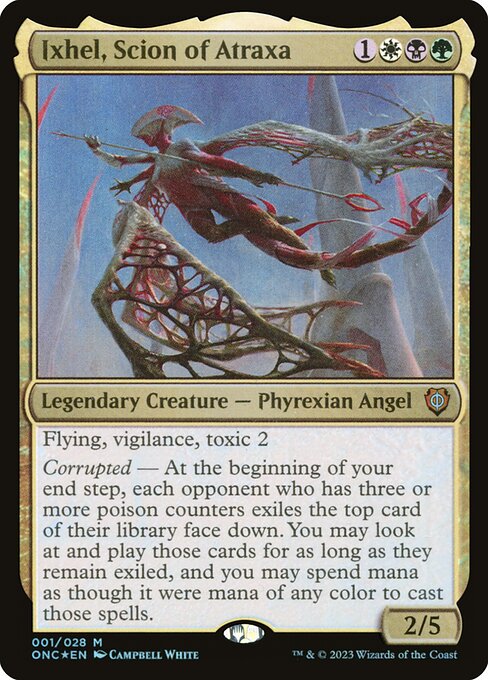
Ixhel, Scion of Atraxa
Corrupted value
Track which opponents individually have three poison, and budget mana for exiled cards.

Vishgraz, the Doomhive
Wide board and commander pressure
Mites cannot block, and the commander's growing power does not raise toxic 1.

Skrelv's Hive
Recurring Mites
Trades upkeep life for tokens and has its own corrupted lifelink condition.

Venerated Rotpriest
Spell targeting engine
Its poison trigger is separate from toxic and cares about spells, not every ability.
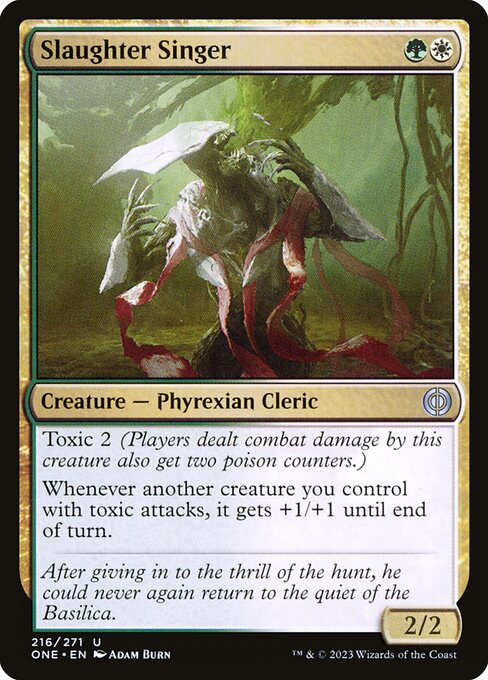
Slaughter Singer
Attack support
Improves other toxic attackers' combat stats without changing their toxic values.
Test the three counter milestone and the final attack
Start with a real opening hand and identify the first poison source you can cast. Rehearse reaching three poison on one opponent and then on several. Track what Ixhel or another corrupted payoff actually supplies at those moments. A theoretical resource engine that never reaches its threshold in a defended game needs better access, not another card waiting for the same threshold.
Next test a wide attack into tokens and a focused attack into one large blocker. Count actual player damage events, total toxic value, and any separate triggers. Do not add poison from a blocked creature that only damaged a blocker. Add a prevention effect in one test so you can see which expected counters disappear and which independent poison triggers remain relevant.
Discuss poison and repeated proliferation clearly before the game if your group uses a pregame expectations conversation. Explain the deck's actual route and speed rather than promising it is weak because its creatures are small. A small toxic board can create a meaningful clock, while an expensive poison deck can still stumble. Accurate descriptions make the game easier to match than a vague power label.
Build your deck and create a free account to save the version with its primary route marked. Record whether failures came from finding initial poison, connecting, drawing cards, or surviving removal. Make the next change address that failure. Adding more poison payoffs cannot fix a deck that never gets the first qualifying combat connection.
Toxic questions
Build your deck
Put these choices into a Commander list. Create a free account to save your deck and keep tuning it with Deckcipher.
FAQ
Does pumping a toxic creature give more poison?
Not through toxic alone. Its total toxic value determines the poison from a qualifying combat hit. More power can increase ordinary damage, improve a block exchange, or support commander damage, but it does not change toxic 1 into toxic 4.
Do multiple toxic abilities add together?
Yes. A creature with toxic 2 and toxic 1 has total toxic value three. That total is used when it deals combat damage to a player. This differs from redundant multiple instances of infect or lifelink. Read the abilities actually present.
Does toxic trigger after combat damage?
Toxic itself is a static ability affecting the consequences of combat damage to a player. It does not create a separate trigger to counter. Other poison abilities, including Venerated Rotpriest's targeting ability, can be triggered abilities and follow the stack process.
Does toxic work with noncombat damage?
No. Toxic requires combat damage to a player. A toxic creature damaging a blocker or using a noncombat damage ability does not give that player toxic counters through the keyword. Separate abilities on the card may give poison for other events.
Can lifelink remove my poison counters?
No. Life gain changes life total rather than poison total. The normal Commander loss threshold remains ten poison even at a high life total. Lifelink can still be useful for surviving ordinary damage while the poison plan develops.
Does double strike apply toxic twice?
It can if the creature deals qualifying combat damage to the player in both steps. Remaining blocked, losing the creature, or preventing damage can stop a later event. Count actual hits rather than assuming double strike guarantees two applications.