
Quick answer
A creature with menace cannot be blocked except by two or more creatures. Check that requirement when blockers are declared. Removing one blocker afterward does not undo a legal block, and multiple instances of menace do not require additional blockers.
Menace asks for two blockers, not two toughness
Menace is an evasion ability that makes a defending player commit at least two creatures to block the attacker. One enormous creature is not enough. A 10/10 that can ordinarily block a menace attacker still cannot do so alone. Two ordinary 1/1 creatures may be sufficient if each is otherwise a legal blocker. The ability counts creatures, not their combined power or toughness.
The defending player may choose not to block. Menace does not force a block and does not force all available creatures into combat. It changes which blocking declarations are legal. If the player has only one legal blocker, they cannot declare that creature as a lone blocker for the menace attacker. The attack can get through unless another effect changes the situation before damage.
Each blocker must independently satisfy the relevant restrictions. A tapped creature normally cannot be declared as a blocker. A ground creature without reach cannot normally block a flyer. A creature prevented from blocking the attacker by protection cannot be used as the second body just to satisfy menace. Two creatures present on the battlefield are not necessarily two legal blockers.
This creates a practical advantage for attacks against thin boards. A player leaving one large creature back may feel defended against normal combat while remaining open to menace. Against a player with many expendable tokens, the same attacker may be easy to contain. Menace's value comes from the defending board and the costs of committing two bodies, rather than a guarantee that it connects.
A legal block stays legal when one blocker leaves
Suppose your 4/4 menace attacker is blocked by two 2/2 creatures. That declaration satisfies menace. Before combat damage, you cast removal on one of the blockers. The remaining 2/2 still blocks the attacker. Menace does not recheck and undo the entire declaration just because only one blocker remains afterward.
The attacker is still blocked and, without trample or another relevant effect, deals its combat damage to the remaining blocker rather than the defending player. Removing one blocker may improve the exchange or preserve your attacker, but it does not automatically turn the attack into four damage to the player. The timing of the removal determines whether it changes legal blocker options or merely changes the eventual combat.
If you remove the creature before blockers are declared, the result can be different. A defender who had exactly two legal blockers may then have only one, leaving no legal way to block the menace attacker. Players receive a window in the declare attackers step before moving to declare blockers. Use that window if the point of the removal is to prevent a two creature block from being declared.
Do not assume a defender must reveal their preferred block before you decide whether to remove a creature. Once the game moves into declaring blockers, that declaration is a turn based action, not an action you interrupt halfway through. You can act before that step or after the declaration, and those moments produce different outcomes. Clear shortcuts and announcements keep a tactical choice from becoming a timing argument.
What happens when the attacker gains or loses menace
Granting menace before blockers are declared changes the legal declarations. An opponent with only one legal blocker can no longer use it alone. Granting menace after a creature has already been legally blocked by one creature does not undo that block. Evasion restrictions are checked for the blocking declaration, not used to rewrite an earlier legal declaration retroactively.
Losing menace before blockers are declared can let a single creature block. Losing it afterward does not make a previously legal two creature block disappear. The block simply proceeds with the creatures that were declared. These cases are easier when you identify what has already happened: the restriction governs the declaration event, while later abilities may affect damage or other combat consequences.
Multiple instances of menace are redundant. Giving an attacker menace twice does not require four blockers. A card with additional text can raise the requirement, but that comes from its separate wording rather than stacking the keyword. Sonorous Howlbonder specifically makes creatures you control with menace require three or more blockers. Read that as an additional restriction, not a new general definition of menace.
If the Howlbonder leaves before blockers are declared, its static restriction is no longer helping. Removing it after three blockers have been legally declared does not erase the block. A defending player deciding what to remove should ask whether they need to open a one or two creature blocking option before declarations, or whether they need to change the actual damage exchange after the block exists.
Combine restrictions carefully: flying and protection
Menace plus flying can make a meaningful attack because the defender needs at least two creatures that can legally block a flyer. One flyer and several ordinary ground creatures are not enough unless one of those ground creatures has reach or another relevant permission. Menace does not remove flying's restriction; both restrictions must be satisfied together.
Protection can shrink the eligible blocker pool further. If an attacker has protection from green and menace, green creatures cannot legally block it, even as part of a pair. A defender needs two legal creatures without the prohibited quality. Multicolored creatures count as every color they have, so a green and white creature is still green for a protection from green restriction.
The reverse combination can make blocking impossible. If an attacker cannot be blocked by more than one creature and also has menace, a block would need both at least two creatures and no more than one. No declaration can satisfy both restrictions. That result comes from the combination of restrictions. It does not mean menace by itself is the same as cannot be blocked.
Restrictions and requirements have their own full rules when a creature is required to block. An instruction to block if able does not authorize an illegal lone block against menace. Determine a legal declaration while satisfying as many applicable requirements as the rules demand. If several requirements and restrictions conflict, slow down and work through the actual cards rather than using menace as a blanket reason to ignore everything else.
| Defending board | Can it block a menace attacker? | Reason |
|---|---|---|
| One otherwise legal 10/10 | No | Menace needs two creatures |
| Two otherwise legal 1/1s | Yes | Power and toughness do not set the count |
| One flyer and ground creatures versus flying menace | Not without another legal flying blocker | Both evasion restrictions apply |
| Two blockers, one removed after declaration | The other remains a blocker | Legal declaration is not undone |
| A menace creature with Sonorous Howlbonder active | Needs three legal blockers | The extra restriction comes from Howlbonder |
Damage exchanges, deathtouch, and trample
Menace does not make combat damage happen early or increase an attacker's power. A 4/4 menace creature blocked by two 2/2s can receive four damage and die in ordinary combat. Its controller chooses a legal combat damage assignment among the blockers under the current rules. Menace created the need for two blockers, but it does not guarantee a favorable trade once those blockers are present.
Deathtouch can make that trade more expensive for the defender. A menace attacker with enough power can assign nonzero damage to several blockers and threaten each through deathtouch. It still receives opposing damage at the normal time unless first strike or another ability changes that. A small deathtouch menace creature is difficult to block profitably in some situations, but it can still trade rather than survive.
Trample changes the consequence of committing small blockers. A large menace trampler can assign lethal damage to both blockers and send excess through. Without trample, two expendable tokens may contain all player damage even when both tokens die. With trample, the defender must consider the total lethal assignments those blockers require rather than assuming two bodies absorb the whole attack.
First strike and double strike introduce separate damage steps and a response window between them. A menace creature can kill blockers early but remain blocked afterward. Without trample, losing all blockers after the first step does not automatically let its second strike hit the player. Read the trample guide for that assignment and the deathtouch guide for the destruction consequences.
Multiplayer attacks reward choosing the right defender
Commander gives you several defending boards to compare. One player may have one large untapped creature, another may have four tokens, and a third may have two valuable engine creatures. The same menace attacker presents a different decision to each. Attacking the first may be nearly free, while attacking the third may force an expensive block if they cannot afford the life loss.
The defender facing one of your attackers cannot ordinarily borrow another opponent's creatures as blockers. In a normal free for all Commander game, a creature blocks attackers that are attacking the relevant defending player or appropriate objects they defend under the rules. An ally's large army across the table does not supply a second blocker for the player you attacked. Team variants can have different rules, so keep the usual Commander context clear.
Spreading several menace attackers among opponents can exploit several thin boards. Concentrating them on one defender can instead overload that player's available legal pairs. Work out the blockers creature by creature. A defender with four ordinary blockers cannot automatically block three menace attackers if each blocker can block only one creature. Abilities allowing additional blocks can change that calculation.
Politics still matters. A player with two important blockers may choose to take damage rather than trade an engine. That does not make the attack guaranteed in future turns; the player may develop tokens or remove your evasion source. Evaluate the actual board each combat. Menace gives you a way to make decisions costly, but the defending player retains agency over blocks, removal, and resource use.
Choose menace support for a coherent attack plan
Goblin War Drums grants menace to creatures you control. It supports a wide board that already exists, but does not make creatures or provide card draw by itself. An opening hand with several evasion enchantments and too few creatures may not pressure anyone. Teamwide menace should support a creature production plan rather than replace the cards that produce attackers.
Iroas, God of Victory grants menace to your creatures and prevents damage to your attacking creatures. These are separate abilities with useful overlap. Preventing damage can preserve attackers through blocks that menace forces opponents to commit. The prevention does not make those attackers immune to exile, sacrifice, or destruction that does not deal damage. Iroas's own creature status also depends on devotion.
Sonorous Howlbonder raises the blocking requirement for your creatures with menace to three or more. It asks for a meaningful density of menace creatures or a teamwide grant. In a deck where only the Howlbonder has menace, its support can be too narrow. A full board of menace attackers may make its restriction much more relevant, though a removable support creature can expose your planned attacks before blockers.
Key to the City offers a different evasion route. Its targeted activation can make one creature unable to be blocked for the turn at the cost of tapping and discarding. Its later draw option has its own mana payment when it becomes untapped. Compare that focused route with teamwide menace instead of treating them as identical. A single commander damage threat may prefer certainty for one attacker, while a token board may prefer a broader grant.
Menace support and a focused alternative
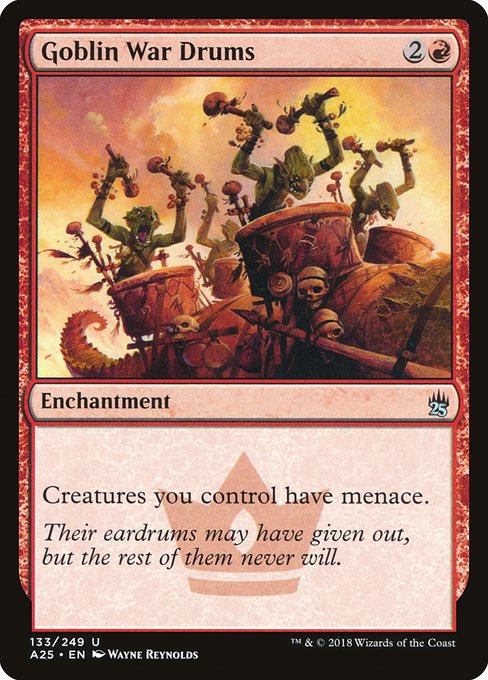
Goblin War Drums
Team evasion
Needs enough creatures to make the shared restriction worth a card.

Iroas, God of Victory
Combat support
Combines menace with damage prevention for your attacking creatures.
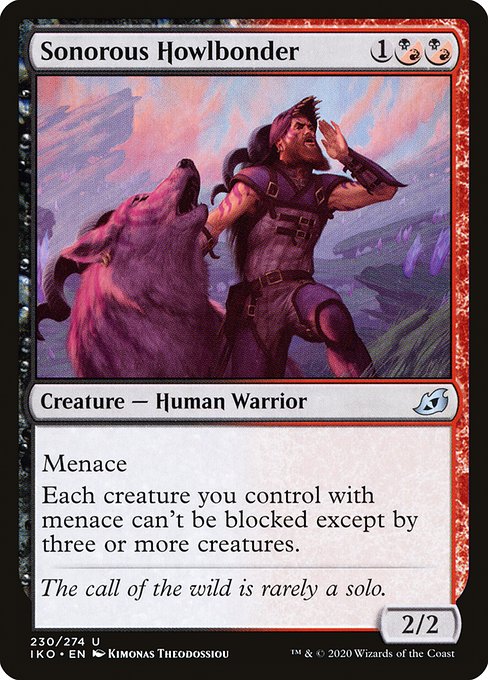
Sonorous Howlbonder
Higher blocker requirement
Uses separate text to require three blockers for your menace creatures.
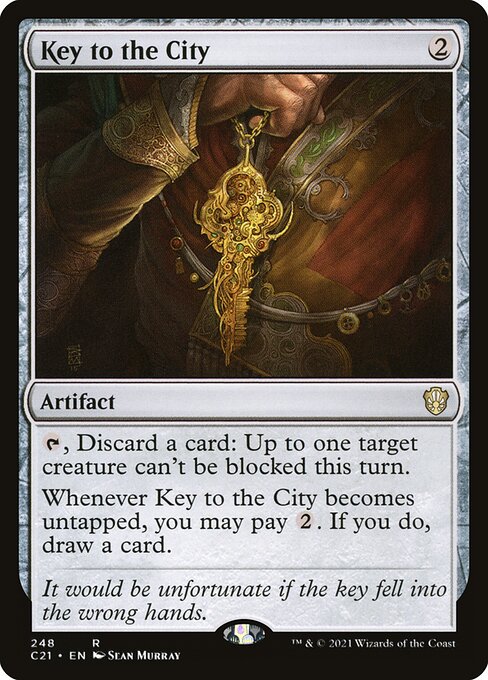
Key to the City
One attacker
Offers targeted cannot be blocked support with discard and later draw costs.
Answer menace and test your attack decisions
Against menace, develop expendable blockers when they fit your plan. Two tokens can defend in ways one enormous body cannot. Do not spend removal after blockers expecting the block to become illegal. If your goal is to let one creature block, remove the menace granting source before the declaration or remove menace with an appropriate effect before then.
If the block is already declared, choose actions based on the damage exchange. Removing the attacker stops its damage. Removing one blocker can preserve resources or alter a trade, but the other blocker remains. A fog or prevention effect may protect life or creatures depending on its exact wording. A toughness boost may matter against ordinary damage and not solve a deathtouch problem. Match the answer to the actual combat.
For your own list, rehearse attacks against one large blocker, a token board, and two important utility creatures. Note whether menace creates a connection, a useful trade, or no meaningful pressure. Use the deck building checklist to check that you have creatures, card flow, and interaction alongside the evasion support. A keyword grant cannot fix an empty board.
Build your deck and create a free Deckcipher account to save a version with that attack plan. Compare one teamwide menace source with a focused evasion card and document the actual attackers each supports. The right choice depends on how many creatures you expect to attack with and which opponents' boards you need to challenge, not on the keyword in isolation.
Menace questions
Build your deck
Put these choices into a Commander list. Create a free account to save your deck and keep tuning it with Deckcipher.
FAQ
Can one large creature block menace?
No, unless another effect specifically changes the relevant rules in a way that permits it. Ordinary menace requires two or more creatures, regardless of their power or toughness. A single 10/10 is still one blocker. Two much smaller legal creatures can satisfy the basic requirement.
What if I kill one blocker after blocks?
The remaining creature still blocks the attacker. The original declaration was legal, and menace does not undo it afterward. Without trample or another relevant effect, the blocked attacker does not simply deal damage to the player. Remove a blocker before declarations if you want to prevent a legal pair.
Does menace twice require four blockers?
No. Multiple instances of menace are redundant. A card such as Sonorous Howlbonder has separate text raising the requirement to three. That is an additional restriction from the card, not the result of adding another copy of the keyword.
Can two ground creatures block flying menace?
Only if both are actually legal blockers for that flyer, such as through reach or another relevant permission. Menace and flying both apply. Merely having two creatures is not enough when one or both fail a different blocking restriction.
Does gaining menace after a block remove the blocker?
No. A previously legal block remains. Grant menace before blockers are declared if you want its restriction to shape the declaration. Giving it later can matter to other effects that care about the ability, but it does not retroactively make the block illegal.
Is menace the same as cannot be blocked?
No. Two or more legal creatures can block an ordinary menace attacker. Combining menace with other restrictions may leave no legal block, but that depends on the actual board and wording. Token armies can often absorb menace attacks that would pass a lone large blocker.