
Quick answer
Any nonzero damage a source with deathtouch deals to a creature can cause that creature to be destroyed. Deathtouch works with noncombat damage, does not bypass indestructible, and makes one assigned damage count as lethal for trample assignment.
The basic rule is about damage to a creature
Deathtouch changes what a nonzero amount of damage means for a creature that receives it. An ordinary 1/1 may not threaten a 7/7 in combat, but a 1/1 with deathtouch can deal one damage and cause that larger creature to be destroyed when state based actions are checked. The size of the damaged creature does not make one damage too small for deathtouch.
The damage still has to happen. Zero damage is not a nonzero amount, and fully prevented damage does not become a deathtouch kill. A creature with zero power normally assigns no combat damage. Giving that creature deathtouch does not make it assign one for free. If a prevention effect stops all the damage, the larger creature has not received the damage needed for this rule.
Deathtouch is not poison and does not make damage to a player lethal at any life total. A 1/1 deathtouch creature that connects with a player ordinarily deals one damage. It does not destroy the player or give poison merely because it has deathtouch. Cards such as Fynn, the Fangbearer add a separate triggered ability that can reward a combat connection with poison counters.
That distinction makes the ability useful in several jobs. A small deathtouch blocker discourages large attacks, an evasive deathtouch attacker can demand a difficult block, and a deathtouch damage source can remove creatures outside combat. Decide which of those jobs your deck actually needs before filling it with small bodies that cannot draw cards, attack profitably, or advance a win.
A normal combat example, including what dies when
You attack with a 1/1 creature with deathtouch. An opponent blocks with an ordinary 6/6. Neither creature has first strike or double strike. In the normal combat damage step, the attacker deals one damage to the blocker and the blocker deals six damage to the attacker simultaneously. After damage is dealt, state based actions are checked.
The 1/1 has lethal ordinary damage marked and is destroyed. The 6/6 has been dealt damage by a source with deathtouch and is also destroyed. Deathtouch does not make the smaller creature deal its damage first. It makes the smaller creature's damage meaningful. In an ordinary exchange, both bodies can die even when the deathtouch creature's controller has described it as killing anything.
Now give the 1/1 indestructible. It can survive the lethal damage while the 6/6 is destroyed. Give the 6/6 indestructible instead, and it can survive the deathtouch destruction while the 1/1 dies. Prevent the 1/1's damage entirely, and deathtouch does not destroy the 6/6. These changes show why the relevant question is which damage happens and which destruction can occur afterward.
If damage causes a triggered ability, that trigger waits for the normal process before it is placed on the stack. Players do not get a window after combat damage is dealt to cast a pump spell before state based actions destroy creatures that have already received lethal damage. Use a trick before damage when it needs to change power, toughness, or relevant abilities for that damage event.
Fight and other noncombat damage still use deathtouch
Deathtouch is not limited to combat damage. If a creature with deathtouch deals damage through a fight effect, its damage can destroy the other creature. A fight normally makes each creature deal damage equal to its power to the other. Those events are not combat damage, but they are still damage from the creatures named in the fight.
First strike does not make one creature win a fight before the other deals damage. First strike changes combat damage steps, and a fight is not a combat damage step. A 1/1 with first strike and deathtouch fighting a 6/6 can still receive the 6/6's damage. Unless another relevant defense applies, both may die. This is a common place where combat intuition is applied to the wrong event.
A creature with an activated ability that deals damage can also use deathtouch. Giving Goblin Sharpshooter deathtouch with Basilisk Collar lets a point of its damage threaten a creature of much greater toughness. The Sharpshooter's untap trigger can provide further opportunities when creatures die. Each activation and trigger still follows the stack and priority rules, so opponents can respond at legal points rather than watching an unexplained automatic sequence.
The source of the damage matters. An Equipment that grants an ability to a creature can make that creature the damage source, while another card may deal damage itself. Check the wording before assuming a creature's deathtouch applies to every damage effect associated with it. If a spell deals the damage, the creature's keyword does not automatically transfer to the spell.
Trample turns small lethal assignments into excess damage
Trample permits damage to be assigned beyond blockers only after the relevant lethal assignment requirement is met. Deathtouch changes that assignment calculation: one damage from a source with deathtouch is considered lethal when assigning combat damage to a creature. This can let a large trampler assign very little to each blocker and send the rest through.
Suppose a 5/5 attacker with deathtouch and trample is blocked by one 8/8. It can assign one damage to that blocker and four to the defending player. The blocker has received a lethal assignment because of deathtouch, even though one is far below eight. After damage is dealt, the 8/8 can be destroyed by deathtouch while the player takes four damage. The attacker may also receive enough damage to die.
With two legal blockers, the attacker can ordinarily assign one to each and three through, assuming no other constraints change the situation. The attacking player is not required to spend all five power trying to match the blockers' combined toughness. Current combat damage assignment does not require the old damage assignment order shortcut. Explain the actual assignment you choose and satisfy the relevant rules for all blockers.
Indestructible does not force the attacker to assign an impossible amount of damage to a blocker. For this assignment calculation, deathtouch can still make one enough even if the blocker will survive destruction. Protection and prevention likewise do not require assigning extra damage to make the damage actually get through. The trample guide separates assignment from the later effects that prevent damage or destruction.
| Damage situation | Deathtouch result | What to remember |
|---|---|---|
| One damage to a normal creature | Can destroy it | Any nonzero amount can matter |
| Zero damage | No deathtouch destruction | The keyword does not invent damage |
| Damage fully prevented | No damage to use | Prevention can stop the relevant event |
| Damage to an indestructible creature | Destruction is prevented | Deathtouch still leads to destruction |
| Damage to a player | Ordinary damage consequences | Poison needs a separate rule or ability |
First strike and double strike change the exchange
First strike creates an earlier combat damage step when relevant creatures have it. A creature with first strike and deathtouch can deal its damage in that first step, potentially destroying a blocker before the normal damage step. If the blocker is gone before it would deal normal damage, it does not deal that later damage. This is why the combination can preserve a small attacker in an exchange that ordinary deathtouch would merely trade.
The combination is not absolute. An opposing first strike creature can deal damage in the same early step. An indestructible blocker may survive the early damage and still be present later. Damage prevention can stop the deathtouch event. Removing the attacker before damage can stop it from dealing damage at all. The number of keywords is less important than the exact battlefield and timing.
Double strike lets an eligible creature deal combat damage in both the first and normal combat damage steps. If it kills its only blocker in the first step, it remains blocked. Without trample, it does not automatically damage the defending player in the second step. With trample, it can assign later damage through according to the situation in that later step. Killing a blocker is not the same action as becoming unblocked.
Players receive priority between combat damage steps after state based actions and triggers are handled. That gives each side a chance to change the second step. A protection spell, removal spell, or power change can alter what happens next. Read the first strike and double strike guide before assuming the second damage event is guaranteed by the first.
Fynn poison is a separate triggered plan
Fynn, the Fangbearer rewards creatures you control with deathtouch dealing combat damage to a player. Its triggered ability gives that player two poison counters. The ordinary combat damage still happens. Fynn does not grant infect or toxic, and its poison amount does not scale with the attacking creature's power. A one power and a five power deathtouch creature each produce the same Fynn trigger when they meet the condition.
Several deathtouch creatures connecting can produce several triggers. A creature with double strike can connect in two damage steps and trigger again in the later one if the condition is met. A damage ability outside combat does not meet Fynn's combat damage requirement even though it benefits from deathtouch for removing creatures. Keep the poison plan's trigger condition separate from the keyword's own broader damage function.
The normal poison loss threshold in Commander is ten. That does not make every deathtouch creature a fast kill by itself. Blockers, removal, and the need to pressure several opponents still matter. A Fynn list can become threatening early enough that opponents prioritize it. The deck needs evasion, cards, protection, and a recovery plan rather than relying on the threshold to make every attack successful.
If Fynn leaves after a qualifying trigger is already on the stack, that trigger does not vanish merely because Fynn is gone. Removing Fynn before damage can prevent the trigger from being created, however. Opponents should act at the right time if stopping poison is their goal. Use the poison counter reference to keep Fynn's triggered counters distinct from infect damage and toxic's damage consequences.
Build deathtouch creatures with a job beyond the keyword
A deck full of one power deathtouch bodies can discourage attacks while making little progress itself. Opponents can develop noncombat engines, make expendable tokens, or use removal that ignores combat. The keyword is strongest when the body also draws cards, supplies a relevant creature type, carries equipment, or enables a commander that converts combat into resources.
Ohran Frostfang gives attacking creatures deathtouch and rewards combat damage to a player with cards. That makes blocking and not blocking costly in different ways. It does not make every attacker unblockable, and the creature itself is a substantial mana investment. A deck must already be able to develop and attack with creatures for its abilities to matter. Adding it to a creature light deck does not create an army.
Basilisk Collar gives deathtouch and lifelink to the equipped creature. On a simple attacker it can improve combat and stabilize life. On a repeatable damage creature it can change the interaction role entirely. Count the cast cost, equip cost, and opportunity to activate the damage ability. An equipment combo requiring a creature to untap is slower and more vulnerable than an immediate removal spell, even if its later ceiling is high.
In a trample deck, a small deathtouch grant can make existing power more efficient at getting through blockers. In a Fynn deck, the deathtouch creature count is part of the poison engine. In a defensive value deck, a few useful blockers may be enough. Those decks should not inherit the same number of small deathtouch creatures simply because the keyword appears in all of them.
Deathtouch cards by their actual jobs
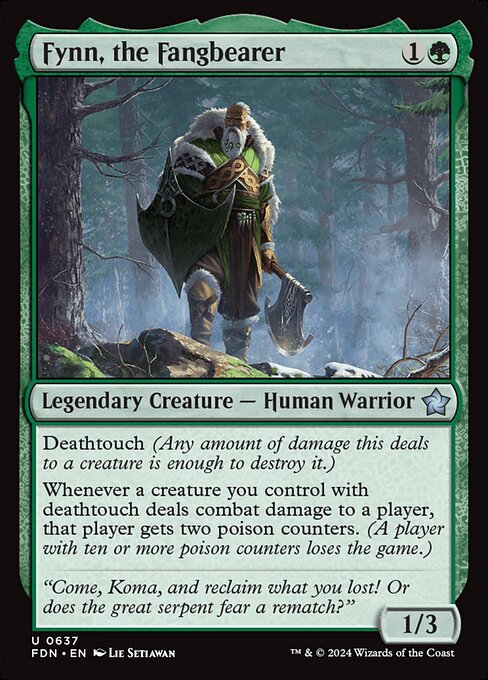
Fynn, the Fangbearer
Poison commander
Adds a separate combat damage trigger rather than changing deathtouch into infect.
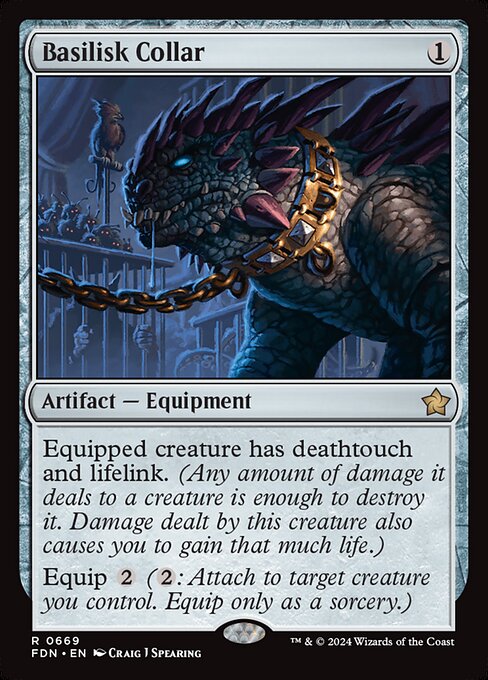
Basilisk Collar
Equipment support
Lifelink and deathtouch can matter on combat creatures or actual creature damage sources.

Ohran Frostfang
Attack and draw engine
Rewards a developed attacking board with difficult blocks and card draw.

Goblin Sharpshooter
Noncombat damage example
Needs a deathtouch grant to turn its own damage into creature removal.

Thornbite Staff
Death based untap support
Read the granted abilities and costs; a sequence still needs legal actions and response windows.
Answer deathtouch and test the important exchanges
The cleanest answer is often to avoid the exchange the deathtouch player wants. A large creature need not attack into a tiny blocker if another line advances your game. Evasive attackers, tokens you can afford to trade, and nontargeted board control can change the pressure. A deck with no way to win outside large ground attackers may need better evasion rather than more power.
If you must interact, remove the relevant creature or ability before damage. Giving a blocker indestructible can preserve it through deathtouch destruction. Preventing the damage can also work. Raising toughness alone does not make a normal creature survive a nonzero deathtouch hit. A pump spell that only adds toughness may therefore fail to do the defensive job you expected.
Use the interaction checker to review how your deck handles utility creatures and repeatable damage engines. Then rehearse one ordinary trade, one first strike exchange, and one deathtouch plus trample attack. Assign the actual damage, apply prevention if any, and check what destruction happens. The sequence is short enough to practice and specific enough to prevent most table disagreements.
Build your deck and create a free account to save the version you want to test. Record whether a deathtouch slot is supplying defense, poison pressure, trample support, or repeatable removal. If it does none of those jobs reliably, replacing that card with draw or interaction can strengthen the deck more than adding another creature that merely shares the keyword.
Deathtouch questions
Build your deck
Put these choices into a Commander list. Create a free account to save your deck and keep tuning it with Deckcipher.
FAQ
Does deathtouch work outside combat?
Yes. Nonzero damage from a source with deathtouch to a creature can lead to destruction whether the damage is combat damage, fight damage, or damage from an ability. Identify the actual source. A creature's keyword does not automatically apply to damage dealt by a separate spell.
Does one point kill an indestructible creature?
Not through deathtouch alone. Deathtouch leads to destruction, and indestructible prevents destruction. Other effects such as exile, sacrifice, or enough toughness reduction can still remove that creature. A large power boost also does not change the fact that ordinary lethal damage is destruction.
Can a zero power creature kill with deathtouch?
It must actually deal a nonzero amount of damage. Zero power ordinarily means no combat damage is assigned. Deathtouch does not supply one damage by itself. A separate ability that causes the creature to deal a positive amount can be a different situation.
How does deathtouch work with trample?
One assigned damage can count as lethal for each blocker, allowing excess damage through under trample's rules. The attacker must still satisfy all relevant assignment requirements. A blocker can survive because of indestructible or prevention even though the assignment was considered lethal.
Does first strike apply to a fight?
No. First strike changes combat damage steps. A fight is noncombat damage, usually dealt by both creatures according to their power. Deathtouch still matters to that damage, but first strike does not make one creature deal its fight damage before the other.
Does deathtouch give players poison?
The keyword alone does not. Fynn supplies a separate triggered ability when your deathtouch creature deals combat damage to a player. Infect and toxic are different mechanics with their own rules. Read which ability gives the poison and which kind of damage or event it requires.