
Quick answer
Damage to a player from an infect source gives that many poison counters instead of causing the usual life loss. Damage to a creature gives that many -1/-1 counters instead of ordinary damage marks. The normal Commander poison loss threshold is ten.
Infect changes damage consequences, not damage itself
Infect is a static ability that changes what damage does to players and creatures. A source with infect dealing four damage to a player normally gives that player four poison counters rather than making them lose four life from that damage. A source with infect dealing four damage to a creature normally puts four -1/-1 counters on it rather than marking four ordinary damage.
The event is still damage. An ability that cares about damage being dealt can still be relevant. A prevention effect can prevent the damage and therefore prevent the associated poison or counters. Lifelink on the infect source can still cause its controller to gain life based on damage actually dealt. Do not describe infect as skipping damage and directly placing counters in every circumstance.
The change is specific to the object receiving damage. Damage to a planeswalker still has the appropriate loyalty consequences, and damage to a battle has its appropriate defense consequences. Infect does not put poison counters on a planeswalker or -1/-1 counters on every noncreature permanent. Read which kind of recipient the damage is reaching.
Multiple instances of infect on the same source are redundant. Granting infect twice does not double poison from one damage event. To increase poison from infect damage, increase the damage actually dealt or create another damage event. Toxic and separate poison abilities can add other consequences, but those come from additional rules or text rather than a second copy of infect.
Poison is a separate race from life and commander damage
A player with ten or more poison counters loses the game when the relevant state based action is checked. Normal multiplayer Commander's forty starting life does not raise that threshold. A player at forty life and nine poison is one poison away from losing. A player at one life and no poison is not close to losing through poison just because their life total is low.
Life gain does not remove poison. A lifelink attack can improve a player's ordinary survival while leaving their poison total unchanged. Preventing later damage can stop later infect counters, but it does not undo counters already received. This persistence is why a table may treat an infect creature as threatening even when the last hit was small.
Commander damage remains another separate loss condition. Combat damage dealt by an infect commander to a player is still commander combat damage and can be tracked toward that commander's twenty one threshold. Infect's poison consequences do not erase the fact that combat damage was dealt. In many simple examples poison reaches ten first, but other effects and prior damage can make both totals relevant.
These parallel totals affect communication. Announce how much combat damage was dealt, how many poison counters result, and which commander damage total changes. Do not subtract ordinary life for an infect damage event unless another rule changes the result. The poison counter reference helps keep direct poison, toxic, and infect distinct when several methods appear in the same deck.
Combat into creatures leaves permanent changes
A 3/3 infect attacker blocked by an ordinary 4/4 deals three damage that becomes three -1/-1 counters on the blocker. The blocker deals its normal four damage to the attacker in the same step if no first strike or other effect changes the sequence. The attacker may die, while the blocker survives as a much smaller creature because its counters remain after the turn.
Ordinary damage marks are normally removed during cleanup. -1/-1 counters are not removed merely because the turn ends. This can make an infect trade useful even when it does not destroy the blocker immediately. It can also make a future fight, removal spell, or proliferation more meaningful. The opponent retains a creature, but its actual power and toughness have changed.
If those counters reduce toughness to zero or less, the creature goes to the graveyard as a state based action. Indestructible does not prevent that action because it is not destruction. A large indestructible creature can still survive a small infect hit if its toughness remains positive. Infect is not an automatic kill against every indestructible blocker; the number of counters still matters.
If +1/+1 counters and -1/-1 counters coexist on a permanent, matching pairs are normally removed through state based actions. Do not keep two separate opposing piles indefinitely as though they cancel only for arithmetic while remaining available to proliferate. Apply the actual state based process. Counter prevention or replacement effects can further change what is placed, so use the relevant card wording when the board includes them.
Trample and double strike amplify actual damage
Infect scales with damage, so power and evasion can combine into a fast clock. A 6/6 infect trampler blocked by an ordinary 2/2 can usually assign two damage to that blocker and four to the defending player. The blocker receives two -1/-1 counters and the player receives four poison from the damage dealt, assuming nothing prevents or changes it.
Deathtouch can change lethal assignment for trample. A creature with infect, deathtouch, and trample can often assign one to each blocker and the rest through. The resulting damage still has infect's consequences. This is an assignment interaction, not a rule that any infect creature needs only one damage assigned to every blocker. Without deathtouch, use the ordinary lethal assignment calculation.
Double strike can create two infect damage events. An unblocked 4/4 infect double striker can give four poison in each step if it remains present and both events deal damage. A blocked one without trample may kill a blocker early and have no later player damage because it remains blocked. Opponents can act between steps. Do not count both hits before checking the actual combat.
A pump spell can increase both ordinary damage output and infect poison output because infect uses the damage amount. That differs from toxic's fixed value. Use the trample guide to calculate blocked attacks and the toxic guide to see why a similar power boost does not produce the same poison result with toxic alone.
| Damage recipient or event | Infect consequence | Important limit |
|---|---|---|
| Player receives four damage | Four poison counters | No normal life loss from that damage |
| Creature receives four damage | Four -1/-1 counters | Counters persist beyond cleanup |
| Planeswalker receives damage | Normal relevant loyalty consequences | Infect does not put poison on it |
| Damage is fully prevented | No infect counters from that event | Damage must actually happen |
| Source has infect and lifelink | Life gain can still occur | Infect damage remains damage |
Skithiryx and Blighted Agent create different attack plans
Skithiryx, the Blight Dragon is a flying infect commander with separate activated abilities for haste and regeneration. The haste ability requires its mana payment before it helps the attack declaration. Regeneration has its own rules and does not answer exile, sacrifice, or a toughness reduction to zero. An expensive commander is not protected from every answer just because it has a built in defensive activation.
Flying gives Skithiryx access against some boards but still permits flying and reach blockers. A focused commander plan needs a way to preserve its threat and enough cards to rebuild when it is removed. Adding only pump spells can leave the deck unable to function without the commander. Command zone access is reliable access, but commander tax can make repeated recasts expensive.
Blighted Agent has infect and cannot be blocked. That supplies a cleaner route through blockers, but not immunity to targeted removal, board wipes, or damage prevention. It is also a small creature that needs support to produce a large poison hit. Protecting the Agent and committing a pump spell are two separate costs in the turn. A defender may answer the creature after you invest the pump.
These plans should not be copied card for card. A mono black Skithiryx deck and a blue infect package have different legal colors, card flow, and support. A five color deck may have access to both but also faces more demanding mana. Start with the actual commander identity and the intended route to connecting before treating every infect creature as part of the same automatic package.
Grafted Exoskeleton has a real detachment risk
Grafted Exoskeleton gives the equipped creature a power and toughness bonus and infect. It can turn an ordinary threat into a poison threat without requiring that creature to have infect printed on it. Casting and equipping the Equipment still cost mana, equip normally uses sorcery timing, and the equip ability needs a legal target you control. A creature with shroud can interfere with that plan.
Its drawback is a triggered ability when it becomes unattached from a permanent, instructing you to sacrifice that permanent. Moving the Equipment away can therefore risk the old wearer. Destroying the Equipment can also make it become unattached and produce the trigger. Read this before treating the card as a reusable infect grant that you move freely among your best creatures.
Sacrifice is not destruction, so indestructible does not by itself preserve a creature you must sacrifice through that trigger. The trigger has its own stack process after the detachment event. Removing the Equipment after the trigger exists does not erase that trigger. Exact control and zone details can matter, but the ordinary case is a meaningful danger to the creature you invested in.
This risk can be acceptable when one successful attack is decisive. It is less attractive when the deck wants to keep a value commander alive through many turns and has little protection or recovery. Compare the Equipment's total cost and drawback with an infect creature, a temporary team grant, or an ordinary combat finisher. A compact poison route is useful only if the deck can execute it without stranding too many resources.
Triumph and Ichor Rats solve different multiplayer problems
Triumph of the Hordes gives your creatures a temporary power and toughness increase, trample, and infect. It is a finishing tool for a board already capable of attacking. It does not create that board or give newly controlled creatures haste. A pile of creatures that cannot legally attack does not become a lethal combat merely because the spell resolved.
Calculate each opponent's blockers and poison total before calling the attack lethal. Three 4/4 creatures becoming 5/5 infect tramplers do not automatically eliminate three fresh opponents through blockers. If each is blocked by a 2/2, each may send only three poison through in a simple assignment. More attackers, existing poison, or a different distribution may change the result. The table still gets response windows before damage.
Ichor Rats supplies poison through an enters trigger as well as having infect. Its trigger gives each player a poison counter, including you. That can seed several opponents without combat, but it also gives you a poison total for other cards to notice. Repeated entries increase your own poison as well, so a blink or recursion plan should not ignore that cost.
Once poison is present, proliferation can advance chosen players without another combat connection. That is a separate engine with its own prerequisites. A deck may choose which players to proliferate, but the Rats' each player trigger does not contain the same choice. Read each method of placing counters individually instead of assuming every poison card can safely ignore its controller.
Infect examples and their costs
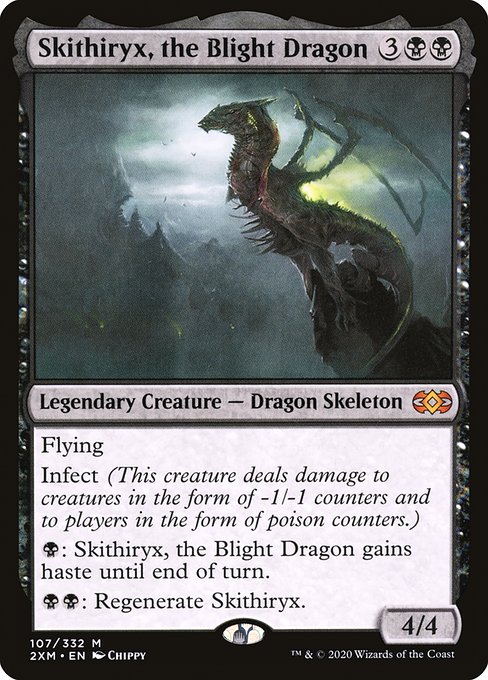
Skithiryx, the Blight Dragon
Focused commander threat
Flying, paid haste, and regeneration support a plan that still needs cards and protection.

Blighted Agent
Small evasive attacker
Cannot be blocked does not protect it from removal or prevent opponents responding to pumps.

Grafted Exoskeleton
Equipment conversion
The detachment sacrifice trigger is part of the card's real cost.

Triumph of the Hordes
Developed board finisher
Needs legal attackers, power, and a real assignment through each opponent's blockers.

Ichor Rats
Initial poison source
Its entry trigger gives poison to every player, including its controller.
Build and answer infect with the actual clock visible
An infect deck needs more than the theoretical ability to deal ten damage. It must connect through several opponents, preserve threats, draw enough cards, and stop opposing wins. A burst that eliminates one player and leaves no resources can lose to the remaining two. Plan how the deck continues after the first removal spell or the first successful attack.
Against infect, prevention and timely removal can stop the damage event. Exile, bounce, sacrifice, and ordinary creature answers remain relevant according to the threat's other abilities. Removing a pump target in response can trade efficiently when the attacker committed several cards. Waiting until after damage to try to remove poison is usually far less practical than answering the source beforehand.
Use the interaction checker to review threats and support, and the deck building checklist to keep the core resources intact. Test one unblocked attack, one blocked trample attack, and a game state where the first threat is removed. Count poison separately from life and note which support cards remain useful when there is no infect body.
Build your deck and create a free account to save those versions. Be clear in the pregame conversation about infect, burst pumps, and repeated proliferation if those define the deck. Describe the actual plan rather than using the ten counter threshold as proof that the deck is either automatically oppressive or automatically weak.
Infect questions
Build your deck
Put these choices into a Commander list. Create a free account to save your deck and keep tuning it with Deckcipher.
FAQ
Does infect deal damage or just place counters?
It deals damage and changes that damage's consequences for players and creatures. Damage prevention, lifelink, and appropriate damage triggers can still matter. A direct poison spell that does not deal damage is a different kind of effect.
Does Commander use twenty poison counters?
Normal Commander uses the ten poison counter loss threshold. Forty starting life does not double it. Some variants or explicit house agreements may use different rules, but do not present those as the default Commander threshold.
Can infect kill an indestructible creature?
Enough infect damage can put enough -1/-1 counters on a creature to reduce toughness to zero. That is not destruction, so indestructible does not prevent it. A small hit leaving positive toughness does not automatically remove the creature.
Does lifelink still work with infect?
Yes. Infect damage remains damage, so a source with lifelink can cause life gain from it. The damaged player receives poison instead of ordinary life loss from that infect damage. Gaining life afterward does not remove poison already received.
Does an infect commander deal commander damage?
Its combat damage to a player is still combat damage dealt by that commander and is tracked for the twenty one damage rule. Poison is a separate total. Damage to blockers and noncombat damage do not count toward that player's commander combat damage total.
Does infect twice double poison?
No. Multiple instances of infect are redundant. More power, a damage modification, or another damage event can increase poison from infect, while toxic or a separate poison ability can add distinct consequences. Count the actual event and abilities rather than repeated keyword text.