
Quick answer
In normal Commander, a player with ten or more poison counters loses as a state based action. Poison stays on the player rather than on the creature that supplied it. Life gain and removing the source do not remove existing poison counters.
The ten poison rule is independent of forty life
Commander normally starts each player at forty life, but its poison threshold remains ten. A player can lose to poison while having a very high life total. The counters are tracked on that player and do not represent ordinary damage marks on a permanent. Raising life, preventing later life loss, or destroying a poison creature does not automatically remove the existing total.
State based actions check the loss condition at the appropriate point before a player receives priority. If a resolving spell gives you your tenth poison counter, finish that spell's resolution and then apply the check. There is not a normal window afterward to cast an instant before the loss condition is noticed. You generally need to stop the relevant effect or change the situation earlier.
This does not mean every counter is immediately lethal. One poison is one tenth of the threshold, but the practical clock depends on what can add the next counters. A single toxic attacker, an infect creature with pump support, and a repeatable proliferation engine create different dangers from the same current total. Evaluate the source of future progress rather than treating every player at one poison as facing an identical timer.
Keep the normal rules separate from house agreements and other variants. A group can explicitly choose a different casual threshold, but that is an exception it should state before play. Two-Headed Giant uses a shared team poison total and a different loss threshold. Do not import that team rule into ordinary free for all Commander just because both games involve more than two people.
Different cards place poison in different ways
Infect makes damage to a player produce that many poison counters instead of the normal life loss from that damage. A four damage infect hit normally adds four poison. It is still damage, so prevention and appropriate damage interactions remain relevant. Infect can apply to noncombat damage when the actual source has infect, not just to a normal attack.
Toxic adds a fixed amount when the creature deals combat damage to a player. A four damage hit from toxic 1 normally adds one poison and causes the ordinary life loss from the damage. More power does not increase toxic's value. Multiple toxic values add, while multiple instances of infect are redundant. These differences change which support cards matter.
Fynn, the Fangbearer supplies a triggered ability when your deathtouch creature deals combat damage to a player. That trigger gives the player two poison. It is neither infect nor toxic. It uses the stack, unlike toxic's immediate damage consequence. An appropriate trigger counter can interact with it, but removing Fynn after the trigger exists does not erase the already triggered ability.
Direct poison effects use their own instructions. Prologue to Phyresis gives each opponent a poison counter and draws a card. Ichor Rats has an enters trigger giving every player poison, including its controller. These effects do not need a creature to connect in combat. The infect guide and toxic guide explain the damage based routes in more detail.
| Method | What starts the poison | How the amount is determined |
|---|---|---|
| Infect | Damage to a player from the source | The damage actually dealt |
| Toxic | Combat damage to a player | The creature's total toxic value |
| Fynn trigger | Qualifying deathtouch combat damage | Two counters from each resolved trigger |
| Direct poison spell or ability | Its own instructions | The amount stated by the effect |
| Proliferate | A chosen player already has poison | One more poison counter per ordinary action |
Proliferate advances a total but cannot start one
Proliferate lets its controller choose eligible players and permanents that already have counters, then add another counter of every kind each chosen recipient already has. A player with poison can receive one more poison through an ordinary proliferation. A player with zero poison does not receive their first poison merely because someone proliferates.
That makes initial poison sources important to a proliferation plan. Seeding one opponent is not the same as seeding all three. If only one player has poison, repeated proliferation can threaten that player while leaving the others at zero poison. A direct each opponent poison effect can solve that access problem, but it also announces that every opponent is now part of the clock.
Proliferate does not target. Hexproof on a player does not stop them from being chosen for the action. The controller makes that choice during resolution, and other players cannot interrupt between the choice and the additional counter. They can respond before the spell or ability resolves, perhaps by countering it or removing the repeatable source before future triggers occur.
Some spells that proliferate have a separate targeted instruction. If all of that spell's targets become illegal, it may fail to resolve and never reach the proliferate instruction. Read the whole spell. Proliferate not targeting does not mean every card containing the word ignores target legality. The proliferate guide separates those checks and explains why mixed helpful and harmful counters can complicate recipient choices.
A worked clock across three opponents
Imagine your three opponents have one, four, and eight poison counters. You resolve one ordinary proliferate action and choose all three. Their totals become two, five, and nine. They do not double, and the player starting at eight does not gain more than the player starting at one. The action adds one of each existing counter kind to each chosen player.
Now you cast a direct effect that would give each opponent one poison. If it resolves normally, the totals become three, six, and ten. Once that effect finishes and state based actions are checked, the player at ten loses. The other two remain in the game with their counters. Eliminating one opponent does not automatically clear poison from the others or end a multiplayer game while more than one player remains.
If the opponent at nine can counter the spell before it resolves, that can prevent the tenth counter from that spell. A life gain spell does not address the poison total. A damage prevention spell helps only if the relevant counter would come from damage it prevents. It does nothing to a nontargeted direct poison instruction simply because poison often appears on attacking creatures.
This example also shows why threat assessment should use reachable actions. A player at nine facing a known repeatable proliferate activation is in a different position from a player at nine facing an empty battlefield and no visible resources. Hidden cards can still matter, but explain the actual immediate route when coordinating responses. Precise totals and sources make the table's decision clearer than calling the whole strategy unfair or harmless.
Prevent the first counters at the relevant event
Against a combat based poison plan, blocking and damage prevention can deny a qualifying hit. A toxic creature blocked by a legal creature does not give toxic poison to the defending player merely because it damaged the blocker. An infect attacker with trample may still assign damage through, so calculate the actual assignment before assuming one token stops the poison entirely.
Remove or disable a dangerous creature before it deals the relevant damage if that is the route you need to stop. Removing a creature after it dealt infect damage does not remove the resulting poison. Removing Fynn after its trigger is already on the stack likewise does not erase that trigger. The point of intervention depends on whether the counters are a damage consequence or a separate resolving ability.
Hexproof and protection need exact targets read. A direct effect saying each opponent gets a counter does not target those players. An ability saying target opponent does. A hexproof creature can still be affected by a relevant untargeted wipe, and a hexproof player can still receive poison through qualifying combat damage. Do not choose a defense solely because poison is the outcome; choose it for the route producing that outcome.
Use the interaction checker to inspect whether your deck can answer creatures, triggered engines, and noncreature support. A suite containing only creature destruction may be able to stop future combat while struggling against a spell based proliferation turn. A flexible package can interact with more of the sequence without dedicating every slot to one opposing strategy.
Counter prevention and the limited removal options
Melira, Sylvok Outcast says you cannot get poison counters. That can stop counters you would otherwise receive, and it has separate text about -1/-1 counters on your creatures and infect on opposing creatures. Those clauses are distinct. The creature must remain relevant for its static protection to apply, and it does not remove poison you already have just by entering the battlefield.
Leeches is a direct poison removal card, but its text includes a cost in consequences: the target player loses all poison counters and then Leeches deals that much damage to that player. A player with a low life total may face a different danger after the counters are removed. It also needs a legal player target. Do not treat it as a free universal reset without reading the damage instruction.
These cards also have color identity and deck slot costs. A mono red deck cannot simply add a white or green answer because it would be convenient in one matchup. Narrow poison answers may be weak draws against the rest of a varied table. Often, flexible interaction that stops the source before the decisive event is more useful across games than a card chosen solely to remove counters afterward.
That does not make every dedicated answer wrong. A recurring group with several poison decks may justify more specific protection. The useful process is to compare the expected problem, the answer's legal colors and timing, and the other jobs the card can do. Avoid the claim that poison has no answers, and avoid the opposite claim that one narrow card means every deck should ignore the strategy.
Build poison without dividing the deck into dead halves
A poison list can use a focused combat threat, a wide toxic board, a deathtouch trigger engine, direct poison followed by proliferation, or a mixture with substantial overlap. Choose the primary input first. Pump spells support infect damage differently from toxic value. A creature token maker supports a wide attack differently from a spell targeting engine. Shared poison counters do not make every enabler interchangeable.
A common failure is drawing all the finishers before the initial counter source. Several proliferate spells can be weak when no player has poison and none of your permanents has useful counters. Another failure is drawing small poison bodies while lacking draw, evasion, or protection. The deck then looks threatening enough to attract removal while lacking resources to continue through it.
Plan what happens after one opponent is eliminated. A burst infect line spending several cards may be decisive against a single player but leave you behind against the remaining two. A recurring engine can be slower but more sustainable. A corrupted value plan can generate resources after three poison on the relevant opponents before trying to reach ten. Choose a route consistent with the game speed you intend to play.
The deck building checklist keeps the ordinary resource needs visible. Lands, colored mana, draw, interaction, and rebuilding still matter in a poison deck. A smaller numerical loss threshold is not a reason to keep a hand with no usable mana or a list with no way to recover from a wipe. Test the support sequence as carefully as the final poison arithmetic.
Poison examples with different roles
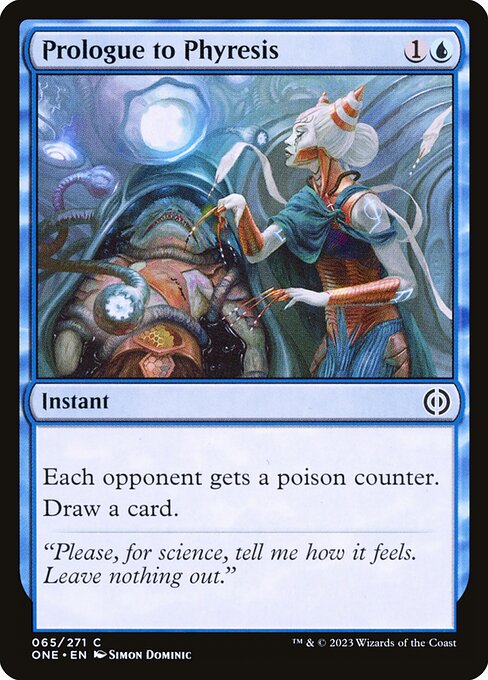
Prologue to Phyresis
Initial counters
Starts poison on each opponent without requiring a combat connection.

Ichor Rats
Entry based counters
Seeds every player, including its controller, and has separate infect text.
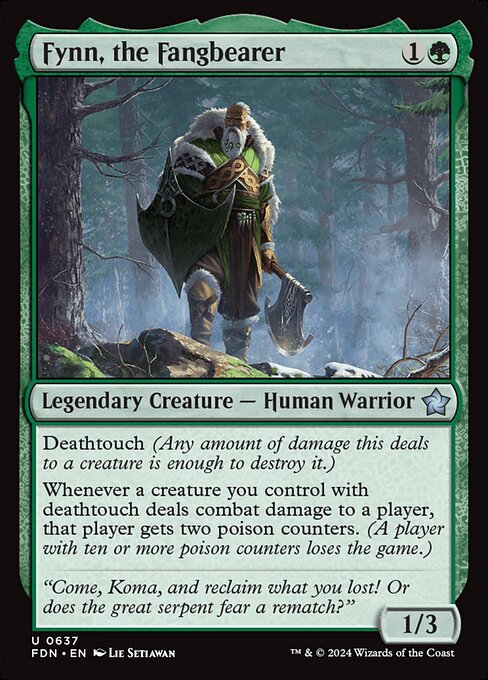
Fynn, the Fangbearer
Combat trigger engine
Needs deathtouch creatures actually dealing combat damage to players.

Melira, Sylvok Outcast
Prevention
Stops future poison while applicable rather than removing an existing total.

Leeches
Counter removal
Removes poison but deals damage equal to the counters lost.
Track counters openly and discuss the actual plan
Use a distinct, visible poison total for each player. Do not reuse a life die in a way that makes the meaning unclear. Commander damage, life, energy, experience, and poison are different values. When several counter types are present, announce which total changed and by how much. A clear record prevents an accidental extra proliferation from deciding a game.
After a source leaves the battlefield, leave the poison total where it belongs. The counters are on the player, so they do not reset when an infect creature dies or a commander returns to the command zone. Likewise, adding a life gain die does not reduce poison. Make the update when the actual effect happens, not only when a player remembers the threat at the end of the turn.
A pregame description can name infect, toxic, repeated proliferation, and the deck's intended speed without revealing every card. Some groups want a relaxed creature game and others welcome compact alternate win conditions. Explain how the deck works rather than demanding a universal verdict about whether poison is acceptable. A single unusual draw also does not establish its normal speed or resilience.
Build your deck and create a free account to save a list with its poison route identified. Test an opening sequence, a defended board, and a game after the first engine is removed. Record whether the bottleneck was initial counters, additional counters, card flow, or protection. The next upgrade should solve that bottleneck rather than merely add another poison themed payoff.
Poison counter questions
Build your deck
Put these choices into a Commander list. Create a free account to save your deck and keep tuning it with Deckcipher.
FAQ
How many poison counters make you lose in Commander?
Ten or more is the normal threshold for an individual player in ordinary Commander. Forty starting life does not change it. Two-Headed Giant uses a shared team total and a fifteen counter threshold, which is a different variant rather than the normal free for all Commander rule.
Does gaining life remove poison?
No. Life total and poison counters are separate values. A player can gain life and still lose at ten poison. Prevention can stop a future damage based poison event when it applies, but it does not retroactively remove counters already placed.
Do counters disappear when the creature dies?
No. Poison counters are on the player, not stored on the creature that supplied them. Removing the source can prevent future damage or triggers, but it does not erase an existing total. A specific counter removal instruction is needed to change that total directly.
Can proliferate give the first poison counter?
No. Proliferate adds another counter of each kind the chosen player already has. A player at zero poison does not receive poison from that action just because another player has poison. Use a separate effect or qualifying combat event to start the total.
Can I respond after receiving the tenth counter?
You can respond before the relevant spell or ability resolves when you have priority. Once the tenth counter is placed and the resolving object finishes, state based actions check the loss condition before ordinary priority returns. An instant cast afterward is not a normal rescue window.
Are infect, toxic, and Fynn the same mechanic?
No. Infect changes damage consequences proportionally to damage. Toxic adds its fixed total toxic value from qualifying combat damage. Fynn uses a separate triggered ability from deathtouch combat damage. Their support cards and interaction windows differ even though all can produce poison.