
Quick answer
To proliferate, choose any number of permanents and players that already have counters, then give each one another counter of every kind it already has. Proliferate does not target, create a new counter type, or double a pile of counters.
What proliferate changes and what it leaves alone
Proliferate grows counters that already exist. A creature with four +1/+1 counters gets one additional +1/+1 counter when you choose it. A planeswalker with three loyalty counters gets one loyalty counter. An opponent with two poison counters gets one poison counter. The starting amount does not change how much an ordinary proliferate action adds. Four counters do not become eight.
You may choose any number of eligible permanents and players, including none. You are not required to help an opponent's planeswalker or add another harmful counter to your own creature. The important limit is that each chosen object or player gets another counter of each kind already present. You choose the recipient, not a preferred subset of its counter types. A creature with both a +1/+1 counter and a stun counter receives another of both if you choose it.
This also explains why proliferate cannot start poison by itself. An opponent with no poison counter is not given their first poison counter merely because you proliferated. That player might have energy or experience counters and be eligible for those, but eligibility does not let you invent a missing counter type. A deck intending to win with poison needs a way to place the first poison counters before the repeated proliferation matters.
The same restraint applies to permanents. Proliferate cannot put loyalty on an ordinary creature, add a shield counter to something that has never had one, or place a new kind of counter because another permanent nearby has that kind. Each recipient is examined independently. This makes the quality and spread of your initial counter sources central to building a useful proliferate deck.
Choose recipients during resolution, without targeting
Proliferate does not use the word target. You choose its recipients as the proliferate action happens during resolution. Hexproof, shroud, and protection do not prevent a permanent or player from being chosen just because they would prevent a targeted spell. That distinction is especially relevant when a poison player hopes a protected opponent can still be advanced toward ten poison.
Players cannot wait to see the chosen recipients and then interrupt the proliferate action. Once a spell or ability begins resolving, finish its instructions without passing priority in the middle. Opponents can respond before it resolves, perhaps by removing a planeswalker or creature they expect you to choose. They cannot respond between your choosing their countered creature and that creature receiving the additional counters.
Some spells containing proliferate also have targets elsewhere in their instructions. Contentious Plan proliferates and then draws a card without targeting. A different spell may target a creature and then tell you to proliferate. If all of that spell's targets become illegal, the spell does not resolve and you do not receive the later proliferate instruction. The fact that proliferate itself does not target does not rescue the rest of a targeted spell.
Read those two questions separately: does this spell have any targets, and does the proliferate action have targets? This avoids a common disagreement where one player correctly says proliferate does not target while another correctly says the whole spell can fail because its only target disappeared. Use the interaction checker to identify the targeted removal around your engine, then read each card's sequence before relying on its final instruction.
A worked example with several kinds of counters
Imagine that you control a creature with two +1/+1 counters, a planeswalker with four loyalty counters, and an artifact with three charge counters. You also have five energy counters. One opponent has two poison counters, while another opponent has no counters at all. Resolving one ordinary proliferate action can increase your creature to three +1/+1 counters, your planeswalker to five loyalty, your artifact to four charge, your energy to six, and the poisoned opponent to three poison.
You can leave any of those recipients unchosen. Perhaps you want the charge artifact to stay below a threshold, or a political agreement makes you leave the poisoned player alone for this action. You cannot choose the unpoisoned opponent and give them poison merely because another player has poison. You also cannot add two loyalty instead of one just because loyalty matters more to your plan than energy.
Now give your creature a stun counter as well. If you choose that creature, it gets another +1/+1 counter and another stun counter. If the stun counter would delay an important untap, declining to proliferate the creature may be better than accepting the larger body. Counter types are not inherently good or bad; their actual consequences determine whether a recipient is worth choosing.
Finally, suppose a creature has a +1/+1 counter and a -1/-1 counter. State based actions normally remove matching pairs before players receive priority. You generally will not preserve those two kinds together between actions just to grow both later. When a resolving effect briefly creates that situation, finish that effect and apply state based actions at the appropriate point. Avoid treating proliferate as a way to suspend the normal rules for opposing counters.
| Recipient before proliferate | If chosen once | Important limit |
|---|---|---|
| Four +1/+1 counters | Five +1/+1 counters | Adds one, not four |
| Two poison and three energy | Three poison and four energy | Every existing kind increases |
| No counters | Cannot receive a new kind through proliferate | Needs a separate initial counter source |
| One shield and one stun | Two shield and two stun | Cannot select only the helpful kind |
Poison is one application, not the entire mechanic
Poison turns proliferate into pressure that does not require another creature to connect in combat. Once each opponent has a poison counter, one proliferation can advance all of them if you choose them. That can be more efficient than sending a small toxic creature through three defended boards. It also makes the engine visible: opponents can see that allowing repeated proliferation may eventually end the game.
The normal Commander poison threshold is ten counters. Forty starting life does not change that threshold. A player with nine poison loses when a resolving proliferate action gives them the tenth, after the current resolving spell or ability finishes and state based actions are checked. They do not receive a normal priority window to cast a life gain spell first, and increasing life would not remove poison anyway.
Proliferate does not deal damage. It does not trigger lifelink, count as commander combat damage, or interact with an effect solely because that effect prevents damage. If an opponent cannot get counters because of an applicable effect, that prevention is relevant; a fog that merely prevents combat damage is not. Distinguish stopping the first combat connection from stopping later counter growth.
You do not have to include poison in every proliferate deck. A counters deck can focus on creatures, planeswalkers, charge artifacts, or energy. Adding one poison card changes how opponents evaluate your entire engine even when poison is technically a backup plan. Discuss that plan clearly and read the poison counter reference if your group is mixing toxic, infect, and direct poison effects. Those mechanics start counters in different ways.
Loyalty, energy, and other counter resources
Loyalty is a resource you can grow without activating a planeswalker's loyalty ability. Proliferating can put a planeswalker into range of a costly ability, but it does not grant an extra activation. You still obey the usual restrictions on activating that permanent's loyalty abilities unless another effect changes them. Increasing loyalty and increasing the permitted number of activations are different benefits.
Energy counters belong to a player. Removing the creature or artifact that generated energy does not remove the counters already on that player. If you have at least one energy, proliferate can add another. An energy deck therefore can use proliferation as a bridge between a producer and a later spender, but one added counter may be a small return if the deck needs six or more energy for a major activation.
Experience counters also belong to a player and can be proliferated once present. The experience commander reads the number you have; it does not store those counters on itself. Recasting that commander after removal can make use of the same experience total. Do not transfer player counters onto a permanent or reset them because the commander changed zones.
Other counter types require careful reading. Adding a lore counter to a Saga can trigger a chapter, while adding a stun counter can postpone an untap. A shield counter has a specific replacement role and is not a general permission to ignore every answer. Inventory the actual counter types in your list before assuming that one proliferate spell always helps every permanent. A deck can accidentally build several competing resource systems that each receive too little support.
Build around repeatable opportunities and useful floors
Evolution Sage rewards land entries, so its support should make land drops and additional land entries plausible. A fetch effect can produce more than one land entry across a sequence, but the Sage must be on the battlefield when each relevant event occurs. Repeated landfall opportunities give the deck a different rhythm from a list built around casting many spells in a single turn.
Thrummingbird needs to deal combat damage to a player before it proliferates. It is a creature that asks for a safe attack, not a guaranteed counter increase each turn. Evasion, opposing flyers, and removal all affect its reliability. A deck with little combat support may prefer a spell that proliferates immediately even if the repeatable creature appears to offer a higher ceiling.
Contentious Plan provides one card and one proliferate action. Its floor is easier to evaluate than an engine that needs several untaps. Karn's Bastion occupies a land slot and offers a repeatable activation, but the activation consumes real mana and the land does not provide colored mana. Several colorless utility lands can leave an otherwise attractive multicolor counters deck unable to cast its early spells.
Atraxa, Praetors' Voice offers proliferation at the beginning of your end step. Removing Atraxa before that step prevents a future trigger from occurring. Removing her after the trigger exists does not by itself remove that trigger. Build enough independent counter sources and useful spells that the deck can function through commander removal. A command zone engine is accessible, but it is also easy for the table to identify.
Different ways to proliferate
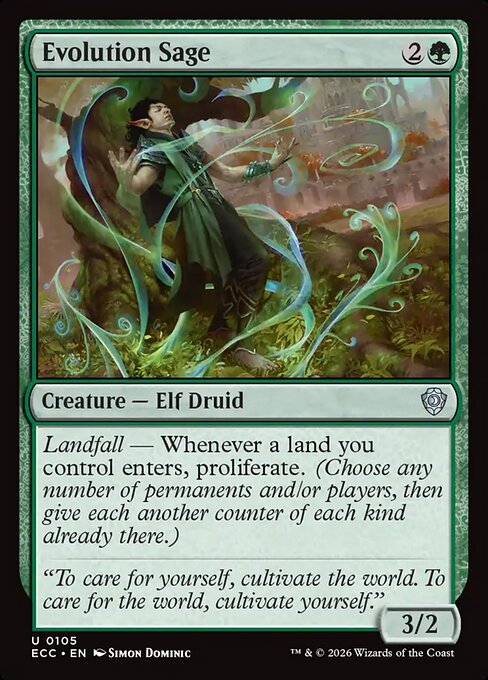
Evolution Sage
Land based engine
Rewards actual land entries and needs a mana plan that supports repeated landfall.
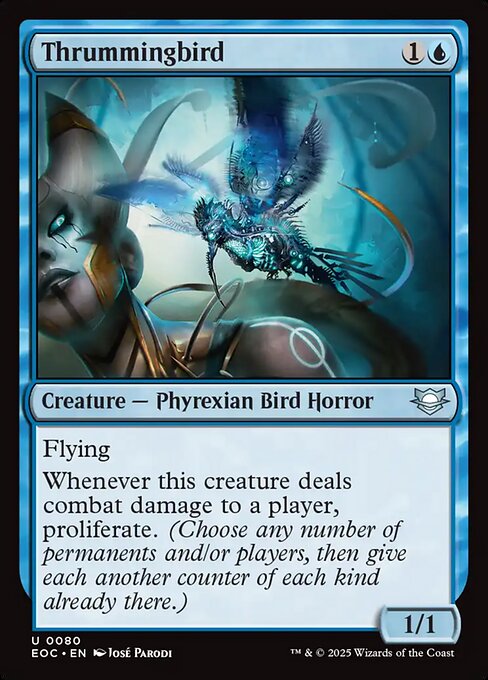
Thrummingbird
Combat engine
Needs combat damage to a player. A blocked attack does not produce its trigger.
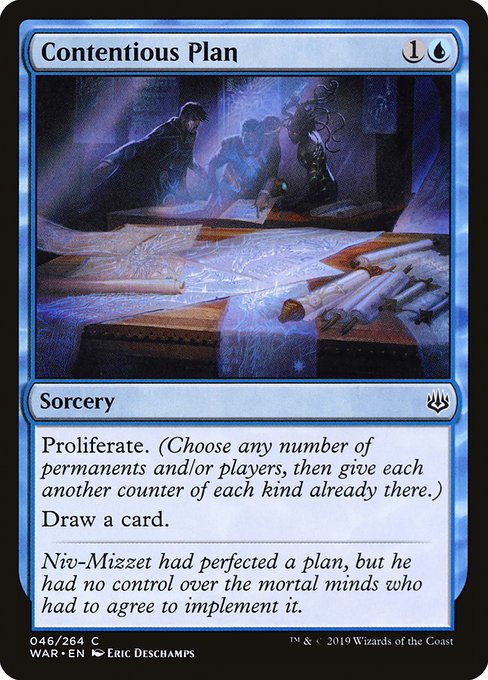
Contentious Plan
Immediate spell
Proliferates, then draws a card, without requiring a combat connection.

Karn's Bastion
Land based activation
A colorless land slot with a mana intensive repeatable ability.
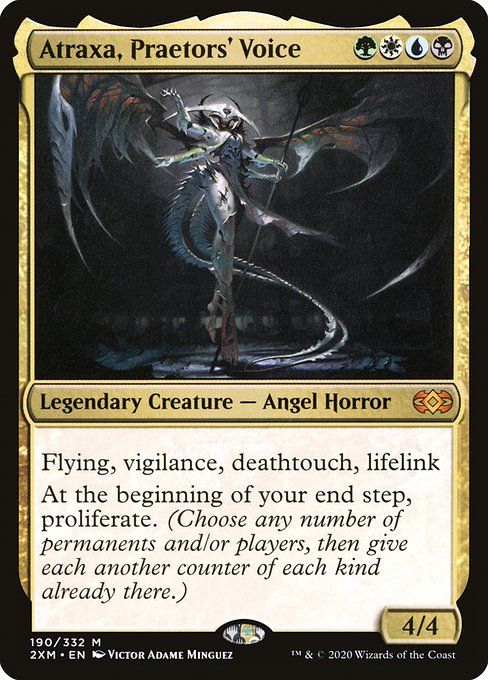
Atraxa, Praetors' Voice
Command zone engine
Gives a predictable end step opportunity that opponents can plan around.
Sequence the first counter before the multiplier
The strongest-looking proliferate card is not useful when there are no counters to grow. In an opening hand, identify what supplies the first relevant counter and what converts that counter into progress. A hand full of proliferation and expensive payoffs can be less functional than a plain hand with lands, a counter source, and one repeatable engine.
For a creature counter plan, putting a counter on two creatures before proliferating can improve more attackers than repeatedly enlarging one. That does not mean spreading counters is always correct. If a single creature has a valuable threshold ability or needs to survive a blocker, concentrating resources may produce the relevant advantage. Choose based on the board rather than assuming wider distribution automatically wins.
For poison, place the first counters before investing mana in a proliferation chain. A player who is still at zero poison does not join the clock just because two other opponents have been seeded. For loyalty, consider whether proliferating before a loyalty activation changes which ability is available. For energy, check whether an extra counter enables an immediate activation or merely sits unused while opponents develop their boards.
Keep mana open for interaction when an engine is already threatening enough. Spending a whole turn adding counters to a dominant board can be worse than protecting the engine from the answer everyone is holding. The Commander deck audit helps review the broader list, but a game decision still depends on whether another counter matters more than a saved spell, a blocker, or an answer to an opposing threat.
Answer and test a proliferate engine
Identify the source of repeatability before spending removal. Destroying a countered creature may reduce one payoff while leaving a landfall proliferate engine untouched. Removing Evolution Sage before a land enters stops future triggers from that event. Removing it after its trigger is on the stack leaves that existing trigger to resolve. Similarly, preventing a combat connection can stop Thrummingbird without destroying every countered permanent.
Countering the spell or ability that actually proliferates is another route when your colors support it. A permanent's hexproof does not prevent it from receiving counters through proliferation, but it can protect the engine from targeted removal. Untargeted answers, attack pressure, and relevant restrictions therefore matter alongside spot removal. Match the answer to the source rather than treating the word proliferate as one uniform card type.
When testing your list, track how often a proliferate card has no meaningful recipient. Also note turns when a recipient exists but the extra counter changes nothing important. A card that advances five different counters can look impressive while failing to draw cards, defend you, or approach a win. Compare those turns with the opportunity cost of a normal draw spell or interaction slot.
Build your deck and create a free account to save a version with a clear primary counter plan. Keep secondary counter packages only when their support overlaps with that plan. A landfall creature deck with a small loyalty package can be coherent; a collection of unrelated energy, poison, charge, and experience cards may simply have too many prerequisites for one proliferation to repair.
Proliferate questions
Build your deck
Put these choices into a Commander list. Create a free account to save your deck and keep tuning it with Deckcipher.
FAQ
Can I proliferate a player with no poison counters?
You cannot give that player their first poison counter through proliferate. If they have another counter type, you may choose them for the counters they already have. That still does not create poison. Use a separate poison source before expecting proliferation to advance that win condition.
Does proliferate target through hexproof?
Proliferate does not target at all. Hexproof and shroud therefore do not stop its recipient choice. A spell that includes proliferate can still have a separate targeted instruction, so check the whole spell before deciding whether a protection ability prevents it from resolving.
Can I add only the good counter type?
No. If you choose a permanent or player, proliferate adds another counter of each kind that recipient already has. You may decline to choose the recipient. You cannot increase its +1/+1 counters while ignoring its existing stun counter during the same proliferate action.
Does proliferating loyalty let me activate twice?
No. It changes the loyalty total. It does not alter how many loyalty abilities that permanent can activate or when they may be activated. Another effect must specifically change those permissions. Extra loyalty can make a different ability affordable within the normal activation limit.
Does proliferate double counters?
An ordinary proliferate action adds one counter of every existing kind to each chosen recipient. It does not multiply the number already there. Separate replacement effects may change how many counters are placed, but that result comes from those effects, not from the basic definition of proliferate.
Do energy and experience disappear with the commander?
No. They are counters on a player, so removing the creature that generated or uses them does not erase the total. If you already have such counters, proliferate can add another. Keep those totals distinct from counters physically placed on creatures or artifacts.