
Improve the attackers, the hits, and the turn after combat
A strong Winota upgrade keeps cheap non-Human attackers and useful Human hits in balance. Start with token makers such as Mogg War Marshal, efficient enablers such as Gingerbrute, and Humans that immediately change combat or rebuild attackers. Keep protection and removal for cards that stop creatures entering from libraries. Expensive Humans alone do not make the deck consistent.
Starting deck targets, not fixed rules
Build two creature systems that support each other
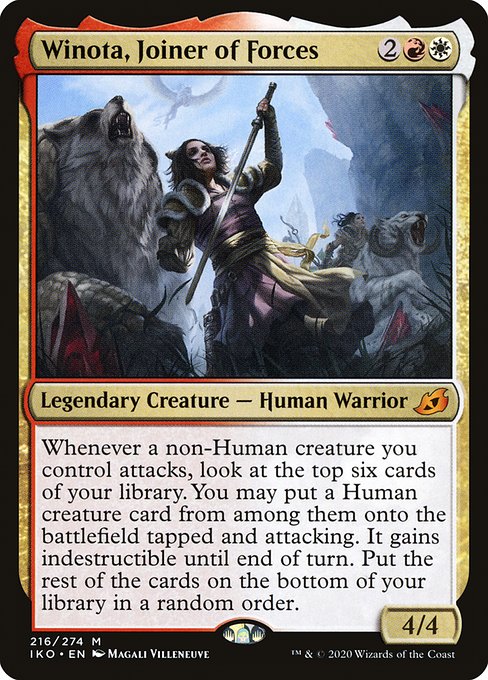
Winota, Joiner of Forces asks you to attack with non-Humans and rewards you with Humans from the top six cards of your library. Each non-Human declared as an attacker creates a separate trigger. The Human enters tapped and attacking with indestructible until end of turn. This is both selection and mana advantage, which is why a humble token spell can outperform an impressive seven-mana creature in the same opening hand.
This guide uses a multiplayer Boros combat build, with an optional light stax package for groups that want it. Winota herself is not a Game Changer, so her presence alone is not a reason to assign a minimum bracket. Your actual acceleration, disruptive cards, combos, and expected finishing turns still need an honest pregame discussion. A low purchase price does not make repeated explosive combats suitable for every table.
Think in terms of jobs rather than a rigid Human-to-non-Human ratio. Some Human creatures also create non-Human tokens. Some token sources are spells, not creature cards. A mana creature that attacks cannot also tap to pay for Winota in that turn unless you untap it or another effect permits both actions. The starting counts above overlap and are not a partition of ninety-nine slots. Audit the actual sequence the deck can produce.
Count token types from rules text, not the picture
Cheap setup cards and useful Human hits
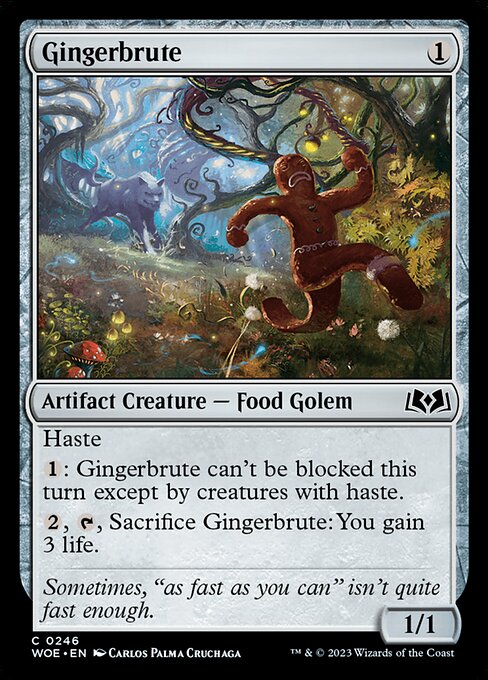
Gingerbrute
Early non-Human attacker
A one-mana artifact creature with haste. Its evasion can help preserve the body, but a safe attack is still a table-dependent choice.

Mogg War Marshal
Multiple non-Human bodies
Makes a Goblin on entry and another on death. Declining echo can leave two Goblins ready for a later Winota turn.

Loyal Apprentice
Human hit and token engine
The Human itself does not trigger Winota by attacking. Its beginning-of-combat Thopter can attack immediately if you control your commander.

Geist-Honored Monk
Human hit that rebuilds attackers
Makes two flying Spirit tokens on entry. They normally wait for a future combat because they lack haste.

Blade Historian
Immediate combat multiplier
Its static effect gives attacking creatures double strike even when it enters through Winota in the middle of combat.

Boromir, Warden of the Tower
Human hit and protection
Can sacrifice immediately to grant your creatures indestructible. That does not answer exile or lethal toughness reduction.
Raise the Alarm creates Soldier tokens without the Human type, so they can trigger Winota when declared as attackers. Adeline, Resplendent Cathar creates Human tokens, which cannot. Hero of Bladehold creates non-Human Soldiers, but those tokens enter already attacking. They do not generate additional Winota triggers during that combat because they were never declared as attackers. If they survive to a later combat and attack normally, they can trigger her then.
Loyal Apprentice is a good example of useful overlap. When you control Winota as your beginning-of-combat step starts, Apprentice can create a hasty Thopter before attackers are declared. That Thopter can produce a trigger immediately. If Apprentice is itself found by Winota after attackers were already declared, its beginning-of-combat trigger has been missed for that combat. It still gives you a Human now and a potential source of attackers later, but it did not secretly add a fifth trigger to the current four.
Improve hit quality without losing the early board
Twenty-four to twenty-eight Human creature hits is a reasonable starting range for this combat approach. The exact number should follow how many hits are useful and how reliably your list produces multiple attackers. Adding four weak Humans can improve the chance of finding a Human while reducing the chance that the found creature matters. Conversely, replacing all the middle-cost Humans with expensive finishers makes hands worse when you naturally draw those cards.
Chance the first trigger sees at least one Human
| Humans left in a 90-card library | Chance in the next six cards | What the number does not measure |
|---|---|---|
| 16 | 70.2% | Whether the Human is useful or the commander survives. |
| 20 | 78.9% | Whether the available Human changes the combat. |
| 24 | 85.4% | The chance that a whole attack wins the game. |
| 28 | 90.1% | The cost of drawing expensive Humans in your opener. |
These are calculated examples for a ninety-card library with no known top cards, not measured deck win rates. The calculation is one minus the chance all six cards are non-Humans, sampled without replacement. Your real library size and remaining Humans change as cards move to your hand, battlefield, graveyard, and bottom of library. Each Winota trigger resolves separately. Do not multiply the first-trigger percentage three times and present it as an exact three-trigger result.
When choosing among hits, take the card that improves the current game state. Blade Historian matters immediately to combat damage. Angrath's Marauders doubles damage from your sources immediately. A protection Human may be correct when opponents are ready to reset the board. Geist-Honored Monk can rebuild a depleted attacker pool while providing a substantial body. Use the Commander deck audit guide to check whether a new package quietly removed the interaction supporting those combats.
Keep hands that set up a real Winota turn
Consider Command Tower, Mountain, Plains, Gingerbrute, Mogg War Marshal, Talisman of Conviction, and Phoenix Chick. Turn one Command Tower casts Gingerbrute. Turn two Mountain plus Tower casts War Marshal and makes a Goblin. Turn three decline echo: War Marshal dies and makes a second Goblin. After playing Plains, use Mountain and Plains for Talisman, then Tower for Phoenix Chick. You now have four non-Human bodies without assuming any helpful draw.
On turn four, the three lands and Talisman produce the four mana needed for Winota, including red and white. All four non-Humans have been controlled since the turn began, so they can attack and generate four triggers. Winota herself does not need haste because she does not need to attack for her ability to work. This line assumes the bodies survive and that playing into the table's interaction is reasonable. It is a sequencing example, not a claim that Winota always attacks with four triggers on turn four.
A hand with three lands, three six-mana Humans, and an anthem is a mulligan even though its hit quality looks exciting. It has no early attackers and little pressure without a successful commander engine. At six, bottom the expensive Human you would prefer to find from the library. Keep sources for both colors, an early attacker package, and a realistic way to reach four mana. Against a pod showing early creature removal, a token maker and protection can be better than one evasive creature carrying the whole plan.
Do not turn a good hand into a mana stumble by filling every land slot with utility. Blade Historian is especially awkward to cast from hand if your lands and rocks mostly produce colorless mana. Winota herself needs both colors. Start with enough colored sources, then add utility lands after checking early sequences. The Commander mana-base guide is useful here because counting total mana is not the same as producing the colors needed on the key turn.
Resolve the combat in the right order
Announce the non-Human attackers and the number of Winota triggers. Resolve one trigger completely, including putting the other five cards on the bottom in random order, before looking at the next six. A found Human can attack a different legal defender from the non-Human that caused its trigger. You are not forced to send every hit into the original opponent. Make those decisions before blockers, while accounting for the remaining players' ability to retaliate.
Suppose the first hit is Goldnight Commander and the next hit is Geist-Honored Monk. Commander does not trigger for its own entry, but it sees Monk enter and later sees each of Monk's two Spirit tokens enter. Each trigger gives creatures you control at that trigger's resolution plus one power and toughness until end of turn. If no one interferes, that sequence can generate three such boosts before blockers. The Spirits normally do not join the current attack, but their entries can increase the damage of creatures already attacking.
Now contrast Combat Celebrant. Winota puts it onto the battlefield attacking, so it never goes through the act of attacking that lets you exert it. It does not immediately create an extra combat from that first entry. Hero of Bladehold likewise does not produce its attack triggers merely by arriving through Winota. Static effects, entry triggers, damage triggers, and attack triggers are different jobs. Rate your Human hits according to what happens this combat, not just everything written on the card.
Pick disruption that does not shut off your own engine
Grafdigger's Cage and Weathered Runestone stop the creature cards Winota tries to put onto the battlefield from the library. They need answers. Drannith Magistrate prevents opponents casting spells outside their hands, but Winota's trigger is not casting a spell, so Magistrate does not stop it. A counterspell that only counters a creature spell cannot counter the Human being put in by the trigger. An effect that counters a triggered ability can address one trigger, and removing Winota after attackers are declared does not remove triggers already on the stack.
Hushbringer does not stop Winota's attack trigger, but it suppresses entry and death triggers that many of your other cards need. It turns off Geist-Honored Monk's Spirits, War Marshal's Goblins, and Goldnight Commander's boosts. Torpor Orb also suppresses relevant creature-entry triggers. A stax build can accept that tension, but adding such a card to an entry-heavy combat list without revisions is an anti-upgrade. Explain which opposing strategy it stops and what your own deck sacrifices.
Archon of Emeria can slow multi-spell opponents while Winota puts Humans directly into play. It also limits your own casts to one spell each turn. If your opening plan requires two cheap creatures followed by protection in one turn, the Archon changes that plan. Deafening Silence is a different restriction because it limits noncreature spells, so creature-heavy development can continue. These are optional metagame tools, not automatic additions for every budget table. The board-wipe guide helps distinguish slowing opponents from actually surviving a reset.
Make conditional swaps that fix the weak turn
Winota upgrade packages to compare
| If present, consider cutting | Add or compare | Why and what you give up |
|---|---|---|
| An early Human that only attacks for small damage | Gingerbrute or Phoenix Chick | Creates an early trigger source. Lowers the Human-hit count, so check the remaining library density. |
| A four-mana token spell that arrives too late | Mogg War Marshal or Dragon Fodder | Moves non-Human bodies before the commander turn. Loses the larger spell's eventual output. |
| An expensive Human with only a delayed attack payoff | Blade Historian | Changes the current combat when found. Its colored cost is awkward when drawn. |
| A premium entry-token Human outside the budget | Geist-Honored Monk | Combines a Human hit with two future flying attackers. Costs five when drawn and needs entry triggers to work. |
| A generic anthem that does not solve removal | Selfless Spirit or Boromir | Adds destruction protection. Spirit is a trigger source; Boromir is a Human hit. |
| Hushbringer in an unmodified entry-heavy build | Interaction aimed at the threat you actually face | Restores your token and pump triggers. Gives up a broad disruptive effect. |
Apply these cuts only when the card or described role exists in your list. Do not replace five Humans with five non-Humans and then wonder why the deck misses more often. Do not replace all independent token sources with expensive Humans that only make tokens after Winota finds them. The budget alternatives guide explains why preserving a role matters more than finding a card with similar words.
Spend first on the cheap attacker package, stable colors, and answers to engine-stopping permanents. Then improve the Human hits. Angrath's Marauders can be a relevant damage multiplier without relying on an attack trigger, but seven mana is a real cost when it starts in your hand. Compare live prices by printing in the deck price calculator. A lower-cost package is a budget option only when the actual local total, including shipping and taxes, supports it; no fixed price is assumed here.
Plan for the first wipe before the first huge attack
Selfless Spirit and Boromir offer immediate sacrifice-based protection once on the battlefield. They do not need to tap or wait a turn. Both grant indestructible to your creatures, which helps against destruction and damage but not exile or sacrifice. Save them for a relevant threat unless sacrificing one now protects a decisive attack. If the original non-Humans are dying in combat, remember that found Humans alone do not guarantee new triggers next turn.
Keep a token maker in hand when your existing board already produces enough triggers to threaten the table. After a wipe, rebuilding two or three attackers can matter more than recasting a six-mana Winota onto an empty board. Cast a drawn Human when it can independently stabilize or generate bodies instead of waiting forever to put it back into the library. Record whether losses come from missed hits, absent attackers, stopped library entries, or commander removal. Those are four different problems, and each calls for a different next upgrade.
Frequently asked questions
Does Winota need to attack or have haste?
No. She only needs to be on the battlefield when your non-Human attackers are declared. Newly cast Winota can trigger from older attackers immediately.
Do tokens that enter attacking trigger Winota?
No. They were not declared as attackers. Non-Human tokens can trigger her in a later combat when they attack normally and are otherwise allowed to attack.
Does Combat Celebrant create an extra combat when found?
Not from that entry alone. It enters attacking without being declared as an attacker, so its exert-as-it-attacks condition is not met.
Does Drannith Magistrate stop Winota hits?
No. Putting a Human onto the battlefield from the library is not casting it. Grafdigger's Cage and Weathered Runestone do stop that library-to-battlefield movement.
How many Humans should I run?
This combat build starts around twenty-four to twenty-eight in the 99, alongside enough independent non-Human sources. Adjust using remaining library counts and useful-hit quality rather than treating one ratio as universal.
Is Winota still a Game Changer?
No. Winota is not on the Game Changers list. Evaluate your full list and its actual game plan when discussing brackets.
Sources and further reading
- Winota Oracle text and rulings. Separate triggers, defender choices, and the difference between entering attacking and attacking.
- Wizards Comprehensive Rules. Official combat and triggered-ability rules.
- Wizards Commander bracket guidance. The official removal of Winota from Game Changers.
- Winota budget primer. A published budget primer used for role comparisons, with independent rules checks.
- Ian Flannery on Winota in cEDH. A specialist competitive primer used to understand disruption tradeoffs, not as a claim about this build's tournament results.
- Players discussing Human and non-Human ratios. Community questions motivating the explicit hit-rate model and token-type discussion.
Check the whole upgrade package
Compare the revised list with your starting deck before buying singles. A stronger engine still needs enough lands and interaction.