
Start with two or three, then make each wipe earn its slot
Two or three board wipes is a useful first draft for a typical Commander midrange deck. Creature-heavy decks may prefer one or two selective wipes, while a control deck can justify four or more when it has a clear way to survive, rebuild, and finish. Count what the wipes actually answer, not just how many cards reset creatures.
The awkward part is not choosing between two and three. It is drawing a sweeper while you are ahead, or finding out that your only reset leaves the opposing engine untouched. A token deck and a planeswalker deck can face the same battlefield and want completely different cards. Before adding another wipe, ask what position it rescues and what your next turn looks like. Those two answers usually reveal more than a deckbuilding ratio.
A starting range, not a format rule
Choose a count from your actual game plan
Treat the range as a hypothesis for the first version of your list. If you win by accumulating creatures, every symmetric reset can erase several turns of your own work. Your best sweeper may be one that leaves a key creature size, permanent type, or your entire battlefield intact. A deck that commits mostly lands and noncreature engines has a lower opportunity cost: it can remove opposing attackers while preserving the resources that matter to its plan.
Where to start and what to check
| Deck plan | First draft | Reason to change it |
|---|---|---|
| Creature swarm or combat engine | 1 to 2 selective wipes | Add one if faster creature boards repeatedly force you into bad attacks. |
| Mixed midrange deck | 2 to 3 wipes | Increase only if the third or fourth copy solves a recurring problem. |
| Low-creature control | 3 to 5 wipes | Check whether you can close the game after clearing it. |
| Strategy built around repeated resets | More than 5 can be intentional | Explain the plan before the game and support it with draw and a finish. |
| Fast noncreature combo environment | Sometimes 0 to 1 creature wipes | Cheap stack interaction or targeted disruption may cover the relevant threats better. |
These are editorial starting points, not measured averages or bracket requirements. A control primer can demonstrate why a high wipe count works in one shell without becoming a shopping list for every deck. For example, the referenced board-control primer deliberately builds toward surviving resets. The transferable lesson is the relationship between its threats and its sweepers. Its card count, age, and local opponents do not establish the right number for your table.
Two wipes means you should not expect one every game
A small wipe package provides occasional insurance. It does not make a deck reliably able to reset a battlefield on schedule. In a 99-card library, with no extra draw, tutors, or mulligans, seeing twelve cards gives the following chance of finding at least one wipe. In ordinary four-player Commander that can represent your opening seven plus five normal draw steps, by the start of your fifth turn. A partner deck has a 98-card library and needs a slightly different calculation.
Chance of at least one wipe in twelve cards
| Wipes in 99-card library | Chance to see at least one | What the number means |
|---|---|---|
| 2 | 22.9% | Most such twelve-card samples contain neither wipe. |
| 3 | 32.4% | An occasional escape hatch, rather than a dependable turn-five plan. |
| 4 | 40.9% | Still below half of twelve-card samples. |
| 6 | 54.9% | More access, with a real cost in proactive deck slots. |
These percentages are exact hypergeometric calculations rounded to one decimal place, not results from playtesting. They count access only: drawing a six-mana spell on turn five does not mean you can cast it, and a damage wipe is not an answer to every creature. Use the Hypergeometric Calculator to change the library size, number of wipes, and cards seen. Keep the practical question beside the result: how often is this particular answer both available and good?
Pick different failure modes, not three copies of the same answer
Three destruction effects can all fail against the same protected battlefield. Damage, destruction, exile, and toughness reduction interact differently with opposing defenses. Diversifying your package makes sense when those defenses actually appear in your games. It does not require buying the most expensive options in every color. Start with the threats that repeatedly survive your current answer, then select a legal card that handles that specific problem at a castable cost.
Three ways to reset a creature board

Blasphemous Act
Damage sweeper
Usually cheaper on a crowded board, but it deals damage. Indestructible creatures can survive it, and a sufficiently large creature can survive thirteen damage.

Toxic Deluge
Toughness reduction
Choose a life payment that reduces the creatures you need gone to zero toughness. A high-toughness commander of your own may survive a smaller payment.
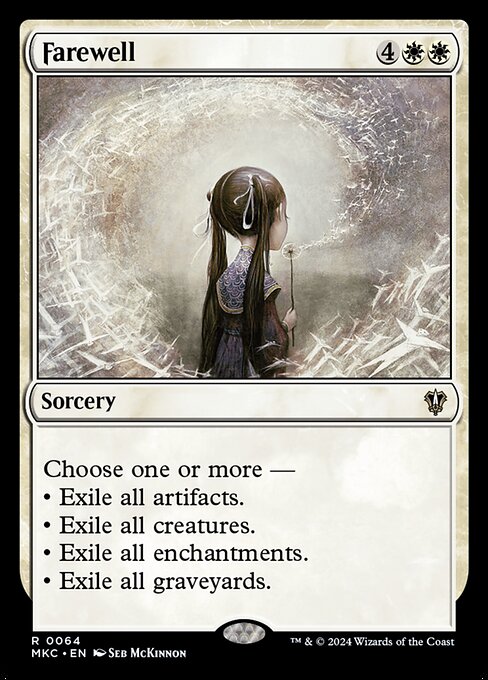
Farewell
Broad exile
Choose the permanent categories and graveyards you need to clear. Exiling your own draw engines and ramp can be a steep recovery cost.
Read that last distinction carefully. A creature with indestructible can still be exiled or put into a graveyard for having zero toughness. Hexproof does not stop an effect that does not target the creature. A destroy effect generally allows creatures to die and can feed death triggers; exiling those creatures does not cause them to die. Those differences matter more than the dramatic language on a card. Check the current Comprehensive Rules when an unusual interaction changes the decision.
Make a symmetric wipe favor your battlefield
Austere Command is a useful illustration because its modes ask you to compare actual boards. Suppose your four creatures with mana value four or greater face ordinary zero-mana-value tokens and several enchantment engines. Choosing creatures with mana value three or less plus enchantments can preserve your attackers while removing those problems. If your own plan depends on enchantments, the same choice may be disastrous. The card is flexible, but flexibility is a decision you make from the battlefield, not an automatic promise that your permanents are safe.
Flexible and selective alternatives

Austere Command
Choose the useful reset
Choose two modes. Match the creature mana-value cutoff and noncreature modes to what you can afford to lose.
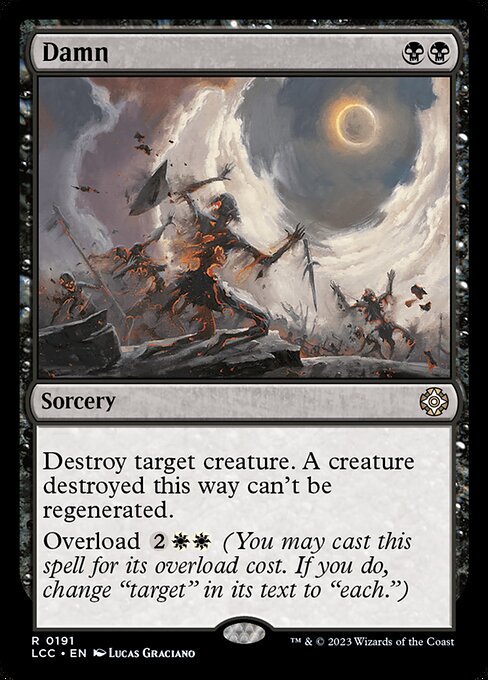
Damn
Spot removal or creature wipe
Its ordinary black cost handles one target. The white overload cost changes the job, useful when you need either precision or a reset from the same slot.
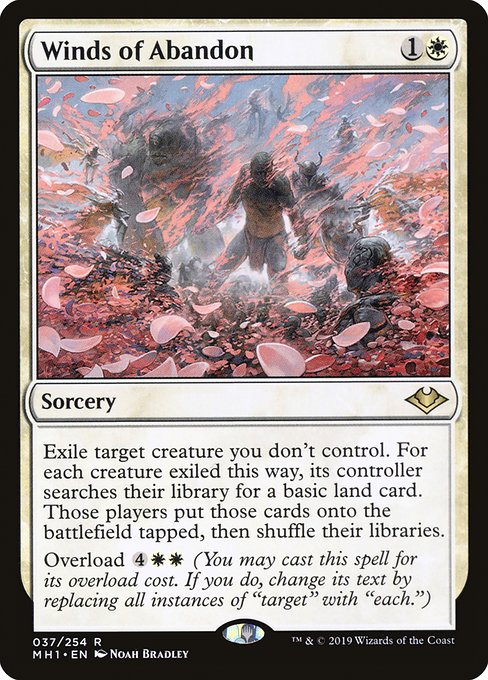
Winds of Abandon
Keep your attackers
The overloaded spell exiles opposing creatures while leaving yours, but the opposing basic lands can fuel a strong recovery. Best when you exploit the opening.
An overloaded Winds of Abandon before a decisive combat has a very different purpose from casting it with an empty board and passing. In the first position, removing blockers may end the game. In the second, you have paid six mana to give three opponents extra resources. The card can still save you from lethal, but survival and advantage are separate outcomes. Describe which one you need before deciding that a one-sided wipe must be superior.
Cast the wipe when the next turn improves
Imagine it is turn six. You have two medium creatures, five lands, and a draw engine in hand. One opponent has eight attackers and threatens lethal against you; another has one utility creature; the last has a full hand and no board. Clearing creatures can be correct to survive, but it also frees the player with the full hand from pressure. If you can reset for three mana and deploy your draw engine immediately, you have a credible recovery. Spending all six and passing is a much weaker position.
Now change one detail: the eight attackers are pointed at the player who is closest to winning, and you have enough blockers to survive the next rotation. Waiting may let opposing resources trade while you develop. You are not obliged to wipe because you can produce an impressive creature count. Conversely, waiting for one more creature is a mistake if a player can win or protect the whole board before you untap. Evaluate the dangerous turn, not the theoretical maximum number of cards removed.
- If you are behind: identify the attack, engine, or lock the wipe must actually stop.
- If you are ahead: calculate whether clearing blockers creates a winning attack or removes your own pressure.
- If you are even: compare cards in hand, preserved engines, mana, and the next player to untap.
- Before passing: name your next useful play. Recasting a commander without protection may simply restart the same problem.
Keep spot removal, even when sweepers create card advantage
Replacing every targeted answer with another board wipe feels efficient until one permanent needs to disappear right now. An opponent can present a lethal engine at instant speed, and many sweepers are sorceries. You may need to remove a single blocker while preserving your attackers, or answer an artifact that a creature-only reset ignores. Mass removal and precision removal overlap in some games, but they do not perform the same work. Use the Commander removal-count guide to budget both jobs without turning the whole deck into reactive cards.
The Interaction Checker helps you inspect removal, wipes, protection, and graveyard hate together. Read the categories as a coverage check, then inspect the cards. A creature wipe does not automatically cover a graveyard combo, and a modal card counted in multiple roles still requires the right colors and timing. The Commander interaction guide explains those different forms of coverage. The Deck Audit adds the broader context: your interaction is much less useful if the list cannot make its land drops or refill its hand.
Build a recovery package instead of adding wipe number five
A fifth reset is tempting when every game seems to need one. Sometimes the actual problem is that your first reset leaves you with nothing to do. Check whether your draw sources survive it, whether you kept a threat in hand, and whether your ramp disappears with your creatures. A deck relying on mana creatures can lose both pressure and the ability to recast its commander at once. More lands, a surviving draw engine, or a lower-cost threat may fix that failure better than another answer.
Recovery also affects sequencing several turns earlier. If you expect to clear creatures, you do not need to deploy every spare body just because you have mana. Hold the piece that rebuilds your engine, while still blocking well enough to reach the reset turn. With a broad wipe, keep track of which artifact mana and enchantments you would lose too. Preserving two useful cards in hand is often more valuable than adding a marginal creature that will disappear alongside everything else.
Use the next few games to diagnose the count
Keep a short note whenever a wipe matters: which threats it answered, what you lost, whether you could afford it on time, and who recovered first. Also record copies stranded in hand while you were ahead. One game with a huge opposing board does not justify rebuilding the whole interaction suite. A repeated pattern does. If your sweeper is always too slow, lower its cost or change the effect. If it misses the same permanent type, diversify. If it is repeatedly unnecessary, try replacing one with a proactive card.
Discuss repeated resets before the game when they are central to your strategy. The concern players describe in the linked Reddit thread is often the combination of frequent wipes and no progress toward an ending. You can enjoy a controlling deck and still explain how it intends to finish. There is no official toxic count. A meaningful pregame description gives opponents a clearer expectation than arguing that a particular number is always acceptable.
Check your full interaction package
Look at board wipes beside spot removal, protection, and graveyard hate, then review the individual cards against your usual opponents.
FAQ
Is two board wipes enough in Commander?
It can be enough for a proactive deck that mostly wants an emergency reset. In a 99-card library, two wipes appear in only about 22.9% of twelve-card samples without extra draw or tutors. If your strategy depends on routinely clearing creatures, two is a small access package.
Should a creature deck run board wipes?
Often yes, especially selective wipes that preserve the creatures or permanent types your deck needs. Start with one or two that rescue genuinely bad positions. Compare each one with targeted removal or protection, since a symmetric wipe can erase the board you were trying to build.
Do board wipes get around hexproof and indestructible?
A wipe that does not target can affect a creature with hexproof. Indestructible stops destruction, including destruction from lethal damage, but it does not stop exile or a creature going to the graveyard for having zero toughness. Read the exact effect rather than assuming every wipe works alike.
Does Farewell stop death triggers?
Creatures exiled by Farewell do not die. Exiling those creatures does not produce dies triggers. The card can also exile graveyards when you choose that mode. Check other triggers and replacement effects separately; a broad exile spell is powerful but still follows its specific text.
Can I replace targeted removal with more board wipes?
Usually that creates holes. Sorcery-speed resets cannot cover every urgent threat, and destroying your own board to remove one permanent is expensive. Keep answers that can stop the relevant permanent or spell at the moment it matters.
How many wipes are too many for casual play?
There is no universal social or rules limit. Extra copies need a strategic purpose, enough draw and recovery, and a way to finish the game. If repeated wipes routinely produce long stalls, discuss that experience and reconsider the package together.
Sources and further reading
- Reid Duke: Board Sweepers. Primary explanation or rules reference.
- Magic Comprehensive Rules. Primary explanation or rules reference.
- Austere Command Oracle text. Check the current card text and printing.
- Toxic Deluge Oracle text. Check the current card text and printing.
- Commander players discuss wipe count and recovery. Player questions and table experiences, used as context rather than rules authority.
- You Won't Survive: board-control deck primer. A specific deck example, not a universal template.