
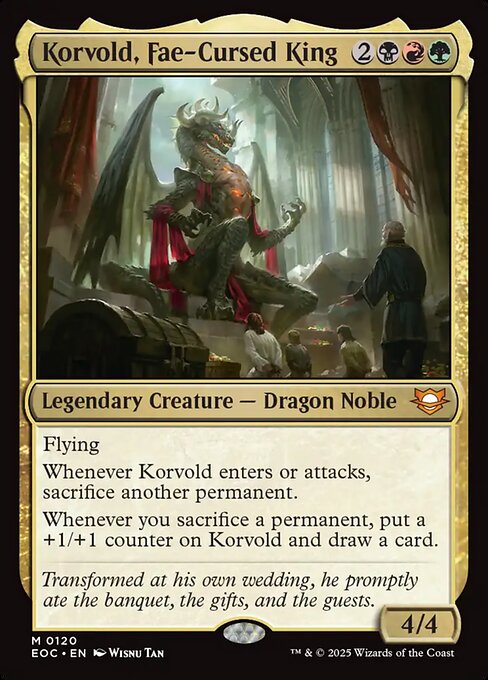
Give Korvold something you can afford to lose
The strongest first upgrades for a sacrifice-focused Korvold deck are cheap expendable permanents, reliable sacrifice outlets, early color fixing, and protection. Start with Sakura-Tribe Elder, Viscera Seer, Jadar, Ghoulcaller of Nephalia, Deadly Dispute, and Tamiyo's Safekeeping if those roles are missing. These cards address the awkward turn where your five-mana commander arrives and the only spare permanent is a land. Add an actual finishing plan after the engine works.
Starting points for a fair sacrifice shell
Choose a sacrifice plan before choosing expensive cards
Korvold, Fae-Cursed King rewards sacrificing any permanent, including Treasures, Food, fetch lands, creatures, and enchantments. That flexibility is useful until the deck starts trying to be a lands deck, a Treasure combo deck, a reanimator deck, and an aristocrats deck at once. You can draw several cards and still lose because the cards need incompatible support. This guide starts with a creature-and-token sacrifice shell that can win through combat or incremental drain, then shows which upgrades change that plan.
Separate your list into fuel, outlets, payoffs, and support. Jadar makes fuel. Viscera Seer turns creature fuel into selection. Korvold turns sacrifices into cards and counters. Mayhem Devil converts them into damage. A hand of three payoffs does very little without something expendable. A hand of token makers can still develop without Korvold. That difference is why the first purchases should usually improve ordinary turns, not add a fifth card that is spectacular only when the commander survives.
The player problem in this Korvold discussion is recognizable: the deck makes mana but lacks material to sacrifice comfortably. Treat that as a useful diagnosis to test against your list, not a universal verdict about ramp. A land-ramp spell and a creature that ramps while leaving a body occupy different places in this deck. You want enough mana to recast Korvold and enough fuel to avoid dismantling that mana.
Build a keepable hand, not a theoretical turn-four dragon
Start testing with roughly 37 lands and about ten inexpensive ramp pieces, adjusting after you record actual opening hands. Your early green source casts Sakura-Tribe Elder or Rampant Growth; black supports Jadar and sacrifice draw; red must arrive by the turn you want Korvold. Three lands that all produce green are not a complete casting plan. The Commander mana base guide explains how to choose sources around the spells you actually cast. Use the mana base calculator to examine those colors separately, especially if many lands enter tapped.
A practical keep has three lands with access to green, an early ramp card, an expendable permanent, and a spell that still matters if Korvold dies. Forest, Swamp, Mountain, Sakura-Tribe Elder, Jadar, Viscera Seer, and Deadly Dispute is a coherent example. A two-land hand with several five-mana engines is not made safe by having a commander that draws cards. Korvold must resolve, stay in play long enough to see a sacrifice, and leave you enough resources to continue.
- Turn two: cast Sakura-Tribe Elder. You may block with it before sacrificing it, but a blocked attacker with trample can still deal damage through that block. Fetch the basic that fixes your missing color.
- Turn three: with the extra basic, deploy Jadar and Viscera Seer if your colors permit. Jadar makes a decayed Zombie at your end step if you control no decayed creature.
- Turn four: after making your normal land drop each turn, you have five lands. Cast Korvold and sacrifice the Zombie to its entry trigger. Keep Jadar and Seer for subsequent turns.
- If the table is holding removal and you have protection in hand, waiting for a sixth mana source can be better than casting Korvold unprotected. This is a resource decision, not an automatic delay.
Use upgrade packages that fix a specific weak slot
There is no single stock Korvold Commander list behind these cuts. The following are conditional, one-for-one changes for cards you actually own and currently play. Do not cut a card merely because it appears in the left column. Identify the stated failure first, make the complete package, and preserve the number of lands and essential interaction. Run your exact list through the deck audit so a proposed improvement does not quietly remove your last answer to an enchantment.
| If this card is in your list | Add instead | Make the swap when |
|---|---|---|
| Vastwood Surge | Sakura-Tribe Elder | Four-mana ramp is arriving too late and you need an expendable early body. |
| Moldervine Reclamation | Deadly Dispute | Five-mana draw engines compete with Korvold and you need an immediate two-mana response. |
| God-Eternal Bontu | Jadar, Ghoulcaller of Nephalia | You already have burst draw but repeatedly run out of disposable creatures. |
| Poison-Tip Archer | Mayhem Devil | Your actual fuel includes many Treasures and lands, not just dying creatures. |
| A second expensive anthem or combat-only finisher | Tamiyo's Safekeeping | Korvold is removed before the finisher becomes relevant. |
The first three rows form a coherent three-card efficiency package. You trade a late ramp spell and two expensive draw effects for earlier ramp, recurring fuel, and cheap conversion. You also give something up: Elder finds one basic rather than two, Dispute is a single use, and Jadar does not refill a hand. Keep Moldervine Reclamation in slower games where your board produces several dying creature tokens after Korvold has been removed. Its token-friendly trigger is a real independent engine, not a mistake.
Fuel, outlet, payoff: three different jobs

Jadar, Ghoulcaller of Nephalia
Recurring fuel
One decayed Zombie at your end step if the condition is met. It cannot block.

Viscera Seer
Free creature outlet
No mana or tap cost, but it cannot sacrifice Food, Treasure, or lands.
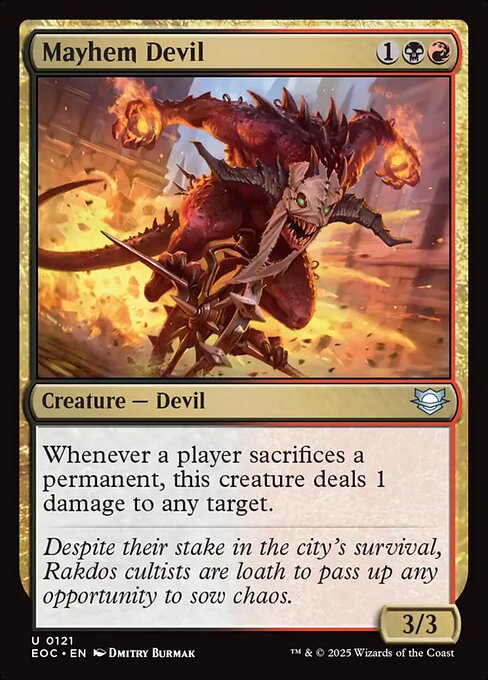
Mayhem Devil
Damage payoff
Triggers for any player sacrificing any permanent, including your Treasures.

Sakura-Tribe Elder
Ramp and sacrifice
Usually sacrifice early for development. Keeping it for a later draw must justify delaying the land.
Budget replacements must preserve the job you need
Skullclamp and Deadly Dispute both draw cards from material, but they are not interchangeable engines. Clamp can repeatedly convert one-toughness creatures into two cards for equip mana. Dispute works once, needs an artifact or creature, and produces a Treasure. Village Rites is another single-use option when one mana matters more than the Treasure. If you cannot justify Clamp at your current local price, several cheap draw spells can improve reliability, but say plainly that you are replacing repeated output with a package of individual effects.
The same distinction applies to sacrifice outlets. Viscera Seer is a sensible low-mana alternative when you need a free creature sacrifice button. It does not replace the mana production of Phyrexian Altar or Ashnod's Altar. A line that requires colored mana from each sacrifice fails if the outlet only scries. Likewise, Tireless Provisioner creates resources from land drops, while a large burst-Treasure card serves a different turn. Use the role-first budget swap guide to keep those differences visible. Compare real prices in the deck price calculator, then buy the role your sequence requires.
Know when Korvold actually draws the card
Korvold is a payoff, not a general-purpose sacrifice outlet. Its entry and attack abilities make you sacrifice another permanent when those triggers resolve. Outside those triggers, you need a separate effect or cost that says sacrifice. You cannot point at a Food and sacrifice it just to draw. A Food normally needs two mana and a tap to activate its life-gain ability; a Treasure can be tapped and sacrificed for mana. Both produce a Korvold trigger if it is on the battlefield when you sacrifice them.
Suppose an opponent targets Jadar with removal while Korvold is in play. Cast Deadly Dispute, paying its additional cost by sacrificing Jadar. Nobody can respond between you choosing that cost and paying it. Korvold's sacrifice trigger goes above Dispute and normally resolves first. Then Dispute draws two and makes a Treasure. The original removal loses its only target. An opponent can counter Dispute, but cannot restore the sacrificed Jadar; Korvold's trigger is a separate object and still resolves unless separately answered.
Treasures spent to cast Korvold do not draw cards from it, because Korvold is still on the stack when those sacrifices happen. Once it resolves, its entry trigger gives opponents a response window before you choose and sacrifice another permanent. If they remove Korvold then, the entry trigger still resolves, but Korvold will not be present to trigger from that later sacrifice. A normal destroy-all-creatures spell also does not count as sacrificing them. Death and sacrifice overlap often, but they are different events.
Convert resources into a finish without losing your board
Your most accessible finish may simply be a large flying commander. Korvold starts at four power and gains one counter per sacrifice, so count prospective attack power and existing commander damage before spending resources. Three sacrifices before combat make an otherwise unchanged Korvold a 7/7. Its attack trigger can make it an 8/8 before damage if you sacrifice another permanent. That is meaningful pressure, but it is not automatically lethal from zero commander damage. Flying also does not defeat flying blockers; removal or trample can still matter.
A drain finish needs enough relevant events. Zulaport Cutthroat drains each opponent when your creatures die, including tokens, but it does nothing when you sacrifice a Treasure. Mayhem Devil sees that Treasure and can shoot any target, while Blood Artist targets only one player per death. If your board holds six creature tokens and Cutthroat, sacrificing all six drains each opponent for six, not eighteen. You gain six life. Count honestly, retain blockers when nobody dies, and avoid turning a stable board into a dramatic turn that leaves an opponent alive with lethal attackers.
Choose a payoff your material actually triggers

Zulaport Cutthroat
Creature-death drain
Hits every opponent without targeting. Creature fuel is required.
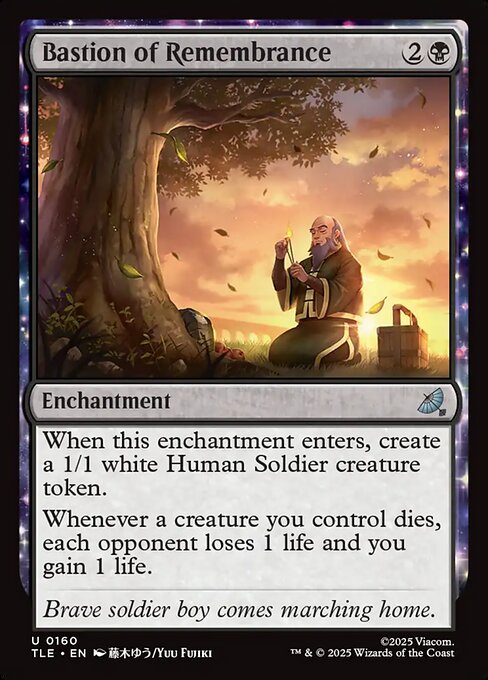
Bastion of Remembrance
Resilient drain permanent
Makes one body and can survive ordinary creature wipes.
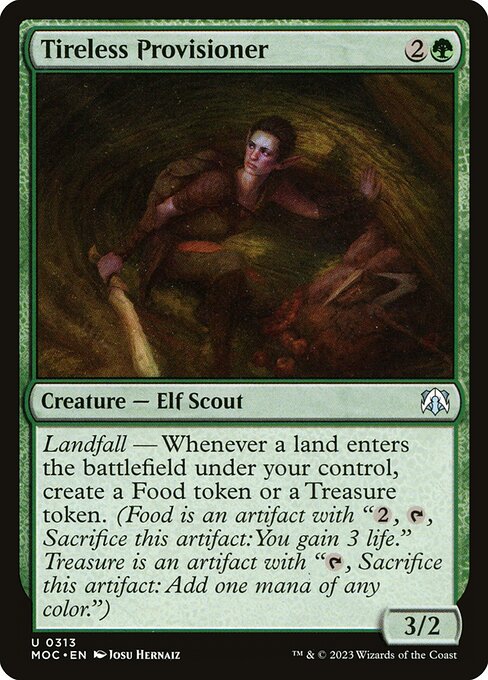
Tireless Provisioner
Land-drop fuel
A land entering makes a Food or Treasure. Sacrificing a land is not its trigger.

Deadly Dispute
Immediate conversion
Useful when removal or a wipe makes a resource about to disappear.
Protect the useful turn and plan the recovery
Tamiyo's Safekeeping can protect Korvold from a targeted exile spell through hexproof and from most destroy effects through indestructible. It does not answer a nontargeting exile wipe, a forced sacrifice, or enough negative toughness. Hold it for a threat that changes your turn. Swiftfoot Boots grants haste and hexproof after equip resolves, but an opponent can remove Korvold in response to the equip ability. Boots is useful preparation, not a guarantee that a tapped-out commander will survive.
Before a creature wipe resolves, an outlet can turn doomed bodies into cards while Korvold is still present. Plumb the Forbidden is particularly clear: sacrificing three creatures to its optional additional cost produces three copies plus the original. Those spells draw four cards and cost four life in total if all resolve, in addition to three Korvold draws if it saw all three sacrifices. This line is powerful, but mandatory draws mean you must track your remaining library. Do not casually sacrifice an entire board when a smaller conversion is enough.
After a wipe, recasting Korvold for seven mana with nothing spare can repeat the original problem. Rebuild a producer first, keep two useful creature cards in the graveyard for Victimize, and retain an actual creature to sacrifice when Victimize resolves. Its sacrifice is not an additional casting cost, so the sacrificed creature cannot be one of the two targets chosen when casting it. If graveyard hate is open, choose a simpler line or force that interaction before committing your only recovery spell.
Review the deck by the turns it fails
During your next games, record the first turn Korvold could be cast, what you sacrificed to its entry trigger, and whether your next turn had both mana and material. If you keep sacrificing lands unwillingly, add earlier fuel. If fuel sits unused while the commander costs nine, add an independent outlet and draw source. If you draw many cards but cannot cast them, use the mana curve guide to lower crowded mana costs or improve colored sources. These observations tell you far more than the total number of sacrifice-related words in your deck.
Price the package before buying it
Import your exact list, compare current printing prices, and check whether each swap still fills its intended role.
Questions before you sleeve it up
Is Korvold a sacrifice outlet?
Only its entry and attack triggers instruct you to sacrifice another permanent. Its card-draw ability does not give permission to sacrifice whenever you want. Use an outlet such as Viscera Seer, a Treasure mana ability, or a spell with a sacrifice cost for additional events. That distinction determines whether a proposed combo can actually start.
Does Korvold draw for tokens and lands?
Yes, if you sacrifice them while it can see the event. Tokens are permanents on the battlefield, and sacrificing a land also qualifies. Destroying a creature, discarding a card, or losing a legendary permanent to the legend rule is not sacrificing it. Treasures used to pay for Korvold itself are sacrificed before it enters.
Should every budget Korvold deck play Food Chain?
No. Food Chain is a distinct combo direction with deckbuilding and finishing requirements. It also exiles creatures rather than sacrificing them, so its activation does not itself trigger Korvold. A combat-and-drain shell can spend its resources on fuel, mana, and protection instead. Choose the intended table experience before purchasing an engine that changes the deck.
What happens if I sacrifice Korvold itself?
It sees its own sacrifice and triggers, so you draw a card when that trigger resolves even though there is no Korvold left to receive a counter. Its entry and attack triggers require another permanent, however, so you cannot use those instructions to sacrifice Korvold itself. Moving the commander to the command zone does not turn a nonsacrifice event into a sacrifice.
What should I upgrade first if I have a small budget?
Fix the first repeatable failure. An early Sakura-Tribe Elder, a recurring Jadar, and a cheap outlet solve different parts of the engine. Add protection when removal prevents you from getting value, and independent draw when commander tax is the real issue. Compare local prices for the complete package rather than assuming the most famous card is the most useful purchase.
Sources and further reading
- Korvold current Oracle text: The sacrifice trigger, mandatory draw, and legal color identity.
- Wizards Throne of Eldraine release notes: Official clarifications about sacrifice costs and Korvold drawing after it is sacrificed.
- Official Commander banned list: Commander banned cards, including Dockside Extortionist.
- Korvold, the Draconic Railgun primer: A published sacrifice-focused deck and an example of a more explosive direction, rather than a stock list for the cuts below.
- Reddit: ramps too heavily, sacrifices too little: Player discussion of running out of expendable permanents. Used to identify a practical deckbuilding problem, not to establish rules.
- Deadly Dispute current Oracle text: The additional sacrifice cost and Treasure production used in the sequencing examples.