
A good curve makes the next useful play affordable
A Commander mana curve is the distribution of your nonland cards by mana value. Read the shape beside your commander, early setup, interaction, ramp, and draw. An average around three can be a useful midrange reference point, but the real test is whether your hand can make useful plays on consecutive turns and still support its finishers.
A deck can report an average mana value of three and still spend the early game doing very little. Perhaps its cheap cards are reactive, its four-mana slot competes with the commander, and its best draw spell also needs a full turn. Another deck with the same average might establish an engine on turn two and play two spells a turn later. The number summarizes the list. Your actual casting decisions explain how the list plays.
Read the curve in context
Mana value is a rules number, not always the mana you spend
Mana value adds up the symbols in a mana cost without regard to color. A card costing three generic mana and one green has mana value four. The older abbreviation CMC means converted mana cost, the former term for the same concept. Lands normally have mana value zero, but including them in a curve average makes the number harder to compare with the costs of your spells. Use a nonland average when examining how expensive your action cards are.
Now separate mana value from practical casting cost. Cost reductions and alternative costs can make a card cheaper or more expensive to use without rewriting its mana value. An X spell usually has X counted as zero away from the stack, even though you expect to spend considerably more when casting it. That is why a printed curve is the first view of a deck, not the final budget for its turns. Flag the cards that your plan normally casts at a different price.
Cards that tell different stories on a curve chart

Blasphemous Act
High mana value, often discounted
Its mana value is nine, but the creature-based reduction can make it cheap to cast. It is still a conditional reactive spell, not a proactive one-mana opening play.

Hydroid Krasis
Low printed value, larger intended spend
Outside the stack its mana value is two. The amount you choose for X determines the creature size and the cast trigger, so plan the mana budget you actually want.
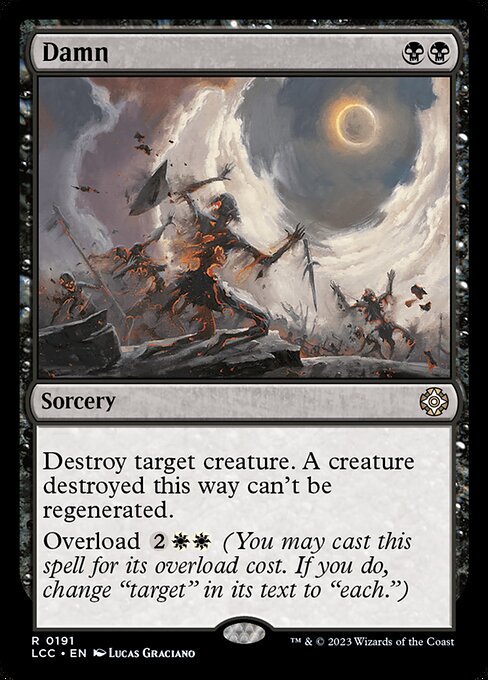
Damn
Two different casting jobs
The card has mana value two. Paying its four-mana overload cost gives it a different role without changing that underlying value.
Read the buckets before trying to lower the average
The nonland average is total mana value divided by the number of nonland cards included in the calculation. Two five-card examples make its limits obvious: costs of two, two, three, four, four average three. Costs of one, one, one, six, six also average three. The second group can look cheaper at the start while leaving a long wait for its expensive half. Neither is a complete deck. The point is that the average loses the shape.
What each part of the curve needs to do
| Cost area | Useful role | Question to ask |
|---|---|---|
| Zero to one | Cheap setup, selection, or efficient interaction | Can I use these early, or are they waiting for a threat? |
| Two | Ramp, engines, enablers, or flexible answers | Does this prepare the turn my commander needs? |
| Three to four | Core engine and meaningful development | Which cards compete for the same entire turn? |
| Five | Strong payoff or broad utility | Does it affect the game soon enough? |
| Six and above | Finishers, rebuilds, or exceptional engines | Why is this worth waiting for instead of playing two cheaper cards? |
You do not need a smooth bell curve for aesthetic reasons. A spell-heavy list may deliberately bunch at one and two; a ramp deck may have a thin middle and a substantial top end. What matters is the bridge between those parts. If ten cards need six mana and the early cards do not help reach six, lowering the average by adding one zero-mana card changes the display more than the game. Repair the missing bridge or reduce the number of cards waiting across it.
Let the commander reserve a turn without banning a whole cost
Your commander is unusually reliable access to a specific spell. If your plan casts a four-mana commander as soon as possible, turn four already has a likely destination. Filling the list with other four-mana setup cards can leave them queued behind it. That does not make every other four-drop a mistake. A critical engine that should enter before the commander, a recovery option after removal, or a different route when the commander is unsafe can deserve its slot.
The question is which sequence you intend to choose. Suppose your commander rewards creatures entering and Guardian Project is your draw engine. Casting the enchantment first may set up later creature casts, but it also means delaying the commander. If you need both to begin generating value and each consumes a whole turn, the plan is slower than either card looks alone. Decide whether cheap setup, extra acceleration, or a different draw engine gives the deck a better opening.
Compare what a setup turn buys
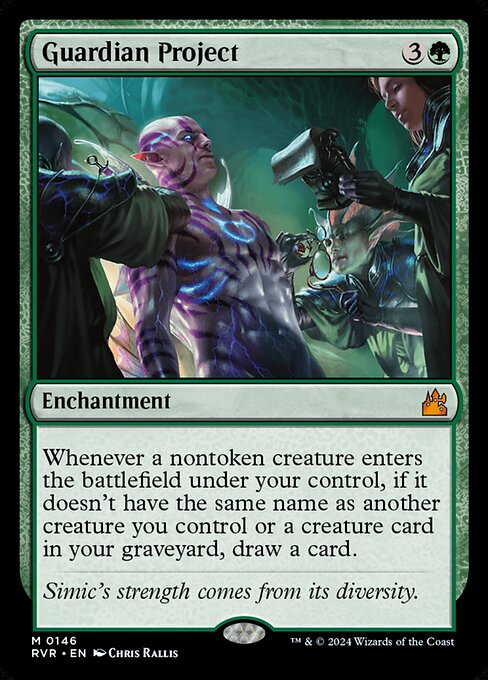
Guardian Project
A four-mana engine that needs follow-up
It draws from qualifying nontoken creatures entering after it is in play. Budget creatures and mana after spending the setup turn.

Nature's Lore
Turn-two acceleration
A castable early ramp spell can help reach a four-mana commander on turn three, provided the lands and target support the sequence.

Cultivate
A different ramp schedule
Its three-mana cost and basic land to hand help a different sequence. It does not fill the same early window as a two-mana ramp spell.

Beast Within
Flexible interaction budget
Holding three mana for this answer changes how much you can safely spend developing. Its flexibility is useful, but it is not free time.
Count proactive early plays separately from cheap answers
A curve analyzer may report twenty cards at one or two mana, and that can be a healthy starting signal. Look at what those cards actually do. Sixteen reactive answers and four setup cards do not give the same opening as twelve enablers, four ramp spells, and four answers. Many reactive cards become excellent after opponents develop, but they may leave you with no productive use for turn two. Role and cost must be read together.
Make two quick piles: cards you are happy to deploy into an otherwise quiet early board, and cards you mainly want to hold for a particular event. Then split the first pile again into mana, card access, and engine setup. This is not a reason to remove efficient interaction. It is a way to find out why cheap hands still feel slow. If all your useful development begins at four mana, the cheap answers are buying time for a plan that may never get ahead.
Match ramp to the turn it is supposed to change
Ramp is most useful when it unlocks a specific play earlier. With lands on turns one, two, and three, Nature's Lore on turn two can leave four lands available on turn three if its target is usable by then. Cultivate on turn three generally develops the next turn and puts another basic in hand, a different kind of stability. Both can be good. Choosing between them requires knowing whether the urgent goal is a turn-three four-drop or a later sequence with dependable land drops.
Adding ramp only at four mana will not cure a deck that cannot start before four mana. Similarly, a one-shot burst does not provide the same ongoing support as an extra land when the deck wants two expensive turns in a row. Inspect what remains after you spend the ramp. Can you cast the commander and another relevant spell later, or does the deck reach its first payoff and stop? The Commander ramp-count guide helps connect acceleration density with the turns you want to improve.
Budget for two spells, protection, and activated abilities
One of the biggest improvements a lower curve offers is combining actions. With six mana, a four-mana engine plus a two-mana enabler may do more than a single six-mana creature. A commander plus a cheap protection spell can be safer than tapping out for the commander alone. The chart cannot tell whether the needed colors or the two cards line up, so write those combinations down. You want useful pairs, not just a pile of independently cheap spells.
Activated abilities also consume mana even though they never appear as additional bars on the curve. If the commander wants three mana every turn to activate, a turn with six lands does not leave six free mana for spells. Equipment, token production, graveyard engines, and repeatable draw create similar demands. A deck with many mana sinks may need a low spell curve so it can activate its engine and still interact. Cutting lands solely because the printed average is low can make those decks much worse.
Repair a crowded curve one role at a time
Consider a hypothetical list with thirty-seven lands and sixty-three nonlands, including its commander. Its nonland buckets contain eight cards at zero or one, ten at two, twelve at three, fourteen at four, ten at five, and nine at six or above. Those counts describe an example rather than a universal template. The warning is the cluster of twenty-four four- and five-mana cards, especially if the commander costs four and most of those cards are setup rather than payoff.
A focused four-slot repair
| Current slot | Candidate change | What it fixes |
|---|---|---|
| Moldervine Reclamation in a black-green list with slow starts | Night's Whisper | Costs two instead of five and immediately finds cards; loses repeatable death-trigger draw and life gain. |
| Cultivate when the crucial goal is a turn-three four-drop | Nature's Lore | Ramps a turn earlier; gives up the second basic going to your hand and needs a suitable Forest target. |
| A redundant seven-mana threat | A cheaper payoff or interaction piece | Reduces opening hands with multiple uncastable finishers. |
| A four-mana enabler that duplicates the commander | An early enabler with a distinct job | Lets the commander turn produce value sooner. |
These swaps are conditional role comparisons, not automatic upgrades. The draw pair exchanges repeatable output for immediate access. The Commander card-draw guide helps decide which you need. Replacing a draw engine with a cheap combat trick lowers the average but can leave the deck empty-handed. Replacing its only finisher with ramp may improve the opening and weaken every late game. After each change, trace a hand through the first several turns.
Earlier access versus repeatable output

Moldervine Reclamation
Repeatable creature-death draw
Useful when many of your creatures die, but five mana and a later death are a substantial setup demand.

Night's Whisper
Immediate two-card access
Two mana draws two cards at a cost of two life. It needs no creature board but provides no repeatable engine.
Know when a high curve is intentional
Some decks deliberately cast enormous spells, reanimate expensive creatures, or use a commander to bypass normal casting costs. Their printed curve can look alarming while the functional plan is efficient. Examine what happens when the shortcut is unavailable, removed, or delayed. A hand full of targets with no enabler can still fail, and repeatedly recasting an expensive commander can demand more land development than the original curve suggests.
The linked Feldon deck description illustrates this dependency: its author discusses the curve becoming a problem when the commander cannot provide the intended shortcut. The lesson is to measure both routes. What does a good hand do with the engine, and what does a plausible hand do without it? You do not have to build every expensive deck as conventional midrange. You do need enough setup, access, or backup plans that the deck can play through the disruption its table actually uses.
Use the analyzer as a diagnostic, then check real sequences
The Mana Curve Analyzer reports nonland average mana value, cost buckets, early plays, and top-end pressure from resolved card data. It separates unresolved names so you can repair an incomplete import. Double-faced and split cards use reported card data, which may differ from how you intend to play a specific face. Read those cards manually when they meaningfully change the plan. A warning is a reason to inspect your list, not an instruction to cut every costly card.
Follow with the Mana Base Calculator to check whether the land count and colors support the desired turns; the mana-base guide covers source counting and timing. Use the Deck Audit to review roles. During actual games, record unspent mana with no useful play, setup cards stranded behind the commander, and finishers that stay uncast. If you routinely hold interaction, note whether that mana was intentionally reserved. Good analysis distinguishes a planned response from a hand that simply has nothing to do.
Find the bottleneck in your curve
Read the average beside the cost buckets, then identify which cards share the same turn and which early plays actually start your engine.
FAQ
What is a good average mana value in Commander?
Around three is a useful casual midrange reference, not a universal target. Read the cost distribution, commander, early development, ramp, and draw together. A higher average can work with deliberate support, while a low average can still hide a hand full of reactive cards and expensive finishers.
Do lands count toward average mana value?
Lands normally have mana value zero, so an average that includes them will be lower. For deckbuilding comparisons, use the nonland average and record land count separately. Check how a particular site treats commanders, multiple faces, and unresolved cards before comparing its number with another tool.
Should I avoid cards that cost the same as my commander?
No blanket rule works. If you intend to cast the commander immediately, another setup card at that cost competes for the same turn. Keep cards that justify an alternative sequence or a distinct role, and trim redundant ones that repeatedly wait behind it.
Does reducing a spell's cost reduce its mana value?
No. Cost reduction changes what you pay, while mana value follows the card's mana cost. That is why Blasphemous Act remains mana value nine even when a crowded battlefield makes it much cheaper to cast.
How do X spells affect the curve?
Away from the stack, X is generally zero when calculating mana value. Hydroid Krasis therefore appears at two even if you plan to spend six or eight total mana on it. Keep a separate practical budget for X spells and other scalable effects.
How do I lower my curve without weakening my deck?
Find the expensive role that keeps blocking development and replace it with a cheaper way to perform that role. Preserve enough draw, interaction, and finishers. Check an actual sequence after each change rather than adding cheap cards only to lower the displayed average.
Sources and further reading
- Reid Duke: The Basics of Mana. Primary explanation or rules reference.
- Reid Duke: Tempo. Primary explanation or rules reference.
- Magic Comprehensive Rules. Primary explanation or rules reference.
- Hydroid Krasis Oracle text. Check the current card text and printing.
- Players discuss curving around the commander. Player questions and table experiences, used as context rather than rules authority.
- Feldon deck primer: dependence on a casting shortcut. A specific deck example, not a universal template.