
Quick answer
Indestructible prevents destruction, including destruction from lethal damage and deathtouch. It does not stop exile, sacrifice, returning a permanent to hand, or a creature going to the graveyard for having zero or less toughness.
Indestructible stops destruction, not every zone change
A permanent with indestructible cannot be destroyed. That includes a spell or ability explicitly saying destroy and the state based destruction that would normally happen when a creature has lethal damage marked on it. A creature can therefore survive a large damage spell while retaining that damage for the rest of the turn. The ability does not prevent the damage itself.
Darksteel Myr provides a simple example because its defensive ability is easy to isolate. A destruction spell cannot destroy it while it has indestructible. A sufficiently large attacker can deal damage to it without causing lethal damage to destroy it. The Myr is still a creature with a toughness value, a controller, and a normal place on the battlefield. Another effect can interact with those characteristics.
An exile instruction does not destroy. A sacrifice cost or sacrifice instruction does not destroy. Returning a permanent to hand does not destroy. Putting a creature with zero toughness into the graveyard is not destruction either. Those effects can move an indestructible permanent without contradicting the keyword. The word indestructible sounds broad in everyday language, so using the rules verb is especially important.
This distinction also keeps protection discussions useful. A card that grants indestructible may be exactly right against a destruction wipe and ineffective against an exile wipe. It has not failed to work; it protected against a different action. Identify the actual answer your deck needs to withstand before buying more copies of the same kind of defense.
Damage happens even when the creature survives
Indestructible does not reduce damage to zero. If a five power creature deals combat damage to your indestructible creature, five damage is dealt and marked normally. Abilities that care about damage being dealt can still function. Lifelink can still cause life gain from that damage. The difference is that lethal damage will not destroy the indestructible creature while the ability applies.
Blasphemous Act deals thirteen damage to each creature. A creature with indestructible can survive that damage even when its toughness is much lower than thirteen. A creature with protection from red may instead have that damage prevented. Both creatures may remain on the battlefield, but they arrived at that result through different rules. Damage based triggers can distinguish those outcomes.
Ordinary marked damage does not subtract from toughness. A 4/4 with three damage marked is still a 4/4, not a 4/1. This matters for effects that look at power or toughness, for subsequent damage, and for the zero toughness state based action. A separate -3/-3 effect changes toughness; three marked damage does not. Do not combine these ideas into a single damage equals shrinking shortcut.
Damage normally stays marked until the cleanup step, unless another effect removes it or the creature leaves the battlefield. If the creature loses indestructible before that damage is removed, the lethal damage can become relevant immediately when state based actions are checked. Surviving a damage event is not a promise that the creature will survive every later change during the same turn.
A worked example when indestructible expires
You control a 3/3 creature and cast a spell giving it indestructible until end of turn. Later that turn it takes five damage. It remains on the battlefield because indestructible prevents lethal damage from destroying it. The creature still has five damage marked. An opponent then resolves an effect that removes its abilities before the turn ends.
Once that effect has finished, state based actions are checked before a player receives priority. The creature no longer has indestructible and has lethal damage marked, so it is destroyed at that check. You cannot wait until after the ability removal resolves and then cast another protection spell before the lethal damage is noticed. You would need to respond earlier with an effect that actually changes the relevant outcome.
The normal cleanup sequence is different from that midturn ability removal. During cleanup, damage marked on permanents is removed and until end of turn effects end in the same cleanup procedure. A creature does not ordinarily die just because its temporary indestructible expires at the normal moment alongside damage cleanup. Do not carry the midturn example over to cleanup as though there were a normal gap between those two events.
Leaving the battlefield also matters. A creature that returns after a blink effect is normally a new object without the damage marked on its previous existence. That new object does not automatically keep a temporary indestructible effect from the previous object either. A blink line can solve one problem while changing other aspects of the creature, including counters and attachments, so read the full sequence before treating it as a universal replacement for protection.
Toughness reduction and counters can still kill it
A creature with zero or less toughness is put into its owner's graveyard as a state based action. This is not destruction, so indestructible does not stop it. Toxic Deluge can reduce a creature's toughness enough to cause that result. The amount needed depends on the creature's actual toughness after all relevant effects, not just the number printed on the card.
-1/-1 counters change power and toughness. A creature with indestructible can receive those counters, and enough of them can reduce its toughness to zero. Infect damage to a creature produces -1/-1 counters rather than ordinary damage marks. That gives infect a different interaction with indestructible than a normal damage spell has. The creature is not being destroyed by lethal marked damage when its toughness reaches zero.
Combining shrinking and marked damage needs care. Suppose a 4/4 indestructible creature has three normal damage marked. A -1/-1 effect makes it a 3/3 with three damage marked. It still survives while indestructible applies because its toughness is positive and the problem is lethal damage. A -4/-4 effect instead makes its toughness zero, so it goes to the graveyard despite indestructible.
Do not describe every minus effect as an automatic answer. A small reduction may leave positive toughness, in which case indestructible still handles lethal damage. A targeted shrinking spell can also face hexproof, ward, or protection separately. The hexproof and shroud guide helps explain why a technically appropriate removal instruction still needs a legal route to its target.
| Instruction or event | Indestructible alone | Why |
|---|---|---|
| Destroy target creature | Survives destruction | The keyword prohibits destruction |
| Lethal ordinary damage | Survives while ability applies | Damage is marked but does not destroy it |
| Exile target creature | Can be exiled | Exile is a different action |
| Sacrifice a creature | Can be sacrificed | Sacrifice is not destruction |
| Toughness becomes zero | Goes to graveyard | Zero toughness is a separate state based action |
| Return to owner's hand | Can return | Bounce is not destruction |
Deathtouch, trample, and combat are separate checks
Deathtouch makes a nonzero amount of damage from its source sufficient to destroy a creature through the relevant state based action. Indestructible prevents that destruction. A tiny deathtouch creature can deal damage to an indestructible blocker without destroying it, provided no other effect changes the result. Deathtouch is not a separate sacrifice or exile instruction.
Trample asks how damage may be assigned through blockers. An indestructible blocker still has a toughness value for lethal assignment. The attacker does not need to assign an impossible amount that would actually destroy an indestructible creature. A five power trampler blocked by an indestructible 2/2 can usually assign two to the blocker and three to the defending player. The blocker survives, but the player is not protected from all excess damage.
Deathtouch and trample together can reduce the assignment required for a blocker to one damage. Indestructible does not prevent that one damage from being considered lethal for trample assignment. A five power attacker with both abilities blocked by one indestructible creature can often assign one to the blocker and four through. The blocker may survive the actual damage because of indestructible while the excess still reaches the player.
Indestructible also does not make a blocked attacker unblocked. If the blocker later disappears, a blocked creature without trample usually does not deal damage to the defending player. Combat status, damage assignment, damage being dealt, and destruction are different steps. The trample guide develops those distinctions with more examples, which is useful before relying on an indestructible chump blocker to stop a large threat.
Exile, sacrifice, and commander decisions
Swords to Plowshares exiles its target creature. Indestructible does not stop that exile, although another ability might make targeting illegal or tax the spell. This is why a removal package containing both destruction and exile has broader coverage than one containing several differently priced destroy spells. A large indestructible threat can expose that difference quickly.
Sacrifice can remove an indestructible permanent when a legal cost or instruction requires it. A player cannot substitute indestructible for paying a sacrifice cost; the permanent actually leaves the battlefield. If an effect lets the player choose which creature to sacrifice, other creatures can absorb the choice. A sacrifice answer may therefore be excellent against one lone protected commander and much less precise against a token army.
An indestructible commander follows the normal Commander zone rules when it actually changes zones. Going to the graveyard or exile gives its owner the relevant command zone option through the rules process. Moving to a hand or library uses the applicable replacement choice. Indestructible does not automatically send a commander to the command zone or make its owner choose that zone every time.
These zone changes also affect rebuilding. Exiling an indestructible creature may deny a graveyard recursion plan. Bouncing it may preserve access but require more mana to cast again. Sacrificing a creature can still trigger appropriate dies abilities when it goes to the graveyard. Choose interaction based on what the opponent can do afterward, not only whether the threat leaves the battlefield once.
Protect a board with the right effect at the right time
Heroic Intervention gives permanents you control hexproof and indestructible until end of turn. The hexproof portion addresses opposing targeting. The indestructible portion addresses destruction. This combination can protect a developed board against many common removal spells, but an untargeted exile effect can still move those permanents. A sacrifice instruction can still require a choice, and a large toughness reduction can still put creatures into graveyards.
The timing of your protection also matters. Cast it before the destruction effect resolves. Once a creature has been destroyed and left the battlefield, granting indestructible later does not reverse that event. If several spells are on the stack, identify which one resolves next and whether your protection can resolve before it. Opponents may respond to the protection with a different answer.
An indestructible source is not necessarily a source of indestructible for everything else. A card may protect only itself, only other creatures, or only a specific category. Removing a source can expose the rest of the board if its effect disappears. If the effect is a temporary resolved effect rather than a static ability, removing the card that created it may not end the duration. Read whether the protection is continuously granted by a permanent or has already been applied for a stated time.
Avoid filling every protection slot with the same coverage. One board rescue can be enough to punish a destruction wipe, while recovery and card draw help after an answer that bypasses it. A deck that can rebuild has more options than a deck that must defend one board forever. The deck building checklist keeps that recovery plan connected to mana and card access.
Cards that demonstrate the boundaries
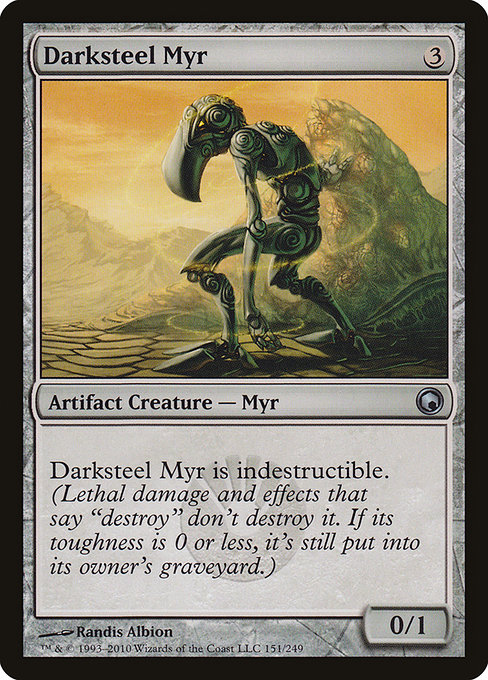
Darksteel Myr
Simple indestructible body
Survives destruction but still has a toughness value and can change zones through other effects.
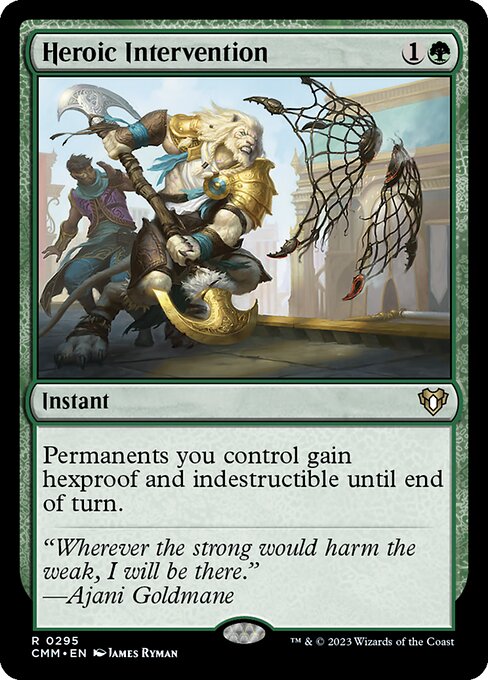
Heroic Intervention
Temporary protection
Combines targeting defense and destruction defense for your permanents.

Blasphemous Act
Damage test
Damage still happens to indestructible creatures even when they survive it.

Toxic Deluge
Toughness test
Enough toughness reduction can remove an indestructible creature.

Swords to Plowshares
Exile test
Exile answers indestructible when targeting and other restrictions permit it.
Build an answer suite and test actual board states
List the indestructible threats you expect to face, then identify which answers in your deck actually remove them. A creature destruction spell, a damage wipe, and a fight spell may all fail against the same threat. That is three cards but one broad weakness. An exile effect, an appropriate bounce effect, or a meaningful sacrifice instruction can diversify the options.
Do not abandon destruction entirely. It can be efficient against most creatures and may be the best way to answer a wide ordinary board. The goal is coverage, not a rule that every removal spell must beat every keyword. Use the interaction checker to inspect the package, then manually verify the indestructible interaction because an automatic removal category cannot capture every board state.
For your own indestructible deck, rehearse one destruction wipe, one exile wipe, and one combat with trample. Track what survives, what damage reaches the player, and which cards you would need to rebuild. Note whether a temporary protection effect expires normally at cleanup or is removed earlier while damage remains. These tests uncover mistaken assumptions before they decide a real multiplayer game.
Build your deck and create a free account to save the result. Write down the specific gap you are addressing with each change. Replacing one redundant destruction spell with exile is easier to justify than replacing the entire removal package after a memorable loss. Likewise, adding recovery after an exile wipe can be more useful than adding another spell that only grants indestructible.
Indestructible questions
Build your deck
Put these choices into a Commander list. Create a free account to save your deck and keep tuning it with Deckcipher.
FAQ
Does indestructible prevent damage?
No. Damage is dealt and normally remains marked on a creature until cleanup. Indestructible prevents the resulting destruction from lethal damage. Lifelink and other damage interactions can still matter. Protection or another prevention effect may instead stop damage, which is a different result.
Can deathtouch kill an indestructible creature?
Deathtouch damage leads to destruction through a state based action, and indestructible prevents that destruction. Another effect can still reduce toughness to zero, remove indestructible, exile the creature, or require its sacrifice. Deathtouch by itself does not bypass the ability.
Can minus counters remove it?
Yes, if the counters reduce its toughness to zero or less. That creature goes to the graveyard through a separate state based action that is not destruction. A small reduction leaving positive toughness does not automatically kill it merely because ordinary damage is also marked.
Does trample get past an indestructible blocker?
It can. Damage assignment considers lethal assignment without requiring the blocker to actually be destroyed. A normal attacker assigns damage based on toughness and existing damage, with deathtouch changing the amount needed. Excess can be assigned through under trample's rules even when the blocker survives.
What if the creature loses indestructible after taking damage?
If lethal damage is still marked, it can be destroyed at the next state based action check after indestructible is removed. Players do not receive priority before that check. Normal cleanup removes damage and ends until end of turn effects together, so ordinary expiration at cleanup is a different sequence.
Does Heroic Intervention stop every board wipe?
No. It grants hexproof and indestructible, which address targeting and destruction. Untargeted exile, applicable sacrifice instructions, and sufficient toughness reduction can still work. Read the wipe's actual action and use a defense or rebuilding plan that matches that action.