
Quick answer
Start a budget Goblins deck with inexpensive bodies, a reliable Krenko activation, and ways to turn a wide board into damage or cards. Spend on the roles the deck is missing before premium lands or combo pieces. Price the actual printings and shipping rather than assuming a fixed deck total.
Choose between growing the mob and forcing attacks
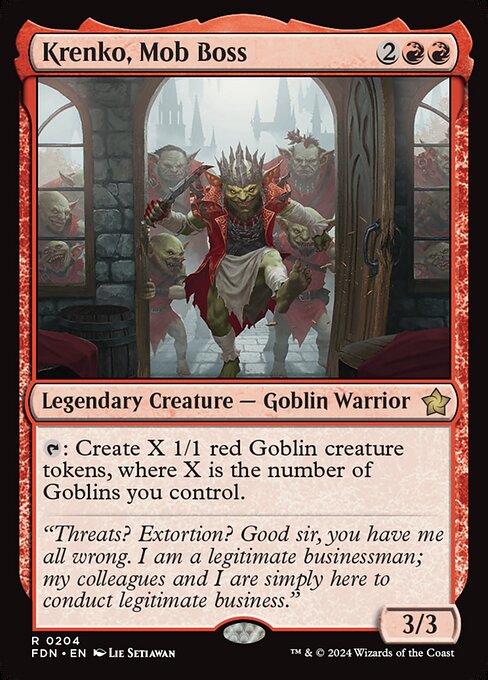
Krenko, Mob Boss is an accessible plan because the command zone supplies the central token engine. His tap ability creates a number of Goblins equal to the number you control when it resolves. A few modest early Goblins can therefore become a substantial board without requiring each creature to be individually impressive. The supporting list needs to get him active, preserve resources, and turn bodies into a finish.
Krenko, Tin Street Kingpin asks for a different sequence. He attacks, grows through his trigger, and makes tokens based on his power. That route values safe attacks, power support, and evasion more directly. The two commanders share a name and creature type but do not justify identical opening hands. Choose the commander before spending the budget on its support package.
This guide centers on Mob Boss with a combat and sacrifice value plan. You can later choose compact untap or copy combos, but their presence changes the deck's intended finish. A cheap collection of combo pieces can be much faster than an expensive pile of Goblin attackers. Discuss the actual plan at the table instead of treating the word budget as a promise about power.
Mono red also makes a practical mana base easier to fund. Basic Mountains provide the colored source your commander and support spells need. Utility lands can be useful, but each colorless land and each land entering tapped has an opportunity cost. Build functioning early turns first. The budget tools can help compare roles after the initial list is assembled.
Reserve space for a complete hundred card shell
Begin with a primary role plan rather than purchasing every Goblin you recognize. One illustrative shell is a commander, thirty seven lands, nine mana or cost support cards, eight card access cards, ten interaction cards, thirty creature and token development cards, and five finishers or other support cards. That totals one hundred when each card is assigned only one primary role. It is a starting construction exercise, not a universal required ratio.
Several Goblins overlap those categories. Skirk Prospector can be assigned to mana, Goblin Ringleader to card access, and Goblin Trashmaster to interaction even though all are Goblins. Do not count each one in several categories and then conclude that the deck has more actual slots than it does. The goal is to preserve the noncreature functions while using creature type synergy where it fits naturally.
The exact land number should respond to your curve, opening hands, and commander recasts. A low average mana value does not mean every hand with two Mountains can cast a four mana commander on time. A list full of three and four mana support needs a different supply from a very lean list. Test the real land sequence with the mana base calculator and opening hand tools.
Keep the first budget focused. A reliable draw option, a flexible removal spell, and an inexpensive token maker can improve more ordinary games than one premium finisher. If a card consumes a large share of your current purchase total, compare what several role upgrades would do instead. Prices change by printing and market, so make that decision from your actual cart.
| Primary role | Illustrative slots | What the role must accomplish |
|---|---|---|
| Commander | 1 | Provide the accessible central engine |
| Lands | 37 | Reach red requirements and recasts |
| Mana or cost support | 9 | Accelerate or compress useful turns |
| Card access | 8 | Refill after deploying small creatures |
| Interaction | 10 | Answer blockers, engines, and dangerous turns |
| Creature and token development | 30 | Build a Goblin count before and after Krenko |
| Finishers and other support | 5 | Convert bodies into a game ending advantage |
Use token makers that establish material immediately
Goblin Instigator gives you its body and a Goblin token when it enters. That is a useful early contribution because both can increase Krenko's later count. It also leaves you with something to sacrifice without immediately losing the entire creature contribution from the card. The token is a creature and Goblin for the relevant abilities even though it is not a card in your library.
Mogg War Marshal has an enters trigger and a dies trigger that each make a token. It does not create all of its lifetime bodies immediately on entry. Its echo payment can make you choose between spending mana to keep the original and allowing it to be sacrificed. Count what is actually on the battlefield when Krenko activates rather than treating a future death token as already present.
Siege-Gang Commander costs more but supplies several bodies from one card and a separate paid sacrifice damage ability. It can help rebuild after a wipe or convert excess Goblins into reach. The activation uses mana, so it is not equivalent to a free outlet. A hand with several expensive token makers can still be too slow if it lacks early bodies and lands.
Avoid filling every development slot with a creature that is only large because you already have many Goblins. A cheap card creating material helps establish the engine; a payoff counting the army asks for the engine to work first. You need both stages in the right order. If early hands repeatedly contain finishers without a Goblin count, replace one payoff with a practical token maker before raising the budget.
Make Krenko active without assuming an untap
A newly controlled Krenko normally cannot activate his tap ability until you meet the continuous control requirement or give him haste. Goblin Warchief can supply haste to your Goblin creatures and reduces the generic portion of Goblin spell costs. It does not remove required red pips. Casting the support before Krenko can therefore change both the cost and the immediate usefulness of the commander.
Haste support has its own cost and vulnerability. An Equipment activation needs a legal target and normal equip timing. A shared haste creature can be removed before you cast or activate the next threat. If your line spends all mana on Krenko and assumes he lives a full round, you have made a real risk choice. That can be correct in some pods, but it is not the same as immediate engine access.
Krenko's ability counts at resolution. With Krenko and three other Goblins, activating can make four tokens if the board remains the same. If an opponent removes one Goblin first, the count is smaller. If Krenko himself leaves after activation, the ability usually remains on the stack and counts the Goblins still present. Removing the source does not simply erase an activated ability.
Likewise, sacrificing Goblins before the ability resolves can reduce its output. Make token growth and sacrifice conversion separate decisions. In many ordinary turns, grow the board first and then spend some bodies afterward when you have the legal opportunity. The haste guide explains immediate activation timing if you are comparing Warchief with other support.
Turn spare bodies into mana, selection, and cards
Skirk Prospector lets you sacrifice a Goblin for red mana. That can accelerate a useful spell or help recast Krenko, but each sacrifice reduces the creature count available for future activations and combat. Producing a large pool with no relevant spell to cast can leave you worse off. Plan the payoff and colored requirements before converting a working board into a temporary resource.
Goblin Matron searches for a Goblin card to hand through its enters ability. It can find the support creature missing from the current board, but it does not cast that creature for free. Keep mana for the follow up if you need the effect immediately. Searching for a card that looks powerful rather than the role you need can turn a flexible tool into a predictable slow sequence.
Goblin Ringleader offers card access tied to Goblin density. Its reveal can return qualifying Goblin cards while other cards go where the ability instructs. Noncreature support lowers the potential hit density, but cutting all interaction just to improve a reveal creates another problem. A healthy construction keeps enough Goblins while preserving the answers and draw the commander cannot provide alone.
Idol of Oblivion is a different resource option. Its draw activation needs you to have created a token that turn. Krenko and your other token makers can satisfy that condition, but an empty board after a wipe may leave the Idol waiting. Compare conditional repeatable draw with a direct red card access spell. The best package contains something useful before the main engine has already succeeded.
Include removal that does more than count Goblins
Goblin Trashmaster combines a bonus for your other Goblins with an artifact destruction ability paid by sacrificing a Goblin. It can remove a threatening artifact while using material the deck already creates. Sacrificing is a real cost, and the ability still needs a legal artifact target. The card does not answer an enchantment simply because both are noncreature permanents.
Goblin Bombardment turns a creature sacrifice into one damage to a legal target. It can finish low life opponents, remove small utility creatures, or preserve value when a creature would otherwise be lost and you have priority. It does not automatically make a board wipe harmless. You may convert your army into damage and still need a plan for the empty board afterward.
Keep some flexible answers outside the creature type. A mono red list can struggle with resolved enchantments or other permanents that small damage cannot remove. The red staples guide compares broader red interaction and the tradeoffs involved. A slightly lower Goblin count can be worthwhile if the added answer stops a permanent that would otherwise end the game.
Do not cut every sweeper simply because you play creatures. Sometimes the opponent has the stronger board and you need a reset. Sometimes a sweeper is the wrong play because your own swarm is ahead. Count actual coverage with the interaction checker, then read the specific effects. Ten cards labeled removal can still all fail against the same large indestructible creature or noncreature engine.
A practical Goblin core to price first
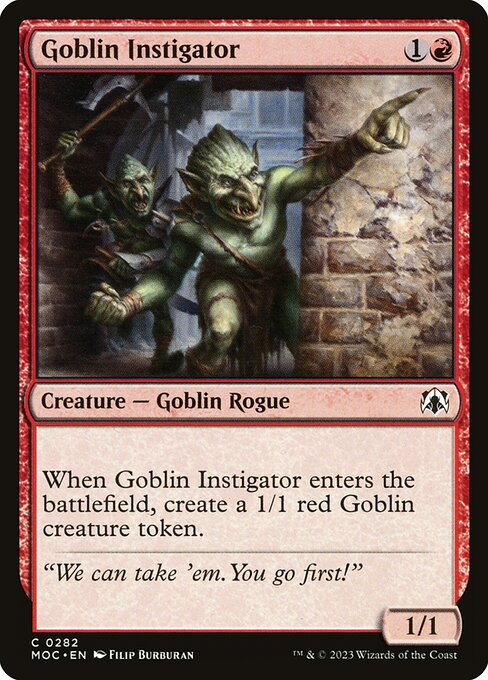
Goblin Instigator
Early material
Two bodies on entry help establish a count without waiting for a large payoff.

Mogg War Marshal
Staged material
Its entry, echo decision, and death produce bodies at different times.
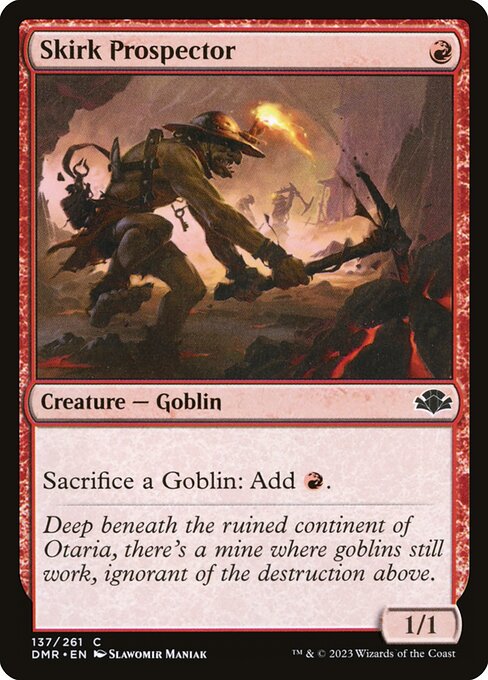
Skirk Prospector
Resource conversion
Sacrifice only when the red mana buys an action worth the lost count.

Goblin Matron
Specific access
Find a missing role, then budget mana to cast the card you found.

Goblin Ringleader
Creature type refill
Balance reveal density with the non-Goblin answers the deck needs.

Goblin Trashmaster
Artifact coverage
Uses existing bodies for interaction while leaving other permanent types unanswered.
Choose a finish and keep a recovery route
Combat finishers reward the board Krenko has built. A team pump or haste effect can turn ordinary tokens into a meaningful attack, but calculate blockers and which creatures can legally attack. New tokens normally need haste for an immediate attack. A board of many bodies is not automatically lethal against several opponents, especially when each has blockers or prevention.
Sacrifice damage gives a different route when combat stalls. Bombardment can turn each body into a point, while Siege-Gang's activation can provide damage at a mana cost. Count the required damage and remaining resources rather than announcing an unlimited loop from a finite token count. An actual combo needs all its specific pieces and a legal repeatable sequence.
Recovery begins with restraint. You do not need to deploy every creature from hand when the existing board already threatens enough. Keeping a token maker or refill card can make the next turn after a wipe more productive. A haste source can help a recast Krenko, but paying commander tax and redeploying support still needs lands and cards.
Exile wipes and effects preventing sacrifice can change the recovery calculation. A death based payoff does not trigger from every zone change, and an outlet cannot be used after a resolving effect has already removed your creatures. Keep the plan connected to actual response windows. The deck should be able to win through ordinary plays before you spend heavily on elaborate insurance packages.
Make budget swaps by function and test real turns
If a premium creature is outside your current purchase total, identify what you needed from it. Replacing a combat cheating creature with Goblin Instigator gives reliable early bodies but loses the ability to put a large card into play through combat. Replacing a costly copy engine with another token maker keeps the swarm plan while giving up combo or enters ability reuse. Name the lost function before calling a substitute equivalent.
For an illustrative start, play a Mountain and a cheap Goblin on turn one, a second Mountain and Goblin Instigator on turn two, and another useful development card on turn three. The hand still needs a fourth mana source or acceleration to cast Krenko on schedule. Do not silently add a land from nowhere when rehearsing the line. If Warchief is involved, apply its actual generic reduction and haste before counting an activation.
Test a version where Krenko is removed before his first untap and another where an activation resolves but the board is wiped next turn. Note whether you have cards and mana to continue. Those are more useful diagnostics than the maximum number of tokens after three uncontested activations. A budget deck improves when its ordinary failed starts become playable.
Build your deck and create a free account to save the initial shell and a revised version. Price the actual cards and printings you choose, including shipping and cards already owned. Keep notes on whether the next upgrade should buy card access, interaction, or haste. A reliable Goblin core can remain inexpensive by improving the weak role instead of chasing every famous creature.
Budget Goblins questions
Build your deck
Put these choices into a Commander list. Create a free account to save your deck and keep tuning it with Deckcipher.
FAQ
Which Krenko should lead a budget Goblin deck?
Mob Boss supplies a tap based token engine, while Tin Street Kingpin rewards attacking and increasing power. Choose the turn pattern you want before buying support. The same creature type does not make their ideal haste, evasion, and resource packages identical.
Does a fresh Krenko activate immediately?
Normally not without haste or another applicable permission. His tap symbol ability faces the continuous control restriction. A haste source can change that, but it must be present or resolve in time, and the creature still needs to be untapped.
Does Krenko remember the count from activation?
His ability uses the number of Goblins you control when it resolves. Removal or sacrifices before then can reduce the output. Removing Krenko after activation does not normally erase the ability, but he no longer contributes to the count if he is gone.
Should every creature be a Goblin?
Creature type density helps several cards, but the deck still needs draw, interaction, and recovery. Assign cards primary jobs and keep the effects your commander cannot supply. A non-Goblin answer can be more valuable than another weak body when it covers a real gap.
Are untap combos required?
No. Combat and finite sacrifice value can be a deliberate plan. Compact loops are an optional construction choice with their own pieces and table expectations. A low card price does not make a repeatable combo equivalent to a slower token combat strategy.
Can this guide guarantee a fixed deck price?
No. The total depends on printings, condition, region, shipping, and cards you already own. Use the core roles to make a real shopping list, compare the current total, and preserve the functions of any card you replace to meet your own limit.