
Make exile cards playable, then make the Treasures lethal
Prosper upgrades work best when cheap exile effects feed an affordable curve and a few focused finishers. Start with Reckless Impulse, Wrenn's Resolve, and interaction that fits beside them. Add damage engines such as Reckless Fireweaver or Marionette Apprentice before filling the deck with Treasure multipliers. More cards in exile do not help if you cannot pay for them before permission expires.
Starting deck targets, not fixed rules
Choose an engine plan instead of every Treasure card
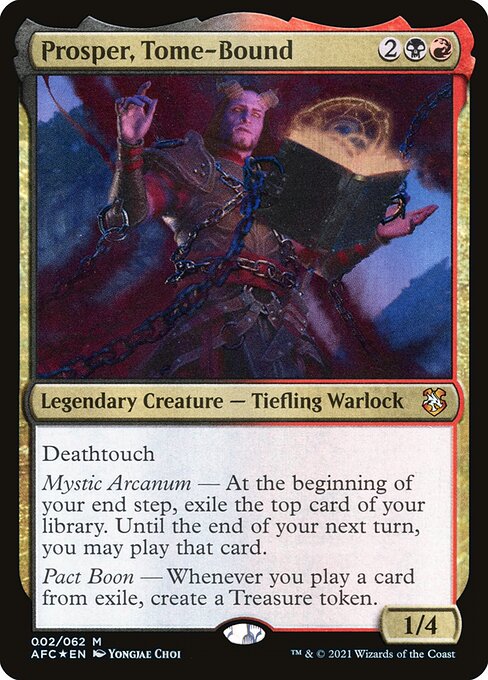
Prosper, Tome-Bound is a Rakdos value commander with two linked jobs. At your end step he makes one card available from exile until the end of your next turn. Whenever you play a card from exile, he creates a Treasure. The deck becomes strong when the first job reliably funds the second. It becomes clumsy when it contains several six-mana multipliers, several narrow payoff enchantments, and too few affordable spells to connect them.
For most multiplayer tables, an exile-driven midrange deck is a useful starting point. Play lands from exile, use cheap impulse draw to keep finding work, interact without exhausting your turn, and turn artifact entries or sacrifices into damage. This guide uses that plan rather than treating Prosper as a dedicated storm deck.
Treasure-focused and exile-focused are not mutually exclusive labels. The practical distinction is what functions when Prosper is removed. Reckless Impulse still offers cards. Deadly Dispute still exchanges a resource for cards and mana. A battlefield containing only Xorn and another Treasure multiplier may do nothing until the commander returns. Keep enough independent cards that one removal spell does not shut off every role simultaneously.
Treat exile as a second hand with visible deadlines
Put exiled cards in separate, readable groups and keep their permissions with them. Prosper grants access through your next turn. Reckless Impulse and Wrenn's Resolve also give a generous window through the end of your next turn. Other effects may end this turn, restrict you to casting spells, or specify an unusual timing window. The card is not in your hand, and an expired permission does not send it to your graveyard. Without another permission, it normally remains stranded in exile.
Before the first land drop of a turn, check what you can reveal or exile. When Prosper's previous end-step card is a land, playing that land can create a Treasure and preserve a land in hand. You still have only your normal land allowance unless another effect changes it. Playing a land from exile after playing a land from hand is not legal just because Pact Boon would reward it. A spell that only lets you cast the exiled card cannot provide a land play.
Do not cast a second impulse-draw spell automatically because the first one resolved. Suppose you have two mana left and two legal spells in exile costing two and three. Another two-mana draw effect may replace a card in your hand with two more deadlines you cannot meet. Casting the useful two-mana spell now creates a Treasure and advances the turn. Community Prosper discussions repeatedly raise this overload problem. Use it as a reason to evaluate the actual mana left, not as evidence for a universal maximum number of exile cards.
Sequence the first four turns with real mana
Consider Command Tower, Mountain, Swamp, Arcane Signet, Reckless Impulse, Deadly Dispute, and Reckless Fireweaver. Turn one play Command Tower. Turn two play Mountain and use both lands for Arcane Signet. Turn three play Swamp. Three lands plus Signet supply four mana, including black and red, for Prosper. At that turn's end step, exile your top card and note the deadline. This hand supports the commander and independent follow-up without assuming a draw-step miracle.
For a specific turn-four example, suppose that end-step card was a Mountain and your draw was an ordinary nonland card. Play the exiled Mountain as your land for the turn and make one Treasure. Four lands plus Signet now provide five non-Treasure mana. Spend two on Reckless Impulse from hand, leaving three. If it reveals a two-mana spell and another land, cast the spell with two of the remaining mana and make another Treasure. The newly revealed land waits for a future legal land play within its permission window.
You end that sequence with one unspent ordinary mana and two Treasures, assuming no other costs or interaction. Use the ordinary mana plus one Treasure to pay Deadly Dispute's one generic and one black, and sacrifice the other Treasure as its additional cost. If preserving artifacts matters more than two fresh cards, do not spend them simply because the line exists. Mana created by Dispute arrives after the spell resolves and does not finance its own costs.
That first hand is a reasonable keep for ordinary midrange games. A two-land hand full of Inspired Tinkering, Nalfeshnee, an expensive Dragon, and payoff enchantments needs a mulligan even if all the cards say exile or Treasure. At six, keep functioning mana and an independent draw effect before a redundant multiplier. Against an opponent likely to remove Prosper immediately, a slower hand with ramp, draw, and removal can be better than a hand whose only action is casting him one turn early.
Use a compact engine with distinct payoff jobs
Exile, artifacts, and damage are different roles

Reckless Impulse
Affordable exile access
Two cards for two mana with access through next turn. Cast before your land drop when possible.
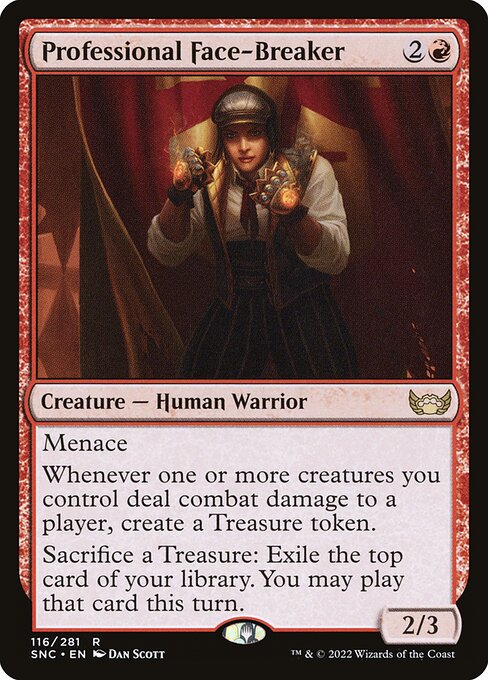
Professional Face-Breaker
Independent resource engine
Combat damage can make Treasure, and spare Treasure can become exile access. Requires creatures that can connect.
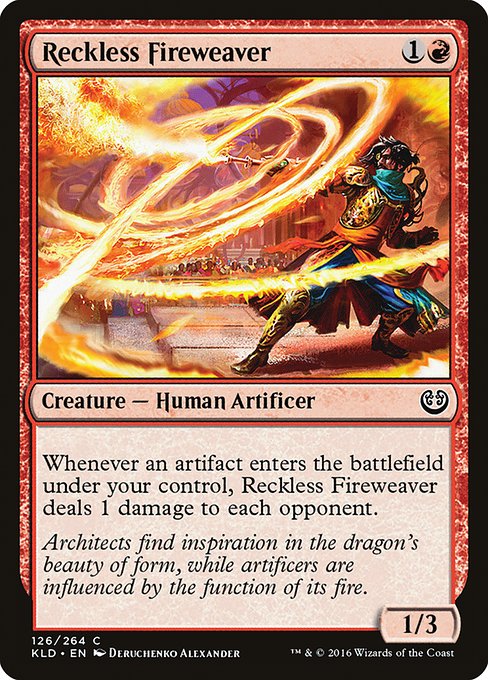
Reckless Fireweaver
Artifact-entry damage
One Treasure entering means one damage to each opponent. Clues and Food from Manufactor can also trigger it.
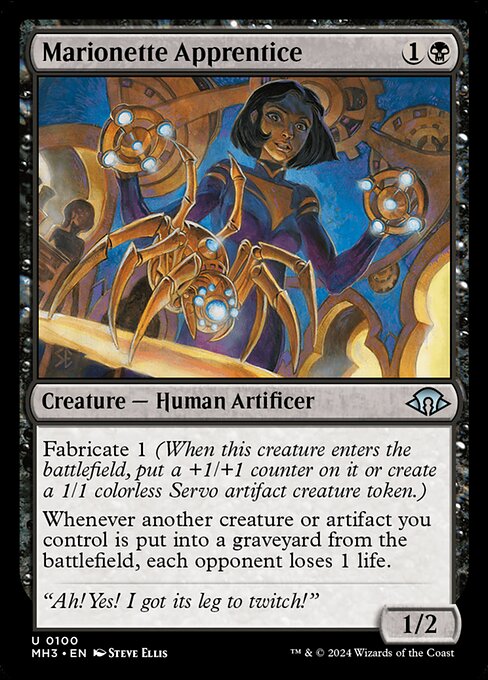
Marionette Apprentice
Sacrifice and death payoff
Rewards spending Treasures. An artifact creature entering the graveyard is one event for its single trigger, not two.
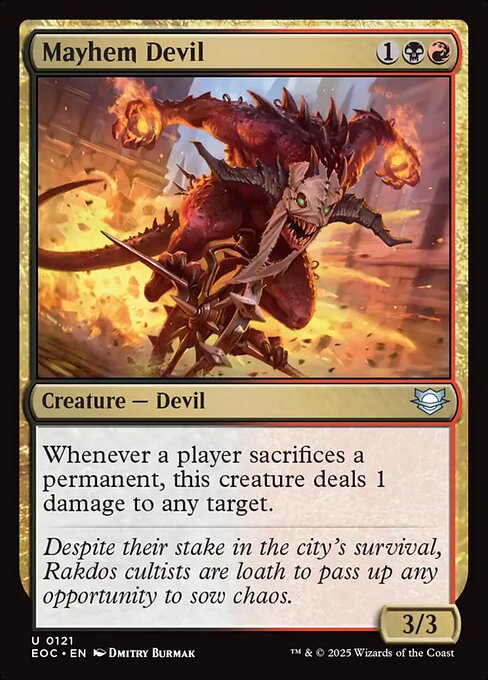
Mayhem Devil
Flexible damage
Sees any player sacrifice a permanent and can target creatures. Requires tracking other players' sacrifices as well.
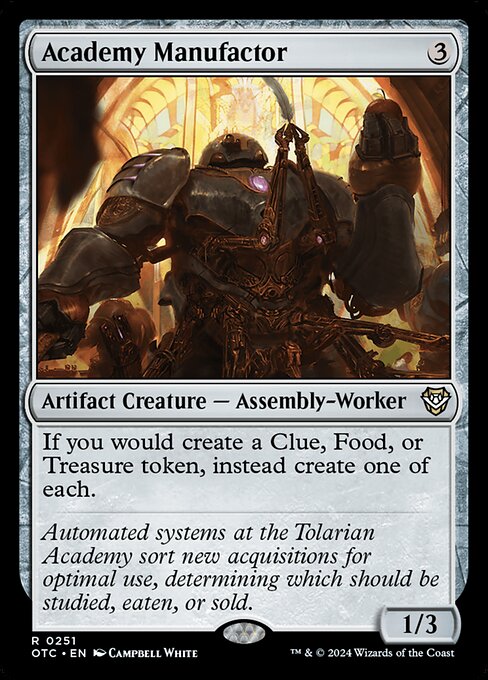
Academy Manufactor
Resource multiplier
Turns one Treasure creation into a Treasure, Food, and Clue. Only the Treasure immediately produces mana.
These cards do not close games at the same speed. Reckless Fireweaver damages all opponents when artifacts enter. Marionette Apprentice drains when your other creatures or artifacts reach the graveyard from the battlefield. Mayhem Devil can clear utility creatures but assigns one damage per trigger to one target. Choose a mixture so ordinary Treasure use advances a win, rather than assuming any card mentioning artifacts provides the same output.
Passionate Archaeologist is another route. It gives your commander creature a trigger for casting spells from exile, with damage equal to that spell's mana value to one opponent. A land play makes Treasure with Prosper but does not trigger Archaeologist. A spell copy made by Nalfeshnee is not itself cast, so it does not produce another cast trigger or another Pact Boon reward. Archaeologist is legal in the 99 even though Prosper does not have "choose a Background." That permission only matters when pairing commanders in the command zone.
Once a payoff survives, map the work it still needs. If every opponent is at thirty life, one Fireweaver needs thirty artifact entries to defeat all three through that effect alone. Five Treasures are useful mana and five damage each, not a table kill. Manufactor increases artifact entries, while a sacrifice payoff makes spending resources productive. This arithmetic helps you choose between protecting a developed engine, playing another payoff, or actually converting the resources already present.
Keep the curve low enough to use what you exile
Start around 36 to 38 lands with nine to twelve early ramp pieces, then adjust for your curve and play patterns. Treasures supplement land drops; they do not guarantee that a two-land opening hand reaches four mana before Prosper exists. Rocks costing two are useful because they support a turn-three commander without requiring a first Treasure. Keep black sources available for removal and Dispute effects instead of assuming a pile of red impulse draw fixes everything.
Inspired Tinkering is a powerful five-mana turn because it provides three Treasures and access to three exiled cards through next turn. It is also a five-mana spell you may be unable to cast from another impulse effect when mana is tight. Nalfeshnee costs six and asks for further spells before its copying text matters. Both can belong in a slower list, but drawing several expensive setup pieces together is a warning. The Commander mana-curve guide explains why average mana value alone can hide this setup bottleneck.
Budget the mana to use your secondary resources. A Clue normally costs two to sacrifice and draw, and Food normally costs two to sacrifice for life. Academy Manufactor gives options, not three free mana per Prosper trigger. If your deck already struggles to spend all the cards it exiles, another expensive engine can make the visible resource pile bigger while leaving the actual turn unchanged. One low-cost removal spell may improve that slot more.
Upgrade with conditional packages and honest tradeoffs
Specific Prosper changes to compare
| If present, consider cutting | Add or compare | What the swap changes |
|---|---|---|
| A second five-mana impulse spell | Reckless Impulse or Wrenn's Resolve | Makes more exile windows affordable. Loses the larger spell's extra resources. |
| A six-mana damage payoff that keeps arriving late | Marionette Apprentice | Puts a sacrifice payoff online early. Does not match a larger card's potential burst output. |
| A generic expensive artifact payoff | Reckless Fireweaver | Rewards normal Treasure entry immediately. The small creature is easy to remove. |
| An unsupported combat-only Treasure card | Deadly Dispute | Uses existing artifacts and provides cards at instant speed. Needs a resource to sacrifice. |
| Jeska's Will when the chosen printing exceeds the budget | Inspired Tinkering | Preserves an exile-plus-mana role at a higher cost. It does not reproduce Will's speed or opponent-hand scaling. |
| A third Treasure multiplier | An inexpensive removal spell suited to your pod | Protects access to the engine. Reduces the spectacular ceiling when nobody interacts. |
Apply those cuts only when the cards are present and the stated problem occurs. Inspired Tinkering is not an equal replacement for Jeska's Will, and two cheap synergy creatures do not replace every premium engine. The budget alternatives guide explains how to compare those differences. Price complete packages in the deck price calculator, then check actual printings, currency, delivery, and taxes. When a single premium card absorbs the whole allowance, a package that fixes both draw and interaction can produce more useful games.
Older Prosper primers can contain Dockside Extortionist, Mana Crypt, or Jeweled Lotus. Those names are not a shopping list for current Commander. Check the official current banned list and card legality before importing a historical deck. Dockside is banned in Commander. Keep lessons about sequencing and engine structure while replacing illegal acceleration. Do not infer that an old combo is available simply because the primer still loads.
Protect access, answer hate, and rebuild deliberately
Prosper is an attractive removal target, so keep a plan for the six-mana recast. If his end-step ability has already resolved, removing him does not erase the play permission it granted. You can use that card within its window; you simply stop making new Pact Boon triggers while he is absent. That makes it reasonable to keep developing from exile instead of spending an entire turn recasting him into obvious removal.
Effects that prevent casting spells from outside your hand shut down a central part of the engine. Such casting restrictions do not themselves forbid playing lands from exile, although ordinary land restrictions still apply. Artifact shutdown effects can make Treasures unable to produce mana. Keep black creature removal and suitable artifact removal available before spending your whole hand on multipliers. Cards that exile a threat and give you future access are attractive, but a delayed answer is not interchangeable with a cheap instant when an opponent is about to win.
After a wipe, rebuild the source of cards first if your hand is empty. Cast the sacrifice payoff first only when you can actually feed it or expect immediate resource deaths. The Commander deck audit guide helps identify which function the surviving deck lacks. Avoid leaving six cards in exile spread across multiple timers and asking the table to reconstruct which permission remains. Clear piles and declared deadlines reduce mistakes and keep a busy Prosper turn understandable. Use the Commander tracker for life and damage notes so your attention can stay on the sequencing.
Frequently asked questions
Does Prosper trigger when I play a land from exile?
Yes. His ability rewards playing a card, which includes a legal land play. It does not grant an additional land drop or make an effect that says "cast" allow lands.
Can I use the new Treasure to pay for the spell that triggered Prosper?
No. You finish paying for the spell before its cast-related triggers go on the stack. The Treasure can help fund later actions.
Do copied spells trigger Prosper again?
A spell copy placed directly on the stack was not played as a card from exile. Nalfeshnee therefore does not double Prosper triggers. Read effects that copy cards separately rather than assuming every copy uses the same rules.
Can Prosper keep playing the card after he dies?
A play permission already created by a resolving end-step ability lasts for its stated duration even if Prosper leaves. His Treasure ability must be present when you play a card to create a new trigger.
How many exile-draw effects should I run?
Ten to fourteen is a starting range for this midrange approach, not a proven optimum. Lower the count or the curve if cards repeatedly expire unused; add access if you routinely have spare mana and no legal action.
Is this a guaranteed infinite-combo deck?
No. The core recommendations generate finite cards, mana, and damage. A specific combo needs its own complete card list, costs, timing, and outlet. Resource growth by itself is not proof of an infinite loop.
Sources and further reading
- Prosper Oracle text and rulings. Oracle wording and the official timing and any-exile rulings.
- Wizards current banned and restricted list. Commander banned cards and restrictions.
- Prosper decklist and strategy discussion. A published primer discussion used to compare engine roles, not to copy an old list.
- Prosper players discussing too many exile effects. Player concerns about accumulating more exile cards than available mana.
- Nalfeshnee card text. The distinction between copying a spell and casting another card.
- Passionate Archaeologist card text. The exact damage trigger and its relationship to commander creatures.
Check the whole upgrade package
Compare the revised list with your starting deck before buying singles. A stronger engine still needs enough lands and interaction.