
Quick answer
To check a precon upgrade, keep the original list, record each cut and addition, then review the complete upgraded deck for bracket restrictions and how it actually plays. Deckcipher connects the precon finder, deck builder, and bracket calculator for this process. No single card count can certify that your upgrades preserve the experience of the original deck.
What a precon upgrade bracket check should answer
A precon usually gives you a recognizable starting point. Once you change several cards, its name becomes a less useful description of the deck across the table. Two Riders of Rohan lists can share a commander and still offer very different games. One may retain slow thematic Humans and monarch politics. Another may spend most of its slots making the first productive combat happen sooner and protecting the resulting board.
The useful question is not simply whether the upgrade contains an expensive card. Ask what became easier, what became faster, and what opponents now need to answer. Removing three awkward spells can improve a deck without adding a famous staple. A cheap repeatable engine can matter more than a spectacular seven-mana creature. Check the package and the commander together, rather than assigning each purchase a harmlessness score.
Deckcipher has connected tools for this job rather than a separate product that guarantees a bracket for every swap. Find a stock list in the Commander precon finder, edit a working copy in the deck builder, and check the resulting list with the Commander bracket calculator. Keep a short written comparison alongside the list. That comparison supplies context that a card scanner cannot infer from your intentions.
Save the stock list before you improve it
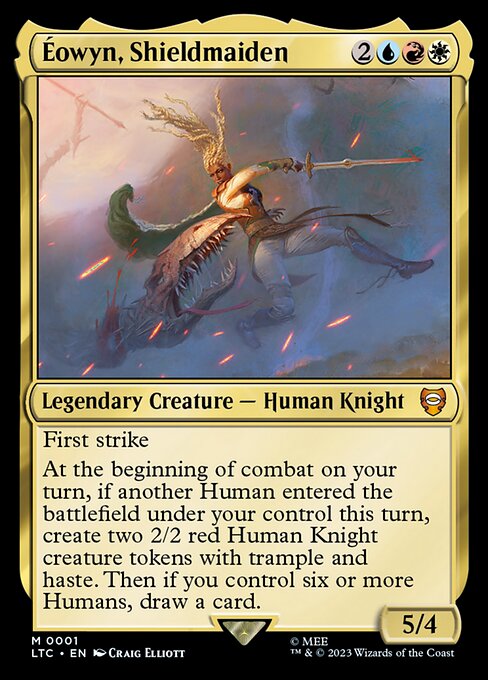
Begin with the exact product and face commander. A list headed by Éowyn, Shieldmaiden is not interchangeable with one headed by Aragorn, King of Gondor, even though both legends come in Riders of Rohan. The cards available to the deck overlap, but the command-zone engine changes. Record which legend starts in the command zone and which remains in the library before counting any upgrades.
Keep a stock version and a working version with clear names. Include the date of your changes and any previous replacements. If you bought a used precon, compare the physical cards with the stock list before calling it unmodified. A seller may have removed valuable cards, included an extra basic land, or quietly added a favorite combo. The box alone is not evidence of the current hundred cards.
Separate ordinary deck cards from tokens, display cards, and sideboard notes. A single-commander deck normally has one commander and ninety-nine other cards. Riders of Rohan includes a thick display commander as a product extra, not an extra legal deck slot. Count actual quantities in the main deck. Checking only the number of unique names can hide a duplicated nonbasic card or a missing basic land.
Distinguish formal restrictions from play expectations
Commander brackets describe intended game experiences as well as card restrictions. The current beta labels are Exhibition, Core, Upgraded, Optimized, and cEDH. Game Changers are restricted in the lower brackets, but they are only part of the review. A list with no listed Game Changers can still be built for an experience that does not fit a slower table. Review the current criteria when you finish the deck, since the beta and its card list can change.
Do not assume that a factory precon is automatically a Bracket 2 deck. The February 2026 update reiterates that preconstructed products have been separated from that blanket assumption. Start by assessing the stock list under the current framework. Otherwise you may claim that an upgrade stayed in its original bracket when the original classification was never established in the first place.
Next review the changes that a simple named-card list misses. Did you add a compact game-ending loop? Did you add redundant ways to find it? Does the deck now prevent opponents from developing their mana? Are extra turns recurring instead of being a one-off splashy spell? These are questions about sequences and consistency. A calculator result is a useful prompt for that review, not permission to skip it.
A verified five-swap Riders of Rohan example
The following is an illustrative revision of the stock Riders of Rohan list with Éowyn, Shieldmaiden as commander. Each cut appears once in that stock list, and each addition is absent from it. The aim is to reduce some expensive setup, add flexible answers, and improve one land. It is not a claim that these are the best five changes for every group, or that the completed list has a certified bracket.
| Cut from stock list | Add to working list | Purpose and cost |
|---|---|---|
| Dearly Departed | Coppercoat Vanguard | Earlier Human and protection tax; loses flying and the graveyard counter benefit |
| Champions of Minas Tirith | Generous Gift | Flexible instant answer; loses a Human and monarch protection |
| Court of Ire | Fellwar Stone | Earlier mana support; loses repeatable damage and a monarch source |
| Taunt from the Rampart | Wear // Tear | Cheaper artifact or enchantment answer; loses a mass goad finisher |
| Tranquil Cove | Adarkar Wastes | Untapped blue or white access; colored mana can cost life |
This table deliberately includes losses. Champions of Minas Tirith can be an important monarch card in a version that wants to defend the crown. Taunt from the Rampart can open a decisive attack. If your regular games stall behind crowded boards, cutting that effect could solve an early-turn problem while creating a finishing problem. Keep a cut only when the role it removes is less important than the problem the replacement solves.
Do not accidentally buy a second copy of an existing stock card. Riders of Rohan already includes Swords to Plowshares, Arcane Signet, Sol Ring, and Talisman of Conviction. Those are reasonable cards to retain, but adding another copy is generally illegal under singleton rules. Check the exact card name against the saved list before placing an order. Similar art and alternate printings do not create a different card name for this purpose.
Why these additions change the opening turns
Éowyn rewards another Human entering under your control during your turn before your beginning-of-combat trigger. Her own entry does not satisfy the word another. A two-mana Human can therefore be useful after you have cast her, when you want to start a productive combat without spending your entire turn on another expensive threat. Coppercoat Vanguard fills that role while supporting the other Humans you already control.
Vanguard gives each other Human you control +1/+0 and ward {1}. It does not give itself those benefits. The ward tax is also not blanket immunity: an opponent can pay it, use an effect that does not target, or remove Vanguard itself. Treat the card as a small improvement to development and protection. Do not keep an otherwise unplayable opening hand on the assumption that one tax will preserve your entire board.
Generous Gift changes a different part of the game. Its broad permanent coverage helps when a noncreature engine would otherwise remain on the table. The targeted permanent’s controller gets a 3/3 Elephant if the spell resolves with a legal target, even if indestructible prevents the destruction. Think about who receives that creature and whether it can interfere with your next attack. Broad coverage is useful, but it is not a free exchange of resources.
Fellwar Stone costs two mana and taps for a color that a land an opponent controls could produce. It does not promise every Jeskai color in every game. Look at the lands across the table before planning a sequence that needs a particular color. In a varied multiplayer group it can be helpful fixing, but it should not replace enough colored lands that your opening hand depends on opponents supplying the missing color.
Five additions to inspect
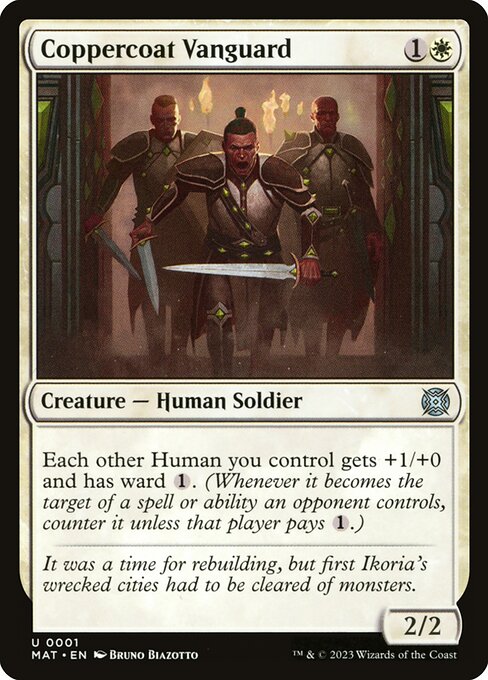
Coppercoat Vanguard
Early Human
Helps the other Humans while remaining a cheap way to enable a later Éowyn combat trigger. It does not protect itself.

Generous Gift
Flexible interaction
Answers a permanent at instant speed while leaving its controller a 3/3 Elephant. Consider the replacement body before choosing a target.

Fellwar Stone
Early mana support
Uses colors available from opponents’ lands. Verify the color you need instead of treating it as unconditional five-color fixing.
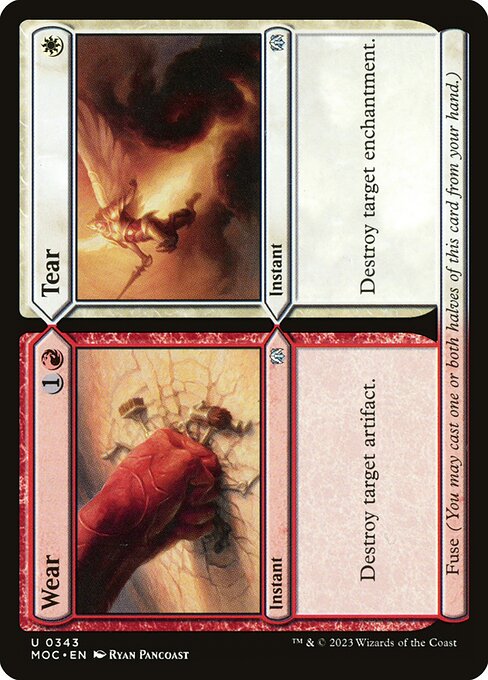
Wear // Tear
Artifact and enchantment removal
Wear costs {1}{R}; Tear costs {W}. From your hand, fuse lets you cast both halves and pay both costs.

Adarkar Wastes
Untapped colored land
Produces colorless without a life payment, or white or blue while dealing 1 damage to you. It does not supply red.
Check the arithmetic without turning it into a rating
The stock Riders list in this example has thirty-eight lands in its ninety-nine-card main deck. These five one-for-one swaps leave both those quantities unchanged. The four removed nonland spells have mana values six, six, five, and five, totaling twenty-two. The four added spells have mana values two, three, two, and three, totaling ten. The replacement land has mana value zero, like the land it replaces.
Wear // Tear needs special care in this calculation. Away from the stack, a split card normally has the combined mana value of its halves. Here that is three. You can cast only Tear for one white mana in a relevant situation, but recording the card as mana value one throughout the deck would distort the comparison. Write down the counting convention before interpreting the curve.
Excluding the commander and lands, the archived stock main deck has sixty-one nonland cards with a total mana value of 202. These replacements reduce that total to 190, moving the average from about 3.31 to 3.11. This is decklist arithmetic, not a simulated win rate. It tells you that this particular package is cheaper on average. It does not tell you how often you will enable Éowyn, draw a second white source, or recover from a board wipe.
Run the upgraded list through the actual tools
Open the bracket calculator and supply the entire working list, using a supported public deck URL or a pasted decklist. A private or inaccessible source link may not import. Confirm that the fetched list is the version you just changed before selecting Calculate Bracket. A correct analysis of an old copy does not answer the upgrade question. Check the displayed commander and card count as a quick sanity check.
Read the explanation and any follow-up refinements, rather than stopping at the largest number on the screen. A flagged card may need context. An unflagged package may still need your judgment about recurring locks or quick wins. If a result seems surprising, inspect the actual list for a forgotten card before trying to argue the result into the bracket you wanted.
Then inspect the curve and mana separately. The mana base calculator can help examine colored sources, while the Commander mana curve calculator makes expensive congestion easier to see. Lowering average mana value does not solve a missing white source, and changing one blue-white land does not solve every red requirement. Use each tool for the question it actually answers.
Review the combinations created by the whole package
Lay out the new cards beside the commander and the strongest cards you retained. Read them as possible sequences. A cost reducer that looked modest in isolation may let you deploy several spells in a turn. A recursion card may turn a one-time answer into a repeated denial pattern. A tutor can make a previously occasional finish happen far more often even when no individual addition has an alarming name.
For a combat deck, also inspect how protection and card advantage compound. A faster board, more cards after each attack, and cheaper protection can produce a much more resilient engine together. You do not need an infinite combo for an upgrade to change the table’s experience. If opponents now need an answer a full turn earlier, say that plainly when describing the revision.
Keep intent separate from capability. Saying that you do not plan to use a loop does not remove the loop from your deck. If the group wants that line excluded, removing a piece is clearer than relying on a promise made differently each week. If everyone wants to try the stronger version, bring it with an accurate description and let the table choose a suitable matchup.
Test the changes and keep a useful comparison
First test ordinary opening hands under the mulligan rules you actually use. Record whether you can make the first several land drops, cast early setup, and reach your commander with the right colors. Include awkward hands. A single perfect sequence can show that a plan is possible, but it cannot establish that the list does it reliably. Small samples are diagnostic notes, not precise probabilities.
Then play real games and record the point at which the upgrades mattered. Did Fellwar Stone help cast Éowyn earlier, or did you need the red source it could not provide? Did Wear // Tear remove an important engine, or sit unused while creatures blocked your attacks? Did cutting a monarch card make the deck less attractive to you even when the opening turns improved? Those observations suggest the next change more clearly than a win-loss total alone.
Keep your pregame description short enough to use. For this example: “Éowyn Humans, five changes from Riders of Rohan, lower curve and more flexible removal. I removed some monarch support and a goad finisher. I still win through combat; let’s review the current bracket fit together.” Update that statement if you later add a different win condition. A clear description helps opponents understand the current deck without needing to memorize the original product list.
Build your deck
Put these choices into a Commander list. Create a free account to save your deck and keep tuning it with Deckcipher.
FAQ
Does upgrading a precon automatically raise its bracket?
No. An upgrade can improve reliability while remaining compatible with the same intended experience. You still need to review the complete list under the current bracket criteria. Neither the number of swaps nor the price paid establishes the result by itself.
Is there a separate automatic precon upgrade certification?
Deckcipher supplies a precon finder, deck builder, and bracket calculator that you can use together. This guide describes that workflow and a manual comparison. It does not promise a separate certification feature or an official ruling for every upgrade.
Can a precon already sit above Bracket 2?
Yes. Do not classify a deck solely because it came in a preconstructed product. Assess its actual cards and intended gameplay using the current framework. The February 2026 bracket update confirms that precons are no longer automatically tied to Bracket 2.
How many cards should I replace in the first batch?
Choose a small enough batch that you can explain each cut and notice its effects. Five changes are useful for the worked example, not a universal safety threshold. One powerful engine can matter more than ten modest substitutions.
Why not add Swords to Plowshares to Riders of Rohan?
The stock list already includes it. You can retain that copy or replace a missing copy in an incomplete used deck. Adding a second ordinary copy would break the singleton rule. Always compare shopping suggestions with the exact current list.
Does a lower average mana value prove that the deck is stronger?
No. It describes the cost distribution under a stated counting convention. A cheaper deck may be smoother, but it can lose important finishing power, resilience, or card advantage. Check actual roles and play patterns alongside the arithmetic.
Should I remove lands after adding a mana rock?
Not automatically. Lands and rocks play different roles, and colored requirements still matter. The five-swap example keeps all thirty-eight lands. Test early land drops and the colors needed for Éowyn before making a separate land-count change.
How should I describe an upgraded precon before a game?
Name the commander, explain the main win plan, and mention changes that affect speed, consistency, combos, or resource denial. Use the bracket as shared context and give the practical details a number cannot convey. An accurate short description is more useful than saying it is just a precon.