
Quick answer
Energy is a player counter resource represented by {E}. It stays between steps and turns until spent or changed by an effect. Pay energy by removing that many counters from yourself. Each card specifies what energy can buy and when you may spend it.
Energy is stored on a player and is not mana
When a card says you get energy, add that many energy counters to your player total. Do not put them on the card that produced them as though they were charge counters. Several different producers can add to the same energy supply, and several different spenders can use it. The total belongs to you rather than to an individual engine permanent.
Energy does not empty from your supply when a step, phase, or turn ends. That lets you save it for a later turn or a different card. Removing the creature or artifact that generated it does not remove the counters already on you. Removing a spender can leave you with unused energy, however, so stored resources are not the same as a guaranteed useful action.
Energy is not mana of a special color. A mana ability adding any color cannot choose energy. Generic mana cannot pay an energy symbol simply because both look like costs. A card such as Aether Hub provides a specific way to spend energy while producing mana, but that conversion comes from the card's ability rather than a general rule allowing exchange in either direction.
Keep the resource visible and distinct from poison, experience, life, and counters on permanents. A die sitting beside an artifact can be a convenient physical marker if everyone knows it is your player total, but the location must not imply the counters disappear when the artifact leaves. Clear tracking becomes especially important when one card supplies energy and another asks for a payment later in the turn.
Payment timing depends on where the cost appears
An activated ability can have an energy payment before its colon as part of the activation cost. You pay that cost when activating the ability. Opponents respond after the activation is completed and the ability is on the stack; they do not respond halfway through your cost payment. Countering the ability afterward normally does not refund the energy you already spent.
A triggered or resolving ability may instead say you may pay an amount of energy during resolution. In that case, you make that payment choice at the specified point in the resolution. Players can respond before the ability resolves, but they cannot normally insert an action between that payment choice and the following if you do instruction. A when you do reflexive trigger creates a different later stack object according to its wording.
You cannot pay more energy than you have. A cost of three energy needs three counters available at the payment moment, not an expectation that a future trigger will provide the missing counter. If you have a legal energy generating ability you can activate beforehand, resolve or pay for it in the appropriate sequence. There is no general permission to cast another spell in the middle of resolving a payment choice.
Optional payment does not automatically mean repeatable payment. If a resolving ability offers one payment for one result, you do not pay it five times to multiply that result unless the text gives that option. This distinction matters when a deck has accumulated a large reserve. A large energy total expands which legal payments you can make; it does not rewrite each spender into an unlimited mana sink.
Satya creates an attack opportunity and a later choice
Satya, Aetherflux Genius triggers when it attacks. The ability can copy up to one other target nontoken creature you control, creating a tapped and attacking token, and gives you two energy. The copied creature does not need to be attacking itself. Satya supplies haste and menace for its own attack, but the target still must satisfy the trigger's exact restrictions.
If you choose a target and it becomes illegal before the ability resolves, that can prevent the ability from resolving and deny its energy as well as the copy. Choosing no target is allowed by up to one; that can be useful when you want the energy without a legal copy target. Do not assume a targeted ability always grants its incidental resource even when its only target disappears.
At the beginning of the next end step, the delayed instruction asks you to sacrifice the created token unless you pay energy equal to its mana value. This is a payment for that token at that next end step, not a new recurring payment every end step forever. Paying once for the relevant delayed ability does not attach a perpetual energy upkeep to the token.
The token's mana value is not automatically zero. A token copy normally copies the relevant mana cost and therefore can have the copied card's mana value. A token made without a copied mana cost can be different. Check what was actually copied before budgeting the end step payment. This is a major reason a Satya deck must consider both the value of a temporary copy and the price of keeping it.
A complete Satya energy budget
Suppose you have one energy before attacking with Satya and copy a legal nontoken creature with mana value three. The resolving attack trigger gives you two energy, bringing the supply to three. If nothing changes that total before the next end step, you can pay three to keep the token. You then have zero energy remaining. You did not gain an unlimited copy engine merely by having enough for this one payment.
If you spend one energy on another card during combat, only two remain for the end step. Without another producer, you cannot pay three and must follow the sacrifice instruction. The earlier combat benefit may still have been worth it. An enters ability or useful damage from a temporary copy can justify declining the keep payment deliberately rather than treating every sacrificed token as a failed turn.
The token enters attacking rather than being declared as an attacker. An ability on the copied creature that triggers when it attacks does not automatically trigger from entering attacking. An appropriate enters ability can trigger, and combat damage abilities can matter if the token actually connects. These are different inputs, so choose copy targets for the events Satya really supplies.
Legendary copies need the legend rule considered as well. Copying a legendary creature while retaining another with the same name can require a choice through state based actions before the combat damage you hoped to get. A powerful enters ability may still make a line useful, but do not assume two ordinary legendary copies coexist freely. Copy characteristics and the energy budget are both part of evaluating a target.
| Starting situation | Action | Energy result in the simple example |
|---|---|---|
| One energy | Satya attack trigger resolves | Three energy |
| Three energy | Keep a mana value three Satya copy | Zero remaining |
| Three energy | Spend one elsewhere before that payment | Only two remain; three cannot be paid without more energy |
| Five energy | Proliferate and choose yourself with energy present | Six energy before other counter consequences |
| Six energy | Activate Aetherworks Marvel | Energy is spent as part of the activation cost |
Dr. Madison Li turns artifact casts into choices
Dr. Madison Li gives you energy when you cast an artifact spell. That trigger is about casting, so simply returning an artifact from the graveyard directly to the battlefield is not the same event. An artifact spell can produce the cast trigger even if the spell is later countered. The trigger and the artifact spell are separate objects on the stack.
Her activated abilities spend different amounts of energy and all use a tap cost. One can improve a creature and give it trample and haste, another draws a card, and another returns a target artifact card from the graveyard to the battlefield tapped. Choosing one normally taps the commander, so the others are not all available from the same untapped body without another untap effect and legal activations.
The tap cost means a newly controlled Madison normally needs haste or another applicable permission before using those abilities. Energy already in your supply does not remove that restriction. You can have plenty of counters and still be unable to activate until the creature is eligible and untapped. The haste guide explains why immediate activation support can matter more than another energy producer in that situation.
Build around the mode you actually expect to use. A draw focused engine wants reliable artifacts and repeated access to the activation. A reanimation plan needs worthwhile artifact cards in the graveyard and enough energy to pay the larger cost. A haste support plan needs creatures worth accelerating. The commander offers choices, but trying to maximize every mode with separate support packages can make the list less coherent.
Liberty Prime makes attacking an ongoing resource decision
Liberty Prime, Recharged has vigilance, trample, and haste. It also triggers when it attacks or blocks, asking you to sacrifice it unless you pay two energy. That means a ready creature is not the same as a free attack or block. You must account for the trigger's payment if keeping the commander matters to your plan.
Its activated ability costs mana, tapping Liberty Prime, and sacrificing an artifact to give you two energy and draw a card. Because vigilance leaves it untapped after attacking, you may have an opportunity to activate that ability in response to its attack payment trigger. If the activation is legal and resolves first, the energy can help pay the later trigger. You still need the mana and an artifact you can sacrifice.
Tapping the already attacking creature does not normally remove it from combat, so that sequence can preserve the attack. It does leave the creature tapped afterward, which can affect later blocking unless another effect untaps it. Using its tap ability before blockers are declared on an opponent's turn can likewise remove its availability as an untapped blocker. The timing of the resource action changes the defensive options.
Do not count the same artifact or energy twice. An artifact sacrificed to this activation is gone and cannot also pay a different sacrifice cost. Energy spent keeping Liberty Prime after an attack is no longer available for a later block's trigger. A Voltron style energy deck can gain a powerful attacker in the command zone while still needing inexpensive fodder, cards, mana, and a clear budget for each combat.
Marvel and Hub show two different spending scales
Aetherworks Marvel spends six energy and taps to look at the top six cards, offering a spell cast without paying its mana cost. That is a large payment for an uncertain selection, not a tutor for any card in the deck. A list needs enough useful hits and reliable energy production for the activation to earn its setup. The artifact's death based energy trigger supplies another route to resources when your permanents go to the graveyard.
Casting the selected spell during the resolving ability follows that permission, but restrictions and mandatory additional costs still matter. A land is not a spell to cast from the selection. An X in a mana cost normally uses zero when cast without paying that mana cost. Finish the ability's instructions before the new spell resolves, and allow the normal response opportunities afterward.
Aether Hub spends energy on a smaller job: colored mana. It provides one energy when it enters, can tap for colorless, and can spend energy while tapping to make a mana of any color. That can help fix an early requirement, but one entry does not supply an unlimited number of colored activations. An energy deck may support it repeatedly; another deck may use its single counter and then have only the colorless option.
Compare the two opportunity costs. Spending the last energy on fixing can enable a crucial spell but delay a Marvel activation or a Satya payment. Hoarding energy for a large payoff can leave you unable to cast a needed answer now. A resource is useful when spent on the relevant action, not merely when a large total is displayed beside the deck.
Energy cards with different resource roles
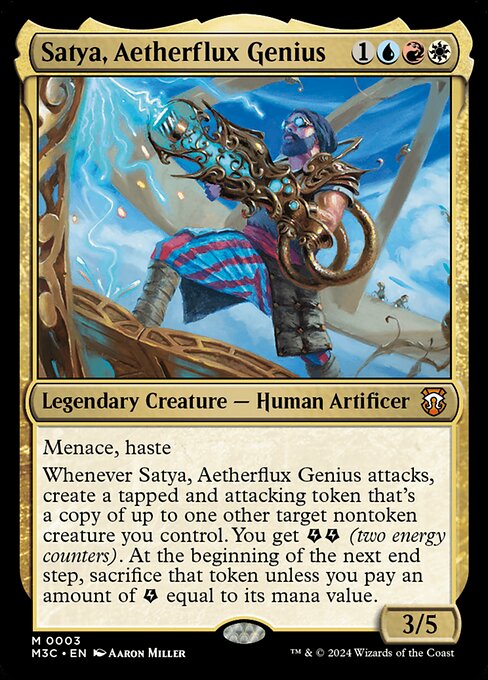
Satya, Aetherflux Genius
Copy and combat plan
Balances temporary copy value with a one time next end step payment.
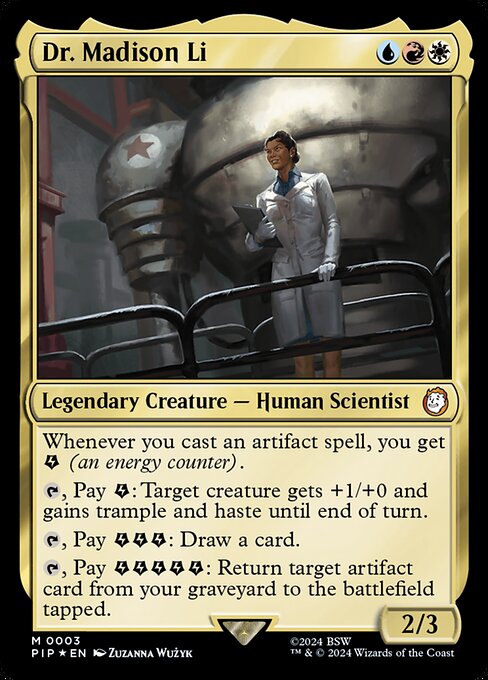
Dr. Madison Li
Artifact cast engine
Tap modes compete for the same body and different amounts of stored energy.
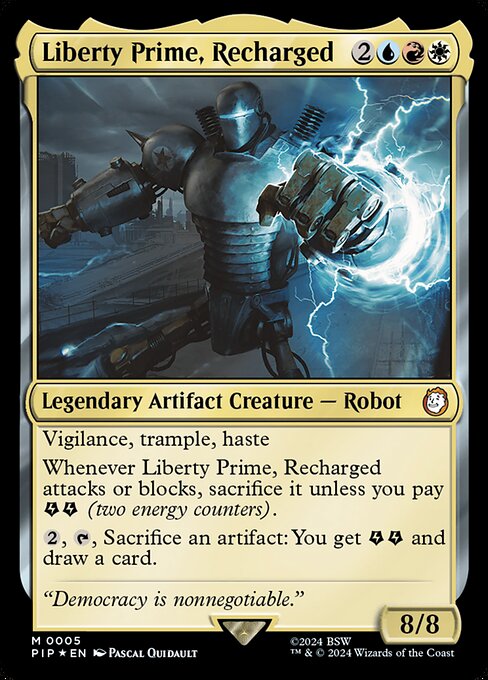
Liberty Prime, Recharged
Combat spender
Attacks and blocks create payment decisions even with haste and vigilance.
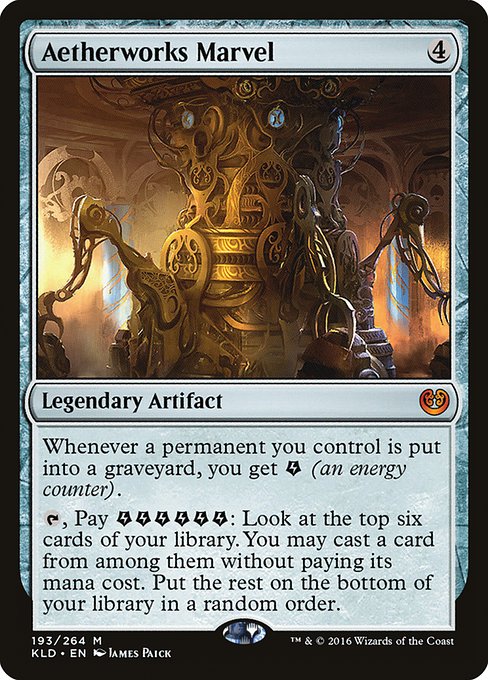
Aetherworks Marvel
Large activation payoff
Needs both six energy and a library containing worthwhile legal spell hits.
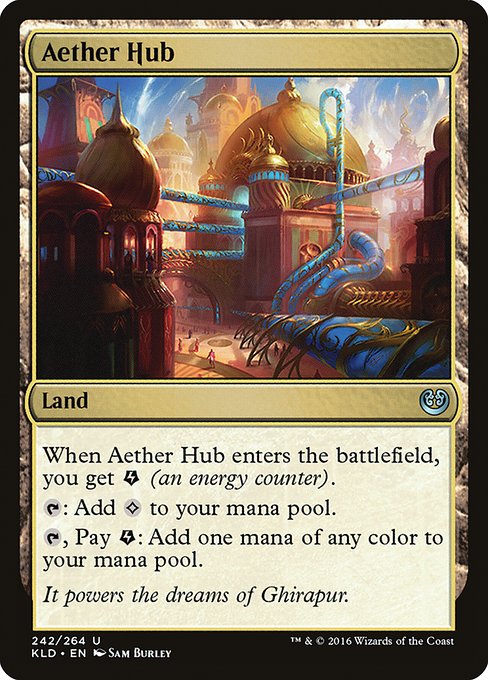
Aether Hub
Mana conversion
Its initial energy is finite; colored activations draw from the player supply.
Proliferate, counter risks, and ordinary interaction
If you already have energy, proliferate can add one more when you choose yourself. It does not double the supply and cannot give you your first energy counter when you have none. If you also have poison or another player counter type, choosing yourself adds another of every existing kind. You cannot select only energy while ignoring the harmful poison counter in that same action.
That makes proliferation a useful supplement rather than an automatic solution for every energy deck. Adding one can enable a payment you are just short of making. A card dedicated to adding one may be less efficient when the deck repeatedly needs five or six. Compare it with producers whose normal actions already give energy while developing mana, cards, or a board.
Opponents can answer the producers and spenders through ordinary interaction. Removing a spender does not erase stored energy, but it can leave the supply unable to influence the game. Countering a targeted ability may stop the immediate payoff without refunding an activation cost. Removing a source before a future trigger occurs is different from removing it after an ability is already on the stack.
Use the interaction checker to identify which answers you can protect the central engine against. The deck building checklist helps keep the energy package connected to draw and mana. A list full of energy text can still fail if half the cards only produce counters and the other half require an engine you rarely find.
Test the supply, the spender, and the recovery turn
A useful energy test records the starting supply, every gain, every payment, and the ending supply for a real turn. Include mana costs and tap costs alongside the counters. A plan with enough energy but no untapped commander is not ready. A plan with an untapped commander but no artifact to sacrifice may also fail. These are distinct missing inputs.
Rehearse a turn where Satya's target is removed, a turn where you deliberately sacrifice the temporary token, and a turn after your main spender is destroyed. Note which cards remain useful. Cheap producers that draw or develop the board can help recovery, while narrow cards waiting for an expensive spender may do little. Do not judge the list solely by its most dramatic successful activation.
Keep an honest primary plan: creature copies, artifact value, a commander attack, or a large activation engine. Secondary spenders are useful when they convert otherwise idle energy without demanding an unrelated package. If every new card asks for different support, the deck may be collecting mechanics rather than executing a sequence. Replace the part that repeatedly lacks an input instead of adding another payoff.
Build your deck and create a free account to save the version with that sequence mapped. Record why you spent or saved the last few energy counters in actual games. Those choices reveal whether the next upgrade should improve production, mana, card flow, or the quality of the spender rather than merely increase the number of cards mentioning energy.
Energy counter questions
Build your deck
Put these choices into a Commander list. Create a free account to save your deck and keep tuning it with Deckcipher.
FAQ
Does energy disappear at the end of a turn?
No. It stays on the player until spent or changed by an applicable effect. Energy is not mana and does not empty between steps or phases. Removing a producer does not erase the energy already in the player's supply.
Can ordinary mana pay an energy cost?
Not without a specific card or effect providing the relevant conversion or permission. An energy symbol means removing an energy counter from yourself. Aether Hub can turn energy into colored mana through its own ability, but that does not create a general exchange rule.
Are Satya token copies always zero mana value?
No. A token copy normally copies the relevant mana cost and can have the original's mana value. Check the actual copied characteristics. The delayed payment uses the token's mana value, so budgeting zero for every copy can make the end step plan fail.
Do I pay Satya every end step forever?
The delayed instruction is for the next end step associated with that created token. Paying the required energy for that instruction keeps it without adding a recurring payment every future turn. Later copies create their own delayed instructions and require their own decisions.
Can proliferate add energy?
Yes, if you already have energy and choose yourself. It adds one ordinary energy counter, not a doubled total. If you also have poison or other player counter types, those existing kinds increase too. You cannot choose only the helpful type on the same recipient.
Does returning an artifact trigger Dr. Madison Li?
Her energy trigger cares about casting an artifact spell. Returning an artifact directly to the battlefield is not casting it. An artifact spell cast normally can create the trigger even if that spell is later countered, because the cast event has already happened.