
Most Commander decks want 8 to 12 true ramp cards
A practical commander ramp count calculator starts at 10 ramp cards, then adjusts for commander mana value, average mana value, key turn, color needs, synergy, and late-game usefulness. Low-curve decks can run 6 to 8, typical midrange decks want 9 to 11, and expensive battlecruiser or landfall decks often need 12 to 16.
The ramp count calculator worksheet
Use ten ramp slots as a first-draft budget, then ask which actual turn those cards enable. This guide's worksheet is a planning aid, not a measured formula built into the Commander Deck Building Checklist. An expensive commander, a high curve, or a mana-hungry engine may justify testing an extra slot. A low-curve plan may justify testing fewer. Do not blindly add and subtract for every label: one deck can satisfy several overlapping descriptions, and the quality of its acceleration still matters more than the arithmetic.
For an illustrative comparison, a four-mana two-color commander with a moderate curve can begin with ten ramp slots. Check whether enough of them cost one or two mana and make the colors needed for a turn-three commander. A three-mana combat commander may instead test seven or eight accelerants if cheap creatures and interaction are more important. These are proposed configurations to compare, not numerical outputs from a simulated deck or a universal rule for those commanders.
Commander ramp count by deck shape
| Deck shape | Recommended ramp count | Why this range works |
|---|---|---|
| Low-curve aggressive or tempo | 6 to 8 | You need pressure and interaction more than extra mana. |
| Typical midrange value | 9 to 11 | You want a consistent early accelerator without flooding on setup. |
| Five-color or color-hungry value | 10 to 13 | Ramp must also fix colors. |
| Expensive commander | 11 to 14 | You need to cast and recast the commander. |
| Big mana, landfall, or battlecruiser | 13 to 16 | Extra mana is part of the main plan. |
| High-power combo | 8 to 12 | Ramp quality, speed, and exact colors matter more than raw count. |
What counts as ramp in Commander
For this calculator, ramp means a card that increases access to mana beyond your normal one land per turn. Arcane Signet, Nature's Lore, Birds of Paradise, and repeatable treasure makers qualify. A tapped dual land, a cantrip, or a cost reducer for one small card type usually does not.
Ramp also has timing. A two-mana rock can move a four-mana commander to turn three. A three-mana spell like Cultivate helps later land drops and colors, but it usually does not accelerate that key turn. Track total ramp and early ramp separately.
Common ramp cards and what they teach

Sol Ring
Explosive artifact ramp
A familiar one-mana accelerator that taps for two colorless mana. It does not fix colors, so check whether generic costs actually use that mana.

Arcane Signet
Color-fixing rock
A baseline two-mana ramp card for many multicolor decks because it accelerates and fixes commander colors.

Fellwar Stone
Flexible two-mana rock
Usually fixes at least one useful color in multiplayer and helps decks that want multiple two-mana accelerants.

Cultivate
Land-based ramp and setup
Better for land drops and color stability than raw speed, and strongest when landfall or high land counts matter.

Nature's Lore
Efficient land ramp
A two-mana spell that can find certain dual lands with basic land types, making it strong in green multicolor decks.

Birds of Paradise
One-mana creature ramp
Excellent for jumping from one to three mana, but more vulnerable to removal than land or artifact ramp.

Sakura-Tribe Elder
Creature-based land ramp
Bridges creature synergies and land ramp, and can block before turning into a basic land.
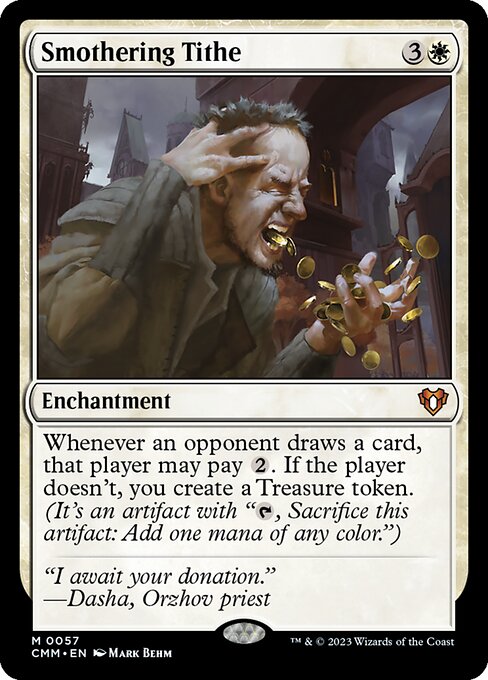
Smothering Tithe
Scaling treasure engine
Not early ramp like a two-mana rock, but it can create large mana advantages in longer multiplayer games.
Start with your curve, not a universal number
A deck with twenty cards that cost five or more needs a different ramp package than a deck whose best plays cost two and three. Identify the first turn where your deck must do something important. If a four-mana commander drives the list, prioritize one and two-mana ramp that enables turn-three commander. If the deck wants seven-mana spells on turn five or six, three-mana land ramp becomes more acceptable.
Check the curve before changing the ramp count
Upload or build your list, inspect where your mana values cluster, and save revisions to your Deckcipher account as you tune the deck. Create a free account to save your deck and return to these choices.
Worked example: four-mana two-color value commander
Example profile: a green-white Trostani, Selesnya's Voice style value deck with 37 lands, a four-mana commander, average mana value around 3.1, token payoffs, and a plan that improves when the commander enters on turn three. Worksheet reasoning: start at 10. No expensive-commander modifier, no high-average-MV modifier, no seven-mana modifier, and no late-draw penalty if the list has token mana sinks. Proposed first draft: ten ramp cards.
Sample package: Sol Ring, Arcane Signet, Selesnya Signet, Talisman of Unity, Nature's Lore, Three Visits, Rampant Growth, Sakura-Tribe Elder, Cultivate, and Smothering Tithe. Check the colors as well as the total: Trostani costs {G}{G}{W}{W}, so three lands plus Sol Ring alone cannot cast her on turn three. A legal example is Forest on turn one, Plains and Arcane Signet on turn two, then another Plains on turn three; Forest and Signet provide two green, while the Plains provide two white. Selesnya Signet also needs a mana input when you activate it, so account for that conversion instead of treating it as a free colored source. If that sequence is rare, replace slower ramp with another one or two-mana accelerator.
- If turn-three commander access matters most, cut Cultivate for Birds of Paradise.
- If artifact wipes are common, trade a signet for Farseek, Rampant Growth, or Sakura-Tribe Elder.
- If colors are the problem, improve dual lands and searchable Forests before adding an eleventh ramp card.
Worked example: low-curve Naya combat commander
Example profile: a Jetmir, Nexus of Revels Naya tokens deck with 36 lands, a four-mana commander, a hypothetical nonland average mana value around 2.5, cheap creatures, and protection. A low curve and the need to draw creatures instead of generic setup suggest testing fewer than ten ramp slots. A conditional Treasure engine can overlap with attacking, so the proposed package uses nine accelerants with different jobs. That is a construction choice to test, not an equation where crossing a precise average-mana-value threshold automatically earns a cut.
Sample Naya package: Sol Ring, Arcane Signet, Birds of Paradise, Llanowar Elves, Elvish Mystic, Nature's Lore, Farseek, Professional Face-Breaker, and Delighted Halfling. Ideal first three turns: one-drop creature or dork, more bodies plus two-mana ramp, then Jetmir setup with protection or a token payoff. Professional Face-Breaker can make a Treasure for each opponent one or more of your creatures deal combat damage to. It costs three mana and requires a successful hit, so treat it as conditional later acceleration rather than an opening-hand substitute for a one-mana creature.
Worked example: three-color non-green treasures and rocks
Example profile: an Esper artifacts or Grixis spells deck with a four-mana commander, 36 to 37 lands, average mana value 3.0, no green land ramp, and several colored pips. Worksheet reasoning: start at 10. No commander adjustment, no high-curve adjustment, no big-mana adjustment. Add 1 if the deck needs three colors by turn three. Subtract 1 if late two-mana rocks are poor without draw. Final target: 10, but the mix matters more than the total.
Sample package: Sol Ring, Arcane Signet, Fellwar Stone, the relevant talismans, the relevant signets, Wayfarer's Bauble, and Curse of Opulence in red shells. Count sacrifice-and-draw cards such as Dockside Chef in card flow, not ramp; sacrificing a Treasure to draw a card does not generate mana. Ideal first three turns: land, two-mana rock, then commander or interaction plus another cheap setup piece. In non-green decks, avoid colorless rocks that do not cast your commander unless the deck has many colorless costs.
Worked example: six-mana landfall commander
Example profile: an Aesi, Tyrant of Gyre Strait landfall deck with 38 to 40 lands, a six-mana commander, a hypothetical nonland average mana value around 3.6, landfall payoffs, and expensive finishers. Here, ramp has several useful jobs: getting to Aesi, supplying later landfall triggers, and supporting larger plays after drawing extra cards. Fourteen ramp slots are a reasonable proposed first draft for this particular example. The recommendation comes from those jobs and the chosen spell package, rather than an unsupported rule that a specific average mana value adds exactly one card.
Sample package: Sol Ring, Arcane Signet, Nature's Lore, Three Visits, Farseek, Rampant Growth, Sakura-Tribe Elder, Harrow, Cultivate, Kodama's Reach, Skyshroud Claim, Migration Path, Sword of the Animist, and Lotus Cobra. Ideal first three turns: two-mana land ramp, another land accelerator, then four or five mana with landfall online. For Omnath, Locus of Rage, which costs seven, use the same shell but treat the commander as a seven-mana payoff and stay near 14 to 16 ramp.
High ramp counts only work if the deck has mana sinks, draw, and payoff density. If your big-mana deck has 14 ramp cards but only a few threats, the fix may be 12 ramp plus two draw or payoff cards, not more setup.
Ramp quality matters more than ramp quantity
Two decks can both run 10 ramp cards and behave differently. One and two-mana acceleration creates early action. Three and four-mana ramp creates slower but more stable development. Land ramp survives most artifact removal, artifact ramp works in more colors, and creature ramp is fastest but vulnerable to sweepers.
Ramp type comparison
| Ramp type | Best fit | Tradeoff |
|---|---|---|
| One-mana creature ramp | Green decks that need speed or creature count | Vulnerable to removal and sweepers |
| Two-mana mana rocks | Multicolor and non-green decks | Can be hit by artifact removal |
| Two-mana land ramp | Green decks that value stable colors | Often uses tapped lands or requires searchable land types |
| Three-mana land ramp | Slower midrange and landfall shells | May not accelerate a four-mana commander |
| Treasure engines | Decks using artifacts, sacrifice, or burst turns | Often inconsistent as early ramp |
Balancing ramp and card draw
Ramp lets you deploy cards faster. Card draw makes sure you have cards to deploy. Many midrange Commander decks are comfortable near 9 to 11 ramp cards and 9 to 12 card advantage pieces. If you add ramp without draw or payoff density, you may empty your hand and topdeck setup. If you add draw without ramp, you may sit with a full hand and no time to use it.
Color identity changes the calculator
Green decks can choose between land ramp, mana creatures, and synergy pieces. Non-green decks rely more on artifacts and treasures. Multicolor decks must care about fixing as much as acceleration: a ramp card that makes the wrong color may not cast the commander or the interaction spell that keeps you alive. In five-color decks, improving lands and color-producing ramp is often better than simply adding another generic rock.
High-power combo ramp is a different calculation
High-power combo decks should not copy a casual package full of three-mana ramp. Their acceleration is judged by speed, color reliability, and combo-turn usefulness. Under the current Commander rules environment, Mana Crypt and Jeweled Lotus are banned, so they should be treated only as historical examples, not recommendations. Legal options include Chrome Mox, Mox Diamond, Lotus Petal, Mox Amber when enabled, one-mana dorks, rituals, and two-mana rocks that make the exact colors needed.
For these decks, 8 to 12 ramp pieces can be a useful range, but count is secondary. Ask whether the ramp supports turn-one and turn-two development, casts tutors or interaction, and remains useful during the combo turn.
Land count and ramp count are separate decisions
Starting with 37 lands and 10 ramp cards is a reasonable casual baseline, but lands and ramp are different knobs. If you miss your third land drop often, adding more ramp may not help because many ramp cards require lands to cast. If you flood with 40 lands and 12 ramp, cutting lands may be correct even if the ramp count is right. Decide whether you are fixing opening-hand stability, early acceleration, color access, or late-game mana use.
How to avoid overcommitting to ramp
Overcommitting to ramp usually looks like hands with mana but no payoff, topdecks that do not affect the board, or early turns spent developing while opponents advance threats. Sometimes the answer is cutting ramp. Sometimes the answer is changing the mix: cheaper ramp for timing problems, color-fixing ramp for casting problems, land ramp for resilience, or mana sinks for late-game flood.
- Quantity problem: you consistently draw three or more ramp cards and too little action.
- Timing problem: your ramp costs too much to affect the turn that matters.
- Color problem: your ramp increases mana but does not cast your key spells.
- Payoff problem: you make extra mana but have no strong way to spend it.
- Resilience problem: one sweeper destroys both your board and your mana.
A practical ramp audit you can run in ten minutes
Tag every card that truly accelerates mana. Sort those cards by mana value. Count how many can be cast before your commander or first important play. Then mark which ones fix colors, which ones are good late, and which ones are included mainly because they are familiar. If the deck has a four-mana commander and only three ramp cards that cost two or less, a total count of 10 is misleading. If the deck has 14 ramp and six payoff cards, it is probably overbuilt for setup.
Ramp audit questions and fixes
| Question | If yes | Likely fix |
|---|---|---|
| Do you keep hands with ramp but no payoff? | Setup density is too high. | Cut 1 to 2 ramp cards for draw, threats, or tutors. |
| Does ramp fail to cast your commander on time? | Your ramp is too slow or off-color. | Prioritize one and two-mana ramp that makes the right colors. |
| Are late ramp draws bad? | The deck lacks mana sinks or utility ramp. | Lower the count or add repeatable ways to spend excess mana. |
| Do sweepers destroy your mana? | You rely heavily on creature ramp. | Add land or artifact ramp if your colors allow it. |
| Do you miss land drops while holding ramp? | You may need more lands. | Check land count before adding accelerants. |
Concrete next steps
If you are building from scratch, begin with 37 lands and 10 ramp cards for a normal casual Commander deck, then adjust. Move to 8 if the deck is low to the ground and can operate on three or four mana. Move to 12 or more if the commander is expensive, the average mana value is high, or extra mana directly triggers your plan. Then test opening hands and check whether the package creates real sequences, not just a good-looking number.
Final checklist: count current ramp, count how much costs one or two mana, count how much fixes commander colors, count how much is still live after turn six, and check whether you have enough draw or mana sinks to spend the extra mana. Add ramp if you miss key turns, cut ramp if you draw setup without action, or replace ramp if the count is right but the timing or colors are wrong.
Build, save, and tune your Commander list
Use the Deckcipher deck builder to enter your ramp package, adjust your curve, and save the deck to your account so you can revisit each version after games.
FAQ
What is the recommended number of ramp cards in a Commander deck?
Use 10 as the default calculator number. Go to 6 to 8 for low-curve aggressive decks, 9 to 11 for normal midrange, 10 to 13 for color-hungry decks, and 12 to 16 for expensive commanders, landfall, and big-mana strategies.
What if my commander is expensive but my average mana value is low?
Prioritize early commander access, not a generic high-ramp label. A six-mana commander with a 2.5 average mana value may want 11 to 13 mostly cheap ramp pieces instead of 15 clunky ramp spells.
Should I add ramp if my colors have weak card draw?
Not automatically. Weak draw makes late ramp worse because you may run out of cards. Add draw, utility ramp, or mana sinks first unless the deck is specifically missing early mana.
Should three-mana ramp count the same as two-mana ramp?
It counts as ramp, but it does not do the same job. Two-mana ramp can move a four-mana commander to turn three. Three-mana ramp usually helps you reach five or six mana later. Track total ramp and early ramp separately.
How many ramp cards should a five-color Commander deck play?
Many five-color decks want 10 to 13 ramp cards, but fixing matters as much as quantity. If your ramp makes the wrong colors, replace it with color-fixing ramp or improve the mana base instead of only increasing the count.
When should I cut Cultivate for Nature's Lore?
Cut Cultivate for Nature's Lore when your deck needs a four-mana commander or key four-drop on turn three. Keep Cultivate when land drops, color stability, and landfall triggers matter more than immediate speed.
Can a Commander deck run no ramp?
It can, but it should be intentional. A very low-curve deck with many cheap spells and strong card selection may trim ramp heavily, but most Commander decks still want some acceleration because multiplayer games reward using more mana over time.