
Bracket 3 is upgraded casual. Bracket 4 is optimized high power.
Commander bracket 3 vs bracket 4 what actually changes is not a single turn-number rule. The practical shift is official Game Changer allowance, plus the table expectation for efficient tutors, legal fast mana, compact combos, cheap protection, and repeated early pressure.
At a glance: official signals and table heuristics
The official boundary: Game Changer limits first
Under the current Commander Brackets beta framework, Bracket 3 is “upgraded” Commander and Bracket 4 is “optimized” Commander. The clearest construction line is the Game Changer count: Bracket 3 decks may include up to 3 cards on the current official Game Changer list, while Bracket 4 decks may include up to 10. If that list changes, use the official Wizards source linked above rather than old article examples.
That count is only the starting point. Bracket 3 should still feel like strong casual: visible setup, varied games, and real response windows. Bracket 4 is the honest label when Game Changers, efficient tutors, legal fast mana, protection, and compact win lines are part of the main plan. Banned Commander cards such as Mana Crypt, Dockside Extortionist, and Jeweled Lotus are not upgrade options for legal Commander decks.
For examples, name cards only after checking the current list. At the time you build, cards such as Rhystic Study, The One Ring, Fierce Guardianship, Demonic Tutor, Vampiric Tutor, or Ancient Tomb may be bracket-relevant if currently listed as Game Changers. The safe pregame habit is simple: disclose the exact count and the cards.
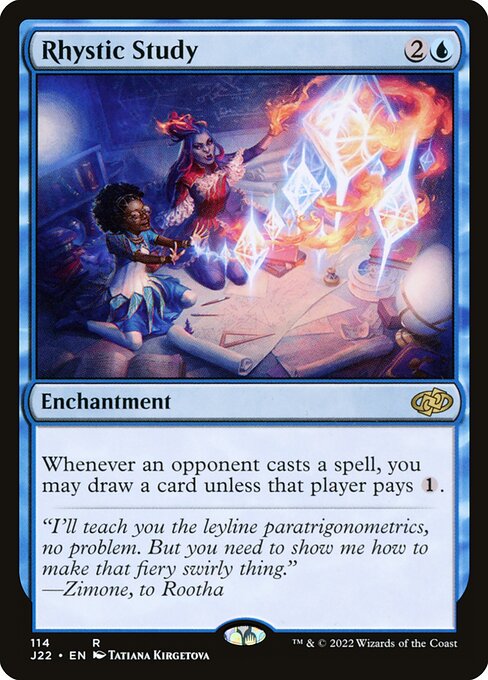
Rhystic Study
Game Changer pressure example
Rhystic Study is a useful disclosure example because it changes table behavior early. In Bracket 3 it may be one of a few premium engines; in Bracket 4 it is often backed by faster mana, tutors, and cheap protection.
What actually changes from bracket 3 to bracket 4?
Bracket 3 is where many tuned precons and upgraded casual decks land. They have coherent plans, good ramp, real removal, and credible win conditions, but they still leave room for theme, splashy cards, combat steps, and games that develop differently.
Bracket 4 removes much of that slack. Cards are chosen because they accelerate, find, protect, disrupt, or win. It is not automatically cEDH, but it is optimized high power: lower curve, more redundancy, fewer pet cards, and more pressure before opponents look stable.
Bracket 3 vs Bracket 4 comparison
| Category | Bracket 3 pattern | Bracket 4 pattern | What it means in game |
|---|---|---|---|
| Game Changers | Up to 3 under current beta guidance | Up to 10 under current beta guidance | Count them and disclose the exact cards |
| Fast mana | Sol Ring, Arcane Signet, signets, talismans, land ramp | Legal acceleration such as Chrome Mox, Mox Diamond, Lotus Petal, Ancient Tomb, Grim Monolith if current and pod-accepted | Explosive starts happen more often |
| Tutors | A few slower, themed, or fair tutors | Efficient tutors aimed at engines, combos, or protection | Games become more repeatable |
| Combos | Possible, often slower or board-dependent | Compact lines such as Thassa’s Oracle plus Consultation, Breach lines, or Scepter/Reversal shells | Opponents must identify what to stop |
| Interaction | Removal and wipes for visible threats | Cheap removal, stack interaction, and free protection where legal | The stack matters earlier |
| Finishers | Combat, value engines, big spells, slower combos | Deterministic wins or protected attempts | One unchecked window can end the game |
| Table fit | Strong casual pods | High-power pods, not necessarily cEDH | Pregame detail matters more than the label |
Consistency is the real upgrade
A Bracket 3 deck may have an occasional explosive game. A Bracket 4 deck is built so strong starts happen repeatedly. The difference is redundancy: more cheap ramp, more card selection, more efficient tutors, and fewer slow cards that do not advance the main plan.
A useful disclosure is, “This list can realistically threaten a win around turn five if unopposed,” but that is not a bracket law. A deck can be Bracket 4 because of card quality and consistency even if its normal win is later, and a Bracket 3 deck can occasionally spike an early win without becoming optimized high power.
Goldfish ten hands and record the first turn you create a must-answer engine, assemble a deterministic line, or hold pressure plus protection. If the Commander Goldfish Simulator shows repeated turn-three engine starts with interaction available, that profile looks Bracket 4 even before you count wins.
Tutors and redundancy change how fair the deck feels
Tutors are not automatically disqualifying for Bracket 3. A tribal deck using Shared Summons for two creatures or an enchantress deck using Idyllic Tutor for a value engine can still feel like tuned casual. The issue is efficiency plus purpose.
Bracket 4 tutor packages tend to find the same high-leverage cards: a missing combo piece, a protected engine, a hate piece, or the protection needed to force a win. When multiple tutors collapse into the same deterministic line, opponents experience inevitability rather than variety.
- Probably Bracket 3: Diabolic Tutor, Solve the Equation, Fabricate, or tribal tutors used mainly for value and theme.
- Probably Bracket 4: Demonic Tutor, Vampiric Tutor, Mystical Tutor, Enlightened Tutor, Gamble, or Imperial Seal aimed at compact wins.
- Bracket 3 disclosure: “I have two tutors, mostly for engines or answers.”
- Bracket 4 disclosure: “I have several efficient tutors that can find combo pieces or protection.”
- Decision rule: describe what the tutors find, not just how many you run.
Combos do not automatically mean bracket 4
A Bracket 3 combo usually gives the table visible checkpoints. Kiki-Jiki, Mirror Breaker plus Zealous Conscripts is powerful, but if it costs five mana, needs a creature to survive, and appears without heavy tutoring, many pods can discuss it as tuned casual. A value deck that sometimes loops Reveillark and Karmic Guide after a long board game is a different experience from a deck built to win from two cards and one open mana.
Bracket 4 starts when the combo is compact, searchable, resilient, and protected. Thassa’s Oracle plus Demonic Consultation or Tainted Pact, Underworld Breach plus Lion’s Eye Diamond plus Brain Freeze, or Isochron Scepter plus Dramatic Reversal are warning lights in optimized shells. Add Silence, Pact of Negation, Fierce Guardianship, Deflecting Swat, or Veil of Summer and the table needs stack-speed answers.
Interaction expectations rise sharply in bracket 4
Bracket 3 tables can often answer what is on board. Beast Within, Generous Gift, Chaos Warp, Feed the Swarm, board wipes, and graveyard hate are all important. The game usually develops enough that players can see who is ahead and choose answers politically.
Bracket 4 asks for earlier and cheaper answers. Swords to Plowshares, Nature’s Claim, Swan Song, Flusterstorm, Spell Pierce, Force of Negation, Fierce Guardianship, and Deflecting Swat change the texture of the game. A four-mana answer may still be playable, but it may not stop a protected Breach turn or Oracle attempt.
The Commander Interaction Checker is most useful when you look at timing, not just count. Eleven answers with only two cheap pieces may be fine in Bracket 3; twelve answers with six cheap pieces, graveyard hate, and stack interaction is a Bracket 4 profile.
How much interaction should you expect?
| Deck posture | Bracket 3 target | Bracket 4 target | Common mistake |
|---|---|---|---|
| Creature-heavy fair deck | Flexible removal and a few wipes | Cheap removal plus protection for key attacks | Only answering creatures |
| Combo deck | Some answers or protection | Cheap interaction, discard, counters, or Silence effects | Assuming speed replaces interaction |
| Control deck | Broad answers and card advantage | Efficient answers across stack, graveyard, and permanents | Playing too many expensive sweepers |
| Graveyard deck | Recursion with some hate awareness | Ways to beat Rest in Peace, Dauthi Voidwalker, and Bojuka Bog | Folding to one hate piece |
| Stax or denial deck | Light tax pieces with a win plan | Purposeful lock pieces and protected engines | Creating a hard lock without disclosing it |
Mana curve and ramp make bracket 4 less forgiving
The ramp package is another concrete divider. Bracket 3 commonly uses Sol Ring, Arcane Signet, talismans, signets, Cultivate, Kodama’s Reach, Nature’s Lore, and Three Visits. Bracket 4 may add legal acceleration such as Chrome Mox, Mox Diamond, Lotus Petal, Ancient Tomb, Mana Vault, or Grim Monolith depending on color, budget, current Game Changer status, and pod expectations.
Do not use banned Commander cards as upgrade targets. Mana Crypt, Dockside Extortionist, and Jeweled Lotus are banned in legal Commander and should only be mentioned as banned examples, not as Bracket 4 staples. Legal fast mana can still push a deck upward, especially when paired with efficient tutors and compact wins.
If you are unsure, compare curve and opening hands in the Commander Mana Curve Calculator, then goldfish. A low curve alone is not Bracket 4; a low curve plus fast mana, Game Changers, tutors, and compact wins usually is.
Audit bracket, interaction, and speed together
Power level is not one number. Check Game Changers, interaction timing, tutor density, and goldfish pressure before you label a deck for a pod.
Example: the same commander in Bracket 3 and Bracket 4
Take Muldrotha, the Gravetide. A representative Bracket 3 package might include Sakura-Tribe Elder, Satyr Wayfinder, Mulldrifter, Baleful Strix, Seal of Primordium, Pernicious Deed, Ashiok, Dream Render, Ramunap Excavator, Living Death, and a big value finisher. The deck is strong, but it usually wins after building a graveyard engine and giving opponents chances to attack Muldrotha or the yard.
A Bracket 4 Muldrotha package looks different: Demonic Tutor, Vampiric Tutor, Entomb, Intuition, Chrome Mox, Mox Diamond, Ancient Tomb, Lion’s Eye Diamond, Underworld Breach, Thassa’s Oracle, Force of Will, Swan Song, and Veil of Summer. What changed is not just card price; the deck now finds specific lines, starts faster, and protects the attempt.
Copyable disclosure: “This is Bracket 4 Muldrotha, not cEDH. It has seven current Game Changers, legal fast mana, efficient tutors, an Oracle line, a Breach line, and several cheap counters. If that is too much, I have a Bracket 3 graveyard-value version.”
Another archetype: enchantress can be bracket 4 too
Bracket 4 is not only graveyard combo. A Sythis, Harvest’s Hand enchantress deck can be Bracket 3 with Wild Growth, Utopia Sprawl, Enchantress’s Presence, Sterling Grove, Sphere of Safety, Sigil of the Empty Throne, and combat or token finishes. It becomes Bracket 4 when it adds a high Game Changer count, efficient tutors, fast mana, protected lock pieces, and compact deterministic lines instead of slower enchantment value.
The pregame description should match the experience: “Sythis enchantress, Bracket 3, no fast combo, mostly value and pillow fort” is very different from “Sythis, Bracket 4, multiple Game Changers, tutors for lock pieces, and can assemble a deterministic win.”
How to move a bracket 3 deck toward bracket 4
Upgrade purposefully and legally. Replace slow broad tutors with efficient ones only if your target bracket and pod accept that shift: Diabolic Tutor to Demonic Tutor, Increasing Ambition to Vampiric Tutor, or Fabricate to Enlightened Tutor when it finds the real engine. Replace clunky ramp with legal, bracket-appropriate acceleration such as better two-mana rocks, Ancient Tomb, Chrome Mox, or Mox Diamond, while checking current Game Changer status.
Then tighten the win. A spellslinger deck might move from big X-spells to Underworld Breach lines. A creature deck might add Finale of Devastation plus a compact combo package. A blue deck might add more one-mana counters and free protection. Adding Game Changers, fast mana, and efficient tutors may move the deck out of Bracket 3 even if only ten cards changed.
Finally, test mulligans honestly. Bracket 4 pilots often ship playable hands that lack acceleration, interaction, or a line. If a hand has lands but no pressure before turn four, it may be too slow for the room.
How to power a bracket 4 deck down to bracket 3
Powering down should create more response windows, not make the deck dysfunctional. Start with the official Bracket 3 Game Changer ceiling, then cut the cards that compress games most reliably. Swap efficient universal tutors for slower thematic tutors. Replace legal fast mana and zero-mana accelerants with signets, talismans, land ramp, or utility lands. Cut free protection before cutting all removal.
Next, soften deterministic wins. Replace Oracle plus Consultation with a graveyard value finisher, replace loop-heavy treasure plans with synergy that needs combat or a turn cycle, or replace extra-turn chains with one splashy extra-turn spell if your pod is comfortable with it. The goal is a deck that still works but stops forcing perfect immediate answers.
- Check legality first; banned cards are not legal power-down or power-up options.
- Keep Bracket 3 at the current official Game Changer limit.
- Reduce efficient tutors before cutting lands or core synergy.
- Replace compact deterministic combos with engines that need board presence or another turn.
- Keep responsible interaction, but reduce free protection that makes wins inevitable.
- Disclose the powered-down list honestly if it can still produce Bracket 4 starts.
Borderline checklist
If you are stuck between Bracket 3 and Bracket 4, use this practical checklist before the pod forms. One “yes” may not decide the bracket, but several together usually mean you should present the deck as Bracket 4.
- Game Changers: more than 3 means it is above current Bracket 3 guidance.
- Tutor purpose: efficient tutors usually find combo pieces, fast engines, or protection.
- Fast mana: multiple legal fast-mana pieces create repeated early pressure.
- Compact combos: one- or two-card lines win without needing a large board.
- Cheap interaction: six or more one- or two-mana answers/protection pieces is a high-power signal.
- Goldfish timing: the deck often creates a must-answer engine or protected line by turns three to five.
Bracket 4 is not the same as Bracket 5 or cEDH
Bracket 4 is optimized high power, but it is not automatically Bracket 5 or cEDH. Bracket 5/cEDH implies maximum-efficiency deckbuilding, competitive metagame assumptions, and very few casual concessions. Bracket 4 can still include pet commanders, budget limits, or table-specific choices as long as everyone understands the deck is punishing.
If you are torn between Bracket 3 and Bracket 4, choose the label that prevents the worst game. “Probably Bracket 4, not cEDH, seven Game Changers and one compact combo” is more useful than “high Bracket 3” when opponents brought upgraded precons.
FAQ
What is the official Game Changer difference between Bracket 3 and Bracket 4?
Under the current beta guidance, Bracket 3 allows up to 3 Game Changers and Bracket 4 allows up to 10. Always verify the current official list and limits before submitting a deck or sitting down for a pod.
Is every combo deck bracket 4?
No. A combo deck can be Bracket 3 if the combo is slower, less consistent, lightly tutored, and gives opponents clear chances to interact. It becomes Bracket 4 when the deck is built to find, protect, and execute the combo quickly and repeatedly.
Do Game Changers automatically make a deck bracket 4?
Not always by themselves, as long as the deck stays within the official limit for its bracket. Context still matters, but exceeding the Bracket 3 Game Changer allowance is a clear reason to move up.
What turn should a bracket 4 deck threaten a win?
There is no official universal turn rule. Early win pressure is a useful table heuristic, but Bracket 4 is better identified by Game Changer count, optimization, tutor purpose, fast mana, compact combos, and interaction expectations.
Is bracket 4 the same as cEDH?
Not necessarily. Bracket 4 can include optimized high-power Commander decks that are not tuned for a cEDH metagame. Bracket 5 or cEDH usually implies maximum efficiency and competitive assumptions.
How should I explain a borderline bracket 3 or bracket 4 deck?
Say how many Game Changers you run, name them, disclose legal fast mana, explain what your tutors find, identify compact combos, and mention cheap protection or stack interaction. That information matters more than the label alone.
What is the fastest way to check my deck's likely bracket?
Use the Deckcipher Bracket Calculator, then compare the result against Game Changer count, interaction timing, tutor density, and goldfish tests. If the deck repeatedly creates protected early pressure, introduce it as Bracket 4.