
Quick answer
A useful cEDH mana base casts the deck's actual early spells while preserving the colors needed for interaction and a win attempt. Build from timing and payment requirements, then add fetchable targets, flexible lands, and any utility lands the plan can support. A low land count or expensive land collection alone does not establish consistency.
Start with the spells that must be paid for together
A cEDH mana base is a sequence of payments rather than a pie chart. A deck may need green on turn one, blue and green for its commander, then additional blue while representing interaction. Another may need two blue plus black during the same win attempt. Those demands are different even if the lists contain similar total numbers of blue and green mana symbols.
Write down the first important actions and their deadlines. Include protection and answers, not only the commander and combo. If an engine costs two mana and the plan also needs one blue left available, the practical requirement is three usable mana with the appropriate colors. A source that can make several different colors provides flexibility, but it does not provide all of them simultaneously.
Command Tower illustrates the difference. It can make a color in the commander's color identity, so it can support several potential requirements in a multicolor deck. One activation still makes one mana. A source count may correctly mark Tower as a blue source and a black source, while the same two checks cannot assume that one Tower pays both requirements in a single action.
Begin with a coherent deck whose early goals are understood, then tune its land and nonland mana together. Copying the land total from a different commander can remove the resources your own sequence needs. The cEDH staples guide explains the different costs of common mana artifacts, which helps distinguish genuine substitutes from changes that shift the whole opening turn.
Separate the land total from the amount of usable mana
Lands provide recurring mana through ordinary land drops, while rocks, creatures, and temporary sources provide different kinds of acceleration. A low land count can work in a specific list supported by those effects and appropriate card access. It should be evaluated as part of that whole plan rather than treated as a defining feature of competitive Commander.
Consider how often an opening needs its second and third land. A commander that supplies cards can help access later sources after it arrives, but the hand still needs to reach that commander. A draw engine that costs three cannot repair every one land keep before it can be cast. If the engine is countered, the remaining hand needs another route to development.
Birds of Paradise is a recurring colored source once it can use its tap ability. It needs green to be cast and normally cannot tap immediately on the turn it enters without haste. Counting it as an unconditional turn one source of blue ignores those requirements. It can make the following turn excellent while doing nothing to fix the opening payment that would allow it to exist.
When reviewing hands, label what each source actually contributes by turn. A tapped land, a newly cast mana creature, and Lotus Petal all have different availability and persistence. Use the mana base calculator for source planning, then test the complete sequence manually. A numerical total is most useful when its assumptions match the rules and the deck's actual cards.
Fetchlands find land types rather than color names
Polluted Delta searches for an Island or Swamp card. It can find a basic Island, but it can also find Underground Sea or Watery Grave because those lands have the relevant basic land types. The search instruction does not require the word basic. Check the type line of every target instead of judging by the colors printed in its mana ability alone.
This is why an apparently off color fetchland can support a multicolor deck. Flooded Strand searches for a Plains or Island. In a blue, black, and red deck, it can find Watery Grave through Island or Steam Vents through Island. One target supplies access to blue or black; the other supplies blue or red. The fetchland's own color identity does not become white merely because its search text mentions Plains.
That flexibility still depends on legal targets actually present in the library. If the only matching dual has already been drawn, the fetchland cannot search it out of your hand. Two fetchlands can also compete for the same remaining target. Listing several lands as theoretical black sources can overstate a real hand if they all rely on a single black producing target no longer available.
Keep a target map with each fetchland and the lands it can find. Note which targets can enter untapped immediately and which require life or another condition. Fetching changes the library and uses a search ability that opponents may be able to interact with. Its fixing is valuable, but it is not the same event as a land simply tapping for any chosen color.
| Land | Useful access | Constraint to track |
|---|---|---|
| Polluted Delta | An Island or Swamp card from the library | Requires a legal target, one life, and sacrificing the fetchland |
| Watery Grave | Blue or black from one land | Untapped entry normally needs a two life payment |
| Mana Confluence | Any color | Each mana activation requires paying one life |
| City of Brass | Any color | Becoming tapped triggers damage, including tapping for another reason |
| Ancient Tomb | Two colorless mana | Does not satisfy blue, black, or other colored requirements |
| Gemstone Caverns | Possible opening acceleration when not starting | Pregame use needs the opening hand condition and an exiled card |
| Otawara, Soaring City | Blue mana or a channel answer | Using the channel ability spends the card instead of making its land drop |
Typed duals trade cost and life against target coverage
Underground Sea supplies blue or black and has Island and Swamp types. Watery Grave provides the same pair of mana options and types, with a choice to pay two life as it enters if you want it untapped. The basic rules function is similar, but the entry payment changes a sequence and the purchase cost can be very different. Neither land taps for two mana merely because it has two types.
A fetchland finding an untapped Watery Grave normally involves one life for the fetch activation plus two for the Grave's entry choice. That three life is a real cost even if forty starting life makes it manageable in a particular opening. Repeated payments can affect combat exposure and cards that use life as a resource. Do not assume the cost is irrelevant in every deck or game.
Original duals are not a prerequisite to understanding or practicing a coherent mana plan. An available shock land may fill the needed typed target role with a life tradeoff. A land that always enters tapped makes a different exchange: it may be inexpensive to acquire but delay an early action or leave interaction unavailable. Evaluate the turn you lose rather than classifying every two color land as the same fixing.
Budget constraints should be stated at the functional level. Which fetches still have targets, which colors can appear on turn one, and which hands become slower after the substitution? A practice method allowed by the group can test those differences before buying. Check an event's actual card and proxy requirements separately. A more expensive printing does not change the underlying mana ability.
Rainbow lands are flexible but have distinct conditions
Mana Confluence pays one life as part of its tap activation to make any color. City of Brass instead triggers one damage whenever it becomes tapped, including if it becomes tapped for a reason other than its mana ability. Life payment and damage are different rules events. A deck interacting with either should preserve that distinction rather than describing both lands as simply costing a life in every possible situation.
Tarnished Citadel can make colorless without its three damage instruction or use its colored mode to make any color and deal three damage to you. That larger colored payment can matter across several turns. Evaluate how often the deck can actually use its colorless mode before treating the land as an identical replacement for another rainbow source.
Exotic Orchard depends on colors a land an opponent controls could produce. It does not promise every color in your own commander's identity, and it does not use the opponent's nonland mana sources. A tapped opposing land can still be relevant to what it could produce, but a board lacking your needed color leaves the Orchard unable to supply that color. Test that uncertainty in opening hands.
Reflecting Pool depends on what your own lands could produce. It can extend a useful land's options, but an opening with only a Pool cannot assume another colored source will materialize. Several Pools do not create an independent first color merely by referring to one another. These conditional lands can be strong in supported states while still deserving separate labels from unconditional early fixing.
Utility lands need a specific reason to displace color
Ancient Tomb can provide two colorless at the cost of taking two damage from its mana ability. That can accelerate a generic cost substantially. It cannot pay two blue, or one blue and one black, by itself. A deck whose crucial early plays are mostly colored may find that a hand with Tomb has plenty of total mana and too little usable mana for the intended action.
Gemstone Caverns can begin on the battlefield with a luck counter if it is in your opening hand and you are not the starting player, with a card exiled from hand for that option. With the counter it can make any color; without it its ordinary ability makes colorless. Starting player status therefore changes its role. A list should not count every drawn Caverns as the same guaranteed rainbow accelerator.
Otawara, Soaring City offers an untapped blue land or a channel ability from hand that can return an eligible permanent to its owner's hand. Channel discards the card and costs mana, with generic reduction for legendary creatures you control. Using it that way means it is not also available to play as a land afterward. That flexibility is useful when one slot can support development or a relevant answer.
Add utility with a concrete goal, then revisit the colored source budget. Several individually useful colorless lands can collectively prevent the commander from arriving on time. If a game is lost with important colored spells stranded, another utility effect may not be the repair. The right question is what action the land improves and which payment becomes less reliable when it replaces a colored source.
Nonland mana changes keep decisions and vulnerability
Mox Diamond requires discarding a land card through its entry replacement choice to enter successfully. That gives recurring access to any color while spending a land from the hand. Counting Diamond as a full extra source without subtracting the discarded land from future land drops misreads the opening. Check whether the hand still develops after its initial burst.
Chrome Mox uses an eligible nonartifact, nonland card exiled through its entry trigger. Its output follows the colors of that card, so the apparent fixing depends on what can be given up. An opening may need the blue card both for imprint and for another purpose. The same card cannot remain in hand for protection after being exiled to make the Mox functional.
Lotus Petal supplies a single mana by tapping and sacrificing itself. That can complete a missing color on an important turn while leaving fewer recurring sources afterward. It should not support a keep on the assumption that it will make another mana next turn after being spent. Mana creatures likewise have timing and survival requirements that lands do not share.
Record those conditions beside the land count. A hand relying on two artifacts to function can be especially exposed to effects that stop artifact activations. A hand relying on creatures can be delayed by removal before the next turn. A competitive mana plan can accept those risks deliberately, but it should have a clear reward for accepting them instead of assuming every source printed in a deck list is equally persistent and available.
Test exact colored payments across two turns
Consider Polluted Delta and Steam Vents as the first two lands in a blue, black, and red list. Delta can find Watery Grave, and paying the normal fetch and untapped entry life costs can make its blue or black available immediately. On the next turn, Steam Vents can also enter untapped for its payment. The resulting pair can provide two blue, or blue and black, or black and red in one round of taps.
The pair cannot provide two black because Steam Vents has no black output. It also cannot provide two blue plus black all at once because there are only two one mana land activations. A Thassa's Oracle plus Demonic Consultation attempt needs those three colored mana before considering protection or cost changes. Lotus Petal could supply the third needed mana, but would be consumed in doing so.
Ancient Tomb as a third land increases total output but still cannot supply the missing third colored payment for that same pair of spells by itself. That example explains why total mana and source access must be checked separately. It is possible for a hand to show four total mana yet fail to pay three particular colored requirements at once.
For a green and blue example, casting Birds of Paradise on the first turn gives a potential source on the following turn, assuming it survives. If green and blue lands then cast Kinnan before Birds is tapped, Kinnan can increase the Bird's later mana output. Tapping Birds before Kinnan resolves receives no retroactive bonus. Sequencing the same sources in a different order can therefore change which response is available after the commander arrives.
Check duplicates, nonbasic exposure, and disruption
A deck using Tainted Pact to pass through the library needs to account for repeated card names. Basic lands can repeat legally in Commander, but duplicate names can stop Pact's process before the intended point. An ordinary Island and a Snow-Covered Island have different names, while two ordinary Islands do not. The combo requirement can therefore influence the land package independently of its color needs.
Blood Moon turns nonbasic lands into Mountains and can substantially change their abilities and types under the rules for that effect. A nonbasic land does not become basic merely because it becomes a Mountain. Fetching an appropriate basic before the effect resolves can preserve a needed color if the deck contains that target and the fetch ability can resolve in time.
Back to Basics creates a different problem: nonbasic lands do not untap during their controllers' untap steps. It does not itself turn them into Mountains. A land that is still untapped may offer one use before the ordinary untap restriction becomes important. Treating every nonbasic hate effect as the same lock can lead to the wrong fetch choice or a missed remaining action.
Decide which disruptions the expected games justify respecting. More basics can improve one axis of resilience while reducing flexible color access or conflicting with Pact naming requirements. Nonland mana can help under one effect and be vulnerable to another. A useful plan identifies its tradeoffs explicitly rather than claiming a premium nonbasic package is automatically the most resilient option in every environment.
Use tests that preserve the assumptions of the real deck
A source calculator can estimate access under its stated assumptions, but it cannot decide every sequencing question from the card count alone. Mark a conditional source as conditional. Keep track of targets that can be depleted and sources that enter tapped. A probability that ignores the life, discard, or survival condition should not be presented as a guaranteed chance of making the whole play.
For practical testing, deal several opening hands and record the first intended payment sequence before drawing more cards. Include the cost of interaction the hand claims to represent. Then test a disruption: remove the mana creature, make the first engine fail, or use an opening where Orchard lacks the needed color. These exercises identify why a hand works and how fragile the proposed keep is.
Do not treat a few successful openings as a measured consistency rate. Their value is finding concrete errors, such as an off color fetch with no legal target or two lands expected to pay three colored mana. A longer record with clear rules can support later tuning, but the sample method and mulligan choices still affect what the result means. The Commander mulligan guide is useful when separating source design from keep decisions.
Save the source package in the deck builder and create a free account to keep the deck and revision notes. When changing a land, record its target coverage, early colors, and the specific turn it improves. A well tuned mana base is one whose payments can be explained from actual cards and timings, with enough flexibility to continue when opponents interfere.
Mana choices and their practical tests

Command Tower
Flexible identity source
Ask which one color is needed from this activation, then leave other sources for the remaining payments.
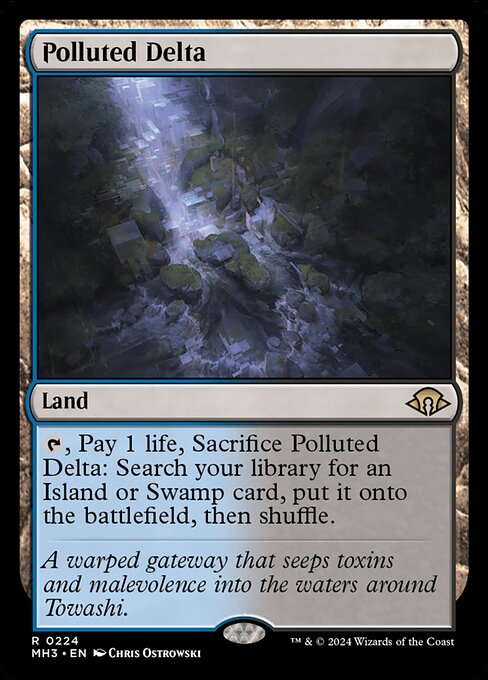
Polluted Delta
Typed access
Check both the matching types and whether the needed target is still in the library.

Watery Grave
Fetchable dual
Include its possible entry life payment when comparing an early untapped sequence.

Exotic Orchard
Conditional color
Test an opening where opponents cannot provide the color the hand needs most.
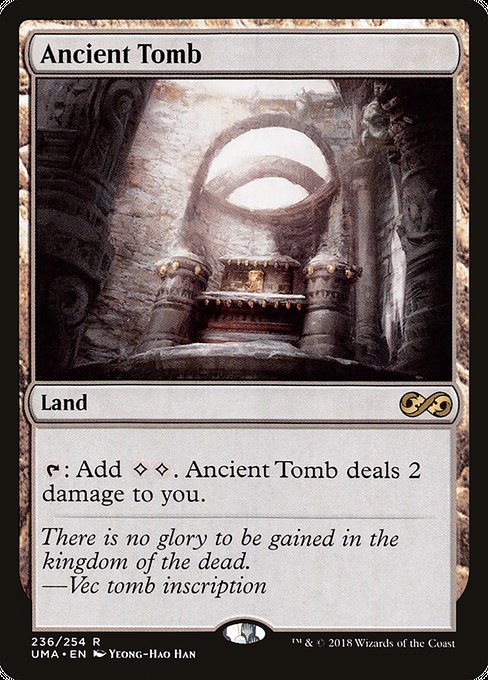
Ancient Tomb
Generic acceleration
Compare the generic cost it advances against the colored land slot it occupies.
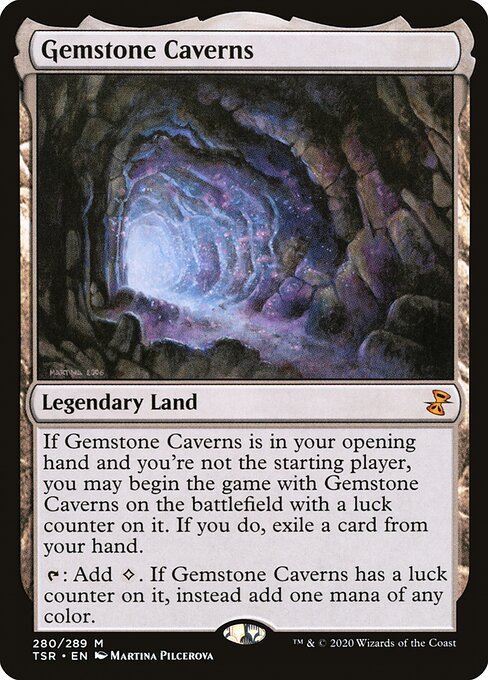
Gemstone Caverns
Opening option
Evaluate separate starting player and nonstarting player hands rather than assuming its best mode.
cEDH mana base questions
Build your deck
Put these choices into a Commander list. Create a free account to save your deck and keep tuning it with Deckcipher.
FAQ
How many lands should every cEDH deck play?
There is no universal correct total. Commander costs, draw access, fast mana, land drops, and the intended opening sequences determine the list's needs. Copy a coherent baseline and test its exact payments before cutting lands.
Can one dual land count as both a blue and black source?
It can count as access to either color in separate source checks. It normally makes only one mana per tap, so it cannot pay both colors simultaneously by itself.
Can Flooded Strand be legal without white in the commander identity?
Yes. Mentioning Plains in its search text does not add a white mana symbol to its identity. It still needs a legal Plains or Island card in the library to find.
Does an off color fetchland automatically fix every color?
No. Its actual target types and the lands remaining in the library determine the available colors. Drawing or using a key target can change what another fetch can provide.
Is Gemstone Caverns always a rainbow land?
No. Its ordinary output is colorless unless it has a luck counter. Its opening battlefield option has specific conditions and requires exiling a card from your hand.
Should nonland mana replace lands one for one?
Not automatically. Discard costs, one use effects, summoning sickness, and vulnerability change when and how long those sources work. Evaluate the complete opening and recovery plan rather than only the total number of mana cards.