
Quick answer
Cascade triggers when you cast the spell. Resolve that ability before the original spell, exile until a qualifying nonland card appears, then decide whether to cast it. The card and the resulting spell must both pass the relevant mana value checks.
What cascade does, in the order it happens
A cascade spell is two separate problems for the table: the original spell and its triggered ability. Casting Bloodbraid Elf puts the Elf spell on the stack and triggers cascade. The cascade ability goes above the Elf, so players can respond before any cards are exiled. If everybody passes, cascade resolves first. The Elf is still a spell at that point, not a creature on the battlefield.
During that resolution, exile cards from the top of your library face up until you exile a nonland card with mana value less than the spell that caused this cascade. Lands do not stop the search. You may cast the qualifying card without paying its mana cost if the spell you would actually cast also has a lower mana value. You cannot skip an inconvenient qualifying card and keep searching for a better one.
After you make that decision, put the cards exiled by that cascade that were not cast on the bottom of the library in a random order. Declining the spell does not put it into your hand or leave it available for later. It goes to the bottom with the other uncast cards. A card that was successfully cast has moved to the stack, so it is not included in that group.
This sequence makes cascade a cast trigger rather than an enters ability. Returning an Elf to your hand and casting it again gives another cascade. Blinking an Elf directly from the battlefield to exile and back does not. A deck using bounce and recasting has a very different engine from a deck using flicker effects, even when both repeatedly reuse the same creature.
Mana value is different from the mana you paid
Cascade checks mana value, not the amount of mana removed from your pool. A cost reduction can make an expensive spell cheaper to cast without changing its mana value. An additional cost such as commander tax can make a commander more expensive without raising that commander's mana value. Neither discounting a spell nor paying extra turns a smaller cascade threshold into a larger one.
For a spell with X in its mana cost, the chosen value of X contributes to mana value while that spell is on the stack. Elsewhere, X is normally treated as zero when determining mana value. These are different questions: the threshold of your spell already on the stack, and the mana value of a card being examined in exile. Work out each object in its current zone instead of carrying one number through the entire process.
Maelstrom Wanderer has mana value eight and two instances of cascade. Paying commander tax does not let either trigger find an eight mana card. Each trigger still looks below eight. Similarly, an Imoti deck can reduce the cost of a six mana spell and still satisfy Imoti's mana value requirement. Cheap casting costs and high printed mana values can work together, but a discount does not give a low mana value card the characteristics of an expensive one.
When reviewing the deck, keep both numbers visible. The mana curve helps evaluate cascade hits. The amount you expect to pay helps evaluate opening hands and ramp. A list full of cards with large printed costs can still produce awkward hands if the discounts depend on a commander that has not resolved. Use the deck building checklist to keep that distinction attached to actual opening plays.
A complete stack example with a counterspell
Suppose you cast Bloodbraid Elf during your main phase. Its cascade trigger is placed above the Elf. An opponent casts Counterspell targeting the Elf spell. If Counterspell resolves, the Elf goes to the graveyard, but its cascade trigger stays on the stack. The trigger exists independently of the spell that created it. Countering the original spell does not erase the trigger.
After the counterspell finishes, players receive priority again. If nobody answers the cascade ability, you exile cards and find a two mana creature. You choose to cast it. That creature spell is placed on the stack during cascade's resolution, but it does not resolve in the middle of resolving the ability. Finish the cascade instructions first, including putting the unused cards on the bottom. Players then receive priority and may answer the new spell.
The opponent therefore needs different interaction to stop different pieces. A normal spell counter can stop the Elf or the newly cast creature, while an effect that counters a triggered ability can stop cascade itself. Removing a permanent that granted cascade after the trigger has already triggered generally does not remove that existing ability from the stack. Check whether the granting effect was present at the relevant cast event rather than assuming it must remain forever.
With two cascade triggers, resolve one completely before moving to the other. Any spell cast from the first trigger can resolve before the second cascade trigger. That ordering can matter if the first hit draws cards, changes the battlefield, or creates another cascade trigger. Keep separate physical piles for separate resolutions so the cards that belong on the bottom never become mixed with an unresolved trigger's cards.
Free casting still has costs and restrictions
Without paying its mana cost is an alternative way to pay for a spell. You cannot combine it with a second alternative cost merely because that other choice looks better. You can usually choose optional additional costs such as kicker, and you must pay mandatory additional costs. A spell that requires sacrificing a creature as an additional cost cannot be cast if you cannot pay that cost.
When you cast a spell with X in its mana cost this way, choose zero for X unless another rule or effect specifically determines that value. A generic X spell can therefore be an unimpressive cascade hit. That is a construction problem rather than a failure of cascade. Some cards have useful effects at X equals zero; others consume a slot while offering almost nothing when found for free.
Cascade allows the qualifying spell to be cast during the ability's resolution. That permission lets you cast a creature or sorcery at a time when you could not normally cast one. It does not remove actual restrictions. If an effect says you cannot cast spells from exile, cascade does not override it. If you have already reached a one spell per turn restriction, being offered another spell is not permission to ignore the restriction.
Targets are also chosen when casting the hit. A targeted removal spell needs a legal target. You can decline a legal spell when its only useful target is your own permanent, but you do not get another attempt at the library. Include enough broadly useful hits that the deck can accept imperfect reveals. A cascade plan depending on every reveal being exactly right is likely to disappoint even when all of its rules interactions work.
Double faced cards, adventures, and split cards
Cards that can be cast in more than one way deserve a separate check. First identify whether the card found in exile qualifies as a nonland card with a sufficiently small mana value. Then identify the spell you want to cast and check that the resulting spell also has a sufficiently small mana value. Passing the first check does not automatically pass the second.
For a modal double faced card with a spell on the front and a land on the back, cascade cannot play the land side. The instruction offers casting a spell, not playing a land. If the front face qualifies, you can consider casting that spell face. It does not give you an extra land drop or permission to put the reverse land face onto the battlefield. Conversely, a card whose front face is a land is not the nonland card cascade is looking for.
Adventure cards require the same discipline. The characteristics used to find the card and those of the adventure spell you choose can differ. Check the resulting spell's mana value instead of assuming that a cheap creature face gives permission to cast any expensive adventure. For split cards, characteristics outside the stack can make the card's mana value different from the particular half you hope to cast. Do not evaluate a split card in exile as though you had already selected one half.
These checks are easiest before a game. Mark flexible cards in your deck and rehearse which cascade thresholds can find them and which faces or halves can actually be cast. That preparation saves time and prevents an illegal reveal from determining a whole turn. The card finder guide can help organize candidates, but the exact card text still decides the play.
Build a curve that produces useful hits
An Imoti, Celebrant of Bounty deck wants six mana value spells because Imoti grants those spells cascade. That does not mean every other slot should also cost six or more. You still need earlier plays that establish mana, defend your life total, and find resources. The tension is choosing low cost cards that remain useful when a large spell finds them later.
Ramp spells are a clear example. A two mana ramp spell can be excellent on turn two and merely adequate when revealed after you already have ten lands. A narrow protection spell might be excellent in your hand and uncastable from cascade when there is nothing useful to protect. A flexible removal spell is more likely to have a legal and relevant target across several stages of the game. Classify hits by their late game floor rather than their printed efficiency alone.
Avoid solving every weak hit by cutting the early game. A deck that removes all cheap ramp to improve cascade quality may never cast its expensive spells on time. Instead, identify the smallest group of early cards that makes opening hands function, then use remaining slots for permanents and spells whose effects scale. Card draw, flexible interaction, and creatures with useful immediate abilities are often easier to accept than a collection of tiny conditional tricks.
Commanders also change the target. Maelstrom Wanderer provides haste and two cascades from an eight mana body. Imoti supports repeated six mana value casts. The First Sliver cares about a creature type and can chain Slivers with cascade after it is on the battlefield. Those are related decks, but copying the same curve between them ignores the work each commander actually performs.
| Cascade decision | What to check |
|---|---|
| The card found in exile | Nonland card with lower mana value |
| The spell you would cast | Resulting spell also has lower mana value |
| Casting it for free | Pay mandatory additional costs and obey restrictions |
| Declining the hit | Put it on the bottom with the other uncast exiled cards |
Cascade cards and what they ask of the deck
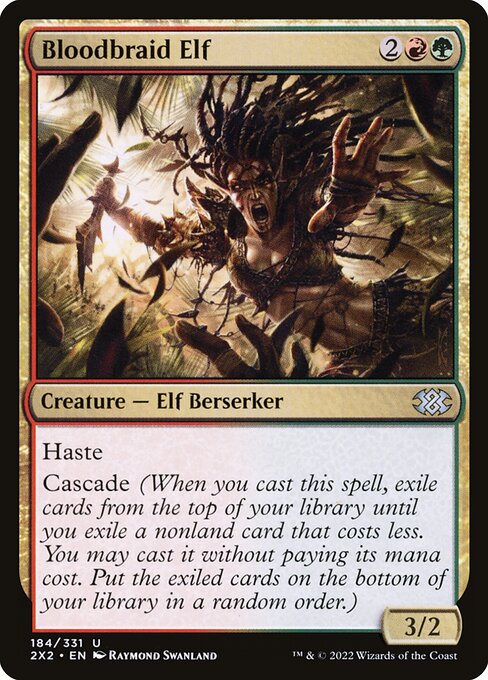
Bloodbraid Elf
Compact example
One cascade trigger attached to a four mana creature spell. Useful for understanding the sequence.
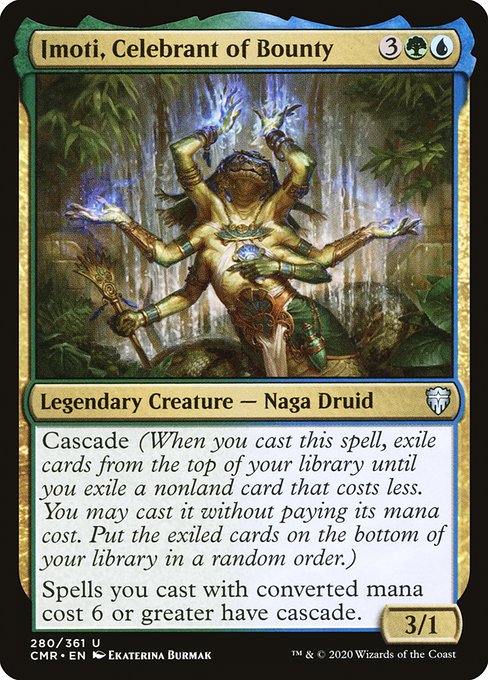
Imoti, Celebrant of Bounty
Big spell engine
Rewards spells with mana value six or greater while still needing a reliable early game.
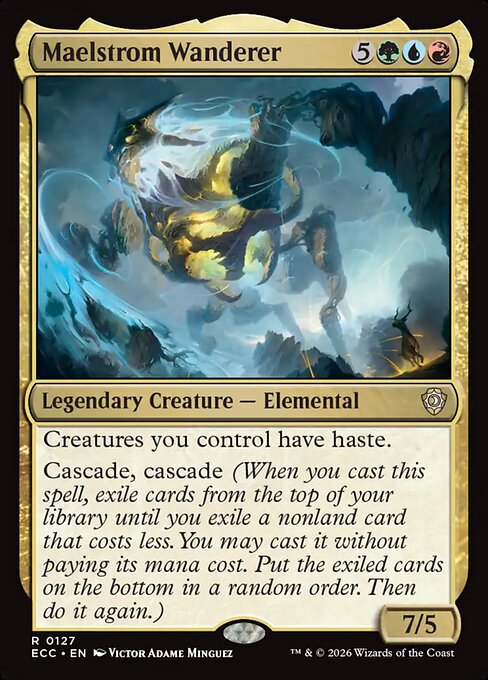
Maelstrom Wanderer
Command zone payoff
Two separate cascade triggers and haste encourage a large mana plan with useful hits.
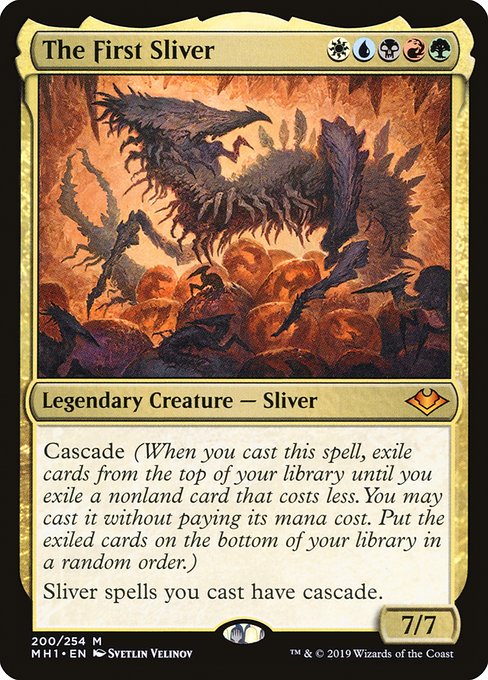
The First Sliver
Creature type engine
Its static ability matters while it is on the battlefield. Do not assume the first Sliver spell retroactively gains it.
Answer cascade without wasting interaction
The best answer depends on what is actually threatening. If the original spell is a lethal threat, countering that spell can be correct even though cascade remains. If a cascade hit is the dangerous piece, let the ability reveal it and save the counter for the resulting spell. You do not need to answer the first object simply because it appeared first. State which object you are targeting so nobody mistakes a spell counter for a trigger counter.
Permanent based restrictions can be effective, but their timing matters. An effect that prevents casting from exile can shut off the optional cast without undoing the mandatory exiling process. An effect limiting spells can prevent additional casts. Those tools may also constrain your own deck, so include them because they fit your plan rather than as universal upgrades. Opponents can remove a restriction before beginning their cascade turn if they have enough information and resources.
Against a deck with many expensive spells, attacking mana can matter more than trading with every reveal. Remove a mana creature before the controller untaps if that changes the next turn's options. Pressure the player who is spending several turns setting up. Keep a board wipe for the battlefield produced by several cascades if the individual spells are not immediately decisive. A resolved cascade does not mean the table has lost the game.
Use the interaction checker to inspect which kinds of answers your own deck contains, then read those cards against the stack example above. A deck with only creature destruction may be able to clear the eventual board but cannot stop a cast trigger from finding a noncreature win condition. Coverage matters more than adding a random number of removal spells.
Test cascade turns without confusing the results
A useful rehearsal starts with a real opening hand, legal land drops, and the actual costs of your setup. Do not place the commander on the battlefield for free and then judge whether the high end feels powerful. The question is whether you can arrive at a cascade turn with enough cards and life to make that power relevant. Record hands that contain impressive spells but cannot cast their first meaningful play.
When testing a reveal, follow the entire process. Exile cards in order, stop at the first qualifying card, decide whether it is legal and useful, and randomize the uncast cards onto the bottom. Do not quietly redraw a bad hit. If a narrow card is regularly declined, note the circumstances. If a cheap ramp spell seems weak only after the deck has already reached a winning position, it may still be performing an important early role.
After several games, separate mana failures from hit quality failures. Missing a land drop before casting an eight mana commander is not evidence that the cascade package needs more expensive cards. Revealing a removal spell with no useful target is not evidence that the deck needs fewer lands. Change the part that caused the problem. The cascade threshold, the early mana plan, and the density of flexible hits each deserve a distinct explanation.
Build your deck and create a free Deckcipher account to save the list while you compare those changes. Keep notes on individual cascade hits and the turn they were found. That produces actionable edits, such as replacing one narrow spell with flexible draw, rather than an expensive overhaul based on a single dramatic reveal.
Cascade questions that come up at the table
Build your deck
Put these choices into a Commander list. Create a free account to save your deck and keep tuning it with Deckcipher.
FAQ
Does countering the original spell stop cascade?
No. Once cascade has triggered, its ability is separate from the spell. A spell counter can remove the original spell while the trigger remains. Players can then respond to the trigger or to a spell cast from it. Be explicit about which object an answer targets.
Can I keep looking if I dislike the first card?
No. Stop at the first nonland card that satisfies the card mana value check. You may decline to cast it, but the instruction does not restart. The uncast qualifying card goes to the bottom with the other cards exiled by that cascade.
Can cascade cast a sorcery during another player's turn?
Its permission allows a qualifying sorcery to be cast during the resolving ability. Actual prohibitions and restrictions still apply. A card forbidding spells from exile or limiting the number of spells you may cast can prevent that cast even though ordinary sorcery timing does not.
Do commander tax and discounts change cascade?
They change the amount paid, not the printed spell mana value. An eight mana value commander still cascades below eight after tax. A discounted spell keeps its mana value. X in a spell on the stack is a separate case because the chosen X contributes there.
What happens if I find an X spell?
When casting without paying its mana cost, choose zero for X unless a specific rule or effect determines it. You can still pay applicable additional costs. Evaluate whether the card does something useful at that value before filling a cascade list with variable spells.
Is a spell copied onto the stack another cascade?
A copy of a spell is normally not cast, so it does not create a new cast trigger. An effect that specifically tells you to cast a copy is different. Read the action the effect performs rather than treating copying and casting as interchangeable.