
Quick answer
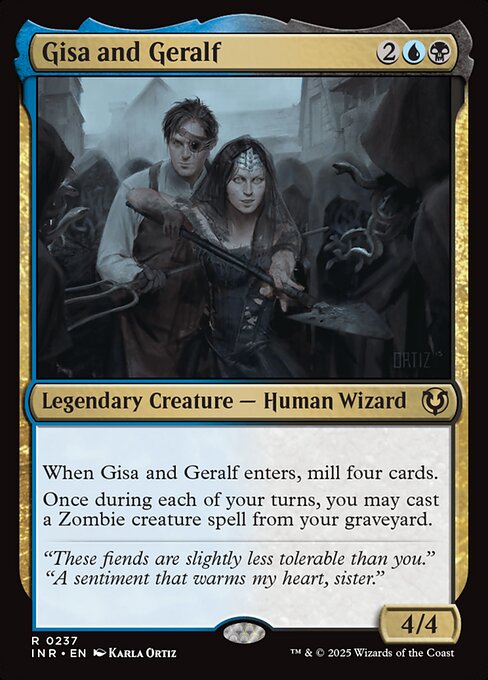
Build budget Zombies around inexpensive creatures that remain useful when cast again, a controlled sacrifice outlet, and draw that keeps the deck moving. Gisa and Geralf provides repeatable graveyard access, while your mana, creature mix, and recovery cards determine whether that access becomes a useful turn.
Choose recursion as the central resource plan
Gisa and Geralf mills four cards on entry and lets you cast a Zombie creature spell from your graveyard once during each of your turns. That gives the deck a way to reuse a modest creature instead of needing every draw to be a new threat. It rewards Zombies with useful entries, deaths, or low costs that leave mana for another action.
The commander supplies access rather than free reanimation. You still pay the spell's cost and obey normal timing unless another effect changes it. You cannot use the permission on every opponent's turn, and it does not let you cast a non-Zombie creature or a milled removal spell merely because it is in the same graveyard. Those limits should shape the list before you buy a large self mill package.
Wilhelt, the Rotcleaver offers a different Zombie engine based on qualifying deaths and end step draw. He can also fit inside a blue black list, but his own decayed rules and support need careful reading. The Wilhelt guide develops that plan separately. This build emphasizes Gisa and Geralf's steady casting access rather than trying to duplicate every Zombie combo.
Start with a clear finish: a resilient creature board, accumulated death related life loss, or repeated entry value leading to a larger payoff. Those routes overlap, but a budget list cannot afford unlimited support for all of them. Choose useful inexpensive creatures and preserve the mana, draw, and interaction needed to cast them repeatedly through ordinary removal.
Cheap Zombies make the first turns and recasts useful
Shambling Ghast is an early body with a death choice. It can provide a small toughness reduction to an opposing creature or a Treasure. That gives a sacrifice outlet something meaningful to convert, but the choice is not both modes at once. A Treasure can help a later colored requirement, while the removal mode needs a legal target and a small enough creature to matter.
Lazotep Reaver contributes a Zombie body and amass Zombies 1 on entry. If you have no Army, the action creates one before adding the counter. If you already have an Army, it grows an Army rather than automatically producing a second token. Recasting it through the commander can therefore produce different board development depending on whether the previous Army remains.
Carrion Feeder is a Zombie outlet whose sacrifice ability does not require mana or tapping. It turns a creature into a counter on itself. It cannot block, so a list using it alongside other nonblocking or decayed bodies should preserve actual defenders. A creature can be excellent engine support while being poor at keeping attackers away from your life total.
These cards supply concrete early functions instead of waiting for a large anthem. An opening hand with a cheap body, a second turn resource play, and lands toward the commander is more coherent than one full of expensive Zombie payoffs. Choose early cards that remain useful when recast later. A low mana value alone is not enough if the creature never advances the chosen resource plan.
Mill enough to supply choices without replacing draw
Milling four on the commander's entry can put useful Zombies into the graveyard, but the result is not guaranteed. A group containing lands and noncreature spells may offer little immediate access. That is normal variance, not proof that the deck should add every available self mill card. More milling creates a larger graveyard without necessarily creating mana or cards in hand.
The distinction matters because the commander only permits a narrow cast. A milled draw spell may be inaccessible without a separate recursion effect. A milled Zombie costing six may remain unusable while you have four lands. The useful graveyard is one containing a creature you can cast for a relevant effect now. A visually large pile is not automatically a resource advantage.
Keep ordinary card access alongside the graveyard plan. Drawing lands and interaction lets you use the commander's permission while still responding to the table. A hand that has emptied itself to mill more can become fragile when graveyard hate removes the pile. A direct draw spell or entry based creature can help the deck operate through that interruption.
Milling the last cards does not by itself create the usual empty library draw loss, but drawing from an empty library can. Do not casually exhaust the library without a supported reason. For this budget midrange plan, a modest supply of useful recursive creatures is normally a more practical goal than racing to mill the entire deck. Test what the next legal cast actually is.
| Resource card or action | Useful outcome | Limit to remember |
|---|---|---|
| Gisa and Geralf entry | Four cards milled for potential options | Does not guarantee a castable Zombie |
| Commander graveyard permission | One Zombie creature spell on your turn | Pay costs and obey timing |
| Lazotep Reaver recast | Entry value and Army development | Existing Army changes the result |
| Shambling Ghast sacrifice | A chosen death benefit | Only the chosen mode happens |
| Direct draw spell | Lands and interaction in hand | Does not replace the need for usable mana |
Build draw around the board states you actually have
Undead Augur draws and loses you a life when it or another Zombie you control dies. That can turn several deaths into a substantial refill, but the life loss is real. A large sacrifice sequence at a low life total can be dangerous. Count the triggers and resolve them rather than treating every body as a free card without consequences.
Cryptbreaker offers a paid discard ability making a Zombie and a separate ability tapping three untapped Zombies to draw and lose life. Newly controlled Zombies can help pay the second ability because it is not their own tap symbol ability. They still must be untapped. A board already tapped for attacks cannot also supply that payment without another untap effect.
Distant Melody draws based on the chosen creature type among permanents you control when it resolves. In an ordinary Zombie board, the Zombie creatures and tokens contribute to that count. The spell does not count Zombie cards in your graveyard. A wipe in response can leave much less draw than the board showed when you cast it. It is a powerful wide board refill with a real dependence on that board.
Compare those three access patterns. Augur wants deaths, Cryptbreaker wants untapped bodies, and Melody wants a surviving count. A balanced package can cover different situations, while too many cards requiring an already successful army can fail together. The deck building checklist helps keep a direct resource route available when the creature engine has not yet assembled.
Use Victimize without misreading when sacrifice happens
Victimize targets two creature cards already in your graveyard. When the spell resolves, you sacrifice a creature, and if you do, the chosen cards return tapped according to its instructions. The sacrifice is not an additional casting cost. Opponents can respond before resolution, potentially changing your available creature or the graveyard targets.
You cannot choose a battlefield creature as one of those graveyard targets on the assumption that you will sacrifice it later in the same spell. Targets are chosen when casting, before that sacrifice. You need the two target cards in the graveyard at that point. This is a useful reason to establish the graveyard and an expendable body before holding the spell as a complete recovery plan.
The creatures return rather than being cast. They can trigger appropriate enters abilities, but they do not create creature cast triggers simply by coming back. Returning tapped can delay blocking or tap activations. A large recovery turn may still leave you exposed until the returned board untaps, so consider the next opponent rather than judging only the material gained.
Use a cheap body whose lost value is acceptable for the sacrifice. A Shambling Ghast can add its own death benefit, but those triggers have their own timing after the resolving spell and state based actions are handled. You do not interrupt Victimize halfway through to resolve the Ghast trigger and spend its Treasure before the spell's return instruction finishes. Keep the whole sequence legal.
Death payoffs and devotion are different finishes
Diregraf Captain improves your other Zombie creatures and makes a target opponent lose life when another Zombie you control dies. It does not trigger from its own death through that ability, and it does not automatically drain each opponent from one trigger. Several triggers can be distributed among legal opponents, but targeting restrictions and changed targets still matter.
Gray Merchant of Asphodel uses devotion to black for its enters payoff. Count black mana symbols in the costs of relevant permanents you control as the trigger resolves. An army of ordinary Zombie tokens without mana costs contributes no black symbols merely because the tokens are black. A few permanents with multiple black symbols can produce a larger result than many such tokens.
Recurring a Merchant through Gisa and Geralf can provide value when you can cast it and have a worthwhile devotion board. That is not automatically an unlimited loop. The commander's permission is limited to once during each of your turns, and the spell still costs mana. A sacrifice outlet does not remove that limit by itself. State the finite sequence accurately before describing the threat to the table.
Combat remains useful too. A lord can make small bodies relevant while death triggers make trades costly. You do not have to abandon attacks merely because the deck has a sacrifice outlet. Choose whether the current board should pressure life, preserve defenders, or supply resources. A resilient midrange list benefits from several useful decisions without needing an unsupported claim that every creature death moves directly toward a deterministic win.
A recursive Zombie package by job
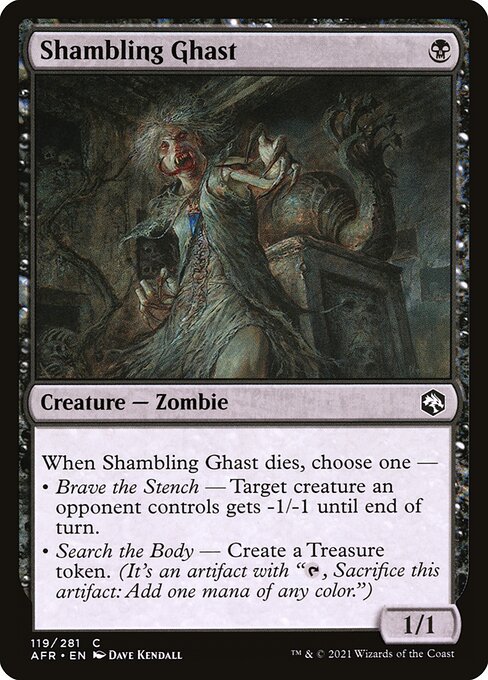
Shambling Ghast
Early material
A death choice can supply a Treasure or small opposing toughness reduction.

Lazotep Reaver
Entry value
Amass develops a new or existing Army rather than guaranteeing a new body every time.
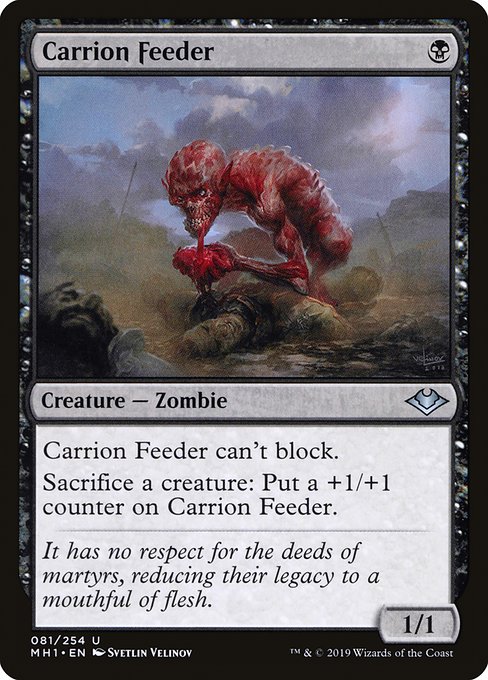
Carrion Feeder
Sacrifice control
A free activation outlet whose inability to block affects defense.
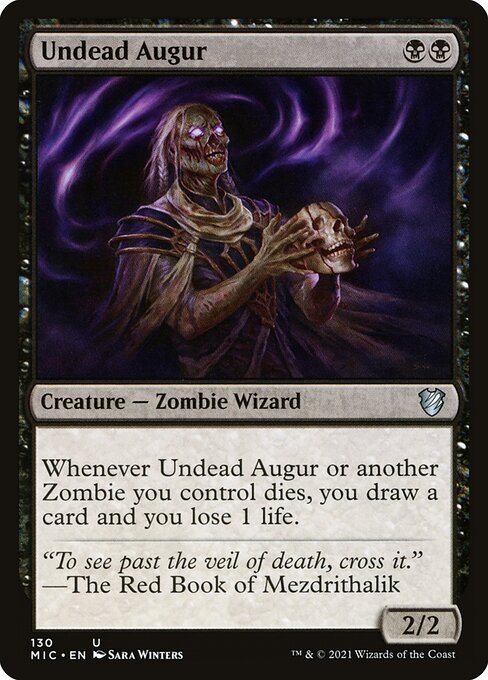
Undead Augur
Death based refill
Several draw triggers also mean several points of life loss.

Diregraf Captain
Combat and targeted drain
A useful other Zombie bonus and single opponent targets on qualifying deaths.

Gray Merchant of Asphodel
Devotion payoff
Needs black symbols on your current board rather than simply a high token count.
Keep a real blue black mana and answer package
Early black creatures and later blue black commanders create actual colored requirements. A colorless accelerator can help generic costs without supplying the missing black or blue pip. Start with enough usable sources of both colors, and note which lands enter tapped. Several inexpensive duals can fix colors while slowing the first meaningful play if drawn together.
Do not solve that by assuming every budget deck needs premium lands. A basic heavy mana base with practical fixing can be coherent when the curve and early requirements are chosen accordingly. Reducing an early double colored demand can sometimes improve hands more cheaply than buying a land. The mana base calculator helps inspect the source plan, then real hand sequences test whether those sources arrive in time.
Feed the Swarm can answer an opposing creature or enchantment and causes life loss based on that permanent's mana value as it resolves. It is a sorcery and the life loss is not a casting payment. Keep other interaction for opposing turns and threats outside its scope. A creature theme does not make noncreature engines less dangerous.
Include graveyard interaction for opposing decks too. Your own recursion plan does not mean every player's graveyard should remain untouched. Use the interaction checker to inspect the spread of creature, noncreature, and stack answers. A Zombie count slightly lower than an ideal reveal or lord count can be worthwhile when the added card stops an opposing engine you otherwise cannot race.
Test an ordinary turn and a graveyard hate turn
A useful opening can begin with a Swamp and Shambling Ghast, then a second land and Lazotep Reaver if the mana works. You have early material and a possible Army before the commander. Reaching Gisa and Geralf still needs the appropriate four mana and both colors. Do not count their graveyard cast permission before they are present or assume the entry mill found the perfect Zombie.
On a later turn, sacrificing the Ghast to Carrion Feeder can supply a death benefit and put the creature in the graveyard. If you have not used the commander's permission that turn, you may be able to cast the Ghast again with its normal cost and timing. That is a small repeatable value line. It does not recast every creature you sacrifice in that turn through the one permission.
Now remove the graveyard from that test. You should still be able to cast creatures and draw from hand. If the list has spent every card on milling and has no live action after one exile effect, diversify the resource plan. Likewise, an exile wipe does not create the death triggers you hoped to use for recovery. Test the actual zone change rather than every board wipe as though it destroyed creatures.
Build your deck and create a free account to save the first list and a lower curve revision. Price the actual cards before committing to premium lords or graveyard engines. Record whether the deck needs lands, draw, a better recursive target, or a flexible answer. A budget Zombie deck becomes useful by making ordinary recasts productive, not by filling the graveyard with cards it cannot actually use.
Budget Zombies questions
Build your deck
Put these choices into a Commander list. Create a free account to save your deck and keep tuning it with Deckcipher.
FAQ
Does Gisa and Geralf cast Zombies for free?
No. The commander gives permission to cast a Zombie creature spell from your graveyard once during each of your turns. You still pay costs and obey normal timing unless another effect changes those rules. It is access, not an automatic reanimation or mana engine.
Can I use the permission on every player's turn?
Its wording says during each of your turns. It does not provide a cast on every opponent's turn. Flash alone does not change that scope. Read both the permission and timing when evaluating a recursion sequence.
Does milling count as drawing cards?
No. Milling can put usable Zombies into the graveyard, but it does not put lands or interaction into your hand. The commander cannot use every milled card type. Keep ordinary card access so the deck can develop and function through graveyard hate.
Can Victimize return the creature I sacrifice to it?
Not as one of its targets chosen for that casting if the creature was still on the battlefield when you cast it. The two targets must already be creature cards in your graveyard. The sacrifice happens during resolution, after those targets were selected.
Do Zombie tokens increase Gray Merchant devotion?
Ordinary tokens without mana costs have no black mana symbols to count, even if they are black. Devotion counts the relevant symbols on permanents you control when the trigger resolves. Token copies with copied mana costs can be a different case.
What is the first budget upgrade?
Fix the repeated failure in real hands: early colors, useful cheap bodies, draw, or interaction. Another expensive lord is unlikely to solve a hand that cannot cast its first creature. Price printings and shipping, then compare a specific replacement by the role it preserves.