
Quick answer
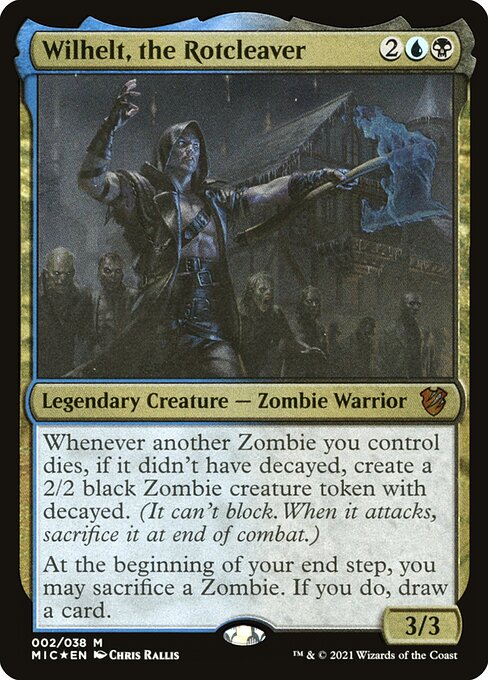
Wilhelt, the Rotcleaver is a blue-black Zombie commander that turns qualifying Zombie deaths into decayed bodies and can sacrifice a Zombie at your end step to draw. Improve the deck by lowering expensive setup, adding controllable sacrifice outlets, and keeping enough Zombies to feed the engine. Choose whether you want combat value or compact combos before shopping, because several familiar upgrades change the deck’s finish substantially.
Choose the Wilhelt deck you actually want to play
Wilhelt supports two closely related experiences. A Zombie combat deck builds a board, uses lords and evasion, and gets extra material from creatures dying. A sacrifice deck treats those bodies as resources for cards and life loss. You can combine the themes, but you still need a priority. A hand of expensive combat payoffs behaves differently from a hand of cheap creatures, a sacrifice outlet, and a death payoff.
Start with a sentence that describes your intended finish. “I want to attack with Zombies and rebuild after removal” is useful. So is “I want to drain the table through repeated sacrifices.” “I want every good Zombie card” leaves the hardest decisions unresolved. Your sentence will tell you whether to keep an expensive lord, add another cheap body, or preserve a slot for protection.
If you own Undead Unleashed, use its stock list as your baseline in the Commander precon finder. Keep an unchanged copy and edit a second list in the deck builder. This makes it easier to spot cards you already own and to reverse a change that made the deck smoother but less enjoyable. The guide’s swap table refers specifically to that Midnight Hunt Commander product.
Understand exactly what Wilhelt replaces
Wilhelt costs two generic, one blue, and one black mana. His first ability triggers when another Zombie you control dies, provided it did not have decayed. It creates a 2/2 black Zombie token with decayed. He does not trigger for his own death, and he does not replace a decayed Zombie with another decayed Zombie by default. Those two limits prevent the commander alone from being an endless sacrifice engine.
A normal Zombie can therefore provide two useful bodies over time: the original creature and, after it dies while Wilhelt can see the event, the decayed replacement. A token without decayed can qualify too. Creature tokens still die when they go from the battlefield to the graveyard, even though they subsequently cease to exist. Exile and bounce are different events and do not produce death triggers merely because a creature left the battlefield.
Decayed means the creature cannot block and, when it attacks, you sacrifice it at end of combat. It does not grant haste. A token you just created normally cannot attack that turn unless something gives it haste. Keep ordinary Zombies and decayed Zombies visibly distinct. Otherwise it is easy to plan a block with a creature that cannot block or expect a second Wilhelt replacement that will never arrive.
Use the end-step draw as a reliable floor
At the beginning of your end step, Wilhelt gives you the option to sacrifice a Zombie and draw a card if you do. This is one opportunity per trigger, not an unrestricted sacrifice outlet that you can activate whenever you like. A decayed token is often good material for it because that token cannot defend you and will not receive another replacement from Wilhelt anyway.
You can also sacrifice an ordinary Zombie. Its death can create a replacement through Wilhelt’s first ability, provided the normal conditions apply. Other cards may reward the same death. That exchange lets a modest creature become a card while leaving a decayed body behind. Think of it as steady resource conversion, rather than assuming every turn must produce a spectacular chain.
Leave an appropriate Zombie available when the end step begins. If you attack with all your decayed tokens, their sacrifice triggers can remove them at the end of combat, before the end step. You may still have an ordinary Zombie to sacrifice, but you should make that choice deliberately. Sometimes keeping one disposable body back is worth more than two extra damage into an opponent who is not under meaningful pressure.
Add sacrifice outlets that solve a specific problem
Carrion Feeder is an inexpensive Zombie with a sacrifice ability that requires neither mana nor tapping. It turns a creature into a +1/+1 counter on itself. It cannot block, which matters when you already control decayed bodies that cannot block. The card improves control over your death triggers, but it does not automatically improve your defensive position. Preserve some creatures that can actually stand in front of attackers.
Viscera Seer is another low-cost outlet and trades each sacrificed creature for scry 1. It is a Vampire Wizard, not a Zombie, so it does not receive Wilhelt’s replacement when it dies. That is a reasonable trade when you need selection and an outlet that operates without mana. Count it under support, rather than pretending every creature in your list advances the Zombie count equally.
A free outlet also helps when an opponent is about to exile or steal a creature. You may be able to sacrifice the creature in response and get your death benefits, depending on the effect and timing. You cannot wait until an effect has already resolved and then undo it. Likewise, sacrificing a targeted creature can make a spell lose that target, but it does not universally counter a spell with other legal targets.
Five verified swaps for the stock precon
This package focuses on cheaper setup and controlled sacrifices. All five cuts appear in the stock Undead Unleashed list. None of the five additions below is already in that stock list. Keep the commander and make each replacement one for one. The result remains a starting point for testing, not a complete finished list or a guaranteed bracket classification.
| Stock cut | Possible addition | Reason and tradeoff |
|---|---|---|
| Curse of Unbinding | Cryptbreaker | Earlier Zombie and card access; gives up a slower theft effect |
| Eater of Hope | Carrion Feeder | Cheap outlet and Zombie body; gives up a large flying threat and removal ability |
| Open the Graves | Headless Rider | Lower-cost nontoken Zombie death support; narrows which deaths qualify |
| Ruthless Deathfang | Plague Belcher | Zombie payoff that drains opponents; loses sacrifice pressure on opposing creatures |
| Dread Summons | Lazotep Reaver | Predictable early board development; loses scalable milling and a potentially larger late-game token burst |
Cryptbreaker asks for resources in two different ways. Its first ability costs mana, a tap, and a discarded card to make a Zombie. Its other ability taps three untapped Zombies you control to draw and lose a life. That second ability does not use a tap symbol on each Zombie, so newly entered Zombies can help pay it. You still need three untapped Zombies; an army that already attacked is not available for that payment.
Lazotep Reaver enters and amasses Zombies 1. With no Army, this makes a new Zombie Army token and puts a counter on it. If you already control an Army, it grows an Army rather than always providing another token. That distinction matters when counting sacrifice bodies. The Reaver itself is also a Zombie, so it can participate in Wilhelt’s engine independently of whether amass made a new creature.
Headless Rider rewards its own death or another nontoken Zombie you control dying with an ordinary 2/2 Zombie token. It does not trigger from your Zombie tokens dying. The ordinary tokens it makes can later qualify for Wilhelt because they do not inherently have decayed. This can leave material after a wipe, but replacement bodies arrive only after the relevant triggers resolve. They do not block damage or pay costs while they are still pending on the stack.
Core cards and their jobs
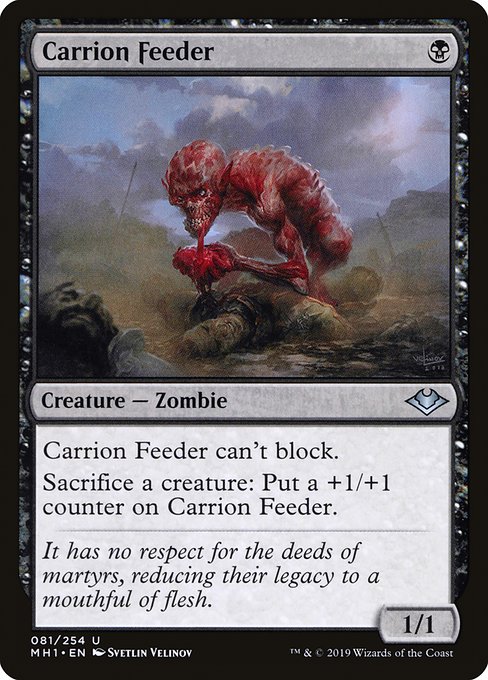
Carrion Feeder
Controlled sacrifice
A one-mana Zombie outlet that grows itself without a mana activation cost. Its inability to block makes defensive planning important.
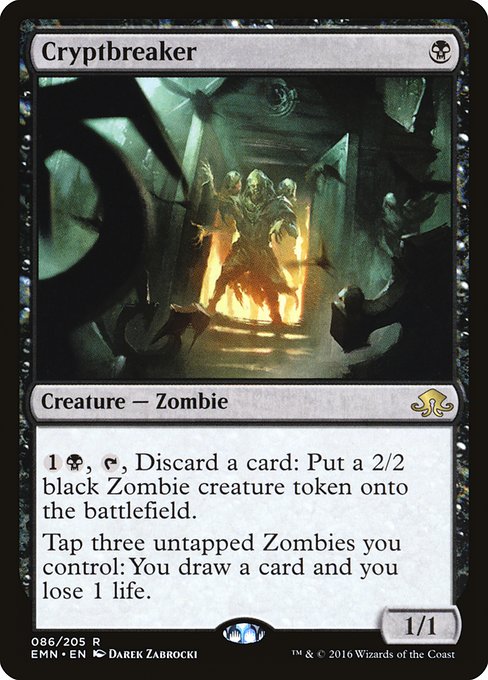
Cryptbreaker
Early development and cards
Makes Zombies through a paid discard ability, or turns three untapped Zombies into a card and life loss. Those are separate abilities.
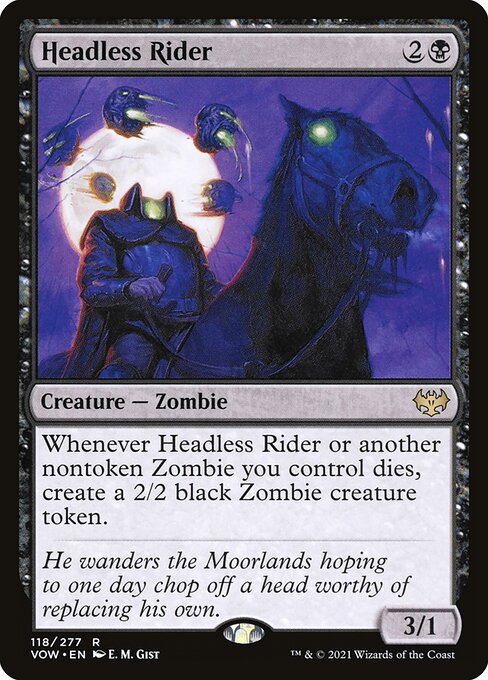
Headless Rider
Replacement bodies
Rewards nontoken Zombie deaths with ordinary Zombie tokens. It does not replace every token that dies.
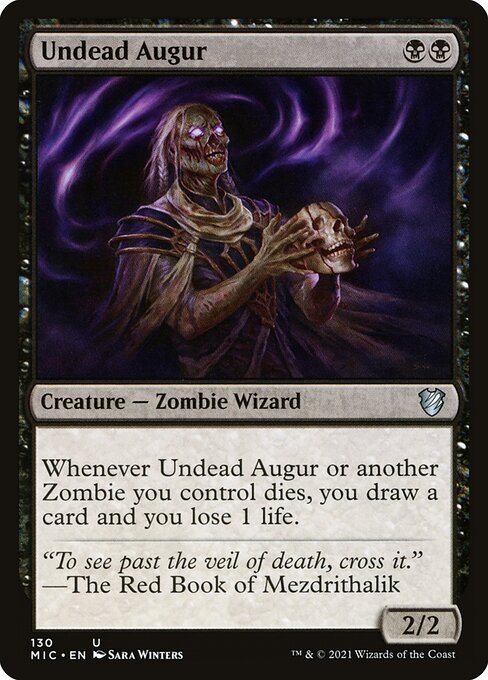
Undead Augur
Death-based draw
Draws and costs you a life when it or another Zombie you control dies. Watch the life total during large sacrifice sequences.

Diregraf Captain
Combat and single-opponent drain
Improves other Zombies and targets one opponent with each qualifying death trigger. It does not drain every opponent per trigger.
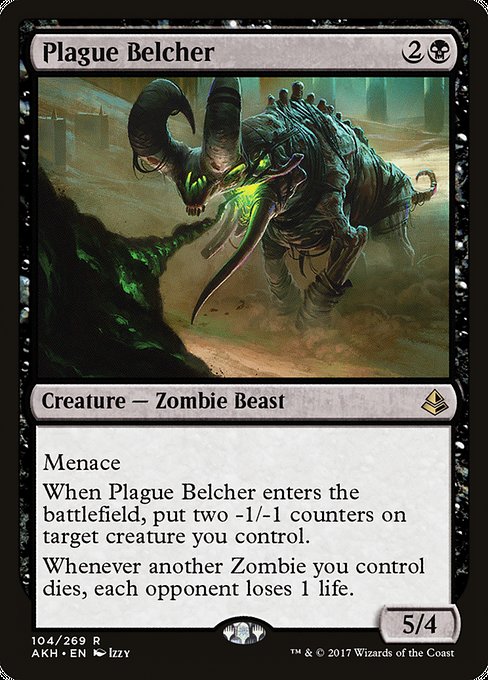
Plague Belcher
Table-wide death payoff
Drains each opponent when another Zombie you control dies. Its entry trigger places two -1/-1 counters on a creature you control.
Keep the good cards you already own
Undead Unleashed already contains Undead Augur, Diregraf Captain, Diregraf Colossus, Feed the Swarm, Rooftop Storm, Sol Ring, Arcane Signet, and Talisman of Dominance. These are cards to evaluate and retain, not a shopping list of new additions. Check a used or previously modified deck separately. A stock-list recommendation does not establish that your physical copy still contains every original card.
Diregraf Colossus grows from Zombie cards in your graveyard as it enters and creates a tapped Zombie token when you cast a Zombie spell. Casting and entering are different events. Returning a creature directly from the graveyard to the battlefield does not count as casting it. That makes cheap castable Zombies especially useful if you want Colossus to keep supplying bodies rather than relying entirely on reanimation.
Feed the Swarm answers an opposing creature or enchantment and causes life loss equal to that permanent’s mana value. It gives Dimir a useful way to address an enchantment, but it is a sorcery and the life loss happens as the spell resolves rather than being a casting cost. Keep other interaction for situations where you need to act during an opponent’s turn. A creature-heavy theme does not remove the need to answer an opposing engine or protect your own.
Draw cards without miscounting the costs
Undead Augur can draw several cards from a large Zombie death event, including its own death. Each qualifying trigger also loses you one life. If your life is already low, sacrificing the whole board can be dangerous even when the resulting hand would look impressive. Resolve the actual triggers and track life rather than treating the draw as a free benefit attached to every body.
Skullclamp is useful when you can arrange for the equipped creature to die, but equipping a plain 2/2 decayed token does not kill it by itself. The equipment gives +1/-1, making that token a 3/1. You still need a death through combat, an outlet, or another effect. A 1/1 creature can die from the toughness reduction, although a lord’s bonus may change that calculation. Inspect the current toughness, not just the printed token size.
Keep mana and timing in the comparison. Equipping costs mana and normally happens at sorcery speed. Wilhelt’s draw happens at your end step. Cryptbreaker needs untapped Zombies. An additional card-draw option is valuable when it covers a situation your existing cards do not. Adding every available draw engine can crowd out the cheap creatures needed to make all those engines work.
Choose finishers that match the rest of the deck
A combat version needs enough ordinary attackers, buffs, and evasion to turn a large board into damage. Decayed tokens can contribute to one attack, but they cannot be relied on as a permanent defensive army afterward. Keep an eye on which creatures will survive the combat step. Leaving yourself with a full hand and no blockers can invite a lethal counterattack before you get another turn.
A sacrifice version can finish with accumulated death triggers. Diregraf Captain targets one opponent per trigger, so distribute targets according to the actual game state and remember that a target can become illegal. Plague Belcher affects each opponent, but its entry counters can weaken or kill one of your own creatures. Those counters may be useful sacrifice setup, but they are a real requirement rather than an optional downside you can ignore.
Gray Merchant of Asphodel offers a different kind of payoff. Its entry trigger uses your devotion to black when that ability resolves. Other permanents and their black mana symbols matter, not the number of Zombies in the graveyard or the number of black tokens. Most ordinary Zombie tokens have no mana cost and contribute no devotion. A board of many tokens can therefore produce a smaller Merchant drain than a few black permanents with several symbols.
Treat compact combos as an explicit upgrade choice
Gravecrawler can be cast from your graveyard while you control a Zombie. Casting it still needs an applicable cost payment and normal casting permission unless another effect changes that. With Phyrexian Altar and another Zombie available, you can cast Gravecrawler for black, sacrifice it for black, and repeat. The loop supplies repeated casts and deaths, but you need a payoff to turn those repetitions into a win. Do not describe it as an automatic victory from two cards alone.
Rooftop Storm, already in the stock precon, can let you pay zero rather than the mana cost of Zombie creature spells. Adding Gravecrawler beside a suitable outlet and another Zombie can therefore create repeated sacrifice lines without buying an expensive altar. This is why cost is a poor substitute for a power conversation. A cheaper upgrade can still assemble a compact engine the slower table did not expect.
Another optional line pairs Rooftop Storm with Acererak the Archlich. If you have not completed Tomb of Annihilation, Acererak’s entry trigger returns him to hand and ventures into the dungeon. You can repeatedly cast him for zero and choose a dungeon such as Lost Mine of Phandelver, completing it and starting it again for repeated room effects. If you have completed Tomb of Annihilation, that return-and-venture condition no longer works. This line is a deliberate combo package, not an ordinary creature upgrade to slip into a value list without discussion.
Preserve mana, interaction, and a recovery plan
Do not cut lands merely because you reduced the curve by a few cards. Wilhelt needs both blue and black, and several useful Zombies ask for multiple black symbols. Look at the actual colored requirements in opening hands. A hand with a colorless accelerator can still fail to cast an early black creature. Use the mana base calculator to inspect sources and then test sequences with the exact lands you kept.
Plan for an exile wipe or graveyard removal instead of assuming every board wipe is favorable. Ordinary destroy effects can give Wilhelt and other death engines material to work with. Exiling the battlefield does not produce the same deaths. A recovery spell is also only as good as the graveyard it can use. Keep some card flow and threats that let you rebuild even when the opponents remove the resources you expected to reuse.
Living Death can be powerful, but it works on every player. It first exiles creature cards from graveyards, then sacrifices battlefield creatures, then returns the creature cards exiled by its first instruction. Creatures sacrificed during the middle step do not join that return batch. Inspect opposing graveyards before casting it. A symmetrical spell that rebuilds three opponents better than you is not automatically a recovery advantage just because your deck has a graveyard theme.
Build your deck
Put these choices into a Commander list. Create a free account to save your deck and keep tuning it with Deckcipher.
FAQ
Is Wilhelt a good commander for a budget Zombie deck?
Yes, he supplies a repeatable value engine and rewards several inexpensive roles: cheap Zombies, sacrifice outlets, and death payoffs. Start with the cards you own and price a small set of improvements. Prices, printings, shipping, and availability vary, so a useful budget plan needs a real shopping total rather than an assumed fixed deck price.
Does Wilhelt replace his own decayed tokens?
Normally no. His death trigger checks that the other Zombie did not have decayed. An ordinary Zombie can leave a decayed replacement, but sacrificing that replacement does not by itself repeat the process. His own death also does not trigger his first ability.
Can decayed Zombies block or attack immediately?
They cannot block. Decayed does not grant haste, so a newly created token normally cannot attack immediately. When it does attack, decayed causes a sacrifice at the end of combat. Track those tokens separately from ordinary Zombies.
Should I buy Diregraf Captain for Undead Unleashed?
The stock precon already contains it, along with Undead Augur and Diregraf Colossus. Check your actual list before buying. If you bought an incomplete used deck, replacing a missing card is different from adding a second copy.
Does Skullclamp immediately kill a 2/2 Zombie token?
No. A plain 2/2 becomes 3/1 from Skullclamp’s +1/-1. It needs another reason to die for the draw trigger. An unmodified 1/1 can die from the toughness reduction, but other bonuses can change that result.
Can Cryptbreaker use newly created Zombies for its draw ability?
Yes. Its draw ability asks you to tap three untapped Zombies rather than using those creatures’ own tap-symbol abilities. Summoning sickness does not prevent that payment. They still need to be untapped and you must have three available.
Does adding Gravecrawler automatically fit a lower-power list?
No. Review the whole deck, especially Rooftop Storm and sacrifice outlets. Gravecrawler is an ordinary recursive threat in some lists and a repeatable combo piece in others. Decide which lines you intend to include and describe them before a game.
What should I test after the first upgrades?
Track whether you can cast early Zombies, reach Wilhelt with both colors, keep useful sacrifice material, and recover after removal. Also note which deaths fail to qualify because of decayed. Use those observations to choose the next swap, then check the completed list’s current bracket fit.