
Quick answer
A budget Dragon deck works best when its expensive creatures arrive on useful turns and contribute to a clear finish. Thrakkus the Butcher supports a two color combat plan, while Ganax with a green Background offers another route. Build the mana, early development, and card access before spending most of the budget on another large Dragon.
Start with a two color plan that can cast its Dragons
Dragons are appealing because a single creature can change combat immediately once it is able to attack. The difficulty is reaching the turn when that creature matters. A hand containing several five and seven mana threats can be impressive to read and still accomplish little while other decks develop. Adding more large creatures does not repair that opening.
Thrakkus the Butcher gives a red and green deck a clear objective. Whenever he attacks, his trigger doubles the power of each Dragon you control until end of turn. He is a Dragon himself and has trample, so he can contribute directly. The ability does not double toughness, produce another combat, or make a creature eligible to attack. It needs Thrakkus to be declared as an attacker and then needs the trigger to resolve.
That plan lets the rest of the deck focus on reaching a useful battlefield and turning it into damage. Two colors reduce the number of different colored requirements the lands must cover compared with a broader Dragon collection. They also exclude some otherwise tempting cards. Staying inside the chosen identity is a practical construction benefit rather than a claim that every multicolor Dragon deck is too expensive.
Use a budget that covers the whole purchase. Cards already owned, available printings, and delivery costs all affect what the same plan costs to assemble. This guide provides roles and interactions rather than a guaranteed price decklist. A productive list of less celebrated Dragons can be a better starting point than a few famous cards surrounded by insufficient mana and no way to draw again.
Distinguish lands, ramp, and discounts before cutting slots
A Dragon deck needs actual mana sources to pay colored requirements and to cast non Dragon support. Lands remain available after creature removal in many ordinary games, while a creature cost reducer may disappear before the expensive spell arrives. Do not reduce the land count merely because several cards say Dragon spells cost less. Savings apply to a qualifying spell; they do not put a mana source onto the battlefield.
Dragonlord's Servant reduces your Dragon spells by one generic mana. Dragonspeaker Shaman reduces them by two generic mana. Both are creatures that need to survive until you cast the relevant spell. Their own costs also occupy earlier turns. Choosing a reducer is partly a question of when its savings become useful, not simply which one has the largest number in its text.
For example, Thrakkus normally costs three generic, one red, and one green. A lone Dragonlord's Servant reduces that to two generic, one red, and one green with no other changes. A lone Shaman leaves one generic, one red, and one green. Neither lets three green mana pay the red requirement. If both reductions apply, the generic portion can be reduced to zero while red and green remain.
Early ramp that increases the available mana also supports draw spells, interaction, and commander tax. Decide how many such early plays the list needs by testing opening hands with real colored costs. Use the mana base calculator to examine the sources, then check the curve with discounts absent as well. A game in which the Servant is removed should be slower, not leave the deck unable to cast anything relevant indefinitely.
Ganax and a Background offer a different command zone
Ganax, Astral Hunter can pair with Acolyte of Bahamut because Ganax has choose a Background. That pair creates a red and green color identity, with two commanders and ninety eight other cards under ordinary constructed Commander rules. It is an alternative command zone plan to Thrakkus, rather than a way to place all three cards in the command zone together.
Ganax creates a Treasure when it or another Dragon you control enters. Its own entry can therefore help a later action after the trigger resolves. Each Treasure is temporary mana with a sacrifice cost, not a land that will keep producing every turn. Keeping the token available can also provide color flexibility when the remaining lands do not line up with the next Dragon's requirements.
Acolyte grants commander creatures you own an ability that reduces the first Dragon spell you cast each turn by two generic mana. With both Ganax and the Background on the battlefield, this can help the next turn's first Dragon. The Background does not independently reduce every Dragon simply because it is sitting beside an empty command zone plan. Its text grants an ability to the relevant commander creature, so keeping that creature present matters.
The once each turn restriction also matters. Casting one Dragon and later removing or recasting an engine piece does not turn a second Dragon spell that turn into the first one you cast. Ganax favors development through entries and a supply of temporary mana, whereas Thrakkus favors a sharper attack. Choose the commander plan based on the turns you want to play before deciding which supporting Dragons deserve their slots.
| Problem to solve | Example | What it actually provides |
|---|---|---|
| Generic Dragon costs | Dragonspeaker Shaman | Two generic mana of savings while it survives, with colored requirements remaining |
| Entry based development | Ganax, Astral Hunter | A Treasure from its own or another controlled Dragon entry |
| Finding a specific Dragon | Sarkhan's Triumph | A revealed Dragon creature card in hand, not a creature already on the battlefield |
| Cards from large damage | Dragonborn Champion | A draw when one source deals at least five damage to a player |
| Attack step mana | Savage Ventmaw | Six mana from an attack trigger that can remain available through that turn |
| Combat multiplier | Atarka, World Render | Double strike for Dragons that actually attack while its ability is present |
Choose Dragons by the work they do when drawn
Demanding Dragon combines a flying body with an entry trigger that targets an opponent. That player can sacrifice a creature of their choice to avoid the Dragon dealing five damage to them. It does not automatically remove their best creature, and it does not ask every opponent to make the choice. The result depends on the targeted player's resources, which makes it different from precise removal.
Savage Ventmaw offers a mana role instead. Its attack trigger adds three red and three green, and that mana does not disappear as steps and phases end during the same turn. The trigger does not require combat damage to a player. A blocked Ventmaw can still have supplied the mana if its attack trigger resolved. The challenge is getting it to a legal attack after casting it.
Earthquake Dragon offers a large body whose generic cost is reduced by the total mana value of Dragons you control. Count those mana values rather than their power, the amount paid to cast them, or the number of Dragons. A discounted Thrakkus still has mana value five. Earthquake Dragon's green requirement remains, and an empty battlefield does not provide the discount that made it appealing in the first place.
These jobs are different enough that the choice should reflect the deck's bottleneck. More attack mana helps when you can reach combat and have useful spells to cast afterward. A discounted large creature helps when earlier Dragons survive. An entry effect can contribute before the new creature attacks. Review how many cards need the same already successful board rather than assuming every inexpensive Dragon is interchangeable support.
Keep card access proportional to the expensive curve
Garruk's Uprising can draw when it enters if you control a creature with power four or greater, and when a creature with that much power enters under your control. It also grants trample to your creatures. Those are useful effects in a large creature deck, but the initial draw is conditional. Casting it onto an empty board does not automatically replace the card immediately.
Thrakkus doubles power during an attack, which is a different event from a creature entering. That attack trigger does not retroactively turn an earlier low power creature entry into a qualifying Uprising trigger. Thrakkus himself normally has power three, so do not count casting an unmodified Thrakkus as an automatic four power entry. Support effects need their actual conditions satisfied, even when the broad themes seem compatible.
Dragonborn Champion draws when a source you control deals five or more damage to a player. Look at each damage event and source. Two separate three damage sources do not combine into one qualifying six damage source for that ability. Combat damage from a large Dragon can qualify, while an effect that merely causes life loss is not damage. That difference matters when reviewing possible finishers.
Keep some card access that can function when no Dragon is connecting. If every draw effect needs a successful attack from an established board, one removal spell can prevent both the damage and the refill. A practical opening should include a way to progress toward the next threat after the first one is answered. Replacing every early draw slot with another giant flyer makes recovery slower even if the deck's average creature becomes stronger.
Sarkhan's Triumph finds a Dragon you still need to cast
Sarkhan's Triumph finds a Dragon creature card, reveals it, and puts it into your hand before shuffling. It does not place the Dragon onto the battlefield. The three mana spent on the search is separate from casting the found card. A turn that searches for a seven mana Dragon may therefore be planning for a later turn rather than producing immediate pressure.
That selection can still have a clear role. If the board supports a finishing attack next turn but lacks the relevant combat multiplier, the search can find it. If the hand contains only expensive Dragons and too few lands, searching for another expensive Dragon does not repair the mana. Choose the card for a concrete next action, not simply the most impressive remaining creature in the library.
Instant timing creates a useful option to preserve mana through opponents' turns and search when the information is clearer. It does not require waiting until the last possible moment in every game. If the needed Dragon must be cast during your main phase before a particular opening disappears, delaying selection may be worse. Consider which interaction the held mana represents and what the deck loses by waiting.
A budget list does not need a search package to be coherent. Redundant creatures that perform useful roles can make ordinary draws more reliable without adding another setup spell. Compare the slot with a direct draw effect or an early mana card. The right choice depends on whether you repeatedly need one specific creature, more overall resources, or simply enough mana to cast the creatures already in hand.
Work out Thrakkus and Atarka combat before declaring attacks
Thrakkus's attack trigger doubles the power of your Dragons until the turn ends. It affects Dragons you control when the effect resolves rather than automatically doubling every Dragon that might enter later. Opponents can respond to the trigger before blockers are declared. Increasing power does not remove blockers, grant haste to new Dragons, or grant trample to every Dragon. Thrakkus already has trample from his own text.
Atarka, World Render has flying and trample, and gives an attacking Dragon double strike through a trigger whenever one of your Dragons attacks. Atarka does not need to attack for its ability to trigger for another Dragon. A newly cast Atarka can therefore support older eligible attackers while staying out of combat itself. The newly cast creature still needs haste to join them as an attacker that turn.
Suppose an unmodified Thrakkus and an older unmodified Savage Ventmaw attack while Atarka is on the battlefield. Thrakkus can become six power and Ventmaw eight after the doubling resolves. With Atarka's triggers resolved, both have double strike. If each remains unblocked and deals both combat damage steps normally, that is twelve damage from Thrakkus and sixteen from Ventmaw. Blockers, removal, and other effects can change those results.
Only combat damage dealt by Thrakkus counts as damage from that commander when he is the commander. Ventmaw's damage does not add to his twenty one damage threshold. Also, a blocked double strike creature without trample does not necessarily reach the player after killing its blocker in the first damage step. The first strike and double strike guide explains those separate steps and their response window.
Practice a development line without assuming perfect draws
A useful early sequence begins by making the colored land drops and developing a source of mana or a reducer before the expensive threats. If Dragonlord's Servant survives, four available mana containing red and green can cast Thrakkus with no other cost changes. Thrakkus normally waits until a later turn to attack. Treat the current turn as development, not as damage already dealt.
If the Servant is removed before the next Dragon is cast, recalculate the cost rather than relying on the planned discount. A hand that can cast a draw spell or another mana source still has a productive action. A hand filled only with Dragons that remain too expensive may need a different opening keep. Test the list with the reducer missing as well as with every support creature surviving.
Later, Savage Ventmaw can attack and generate six mana through its trigger. That mana can remain through combat into the second main phase, allowing another Dragon to be cast after damage. It does not give the newly cast Dragon an attack during the combat that already happened. Planning a follow up creature after combat can be valuable, but count only the attackers that were eligible at the declaration of attackers.
If the follow up is Earthquake Dragon, add the mana values of the Dragons still controlled when determining its cost. A creature lost in combat no longer contributes. Mana from Ventmaw is red and green in a fixed mixture, so check the final costs of multiple intended spells rather than treating the six as any colors you like. The sequence works through specific resources, not a general promise that attacking pays for everything.
Reserve room for defense and rebuilding
A deck that commits several large Dragons can attract a sweeper. Keeping another creature in hand can matter more than extending an already adequate attack. Mana based on lands often remains after a creature wipe, while cost reducers and Dragon based discounts may vanish together. That is a reason to preserve a balanced mana plan even when the deck has many appealing discount effects.
Earthquake Dragon can return itself from the graveyard to your hand by paying its listed ability cost and sacrificing a land. That is another real resource exchange, not automatic recursion. It still needs to be cast afterward. Giving up a land can be worthwhile late in a game, but doing it when mana is already the bottleneck may delay the very Dragon you recovered. Graveyard interaction can also remove the card before the return resolves.
Keep answers for permanents that prevent combat from being useful, and avoid assuming a large flyer can solve every board. Flying has meaningful blockers, and an opponent may win before your next attack. Removal and protection should address the problems the deck actually encounters. A purely thematic card that is never cast because an unanswered permanent shuts down the plan is a candidate for the next cut.
Use the deck builder to save the curve and tag the role of each Dragon. Create a free account to keep the deck and testing notes together. Record whether a loss came from missing lands, insufficient card access, a disrupted attack, or inability to rebuild. Those observations identify a useful upgrade more reliably than buying the largest creature still missing from the collection.
Choose upgrades that improve the next real turn
Protect the spending limit by comparing function before reputation. If a low priced Dragon provides an entry effect you need, it may fit better than a more expensive card whose advantage requires an established board. A purchase also needs a planned cut. Replacing an early mana creature with another seven mana Dragon changes how the deck develops even though the headline threat has improved.
Keep the finishing package compact enough to draw useful setup. Thrakkus and Atarka can already create a substantial combat turn from a modest group of surviving Dragons. More multipliers do little when no creature can attack. Similarly, several search spells are not a substitute for the mana and card access needed to use the creatures they find. Each role should support a reachable sequence.
Review double strike, commander damage, and large damage triggers with the actual board before announcing a knockout. A missed blocker or a tapped Dragon can change which opponent is threatened. Leaving resources to rebuild after an incomplete attack may be wiser than using every card for a damage total that depends on opponents having no response.
The finished budget deck should feel like Dragons because its large creatures matter, not because every nonland slot must share their type. Useful early plays and ordinary answers give those Dragons the chance to participate. Start with a stable two color structure, play it through disrupted openings, and spend later money on the part that repeatedly prevents the next meaningful action.
Dragon roles worth comparing
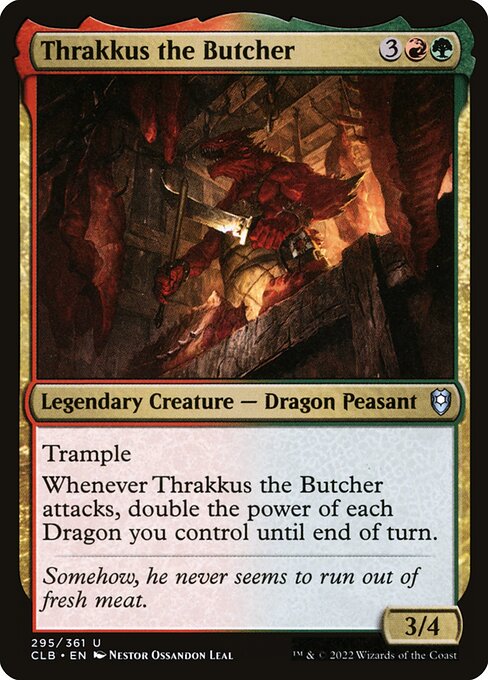
Thrakkus the Butcher
Combat commander
Check which Dragons can attack and survive rather than evaluating the power multiplier in isolation.

Ganax, Astral Hunter
Alternative commander
Entry based Treasures favor follow up development and can support a Background command zone.
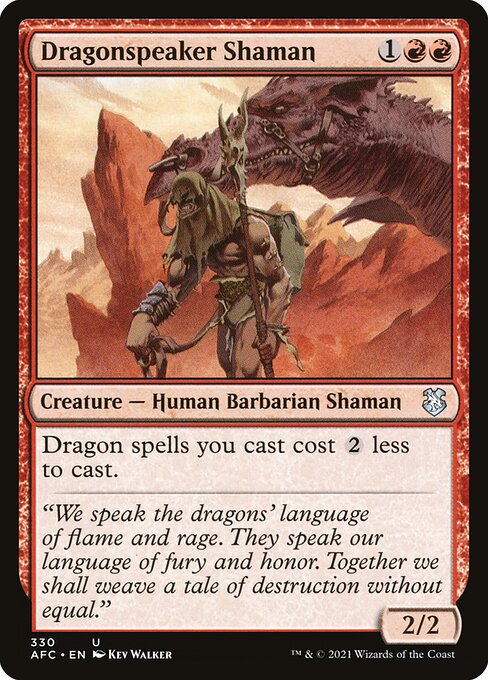
Dragonspeaker Shaman
Cost reduction
Its savings are useful only while it remains available for qualifying casts.

Dragonborn Champion
Card access
Damage from one sufficiently large source can provide another card without relying on total damage across the whole attack.

Savage Ventmaw
Attack mana
A legal attack can fund second main phase plays even when combat damage does not connect.
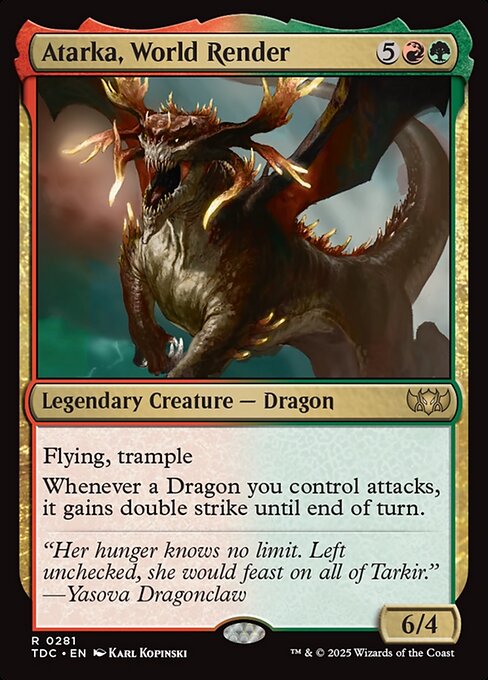
Atarka, World Render
Finisher
Older Dragons can receive double strike while Atarka stays back on the turn it arrives.
Budget Dragon questions
Build your deck
Put these choices into a Commander list. Create a free account to save your deck and keep tuning it with Deckcipher.
FAQ
Can Thrakkus and Ganax with Acolyte all be commanders?
No. Ganax can use choose a Background to pair with the Background Acolyte of Bahamut. Thrakkus does not join that command zone. Choose one legal commander arrangement and build within its color identity.
Do Dragon discounts replace the land and ramp package?
No. Discounts apply only to qualifying costs and ordinarily reduce generic mana. Lands and actual mana sources still pay colored requirements, support spells, and costs when the reducer is removed.
Does Thrakkus double toughness too?
No. His attack trigger doubles the power of each Dragon you control when the effect resolves for that turn. It does not double toughness or grant those creatures haste.
Does Savage Ventmaw need to hit a player to produce mana?
No. Its ability triggers when it attacks. If that trigger resolves, it produces the listed mana and lets you keep it as steps and phases end until that turn ends.
Does Earthquake Dragon count Dragon power for its discount?
No. It counts the total mana value of Dragons you control. Cost reductions used to cast those Dragons do not change their mana values.
Can Atarka help attackers on the turn it is cast?
Yes. Its ability can trigger when your other Dragons attack even if Atarka stays back. Atarka itself still normally cannot attack immediately unless it has haste or another applicable permission.