
Quick answer
Sultai staples should connect green mana, blue access, and black recovery with the commander's actual resource plan. Sultai Charm, Eternal Witness, and a suitable mix of cheap interaction are useful comparisons. Muldrotha permanents, Sidisi self-mill, Tasigur choices, Yarok entries, and Zaxara X spells each need different support. A large graveyard alone is not a finished engine.
Sultai resources need an intended use
Sultai is black, green, and blue. It can develop mana, draw or select cards, use the graveyard, and interact on several axes. Those strengths create many possible decks, from land engines and creatures to self-mill, X spells, and control. They can also create a list that spends the whole game preparing. Choose what the resources are meant to accomplish before adding another card that merely increases them.
Muldrotha, the Gravetide wants useful permanent types in the graveyard and mana to replay them. Sidisi, Brood Tyrant rewards creature cards moving from the library into the graveyard. Tasigur, the Golden Fang makes graveyard composition and an opponent's choice relevant. Yarok, the Desecrated rewards qualifying entry triggers. Zaxara, the Exemplary wants actual X-spell casts. One generic graveyard package cannot optimize all those events at once.
Keep a first useful turn in mind. A commander costing six needs meaningful development before it arrives. A self-mill plan needs access to the cards it mills. An X-spell plan needs enough mana to pay both X and the colored symbols. A flexible answer needs the relevant color left available. The best staple package connects these payments and events instead of assuming the engine will eventually work because the colors have strong cards.
Sultai-specific cards and their limits

Sultai Charm
Flexible instant
Can destroy a monocolored creature, destroy an artifact or enchantment, or draw two then discard one. Colorless and multicolored creatures do not fit the monocolored mode.
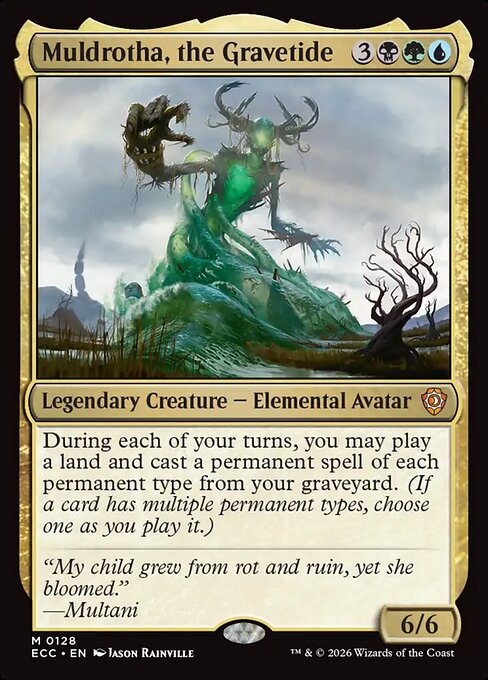
Muldrotha, the Gravetide
Permanent access
Provides limited graveyard play and cast permissions on your turns by permanent type. You still pay costs, use land plays, and choose a type for a card with several permanent types.
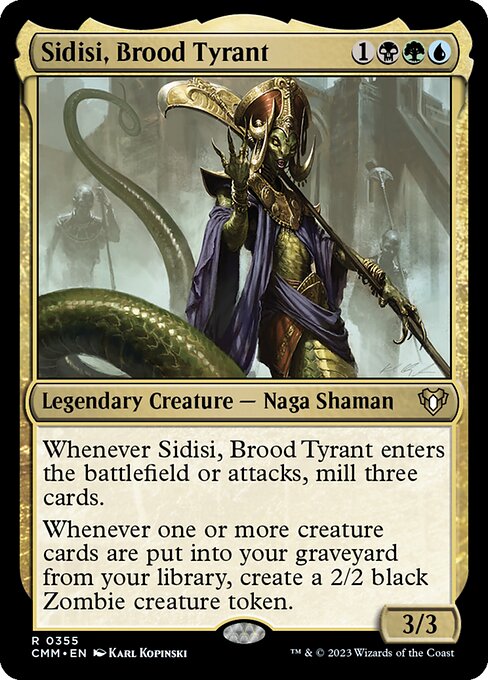
Sidisi, Brood Tyrant
Mill and token production
Mills on entry or attack and makes a Zombie when one or more creature cards move from your library to your graveyard. One batch is not a Zombie for every creature card milled.

Tasigur, the Golden Fang
Controlled graveyard choices
Delve can lower its generic cost, while its activation mills and lets an opponent choose a nonland card to return. The returned card is not always the one you most want.
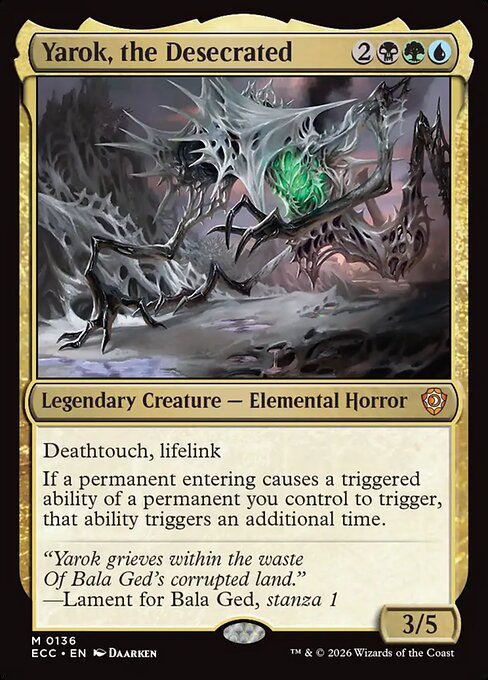
Yarok, the Desecrated
Entry-trigger support
Adds another occurrence of a qualifying permanent ability triggered by a permanent entering. It does not double every replacement effect or cast trigger.

Zaxara, the Exemplary
X-spell support
Taps for two mana of one color and rewards casting a spell with X in its mana cost with a Hydra. A spell copy not cast does not automatically create that trigger.

Villainous Wealth
Scalable access payoff
Uses X to exile cards from one opponent and offers casting qualifying spells without mana costs. It is a mana sink with variable outcomes, not guaranteed access to a particular finish.
Green development must provide all the needed colors
Nature's Lore and Three Visits find a Forest card, which can be a legal typed dual. They do not force that land tapped, but its own entry conditions still matter. Farseek can find a Plains, Island, Swamp, or Mountain and puts it tapped. Sultai can use its Island and Swamp access, including duals that also have Forest. Build the actual target range before counting the spells as full fixing.
Zagoth Triome has useful basic land types and can provide all three colors, but enters tapped. It can be a search target without being an immediate extra mana that turn. Command Tower supplies colors through a different kind of source and lacks those land types. A hand can contain several future colors and still fail an early green spell or blue answer because of entry timing.
Mana creatures, land ramp, and artifacts can all be useful, depending on the engine. Muldrotha may value a permanent it can replay. Yarok can reward a suitable entry ability from a creature. A more generic land-ramp spell can be resilient after wipes. Use Mana Base Calculator to review actual early sources, and count the colors needed for both the commander and the first follow-up.
Muldrotha needs types, mana, and legal timing
Muldrotha lets you play a land and cast a permanent spell of each permanent type from your graveyard during each of your turns. It is not unrestricted access to every card. Instants and sorceries are outside those permanent-spell permissions, and the land still uses an available land play. Casting a spell still needs its costs and applicable timing unless another effect changes them.
A card with multiple permanent types uses one chosen type for that permission as you play it. An artifact creature does not automatically consume or supply every category at once. This can make flexible permanent types useful, but requires tracking what has already been used that turn. Keep a clear note rather than treating a graveyard full of artifacts and creatures as unlimited free plays.
Choose useful low-cost permanents that do something when replayed: development, cards, or answers. Several expensive creatures may compete for the same creature permission and available mana. A small permanent with a sacrifice ability can be more useful than another large generic threat. Retain independent action for the turns before Muldrotha arrives and for games where the graveyard is removed.
Sidisi wants the correct card movement
Sidisi mills three on entering or attacking. Its Zombie trigger sees one or more creature cards put into your graveyard from your library. If a single mill event moves several creature cards, that event still creates one trigger from one Sidisi. Separate events can create separate triggers. Discarding a creature from hand does not meet the from-library condition merely because the card reaches the graveyard.
This gives creature density and mill-event structure a specific role. A card that repeatedly mills small batches can function differently from one large mill spell. A deck with many noncreature payoffs can reduce the chance that a mill event includes a creature. Do not maximize the mill total without checking the cards it moves and how the list accesses them afterward.
Tokens create a second resource, but their deaths do not place creature cards from the library into the graveyard. A Zombie sacrificed for value is not another Sidisi trigger by itself. A sacrifice outlet can still be useful for another payoff or recovery route. Keep the chain explicit: what mills, what creates a token, what spends it, and what gives the next useful card or mana.
Tasigur rewards a deliberate graveyard menu
Delve can exile graveyard cards to pay generic portions of Tasigur's cost. That may speed deployment but consumes resources another recursion plan could use. The commander still needs its required black mana and any remaining costs. Choose the cards exiled based on what the hand and future turns need, not simply the first cards available.
Its activation mills two and returns a nonland card of an opponent's choice from your graveyard to hand. The opponent can choose something less immediately useful than your best spell. Graveyard composition and the player chosen can therefore affect the result. A small curated range can create different decisions from a graveyard packed with redundant setup that the opponent can repeatedly return.
A political choice is not a guaranteed agreement. Another player may prefer you to answer the current threat, but that does not obligate them to return the card you requested. Build useful outcomes instead of assuming cooperation. Keep independent draw and a finish, and remember that a repeated activation still costs mana. The engine is a resource tool, not automatic access to every card you mill.
Yarok needs triggered abilities, not every entry effect
Yarok adds another occurrence of a qualifying triggered ability of a permanent you control when a permanent entering causes it to trigger. Landfall can qualify, as can many creature entry abilities. An instruction that replaces how a permanent enters is a different kind of effect. A counter placed as part of entering is not automatically another trigger for Yarok to duplicate.
Cast triggers are also a different event. Beast Whisperer follows casting a creature; Guardian Project follows a qualifying nontoken entry with its own same-name condition. A deck returning creatures directly to the battlefield may support the second and not the first. Choose the actual event rather than assuming all green creature draw gains the same benefit from an entry-focused commander.
A useful Yarok target should matter even when repeated value is interrupted. A creature that finds a land, draws, or answers an artifact can bridge development and engine use. A hand full of extra trigger multipliers may have no target worth repeating. Keep the ratio practical and retain some instant-speed answers so the deck can act without waiting for another sorcery-speed creature entry.
Zaxara and X spells require full cost accounting
Zaxara taps for two mana of any one color. It does not choose a different color for each of those two mana, and it normally cannot tap the turn it enters without haste. Its Hydra trigger requires casting a spell with X in its mana cost. A copy placed directly on the stack was usually not cast, so copying a large X spell does not automatically create another Hydra from Zaxara.
For a concrete hypothetical, Villainous Wealth with X equal to three costs three generic plus black, green, and blue before other modifications. Its X is three, while the spell's mana value on the stack includes those colored symbols. Zaxara's token receives three plus-one counters from that X. Do not replace the chosen X with the total mana paid or total mana value when calculating the Hydra.
Villainous Wealth targets one opponent and offers spells from the exiled cards that meet its X restriction. Lands are not spells to cast. The result depends on the opposing library and legal casts, so the spell is not a guaranteed selected finish. A large mana sink can be fun and useful without supporting an assertion that it wins every time. Retain reliable card access and interaction around the variable payoff.
Use black and blue access without overfilling draw
Night's Whisper works with no battlefield at a life cost. Fact or Fiction offers a pile choice and can supply graveyard material. Sultai Charm draws two then discards one, which combines access and setup with a smaller net hand increase than simply drawing two. Choose the missing function: quality, quantity, graveyard supply, or a particular answer.
Rhystic Study and Mystic Remora depend on opposing spell patterns and payments. Creature entry, cast, and death engines depend on your own events. A commander already supplying access can free some slots for pressure or protection. Do not add several expensive engines merely because Sultai can draw well. A list with resources and no finish can remain passive while opponents establish a decisive plan.
Self-mill is not ordinary draw. A card in the graveyard is useful only if the deck can access it in the relevant way. Several return spells can also become dead together after graveyard exile. Keep a mix of independent cards, useful permanents, and resource actions that function before the commander. The best draw upgrade depends on where the normal turn actually stalls.
Keep coverage for creatures, engines, and graveyards
Sultai Charm can destroy a monocolored creature, not a colorless or multicolored one. Its artifact-or-enchantment mode provides another range. Beast Within and Assassin's Trophy offer broader destruction with compensation, while Reality Shift can exile a creature with a manifested replacement. Counterspell and Arcane Denial act on the stack with different colored costs and drawbacks. Build the mix around the threats, not the count alone.
A temporary bounce effect can buy time and still leave an opponent able to replay the engine. A destroy effect can fail against indestructible. Graveyard hate can interrupt a recursion plan without touching the battlefield. Use Interaction Checker to inspect these categories, then keep scope and timing beside the names. A flexible spell still has restrictions that determine whether it solves the actual problem.
Soul-Guide Lantern can exile opponents' graveyards through one sacrifice ability while leaving yours alone. A symmetric sweep may remove your setup too. Heroic Intervention protects permanents, not graveyard cards. Choose the interruption tool and the fallback plan together. A deck should be able to continue after an opponent interacts with its primary zone rather than treating that interaction as outside normal Commander.
Make swaps that connect the next action
| Current failure | Comparison to test | Tradeoff |
|---|---|---|
| Muldrotha has several expensive cards of one type | A redundant large permanent to a useful cheaper type | Lower individual ceiling, more actual plays |
| Sidisi mills without enough useful creature outcomes | A disconnected noncreature payoff to a compatible creature | Different coverage and trigger density |
| Tasigur opponents return weak setup repeatedly | Review the graveyard menu and independent access | Less speculative accumulation, more useful choices |
| Zaxara makes mana but lacks a paid X turn | A redundant multiplier to development or action | Less theoretical token output, a functional spell sequence |
Save the earlier version and compare one bottleneck. Use Mana Curve Analyzer for printed setup costs, while noting X, delve, and activation payments manually. Prices vary by printing, so compare a real upgrade package. A cheap answer or reliable source can improve normal hands more than another premium engine that repeats the part the deck already does well.
Frequently asked questions about Sultai staples
Build your deck
Put these choices into a Commander list. Create a free account to save your deck and keep tuning it with Deckcipher.
FAQ
Does Sultai Charm destroy any creature?
Its creature mode targets a monocolored creature. A colorless creature has no colors and is not monocolored, while a multicolored creature also fails that restriction. Its other modes cover artifacts or enchantments and card access. Keep another answer for creatures outside the mode.
Does Sidisi make a Zombie for each creature milled?
One Sidisi triggers when one or more creature cards move from your library to your graveyard in an event. A batch containing several creates one trigger, not a trigger for each card. Separate mill events can create separate opportunities.
Does Muldrotha make graveyard cards free?
No. Its permissions still require costs, legal timing, and available land plays. It also uses permanent-type categories rather than unrestricted access to every card. Instants and sorceries are outside that permanent-spell permission. Track the type chosen for a multi-type card.
Does Yarok double cast triggers?
Its relevant ability concerns a permanent entering causing a triggered ability of a permanent you control to trigger. Casting is a different event. It also does not simply duplicate every replacement effect that changes how a permanent enters. Read the exact event and ability type.
Does Zaxara make a Hydra from every copied X spell?
Its trigger requires casting a spell with X in its mana cost. A copy placed on the stack usually was not cast. An effect that tells you to cast a copy creates a different event. Also use the chosen X, not the total mana paid, for the Hydra counters.
What is the main Sultai deckbuilding trap?
Accumulating mana, cards, and graveyard supply without enough useful actions or a finish. A resource engine needs an intended use and a fallback when its zone is disrupted. Fix the point where ordinary turns stall before adding another way to create more of the same resource.
Build Sultai with a destination for the resources
Build your deck around permanent reuse, mill, entry triggers, or paid X spells. Create a free account to save the version and compare it across the connected tools. Mark how each resource reaches the next action, including timing and costs. Sultai becomes coherent when its excellent resource tools lead to interaction and a finish instead of another turn of preparation.