
Quick answer
Rakdos staples should turn black card access and creature removal into a plan that benefits from red pressure, artifact interaction, or burst mana. Terminate, Rakdos Charm, Deadly Dispute, and Chaos Warp are useful comparisons. Sacrifice payoffs such as Mayhem Devil need actual sacrifice activity, while exile engines need enough mana to use the cards they reveal.
Choose which red-black resource engine you want
Rakdos is the black-red color pair. It can sacrifice creatures and artifacts, reuse graveyards, apply damage, and create explosive turns with temporary resources. Those strengths support several distinct decks: aristocrats, Treasures, reanimation, exile casting, spells, and creature combat. The colors alone do not decide which cards belong. A sacrifice payoff can be excellent in a token engine and nearly blank in a deck that mostly casts expensive creatures.
Start by naming what the commander supplies and what the rest of the deck must provide. A commander that creates expendable bodies needs outlets and payoffs. A commander that supplies card access may need mana and interaction. A commander that discounts creatures needs a way to turn on the discount and useful creatures to cast. Keep those pieces in balance before adding general-purpose engines simply because they are powerful.
Red and black both exchange resources rather than guaranteeing permanent accumulation. Black may spend life or a creature for cards. Red may exile cards with a deadline or create mana for one turn. A hand can look full of value while lacking the ability to pay those costs. A useful staple package supplies ordinary turns as well as dramatic ones, and includes a way to recover when an opponent removes the commander.
Rakdos candidates by role

Terminate
Creature removal
Destroys a creature and prevents regeneration. It does not bypass indestructible or target a noncreature permanent.

Rakdos Charm
Flexible interaction
Offers graveyard exile, artifact destruction, or creature-based damage to controllers as separate modes. Choose the relevant mode when casting.
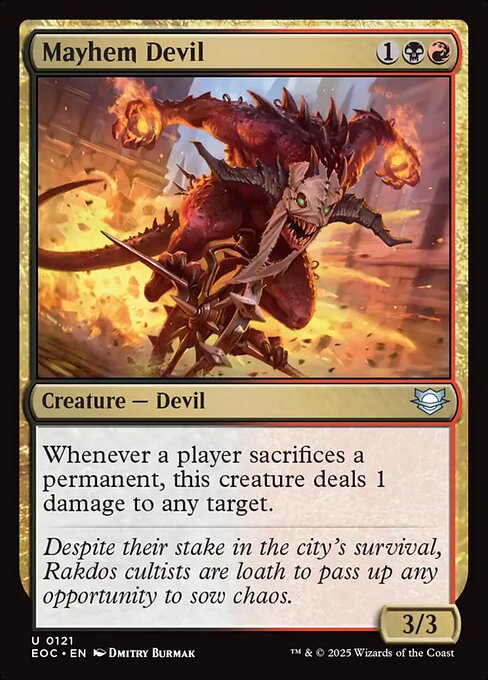
Mayhem Devil
Sacrifice payoff
Deals one damage to a target whenever a player sacrifices a permanent. It supplies no sacrifice outlet itself.

Deadly Dispute
Sacrifice draw
Sacrifices an artifact or creature as an additional cost, then draws two cards and creates a Treasure when it resolves.

Chaos Warp
Broad permanent answer
Can handle permanent types the pair struggles against, at the risk of a revealed replacement permanent.

Talisman of Indulgence
Early mana
Makes colorless without damage, or black or red while dealing one damage to you. It can normally tap once it resolves.
Use the two colors to cover different permanent types
Terminate is a clean comparison point for creature destruction. Two colored mana can remove a creature at instant speed, with regeneration prevented. Indestructible still prevents that destruction. Bedevil expands the target range to an artifact, creature, or planeswalker but requires more mana and two black pips. Neither can remove an enchantment. The more expensive card is not automatically the better staple if its extra coverage is already handled elsewhere.
Red gives access to Abrade, Vandalblast, and other artifact answers. Abrade chooses between creature damage and artifact destruction, while Vandalblast can be overloaded to remove opposing artifacts without destroying yours. Black supplies creature removal and some enchantment coverage through Feed the Swarm or Withering Torment. Compare those with Chaos Warp, which can target any permanent but may replace it through its reveal. Decide which drawback fits the list and the threats you expect.
Rakdos Charm is particularly useful when several narrow roles compete for space. Its graveyard mode targets a player and exiles that player's graveyard. Its artifact mode destroys one artifact. Its damage mode makes each creature deal one damage to its controller, which can punish a large creature army. That last mode is not unconditional player removal: life totals, prevention, and the exact board still matter. Flexibility reduces dead draws, but you still choose one mode.
Sacrifice engines need three connected parts
A sacrifice deck needs something to sacrifice, a way to sacrifice it, and a reason that the sacrifice matters. A card that makes tokens is not automatically an outlet, and an outlet is not automatically a payoff. Viscera Seer can sacrifice creatures to scry, while Goblin Bombardment converts a creature sacrifice into one damage. Mayhem Devil rewards a player sacrificing any permanent but does not provide the ability to sacrifice one.
Blood Artist and Zulaport Cutthroat reward creature deaths with different scope. Artist targets a player and can see creatures beyond your own. Cutthroat focuses on your creatures and drains each opponent. Tokens can die and trigger these abilities, but some other payoffs specifically require nontoken creatures. Read that distinction before counting every creature token as support for every death trigger. A payoff that triggers once each turn also behaves differently from one that can trigger repeatedly.
Avoid filling half the deck with payoffs while leaving only a few ways to produce fodder. In a normal hand, a token producer plus an outlet can be useful before you find the payoff. Three payoffs with no creatures may do nothing. Likewise, an outlet with no repeatable source can consume the board without establishing an engine. Build a working first loop of resources before multiplying the rewards.
Choose draw that does not eat the engine
Deadly Dispute and Village Rites are efficient when you have an expendable permanent or a creature that is already being removed. Their sacrifice is an additional cost, so losing the spell to a counter does not return the sacrificed card. Dispute can use an artifact as well as a creature and supplies a Treasure when it resolves. Those differences matter in a Treasure or artifact-token list.
Night's Whisper is less connected to sacrifice but works on an empty battlefield. That reliability can be valuable after a sweeper or in an opening hand without fodder. Faithless Looting improves selection and can stock the graveyard, but drawing two and discarding two does not create the same raw advantage as a two-card refill. Choose whether the deck needs cards, selection, or graveyard setup instead of placing every effect in one draw count.
Red exile access creates another requirement: enough mana and time to play the card. Professional Face-Breaker can sacrifice a Treasure to exile the top card with permission to play it that turn. It does not put that card into your hand or waive its costs. A land still needs an available land play. If you use the last Treasure merely to see another expensive card, you may lose access without gaining anything. Plan the rest of the turn before consuming the resource.
Treasure mana and sacrifice payoffs overlap, but are not identical
A Treasure normally sacrifices itself to make one mana of any color. That can trigger Mayhem Devil and help cast a spell in the same sequence. It remains a one-use resource. A Treasure count that grows during one explosive turn should not be treated as permanent mana for every later turn. If the deck spends all its tokens and then loses its engine, the next turn may have far fewer options.
Professional Face-Breaker triggers when one or more of your creatures deal combat damage to a player. Connecting several creatures with the same opponent produces one trigger for that player from that event, not a Treasure for every connecting creature. Connecting with multiple opponents can produce multiple triggers. The card wants a realistic attack pattern, evasion, and opportunities to spend or retain the Treasures afterward.
Do not count every artifact payoff as ramp. Dockside Chef can turn an artifact or creature into card draw through a paid sacrifice ability, but it does not create mana. A sacrifice outlet and a mana engine may be useful in the same deck without filling the same slot. Mark the actual resource each card produces so the list does not appear to have enough ramp while its opening hands remain slow.
Burst mana needs a useful destination
Dark Ritual trades a card and one black mana for three black mana once. Jeska's Will can produce red mana based on a target opponent's hand, provide temporary access to three cards, or use both modes when you control a commander. The colors and timing matter. Neither guarantees casting an expensive black-red spell if the remaining sources cannot provide its colored pips.
Mana Geyser rewards a board with many tapped opposing lands and gives red mana. That can enable a decisive turn when you have a compatible payoff, but it is awkward in a hand of reactive spells or heavy black requirements. Ruby Medallion reduces only generic costs of red spells. It does not remove a required black or red symbol from a multicolor spell. Compare the actual savings before counting it as equivalent to a two-mana rock.
A slower Rakdos deck can prefer permanent acceleration such as Arcane Signet, Talisman of Indulgence, or Rakdos Signet. The Signet needs a one-mana input to produce black plus red. A reliable turn-two accelerator may improve the deck more than another conditional ritual if the commander is expensive. Use Mana Base Calculator to inspect color access alongside total mana, and retain enough lands to cast the acceleration in the first place.
Reanimation and temporary theft reward different support
Reanimate can return a creature from any graveyard at a life cost based on its mana value. Animate Dead returns a creature through an Aura with its own conditions. A reanimator package needs setup as well as targets and return spells. If the hand contains only expensive creatures and recursion, it may lack a way to get a creature into the graveyard. Keep some targets you can cast normally and independent card access for games with graveyard hate.
Temporary theft effects can become removal when paired with a sacrifice outlet, but the outlet must accept the stolen permanent and be available at the relevant time. A creature stolen until end of turn normally returns if you do nothing else. Sacrificing it before that point can change the exchange, but an outlet that only accepts artifacts or has a tap restriction may not perform the intended job. Verify the complete line rather than assuming all sacrifice cards are interchangeable.
Not every Rakdos commander needs both packages. Prosper, Tome-Bound rewards playing cards from exile and supplies its own timed access. Rakdos, Lord of Riots instead needs an opponent to have lost life before it can be cast and reduces creature-spell generic costs according to opponents' life loss that turn. A generic reanimation suite may be central to one deck and an unnecessary detour in the other.
Choose wipes that leave a useful rebuild
Blasphemous Act deals thirteen damage to each creature and gets cheaper based on creatures on the battlefield. Its required red mana remains. It does not destroy indestructible creatures through damage alone. A deck with damage-based rewards may use it differently from a deck whose entire engine is made of fragile creatures. A cheap reset is still a reset of your own board unless you have a specific way to profit or survive.
Toxic Deluge uses life to give all creatures a toughness reduction. It can remove indestructible creatures if their toughness becomes zero or less, but it affects your creatures too. Living Death exchanges the battlefield with previously exiled graveyard creatures through its sequence and can give opponents a large new board. Count opposing graveyards before treating it as a one-sided reanimation spell.
A sacrifice deck may gain death triggers from a reset, but those triggers do not guarantee that rebuilding is easy. Tokens disappear after leaving the battlefield, and a graveyard return spell cannot simply return a token card later. Retain a producer, recursion target, or draw spell that allows the next turn to matter. If the deck regularly ends a wipe with no resources, another payoff may be less useful than recovery.
Make focused replacements instead of adding every engine
| Observed problem | Comparison to test | What the swap costs |
|---|---|---|
| Removal ignores enchantments | A redundant creature kill spell to Withering Torment | Different mana and life requirements |
| Too many death payoffs, no outlet | An extra drain creature to Goblin Bombardment | Less passive drain, more control over deaths |
| Draw spells lack fodder | Village Rites to Night's Whisper | Independent access loses sacrifice utility |
| Rituals create mana without action | A redundant burst spell to compatible draw | Less explosive ceiling, more meaningful resources |
Keep a copy of the original version and test one role at a time. The Interaction Checker can help expose missing answer types, while the Mana Curve Analyzer shows when engines compete for the same turn. Neither replaces checking whether a sacrifice outlet accepts your tokens or whether an exile permission lasts long enough. The details determine whether the engine works.
Frequently asked questions about Rakdos staples
Build your deck
Create a free Deckcipher account to save this Commander list and compare each change with the connected tools.
FAQ
Does every Rakdos deck need sacrifice cards?
No. Sacrifice is a strong option, but Rakdos also supports exile casting, reanimation, damage, and combat. Add outlets and payoffs when the commander and creature or artifact supply support them. A few disconnected sacrifice cards can weaken an otherwise coherent spell or creature plan.
Can Terminate kill an indestructible creature?
No. Terminate destroys the target creature and prevents regeneration, but indestructible still prevents destruction. Use exile, a suitable toughness reduction, sacrifice when the choice can be constrained, or another appropriate answer for that problem. Regeneration and indestructible are different defenses.
Is Rakdos Charm always lethal against a token deck?
No. Its damage mode makes each creature deal one damage to its controller. The result depends on the creature count, life totals, and applicable prevention or other effects. It can be a strong punishment for a large board without being automatic player removal.
Does Mayhem Devil create a sacrifice outlet?
No. It triggers when a player sacrifices a permanent and deals one damage to a target. You still need an effect that allows the sacrifice. Treasure tokens, fetch lands, and outlets can provide sacrifice events, but the Devil does not let you sacrifice arbitrary permanents by itself.
Does exile access count as drawing cards?
It can provide useful access, but it is not a draw event. It usually has a deadline and still requires the mana and permission to play the exiled card. That distinction matters for draw triggers, timing, land plays, and how much mana the turn needs.
What should I upgrade before a premium Rakdos engine?
Check lands, early acceleration, card access that works without setup, and answers to noncreature permanents. If those roles are missing, another engine may only make the best hands stronger. Fix the normal turns and the recovery plan before spending the budget on a higher ceiling.
Build a Rakdos engine that can keep playing
Build your deck with the resource flow visible: what produces fodder, what spends it, what rewards it, and how the deck rebuilds. Create a free account to save that list and compare each change with the connected tools. A strong red-black package can be explosive, but its most useful feature is a sequence you can actually pay for and repeat in the games you intend to play.
For an opening-hand check, separate the resources you already have from the ones you hope to create. Two lands, a sacrifice payoff, and an expensive token maker do not supply an early sacrifice engine. A ritual may cast that maker sooner but leave you without protection. A two-mana rock may be slower on the first turn yet support later turns. Keep the hand only when its actual land sequence and costs support a useful first play.