
Quick answer
Jund staples should connect green development, black resource exchange, and red pressure or artifact interaction. Jund Charm, Riveteers Charm, Maelstrom Pulse, and a compatible sacrifice engine are useful comparisons. Korvold, Henzie, and Ziatora reward different sequences, so choose the event your deck produces before adding more payoffs.
Build Jund around a resource you can actually spend
Jund is black, red, and green. It offers land ramp, creature value, sacrifice, graveyard recovery, and damage. The colors can support grindy engines, expensive creature combat, tokens, or explosive sacrifice turns. The familiar good-stuff label does not tell you which package will function. Start with the commander's resource exchange and build enough supply to pay for it.
Korvold, Fae-Cursed King rewards sacrificing permanents. Henzie "Toolbox" Torre grants blitz to a particular range of creature spells. Ziatora, the Incinerator converts another creature at your end step into damage and Treasures. A creature can be useful for one of these plans and poorly timed for another. A large body without an entry or death effect may be acceptable for Ziatora and less attractive when a Henzie list wants immediate value from its short-lived creatures.
Give the list a normal early game as well as an impressive late turn. A five- or six-mana commander needs lands, acceleration, and useful plays before it arrives. Several sacrifice rewards do little without a permanent to spend. Several recursion spells do little without a target. Keep independent cards that develop resources, answer a threat, or draw when the commander is absent.
Jund-specific cards and their restrictions
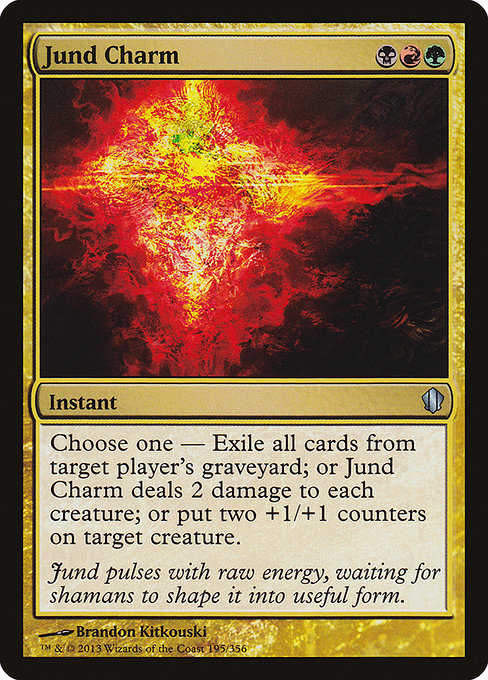
Jund Charm
Flexible instant
Can exile one player's graveyard, deal two damage to every creature, or place two plus-one counters on a creature. It supplies one selected result, not a general answer to every permanent.

Riveteers Charm
Access or interaction
Can force an opponent to sacrifice a highest-mana-value creature or planeswalker, provide timed access to three cards, or exile a graveyard. Opposing choices and the access deadline matter.

Maelstrom Pulse
Broad sorcery removal
Destroys a nonland permanent and other permanents with the same name. That can affect your copies too, and it still uses destruction.
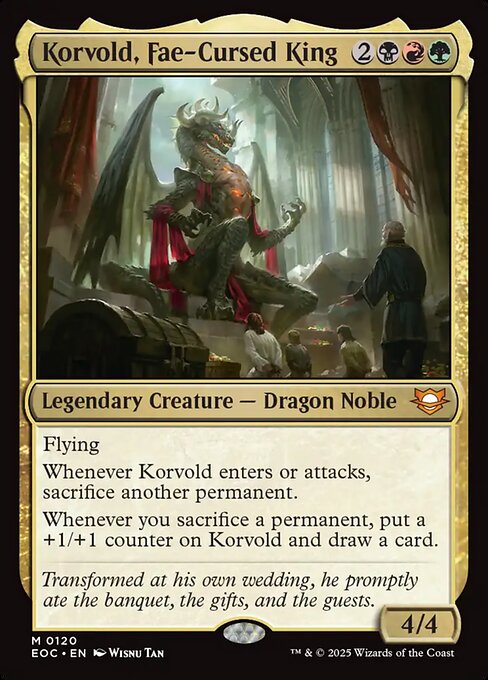
Korvold, Fae-Cursed King
Sacrifice engine
Requires another permanent to be sacrificed when entering or attacking and rewards your sacrifices with a counter and a card. It needs expendable resources as well as protection.
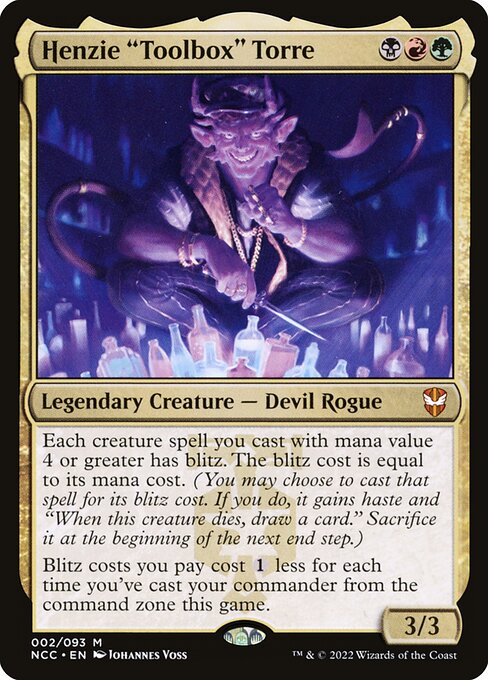
Henzie "Toolbox" Torre
Blitz support
Grants blitz to creature spells with mana value four or greater. Its discount follows commander casts from the command zone and reduces generic payment, not required colored pips.
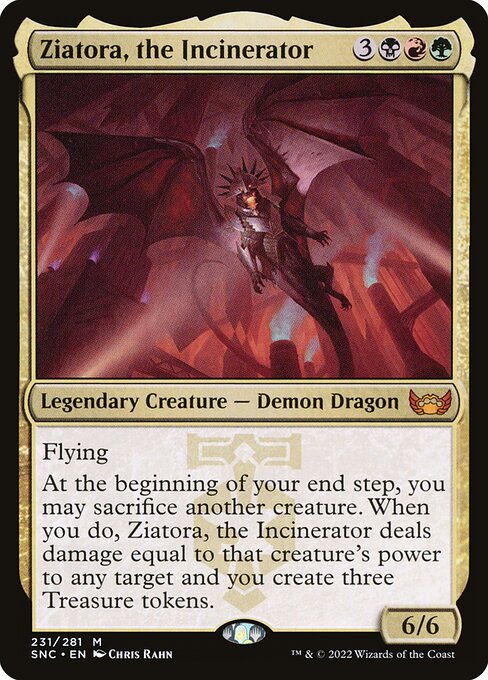
Ziatora, the Incinerator
End-step conversion
Can sacrifice another creature at your end step, then deal damage based on its power and create three Treasures. The trigger is not an outlet available at every moment.

Riveteers Ascendancy
Descending recursion
Can return a lower-mana-value creature after a creature sacrifice, tapped and only once each turn. It needs a legal lower-value target rather than simply any graveyard creature.
Green development should cast the real colored costs
Nature's Lore and Three Visits can find a Forest card, including an appropriate typed dual. The spells do not force the land tapped, but the land's own entry condition still applies. Farseek can find a Plains, Island, Swamp, or Mountain and puts the chosen land tapped. Jund can use its Swamp and Mountain access, including duals that also have Forest, while a plain basic Forest is not a Farseek target.
Sakura-Tribe Elder can convert a creature into a tapped basic land through a sacrifice ability without a tap symbol. That can support a death or sacrifice engine and create lasting mana. Birds of Paradise supplies color fixing through a creature that normally must wait to tap. Land ramp and mana creatures face different removal risks. Choose the mix based on timing, creature count, and how the deck recovers after a wipe.
A Treasure can provide a needed color once, but spending it also reduces the reserve available for other costs or artifact-count payoffs. Korvold can reward the sacrifice, yet the mana remains temporary. Use Mana Base Calculator to review the actual early colors. Do not assume a large green ramp count guarantees black-red support spells or the commander's complete colored cost on the desired turn.
Supply, outlets, and rewards are different slots
A sacrifice deck needs permanents to spend, effects that permit spending them, and payoffs that make the exchange worthwhile. Viscera Seer offers creature sacrifice for selection. Goblin Bombardment turns creatures into damage. Mayhem Devil rewards any player sacrificing a permanent. The Devil does not supply an outlet, and a token producer does not automatically let you sacrifice the tokens whenever you choose.
Korvold can draw from a sacrificed Treasure, fetch land, creature, or other permanent. That broad scope can make resource pieces work together, but its entry and attack trigger also asks you to sacrifice another permanent. If the board contains only essential sources, the exchange may be costly. Build expendable supply before multiplying the rewards, and retain enough mana after sacrifices to use the cards drawn.
Ziatora operates at a particular end-step window. It can use a creature that already attacked or supplied entry value, but it is not an emergency outlet for every targeted removal spell during an opponent's turn. An independent outlet can provide that timing at the cost of another slot. Choose whether the deck needs that control rather than assuming the commander's sacrifice text covers every situation.
Henzie wants creatures worth a short visit
Henzie grants blitz to creature spells with mana value four or greater. Casting through blitz gives haste and a death-draw ability, followed by a sacrifice at the beginning of the next end step. The temporary body can produce immediate entry value, attack, and later replace itself if it dies as required. A creature that needs several untaps to begin doing anything may be a weaker fit.
The blitz discount counts times you have cast your commander from the command zone. Returning the commander directly to the battlefield is not another cast for that count. A discount reduces generic costs but cannot erase colored pips. A creature can qualify by mana value and still demand colors the mana base cannot provide. Review the actual payment instead of translating every large creature into a presumed cheap play.
Blitz and reanimation are different events. Putting a creature directly onto the battlefield did not cast it for a blitz cost, so it does not automatically acquire that temporary package. A creature-return effect can still be useful, but choose it for the permanent value or repeated entry it provides. Do not assume every return also draws when the creature dies. The casting choice and granted ability matter.
Choose card access for the resources you have
Night's Whisper works without a creature at a life cost. Deadly Dispute needs an artifact or creature sacrificed as an additional cost and supplies cards plus a Treasure when it resolves. A deck rich in expendable material can use Dispute well, while a hand with only its commander and essential mana may prefer unconditional access. Count the resource spent, not only the words draw two.
Moldervine Reclamation rewards your creatures dying, while Guardian Project rewards qualifying nontoken entries. Beast Whisperer rewards creature casts. Henzie can naturally produce casts and later deaths; a recursion-heavy list may favor entries instead. Choose engines that see the actual sequence. A large creature count does not make every creature-based draw effect equally reliable.
Riveteers Charm provides access to the top three cards until your next end step, rather than only the current turn. You still need mana and legal timing to play those cards, and land plays remain limited. Casting it on an opponent's turn can create a different window from casting it during your own main phase. Plan when the access expires before spending the last mana on the spell.
Use the color combination for broad coverage
Black can handle creatures, red can remove artifacts, and green can answer artifacts or enchantments. Assassin's Trophy can destroy an opposing permanent with basic-land compensation. Beast Within destroys a permanent and supplies a token. Terminate destroys a creature and prevents regeneration but not indestructibility. Pick a mix that covers the threats rather than several cards that all destroy the same creature types.
Maelstrom Pulse can remove multiple permanents sharing a name with its target. That can be useful against some token boards, but your matching permanents can be included too. It is a sorcery and does not bypass indestructible. A token's name and characteristics depend on how it was created, so do not assume every token of a vaguely similar theme shares the same name.
Jund Charm offers a small creature reset, graveyard exile, or counters. Two damage can remove small utility creatures but will not clear every large board. Riveteers Charm's sacrifice mode restricts the opponent to a greatest-mana-value creature or planeswalker among those they control. It is not a targeted instruction to sacrifice whichever cheap engine you dislike. Use Interaction Checker and keep these restrictions visible beside the categories.
Recursion should have a useful target after the sacrifice
Eternal Witness returns a card to hand on entering. Reanimate returns a creature from any graveyard at a life cost. Victimize needs two graveyard targets and a creature to sacrifice during resolution, then returns those targets tapped. These cards recover different resources and ask for different setup. The creature sacrificed to Victimize cannot become one of the already chosen targets during that resolution.
Riveteers Ascendancy can return a creature with lesser mana value than the creature sacrificed, tapped and only once each turn. A normal token with mana value zero does not supply a route to an ordinary positive-value creature through that lesser-value restriction. Token copies can have different mana values, so read the token's origin rather than assuming every token is zero. The recovery chain needs actual descending values.
Keep some action that survives graveyard exile. Returning a spent creature is powerful until the relevant card is gone. A list with several return spells can still be helpless if none has a target. Castable threats, independent draw, and lasting land development provide a fallback. A graveyard engine should create additional choices rather than turn one opposing exile effect into several unusable cards in hand.
Protection and wipes need to agree with the engine
Heroic Intervention gives your permanents hexproof and indestructible for the turn. It can preserve a board through destruction, but not every exile, sacrifice, or toughness-reduction effect. Tamiyo's Safekeeping can focus on one permanent. A deck investing in Korvold may value cheap single-target protection differently from a token army needing broad preservation. Choose the exposed resource that matters most.
Blasphemous Act deals thirteen damage to creatures with a cost reduction based on creatures present. Indestructible creatures survive that destruction route. Toxic Deluge can instead reduce toughness at a life cost. Living Death can reset creatures and recover graveyard bodies, including opponents' creatures. A sacrifice deck can profit from deaths without assuming every reset leaves it ahead.
If the deck sacrifices all its producers and then wipes, its payoffs may have nothing left to reward. Retain a useful recovery target, a hand of new action, or a commander-independent producer. Tokens normally cease to exist after leaving the battlefield, so ordinary reanimation cannot retrieve the pile. Recovery should match what the deck actually spent or lost.
Make the finish follow the resource chain
Jund can win through combat, repeated sacrifice damage, recursion, or a verified compact loop. A deck that already turns creature power into Ziatora damage may need protection and repeated supply rather than a separate team-combat package. A Henzie list may pressure opponents through short-lived threats, while Korvold can convert sacrifices into cards and a large flying attacker. Choose the route the normal turns prepare.
A repeatable sacrifice line is not automatically infinite. Count the cost to return the creature, the permanent supply, the mana produced, and any once-per-turn restriction. A death payoff may reduce opponents' life without refunding the mana required for the next repetition. Riveteers Ascendancy's limit and lower-value condition are examples of details that prevent a vague recursion story from becoming a real loop.
Explain intentional loops or large deterministic turns before games. A deck can look like creature value and still contain a compact finish. Conversely, several expensive staples may simply support a combat plan. Clear expectations help choose an appropriate amount of tutoring, burst mana, and protection. The goal is a coherent list for the games you want, not the largest collection of individually powerful Jund cards.
Make cuts at the missing link
| Current problem | Comparison to test | Tradeoff |
|---|---|---|
| Several sacrifice payoffs and no reliable outlet | A redundant reward to Goblin Bombardment or another suitable outlet | Less payoff density, more control of the event |
| Henzie threats need several turns to work | A slow setup creature to a useful entry or attack threat | Less long-term ceiling, better short visit |
| Korvold draws cards but consumes colored sources | Some expendable-source dependence to stable land development | Less burst synergy, better casting after the exchange |
| Recursion fills the hand with no legal targets | A redundant return spell to independent draw | Less graveyard focus, a fallback resource route |
Keep the old version and compare one problem at a time. Use Mana Curve Analyzer to inspect the expensive end, while noting Henzie discounts and sacrifice costs manually. Price the actual printings and the full package before buying. A modest producer, reliable source, or useful cheap answer can improve normal games more than another premium reward for a resource the deck still cannot supply.
Frequently asked questions about Jund staples
Build your deck
Put these choices into a Commander list. Create a free account to save your deck and keep tuning it with Deckcipher.
FAQ
Does every Jund deck need sacrifice cards?
No. Jund also supports creature combat, lands, graveyards, and other plans. Sacrifice cards are useful when the commander and permanent supply support them. A few disconnected payoffs can consume slots without creating a working engine.
Does Henzie discount colored mana?
Its blitz discount reduces generic payment and does not erase required colored pips. The creature must qualify by mana value, and the discount follows commander casts from the command zone. Putting the commander directly onto the battlefield is not another cast for that count.
Is Ziatora an outlet I can use whenever I want?
Its sacrifice opportunity comes from its beginning-of-end-step trigger. It is not a repeatable activated outlet available in response to every removal spell. Add a separate outlet if the deck needs that timing, and make sure it accepts the permanent you intend to spend.
Does Riveteers Ascendancy return any creature?
No. It requires a target with lesser mana value than the sacrificed creature, returns it tapped, and operates only once each turn. The restrictions matter for token fodder and repeated loops. Plan actual descending targets rather than assuming general recursion.
Does Maelstrom Pulse only hit opponents' copies?
No. After destroying its targeted nonland permanent, it also affects other permanents sharing that name, including yours. Check names and the current board before using it as a token answer. It also remains destruction, not exile.
What should a Jund deck upgrade first?
Find the missing link: early colored mana, permanent production, a usable outlet, card access, or a compatible finish. Another powerful payoff rarely fixes a supply problem. Improve the normal resource exchange before increasing its ideal ceiling.
Build Jund around a complete exchange
Build your deck with supply, outlets, rewards, and recovery marked separately. Create a free account to save that version and compare it across the connected tools. For each staple, name what it costs and what resource remains afterward. Jund becomes more reliable when the next turn is part of the plan, rather than an assumption made after the current sacrifice.