
Quick answer
Izzet staples should connect blue card selection and counters with red mana, copying, and artifact answers. Izzet Charm, Expressive Iteration, Goblin Electromancer, Storm-Kiln Artist, and Archmage Emeritus are role-dependent options. Start with the spells your commander wants to cast, then choose engines that reward those exact events.
Choose the kind of blue-red deck first
Izzet is the blue-red color pair. Its commanders support spells, artifacts, Dragons, copying, combat, and other engines. The colors offer an attractive spellslinger package, but that package is not automatically useful in every list. A Jhoira, Weatherlight Captain artifact deck may need cheap historic spells more than expensive instant-and-sorcery payoffs. A large-creature deck may want a smaller interaction package and reliable mana instead.
For a spell deck, choose what the spells accomplish. Cheap cantrips can find resources and trigger a commander, but do not normally generate raw card advantage. Copy effects can multiply a valuable spell, but need a worthwhile target and mana to act in the same window. A payoff can reward several casts, but does nothing by itself when the hand is empty. Build the chain rather than collecting the most recognizable engines.
Blue-red often has many ways to spend a turn and fewer ways to repair a stalled battlefield. Keep actual creature answers, artifact interaction, and a route through troublesome enchantments. A list with a large draw count can still lose with cards in hand if every answer works only before a permanent resolves. Define those missing roles before adding another spell-copying enchantment.
Izzet candidates and their restrictions
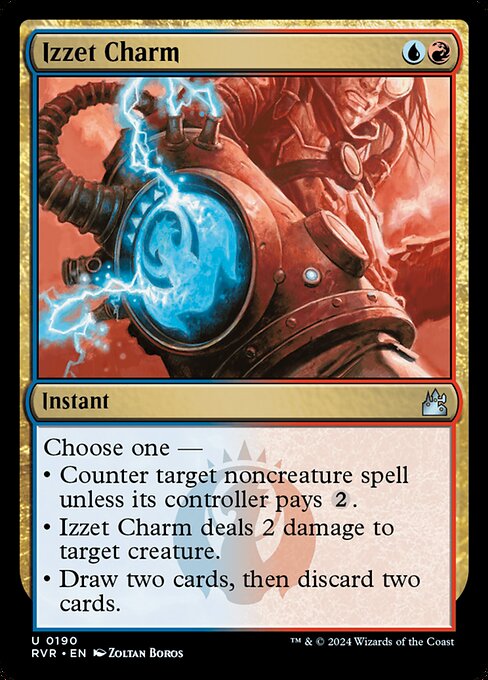
Izzet Charm
Flexible small interaction
Offers a noncreature counter with a payment escape, creature damage, or draw-and-discard selection. Choose one mode, not every effect.

Expressive Iteration
Card access and selection
Distributes the top three among hand, library bottom, and exile. The exiled card can be played only that turn.

Goblin Electromancer
Cost reduction
Reduces generic costs of your instant and sorcery spells. It does not remove colored pips or discount every spell type.

Storm-Kiln Artist
Spell-based mana
Magecraft creates a Treasure when you cast or copy an instant or sorcery. It needs those events and is a four-mana setup creature.

Archmage Emeritus
Spell-based draw
Magecraft draws when you cast or copy an instant or sorcery. A copied spell can qualify even though it was not cast.

Prismari Command
Flexible two-mode spell
Select two listed modes for damage, selection, Treasure, or artifact destruction. Its options solve different parts of a turn.
Selection should lead to resources, not replace them
Ponder and Preordain smooth early draws and help find a needed land or answer. Ponder has an optional shuffle, while Preordain can move unwanted cards to the bottom through scry. Brainstorm draws three and returns two cards to the top, which becomes more useful with a way to move those returned cards away. None is a guarantee that a weak hand will find the missing resource.
Expressive Iteration asks for a plan before you spend the mana. You put one of the top three into hand, one on the library bottom, and one into exile with permission to play it that turn. A land in exile still needs an available land play. A spell still needs mana and a legal casting time. Casting Iteration after your land drop with little spare mana can waste part of its access. Sequence it around what the turn can actually use.
Faithless Looting and Izzet Charm can stock a graveyard while improving card quality, but discarding cards is not the same as drawing extra resources without a cost. A deck that uses flashback or recursion can value the discarded cards more than a deck that cannot. Keep some actual refill or repeated draw if the commander does not supply it. Several cantrips and looting effects do not automatically prevent the hand from running empty.
Cost reducers need reducible costs
Goblin Electromancer reduces the generic portion of instant and sorcery costs. A spell costing one blue has no generic portion to reduce. A spell costing one generic plus one blue can become one blue. A multicolor spell still requires its colored mana. This is why the printed number of instant and sorcery cards is not enough to judge a reducer. Examine the actual costs you expect to pay over a turn.
Baral, Chief of Compliance also reduces instant and sorcery costs and can provide draw-and-discard selection when your spell or ability counters a spell. That second ability is not a free card whenever anyone counters anything. It has its own controller and event requirements. A creature that supplies repeated discounts can be valuable, but it also exposes part of your mana plan to creature removal.
Compare a reducer with a two-mana rock in realistic hands. The rock can pay toward the commander and many spell types, while the reducer may save several mana during a spell chain. If the hand has one qualifying spell and several artifacts, the reducer may do little. If it has several qualifying spells with generic costs, the savings can compound. Choose the resource pattern the commander actually needs.
Copying is different from casting
A spell copy placed directly onto the stack is usually not cast. It can trigger an ability that explicitly sees copying an instant or sorcery, but not an ability that only rewards casting. Archmage Emeritus and Storm-Kiln Artist use magecraft and can see both events. Young Pyromancer rewards casting an instant or sorcery instead, so a copied spell does not automatically produce another Elemental from that ability.
Thousand-Year Storm counts other instant and sorcery spells you have cast that turn when it produces copies. The copies it creates do not themselves increase that cast count. It is a substantial setup enchantment, and a hand needs both mana and spells afterward to exploit it. A copy engine can have a high ceiling without being a useful draw in every ordinary turn.
Veyran, Voice of Duality can add another occurrence of certain triggered abilities of permanents you control when casting or copying an instant or sorcery causes them to trigger. That is not a blanket instruction to double every copied spell or every effect in the deck. Check the event and the exact permanent ability. The interaction can be powerful, but it should be described as a verified sequence rather than a vague promise that everything doubles.
Keep counters and resolved-permanent answers together
Counterspell has broad spell coverage but asks for two blue mana. Arcane Denial is easier to cast and compensates the target spell's controller with cards. Swan Song covers a restricted set of types. Izzet Charm can counter a noncreature spell unless its controller pays two, so it becomes less reliable as opponents gain spare mana. Choose which window and restriction the list can support.
Blue offers Pongify and Rapid Hybridization for creature destruction with a replacement token, and Reality Shift for creature exile with a manifested replacement. Resculpt can exile an artifact or creature and gives a 4/4 token. Destruction does not answer indestructible in the same way exile does. Red supplies Abrade and Vandalblast for artifacts, while Chaos Warp can cover a broader permanent with its replacement risk.
An enchantment already on the battlefield can be a particular concern for blue-red. Countering it was one window; a bounce spell or Chaos Warp is a later option. Bounce can buy time without permanently solving the issue. Use Interaction Checker to compare the mix, then identify what the deck does during the time a temporary answer creates. A turn of relief is useful only if it helps you stabilize or close.
A mana engine is still a setup investment
Storm-Kiln Artist costs four mana before its magecraft triggers can repay the investment. A deck with several cheap spells can produce Treasures during a chain, but a hand with only expensive follow-ups may not start that chain. The Treasures are one-use mana, not permanent resources after you sacrifice them. Keep an early acceleration package that does not depend entirely on a four-mana creature surviving.
Jeska's Will can produce red mana based on a target opponent's hand or temporary access to three cards, and can use both modes if you control a commander. The exiled cards still need to be played that turn. Mana Geyser depends on tapped opposing lands and gives red mana. Both can create a large window, but neither supplies blue pips just because the total mana is impressive.
Arcane Signet, Talisman of Creativity, and Izzet Signet can support more ordinary development. The Signet needs a one-mana input to make blue plus red. The Talisman taps for one mana directly, while dealing one damage to you for colored output. Sol Ring does not solve colored costs such as Niv-Mizzet, Parun's three blue and three red. A strong generic-mana hand can still fail to cast the central engine.
Recursion should connect to the spells you can use
Past in Flames gives instant and sorcery cards in your graveyard flashback for the turn, with flashback costs based on their mana costs. It does not grant that access indefinitely or waive the mana needed to cast them. You need a stocked graveyard, available mana, and a useful sequence. Flashback also changes where the spell goes when it leaves the stack, so the same resource is not necessarily reusable on every future turn.
Mizzix's Mastery can exile a graveyard instant or sorcery and let you cast a copy without paying its mana cost, with overload offering a larger version. The instruction to cast the copy is different from simply placing a spell copy on the stack, so cast triggers can matter. Read the exact permission and timing rather than importing the usual statement that all copies are never cast. The wording determines the event.
Archaeomancer can return an instant or sorcery to hand on entering. That is slower but can support creature recursion or blink. A spell deck without those synergies may prefer a different recovery effect. Keep room for graveyard interaction too. A recursion plan can fail when opponents remove its resources, and your own symmetric graveyard sweep may remove the spell package you intended to reuse.
Let the commander decide the payoff density
An Izzet deck using Talrand, Sky Summoner in the ninety-nine can turn instant and sorcery casts into creatures. Cheap interaction and cantrips can therefore advance both resource quality and pressure. The deck still needs a way to turn the resulting army into a finish, and a copied spell does not automatically count as another cast. Retain enough actual spells after adding token payoffs and protection.
A Veyran deck can emphasize magecraft and other qualifying triggers, while Mizzix of the Izmagnus rewards a specific sequence of spell costs through experience counters and discounts. A Niv-Mizzet, Parun deck has demanding colored mana and a commander that already supplies draw-related pressure. The same generic package can overfill one role in one list and leave another list without a resource engine.
Artifact Izzet needs another comparison. Jhoira, Weatherlight Captain rewards historic spell casts, which include artifacts, legendary spells, and Sagas. An instant-and-sorcery reducer may be less relevant than a cheap artifact or reliable protection for that engine. Choose the payoff after reading the commander, not after choosing the color pair. This preserves the reason for building a distinct deck rather than another interchangeable spell pile.
Choose a finish and leave room for it
A spell-triggered creature army can win through combat, a damage engine can convert repeated casts into life loss, and a carefully built spell chain can support a different finish. Avoid assuming that drawing many cards is itself a win. The deck needs a route from resources to an ending, and enough mana and protection to use that route when it appears.
A large X spell has a scalable cost and can be copied, but copies retain the chosen X unless an effect says otherwise. Casting a spell without paying its mana cost normally means an X in that cost must be zero unless another rule or effect provides a different instruction. That can make a graveyard-copy effect a poor pairing with an intended huge X finisher. Check the actual payment and copy sequence before adding the package.
Discuss repeated extra turns, long spell chains, or deterministic loops before a game when they are central to the list. Those plans can change the play experience even when the deck has no fast opening. A clear explanation helps you choose support at the desired pace. It also prevents adding an explosive staple that gives the list a different identity from the one the rest of the group expects.
Make swaps that improve actual spell turns
| Problem you observe | Comparison to test | Tradeoff |
|---|---|---|
| Reducers see too few generic costs | A redundant reducer to a mana rock | Broader casting support, less chain ceiling |
| Many copy spells, no useful targets | A redundant copier to draw or interaction | Less multiplication, more functional resources |
| The deck cannot answer a resolved enchantment | A redundant creature answer to Chaos Warp or suitable bounce | Replacement risk or temporary relief |
| Selection empties the hand | A redundant cantrip to a compatible draw engine | Higher setup cost, repeated access when supported |
Save the old version and change one bottleneck at a time. Use Mana Curve Analyzer to inspect the setup costs and Mana Base Calculator to review the pips needed during a chain. A turn can have enough total mana and still lack blue for protection. Price the actual printing before buying, and improve the cards that make ordinary turns work before collecting every premium copy engine.
Frequently asked questions about Izzet staples
Build your deck
Put these choices into a Commander list. Create a free account to save your deck and keep tuning it with Deckcipher.
FAQ
Does a copied spell trigger cast abilities?
Usually a copy placed directly onto the stack was not cast, so cast-only abilities do not trigger. An effect that specifically tells you to cast a copy creates a cast event instead. Magecraft abilities can explicitly see casting or copying instants and sorceries. Read the effect that creates the copy.
Does Goblin Electromancer reduce colored mana?
No. It reduces generic costs of your instant and sorcery spells. Required red or blue pips remain. A spell with no generic portion may receive no discount. Compare actual costs and expected casts rather than simply counting the number of spells in the deck.
Can Expressive Iteration play its exiled card later?
Only during the turn specified by its permission. You still need mana, legal timing, and an available land play if it is a land. The other chosen card goes into hand and has no exile deadline. Plan the turn before casting Iteration with little mana left.
Is Storm-Kiln Artist early ramp?
It is a four-mana creature that generates Treasures from qualifying later events. It can fuel a spell chain but does not replace the early mana needed to cast it. A deck with slow opening hands may need cheaper rocks or better lands before another engine.
Should every Izzet deck use spellslinger staples?
No. Artifact, Dragon, combat, and other commanders can need different support. Jhoira rewards historic casts, while a magecraft commander rewards a different event. Choose engines that follow the normal action of your actual list. Color identity provides access, not a requirement to use one archetype.
What is the main Izzet deckbuilding trap?
Adding too many engines and copy effects while leaving too few useful spells, resources, or answers. The best hand should not need three setup permanents before doing anything. Keep ordinary early turns, a recovery route, and a clear finish alongside the exciting spell chain.
Build an Izzet package with a legal sequence
Build your deck around the casts, copies, or historic spells your commander actually rewards. Create a free account to save it and compare the same list across the connected tools. For every proposed engine, name the first useful follow-up and its cost. That makes the staple package a sequence you can execute instead of a collection of promises about a spectacular future turn.