
Quick answer
Grixis staples should connect blue selection and counters with black recovery and red artifact interaction or burst mana. Terminate, Rakdos Charm, a suitable counter, and reliable card access are useful first comparisons. Spell recursion, wheels, theft, and death engines ask for different support. Choose the resource plan before adding every explosive blue-black-red card.
Grixis is a resource menu, not one compulsory combo shell
Grixis is blue, black, and red. It supports spell recursion, reanimation, theft, wheels, artifacts, and creature-death engines. The colors also appear in competitive combo decks, but sharing those colors does not make a casual list play the same game. Select the commander and intended pace, then choose staples for the actual actions the list takes.
A Kess, Dissident Mage deck can reuse a spell from the graveyard. Nekusar, the Mindrazer rewards opponents drawing. Marchesa, the Black Rose cares about creatures with plus-one counters dying. Those plans can share efficient interaction while wanting different draw, setup, and finishers. A wheel may advance one commander and refill opponents without meaningful benefit in another.
Start with four practical needs: cast the commander, gain resources without perfect setup, interact with a relevant threat, and present a finish. An explosive ritual or a high-ceiling graveyard spell can strengthen an ideal turn while doing little for a weak opening. Keep enough ordinary cards that the deck can function after the commander is removed or the graveyard is exiled.
Grixis comparisons with clear limits

Grixis Charm
Flexible board interaction
Can return a permanent to hand, reduce a creature's size for the turn, or boost your creature team. Its modes are different jobs, and it does not counter spells.

Crosis's Charm
Flexible removal
Offers permanent bounce, destruction of a nonblack creature, or artifact destruction. The creature restriction can matter against the exact threat you face.
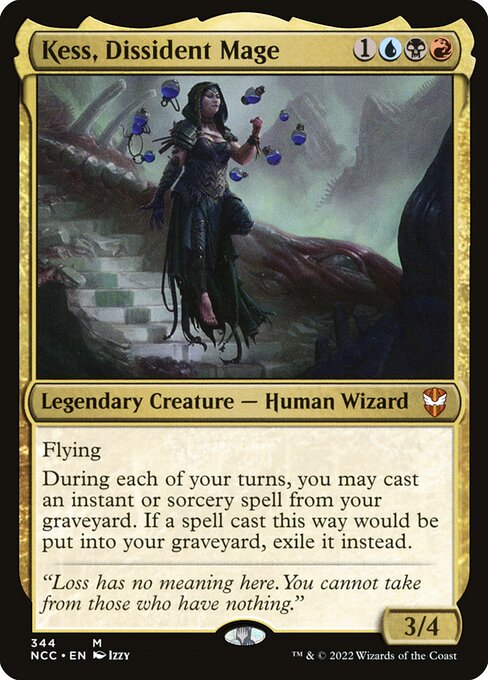
Kess, Dissident Mage
Spell recovery
Provides a limited permission on your turns to cast an instant or sorcery from your graveyard. You still pay costs and follow relevant timing.
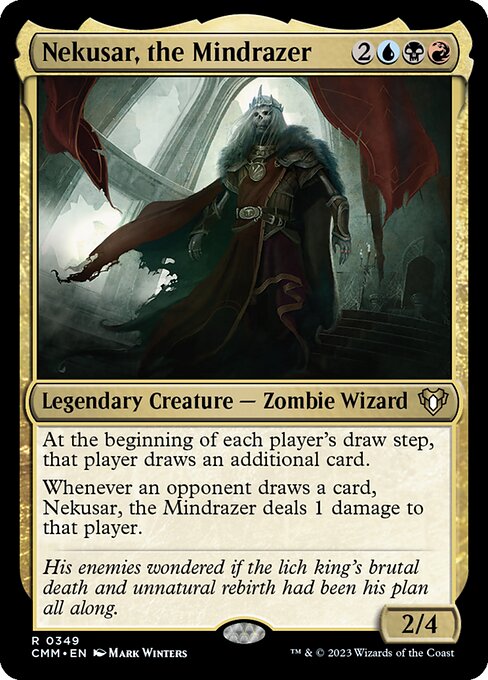
Nekusar, the Mindrazer
Draw-based pressure
Gives additional draw access and punishes opponents drawing. It can also feed them resources, so the deck needs a plan for the new hands.

Marchesa, the Black Rose
Counter and death support
Rewards creatures with plus-one counters dying through delayed recovery. It needs the counter condition and a suitable death rather than merely any creature leaving.

Rakdos Charm
Artifact and graveyard coverage
Provides separate modes for a graveyard, an artifact, or creature-based damage to controllers. It is useful flexibility, not all three results at once.
Mana must support three colors during the important turn
Grixis normally uses artifacts, rituals, and Treasures rather than a generic green land-ramp package. Arcane Signet can supply a commander-identity color. Talismans supply one mana directly, while dealing one damage to you for colored output. Signets need an input before producing their pair. Sol Ring supplies colorless mana and cannot replace the blue, black, and red requirements on the commander or a Charm.
Choose early sources for the sequence you actually need. A turn-two selection spell, a turn-three commander, and protection on the next turn can ask for different colors. Counterspell needs two blue. A black draw engine may compete for black pips. A red ritual can create a large total without paying the missing blue or black. Mark the cost of each spell and the source that pays each colored symbol.
Crumbling Necropolis fixes all three colors but enters tapped. Command Tower has a different timing profile and no basic land types. Pain lands and check lands can support earlier interaction under their conditions, while utility lands may reduce colored access. Use Mana Base Calculator to compare the actual early sources. A more demanding card package can require changing spells as well as lands when the budget limits fixing.
Cheap card access should work before the engine
Ponder and Preordain can smooth a hand, while Night's Whisper adds cards independently of the battlefield at a life cost. Faithless Looting draws and discards, which can set up a graveyard but is not the same as gaining extra hand resources. Choose whether the deck needs lands, a particular answer, graveyard material, or raw quantity. Those are related but distinct problems.
Fact or Fiction can supply a pile of cards and put the other pile into the graveyard. A spell-recursion commander may value both zones, while a creature-reanimation plan may need a different setup card. Rhystic Study and Mystic Remora provide conditional access from opponents' spell patterns and payments. Remora also demands upkeep investment. A creature-heavy table can offer fewer of its relevant events than an idealized spell-heavy opening.
Sacrifice draw such as Deadly Dispute needs an artifact or creature you can afford to spend. A spell deck with very few expendable permanents may prefer unconditional access. An artifact-token deck can support Dispute more naturally. Do not let several conditional draw cards conceal a hand that cannot pay any of their setup costs. Keep a route to resources after the battlefield is cleared.
Wheels need a reason to help you more than opponents
Windfall makes players discard and draw according to the greatest number of cards discarded this way. It is not simply a promise that every player gets seven cards. The effect can improve a nearly empty hand, stock graveyards, and enable draw payoffs. It can also discard your useful answers and give three opponents new opportunities. Compare the current hands and engines before treating a wheel as generic advantage.
Nekusar can turn opposing draws into damage while also giving additional draw access. That pressure needs to be relevant before the resources opponents receive overwhelm you. A commander removed in response can leave a wheel resolving without the expected payoff. Retain interaction and a plan that works when the damage engine is absent, rather than assuming the table must passively draw itself out of the game.
Narset, Parter of Veils and Notion Thief can change what opposing draw effects do under their own wording. Combining a hand reset with draw denial can create a severe resource lock rather than an ordinary refill. Treat that as a deliberate strategy and explain it before games. It is not a harmless upgrade simply because the individual cards fit the colors. Choose the pattern of play you intend, then support it honestly.
Spell recursion still pays costs and obeys windows
Kess supplies a permission during your own turns to cast a qualifying graveyard spell. It does not give unlimited graveyard access on every opponent's turn. A counterspell in the graveyard may therefore be less useful than an instant you can cast during your turn. The spell still needs legal targets, mana, and applicable timing. Read the exile replacement and the limit on the permission before planning repeated use.
Past in Flames gives graveyard instants and sorceries flashback for the turn. Mizzix's Mastery can create copies and instruct you to cast them through its own effect. Those are different sequences with different costs. A copy placed onto the stack is usually not cast, while an instruction specifically to cast a copy does create a cast event. That distinction matters for the draw and mana engines the deck uses.
A graveyard stocked with powerful spells is useful only if you can access the relevant one. Retain enough mana, independent draw, and redundancy that a graveyard exile effect does not strand the entire plan. A return-to-hand creature such as Archaeomancer can recover an instant or sorcery, but costs mana and needs an entry. It is a package choice, not a universal replacement for every spell-recursion effect.
Reanimation and temporary theft need different support
Reanimate can return a creature from any graveyard and costs life equal to its mana value. Animate Dead uses an Aura with its own relationship to the returned creature. A dedicated reanimator deck needs targets and setup as well as return spells. Filling the deck with expensive creatures without enough ways to put them into the graveyard can produce hands full of uncastable potential.
Sedris, the Traitor King gives creature cards in your graveyard unearth through a specified cost. Unearth is not ordinary permanent recursion: it has timing and exile consequences, including what happens when the creature would leave the battlefield. A sacrifice plan cannot assume that the unearthed creature simply returns to the graveyard for another use. Learn the exact keyword before building a repeated loop around it.
Temporary theft can turn into removal when a suitable sacrifice outlet consumes the stolen creature before control returns. The outlet must accept that permanent and be usable at the needed time. A death payoff alone does not supply an outlet. A spell that temporarily steals any permanent can also have uses beyond creatures, but that does not mean every outlet can sacrifice the artifact, land, or planeswalker it takes.
Marchesa changes which creature staples fit
Marchesa grants dethrone to other creatures you control and rewards qualifying creatures dying with plus-one counters through delayed return. The counter condition matters at death. A creature exiled or bounced did not die, and a token does not become a reusable card after leaving and ceasing to exist. The deck needs reliable ways to establish counters and control deaths, not just a collection of good entry abilities.
A sacrifice outlet can let the pilot choose when a qualifying creature dies, but it must be present and available. Dethrone depends on attacking the player with the most life or tied for most life, so the board may not always offer the ideal attack. Another reliable counter source can improve continuity. A generic wheel or expensive spell payoff may be less useful than a modest creature that supplies the missing event.
Recovery through a delayed trigger also has a window where the card is in the graveyard. Opponents can interact before the return occurs. Do not describe the engine as immune to removal. Retain useful cards that do not require the full loop, and choose a finish supported by repeated entries, deaths, or combat. The commander's resilience is strongest when its requirements are built into ordinary turns.
Cover enchantments and resolved engines
Blue counters work before a spell resolves. Terminate can destroy a creature and prevents regeneration, but not indestructibility. Red can remove artifacts through Abrade, Vandalblast, or a Charm. An enchantment already on the battlefield can require a more specific answer. Feed the Swarm, Withering Torment, Chaos Warp, or appropriate bounce provide different costs and risks.
Grixis Charm can reduce toughness enough to remove some indestructible creatures, depending on their final toughness, or bounce a permanent. Crosis's Charm has a nonblack restriction on its creature-destruction mode. These details determine which flexible spell covers the gap. A mode that looks redundant in a generic list may be valuable if it answers a particular defense your other spells cannot.
Graveyard interaction remains necessary even in a graveyard deck. Soul-Guide Lantern can clear opponents' graveyards through its sacrifice ability without exiling yours. Rakdos Charm can target one player's graveyard. Choose the scope that preserves your own plan while interrupting a relevant threat. Use Interaction Checker to review the package, and keep temporary bounce separate from a lasting answer in your notes.
Burst turns need recovery and an ending
Dark Ritual and Jeska's Will can accelerate a useful turn, but create colored temporary resources with their own conditions. Mana Geyser rewards tapped opposing lands and supplies red mana. A list that spends its hand on setup and has no payoff can become weaker after the burst. Before including a ritual, name the important spell or sequence that makes spending a card for temporary mana worthwhile.
Underworld Breach grants graveyard escape under its own rules and costs, consuming other graveyard cards as a resource. It is not free unlimited recursion just because the graveyard is large. A compact loop needs a verified balance of mana, cards exiled, and repeatable actions. Do not label two synergistic cards infinite without checking every payment and the interruption points.
Choose whether the ending is combat, draw-based damage, creature recursion, or a spell line. A large hand and a stocked graveyard are resources, not an ending by themselves. Explain the intended finish and any resource denial before games. The right staples should make the chosen plan reliable while leaving room for interaction, rather than giving the deck several incomplete and competing explosive packages.
Make focused replacements
| Current failure | Comparison to test | Tradeoff |
|---|---|---|
| Wheels improve opponents' hands more than yours | A redundant wheel to independent draw or interaction | Less burst refilling, more controlled resources |
| Kess graveyard contains few useful own-turn spells | A redundant off-turn card to a reusable spell matching the plan | Less reactive breadth, more actual commander use |
| Marchesa creatures die without counters | An extra payoff to a reliable counter enabler | Lower reward ceiling, more qualifying deaths |
| Artifact and creature answers miss an enchantment | A redundant narrow answer to Withering Torment or Chaos Warp | Different mana, life, or replacement risk |
Save the old version and compare one bottleneck at a time. Use Mana Curve Analyzer to inspect setup costs, and price the actual printings before buying an upgrade package. Better colored sources, useful cheap spells, or independent draw can improve ordinary games more than another premium explosive engine. Keep the changes tied to the game pattern you want rather than an unsupported ranking of blue-black-red power.
Frequently asked questions about Grixis staples
Build your deck
Put these choices into a Commander list. Create a free account to save your deck and keep tuning it with Deckcipher.
FAQ
Does every Grixis deck need wheels?
No. A wheel helps when the deck uses the new hand, graveyard setup, or draw triggers better than opponents do. It can also discard useful answers and refill three other players. Spell, theft, artifact, and death engines may prefer more controlled card access.
Can Kess cast a graveyard counter on every opponent's turn?
Its permission applies during your turns and has its own limit. It does not give unrestricted off-turn access. You still need legal targets and costs. Choose graveyard spells that the commander can actually use in the intended window.
Does Grixis Charm counter a spell?
No. Its modes concern permanent bounce, a temporary creature-size reduction, or a boost to your creatures. Use a real counterspell for stack interaction. Flexible text should not be mistaken for coverage of a mode the card does not have.
Does a Marchesa creature return after exile?
Its relevant recovery condition requires a qualifying creature to die. Exiling or bouncing it is not dying. The plus-one-counter condition, delayed timing, and availability of the card also matter. Opponents can interact with the graveyard before the delayed return.
Is unearth the same as reanimation?
It returns a creature through a temporary permission with its own timing and exile rules. A creature leaving under unearth does not necessarily go back to the graveyard for another use. Read the exact keyword and card before building a sacrifice or repeated-return sequence around it.
What should a Grixis deck fix first?
Check early colored mana, independent cards, answers to resolved noncreature engines, and a defined finish. An explosive graveyard or ritual package can strengthen ideal starts without repairing ordinary hands. Choose the missing role before adding another high-ceiling engine.
Build Grixis around a deliberate resource exchange
Build your deck around spell reuse, wheels, theft, or creature recovery. Create a free account to save it and compare that version across the connected tools. Note what each staple spends, which zone it uses, and when the payoff arrives. A strong Grixis package gives the commander a workable resource loop and a clear ending without relying on the table to ignore its setup.