
Quick answer
Four-color decks without white use blue, black, red, and green. Start with a coherent resource engine, reliable fixing, and answers for resolved threats. Yidris cascade and Thrasios-Vial Smasher resources ask for different spell sequences. Green land development, blue interaction, black access, and red burst turns are options to assign by role rather than four packages to include in full.
Four colors need one resource plan
Blue-black-red-green can ramp, draw, counter, use graveyards, and create explosive spell turns. The broad card pool can make the deck harder to finish because every color offers another attractive engine. Choose the repeated action first. Yidris, Maelstrom Wielder rewards a combat connection before hand casts. Thrasios, Triton Hero and Vial Smasher the Fierce can combine a paid resource sink with first-spell damage across turns.
Those command zones need different support. Yidris wants an attack that connects, useful spells left in hand afterward, and mana for the resulting main phase. A Thrasios-Vial Smasher plan can value instant-speed resources and useful first spells on several turns. An expensive spell with a discount can interact with Vial Smasher differently from a cheap cantrip, even if both cost little actual mana in the moment.
Do not import complete Grixis, Sultai, and Temur staple lists. They overlap in resources and compete for finite slots. Assign early development, card access, interaction, protection, and a finish across the whole list. A card earns its place when it connects those jobs to the commander rather than simply being a powerful card the identity permits.
No-white comparisons and their limits
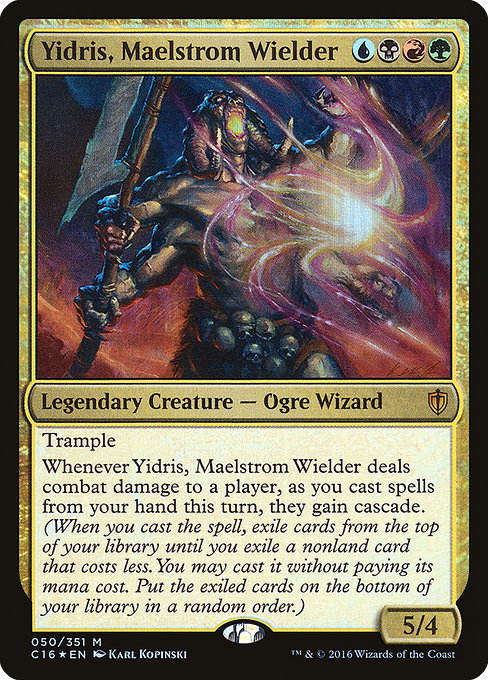
Yidris, Maelstrom Wielder
Combat-to-cascade engine
Combat damage to a player gives spells cast from your hand that turn cascade. Graveyard casts and spells cast from exile are different origins. Connecting and retaining hand resources both matter.
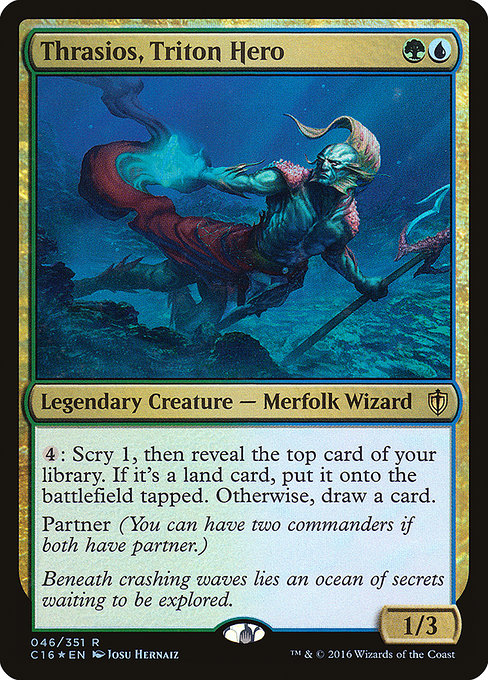
Thrasios, Triton Hero
Mana sink
A paid activation scries, then reveals the top card for a land entering tapped or another card drawn. It needs four mana each time and does not by itself supply unlimited resources.

Vial Smasher the Fierce
First-spell pressure
Your first spell each turn can deal damage based on its mana value through its random-opponent procedure. It does not reward every spell, and the damage is not commander combat damage.

Assassin's Trophy
Broad answer
Destroys an opposing permanent and can compensate its controller with a basic land. The spell does not force that land tapped. Use the breadth when it solves a real gap.

Arcane Denial
Castable stack interaction
Needs one blue rather than two blue, but can give cards to the countered spell's controller. Its easier payment is a tradeoff, not a strictly better result in every situation.
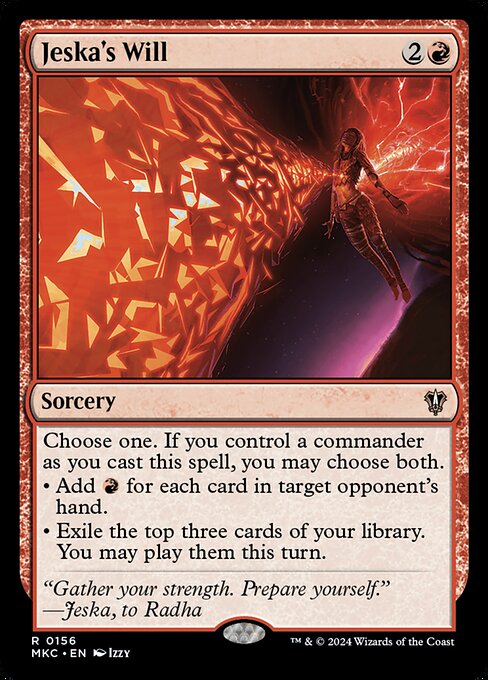
Jeska's Will
Red burst and access
Its mana counts a targeted opponent's hand and its exiled cards have a current-turn deadline. Both modes are available when you control a commander. Red mana still cannot replace missing blue or black pips.

Farseek
Typed-land fixing
Can find a Plains, Island, Swamp, or Mountain card, tapped. A dual with Forest can qualify through another listed type, while a plain Forest cannot.
Make green development fix the other colors
Nature's Lore and Three Visits find Forest cards, including suitable typed duals. They do not force those lands tapped, though a land's own conditions still apply. Farseek can access the listed types and forces its chosen land tapped. In four colors, the search-target package determines how many different problems the spells solve. A source that produces green but lacks Forest is not a legal Lore target merely because it is green fixing.
Choose enough early green sources to cast the development in the first place. A hand with future access to every color can still stumble if its first land enters tapped and its second cannot cast the ramp. A later black engine or blue answer also needs colored sources after the ramp resolves. Use Mana Base Calculator to examine a real sequence instead of dividing sources evenly among four colors.
Mana creatures can provide fixing and bodies, while land ramp can survive many creature wipes. An attack-based commander may appreciate a creature but also needs enough permanent development to recast after removal. Thrasios wants mana available beyond ordinary casts. Choose the mixture for those turns. A high total ramp count is less informative than which cards provide the first useful payment.
Yidris must connect before the cascade turn
Yidris has trample, but still needs to deal combat damage to a player to produce the permission. Attacking alone without damage does not suffice. A protection spell can preserve the creature while leaving blockers relevant. An evasion effect can help connect without protecting against removal. Identify which obstacle actually stops the attack before adding another card that assumes the connection already happened.
The resulting permission applies as you cast spells from hand that turn. A spell cast from the graveyard through recursion did not come from hand. A spell found and cast through cascade comes from exile and does not gain another cascade from that same hand-cast permission. Those zone distinctions prevent a vague promise that every cascade hit automatically starts another unlimited chain.
Keep useful hand resources and mana after combat. Spending every card to force through Yidris can leave no spell to exploit the reward. A cheap protection spell and a useful refill can be more relevant than another expensive cascade payoff. Plan both halves of the turn: obtaining the connection and converting it into meaningful action without assuming ideal draws.
Cascade changes card quality, not the need for early plays
Cascade can provide extra casts, but a narrow counterspell can be awkward when it has no useful target during the chain. A ramp spell can be excellent early and modest late. Those tradeoffs do not mean cutting every cheap support card. The deck still needs to reach Yidris, answer threats, and connect. Choose a balance between ordinary function and useful later hits.
The cast offered by cascade is optional, and legal targets and restrictions still matter. An X spell cast without paying its mana cost normally uses zero for X unless another instruction changes that. A high printed ceiling does not make it an effective free-cast result. Read the permission that creates the cast rather than assuming the maximum version is available.
Spells with no mana cost need their own casting permission and can have awkward hand behavior. A cascade package built around them is a deliberate construction choice with corresponding tradeoffs, not an automatic budget upgrade for every Yidris deck. Preserve card access and useful early spells rather than maximizing an ideal chain at the expense of the turns required to start it.
Partners change how resources are used across turns
Thrasios offers a four-mana activation with scry before revealing the next card. A land goes onto the battlefield tapped; a nonland result is drawn. That can use otherwise spare mana, but is not a promise that every activation provides an untapped extra source or a chosen answer. The deck needs enough resources to activate without abandoning necessary interaction.
Vial Smasher rewards the first spell you cast each turn, not every spell in a chain. Its damage uses the spell's mana value rather than the amount of mana actually paid. Discounts, alternate costs, and commander tax do not simply rewrite that value. The random-opponent procedure also means the pilot does not select whichever opponent is most convenient as if it were a normal targeted burn spell.
A useful instant on an opponent's turn can therefore matter differently from another sorcery in the same main phase. Choose spells that are worthwhile independently, with their resource or interaction role intact. Do not add a large printed-mana-value card only for a hypothetical damage total if it is otherwise stranded. The damage is also noncombat, so it does not add to commander combat-damage tracking.
Choose draw for quantity, setup, or timing
Night's Whisper supplies independent cards at a life cost. Fact or Fiction can provide a pile choice and graveyard material. Ponder and Preordain smooth quality without normally growing the hand. Faithless Looting can discard useful graveyard resources but is not the same as a raw refill. Choose which problem the list has before counting every access effect as interchangeable draw.
Rhystic Study and Mystic Remora depend on opposing casts and payments, with Remora also asking for upkeep. Creature-based engines can support a creature-focused build, but need their qualifying events. A Yidris list may prefer access that retains useful spells in hand for its permission. A graveyard subtheme may prefer a different exchange. Let the commander's casting origin and timing influence the package.
Life-paid access remains a real cost. Four colors without white still have ways to gain or preserve life, but do not assume the future engine makes every payment free. Add together fetch-land, pain-land, draw, and removal costs in an ordinary turn. Keep interaction and a way to stabilize rather than exchanging life for a full hand that cannot be deployed safely.
Cover the permanent types after they resolve
Blue counters can stop a threatening spell, while black creature answers, green artifact-or-enchantment removal, and red artifact pressure act on resolved cards. Assassin's Trophy and Beast Within provide broad destruction with compensation. Reality Shift can exile a creature with a manifested replacement. Chaos Warp provides another broad route with a possible revealed replacement permanent. Choose the actual gap and drawback.
A package filled with counters can miss an engine that resolved while the pilot developed. A package filled with creature destruction can miss enchantments or indestructible creatures. Use Interaction Checker to review timing and types rather than celebrating a large total. Keep a cheap answer that can be held alongside the commander turn when that window repeatedly matters.
Graveyard interaction can fit a graveyard deck when its scope preserves the intended resources. Soul-Guide Lantern can exile opponents' graveyards through its sacrifice ability while leaving yours alone. Rakdos Charm can target one player's graveyard or use another mode. A symmetric sweep can instead remove your setup. Read the scope and the next action the deck needs before choosing the tool.
Protection and burst resources need a fallback
Heroic Intervention can preserve permanents through targeted effects and destruction, but not every exile, sacrifice, or toughness reduction. Veil of Summer has specific color and effect coverage rather than universal protection. A counter protects a different window. Choose the effect that matches the threat to Yidris or the resource engine, and retain enough colored mana after development to use it.
Jeska's Will and Mana Geyser can generate a powerful red-mana window, but the hand needs compatible action and any missing colors. Dark Ritual gives a different colored burst. Those cards do not increase every future turn's mana. A stable land base and independent access can improve ordinary games when a ritual package repeatedly empties the hand or produces the wrong pips.
Eternal Witness can recover a graveyard card to hand, while creature return or spell-recursion effects have different target ranges and casting origins. A recovered card in hand can support Yidris differently from a cast directly from the graveyard. Plan that zone movement and payment. A hand full of recovery with no available target is not a fallback after graveyard exile.
Choose a finish before collecting more engines
Yidris can support combat, cascade value, or a deliberate spell sequence. A partner list can use resources to sustain pressure or assemble a verified finish. Neither command zone commits the deck to a universal competitive package. Choose the actual route and the game pace, then reserve enough slots for its enablers and interaction.
A long cast chain is not automatically infinite, and several triggers are not automatically lethal. Count mana, hand resources, casting zones, targets, and restrictions. A discount may help pay one part while leaving another color missing. A recursion line may consume the graveyard cards the next repetition needs. Explain the complete sequence rather than using a broad synergy claim as proof.
Discuss deterministic loops, repeated extra turns, or draw denial before games if they are central to the list. Four-color access makes many such options available without requiring any of them. The staple package should reinforce the pattern the deck intends to play, with enough ordinary action to survive disruption and enough finishing power to turn resources into an ending.
Make focused replacements
| Current problem | Comparison to test | Tradeoff |
|---|---|---|
| Yidris connects but has no hand follow-up | A redundant combat enabler to useful card access | Less attack redundancy, resources for the payoff window |
| Cascade hits too many unusable narrow effects | Review early support against useful later outcomes | Different coverage, more meaningful extra casts |
| Vial Smasher cards are chosen only for large printed costs | A stranded payoff to useful first-spell interaction | Less ideal damage, more functional turns |
| Thrasios has no spare mana after development | A redundant engine to stable resources or cheaper action | Less ceiling, actual activations |
Save the original list and compare the bottleneck. Use Mana Curve Analyzer for printed setup, while noting discounts, activation payments, and cascade choices manually. Prices vary by printing. Better colored sources and useful cheap action can improve more ordinary hands than another premium reward for a chain the deck rarely begins.
Frequently asked questions about no-white four-color staples
Build your deck
Put these choices into a Commander list. Create a free account to save your deck and keep tuning it with Deckcipher.
FAQ
Does Yidris give cascade to graveyard spells?
Its combat-damage reward applies as you cast spells from hand that turn. A graveyard cast is a different origin. A spell cast from exile through cascade also did not come from hand. Track the zone rather than assuming every cast gains the same permission.
Does Yidris trigger merely by attacking?
It needs combat damage to a player. Trample can help but does not guarantee the event. Choose protection and evasion according to the actual obstacle, then retain cards and mana to use the reward afterward.
Does Vial Smasher use the mana I paid?
Its damage uses the spell's mana value. Discounts and alternate payments do not simply turn that into the mana spent. It also rewards the first spell each turn and uses its own random-opponent procedure. The damage is noncombat for commander-damage purposes.
Does Thrasios always put a land in untapped?
Its activation puts a revealed land onto the battlefield tapped. A nonland result is drawn instead. The ability costs four mana and includes scry first, so it is a useful mana sink rather than automatic chosen access or free acceleration.
Should every no-white deck be a combo deck?
No. The identity supports lands, creatures, cascade, control, and other plans as well. Choose a coherent route and intended pace. Competitive staple packages are not compulsory simply because the colors can cast the same cards.
What should I fix before another explosive engine?
Check early green access, all four colored requirements, useful hand resources, interaction after permanents resolve, and a finish. Fix the stage where ordinary turns fail. A larger ideal chain does not repair a commander you cannot cast or a hand with no follow-up.
Build the four colors around a paid sequence
Build your deck around the combat-cascade or cross-turn resource plan you chose. Create a free account to save the version and compare it across the connected tools. Mark mana colors, casting origins, and the first useful follow-up. A strong no-white package makes its wide resource menu serve one clear engine instead of four incomplete ones.