
The best colorless Commander staples solve three problems: mana, cards, and reset buttons.
Start with Sol Ring, Thought Vessel, Mind Stone, Forsaken Monument, Mystic Forge, War Room, and All Is Dust. Then tune lands, finishers, and utility around your commander instead of jamming every expensive artifact.
Core colorless Commander staples to know first

Forsaken Monument
Mana engine and anthem
Best in heavy colorless decks where many lands and rocks tap for true colorless mana.

Sol Ring
Fast universal ramp
A one-mana artifact that taps for two colorless mana, helping pay generic and specifically colorless costs.
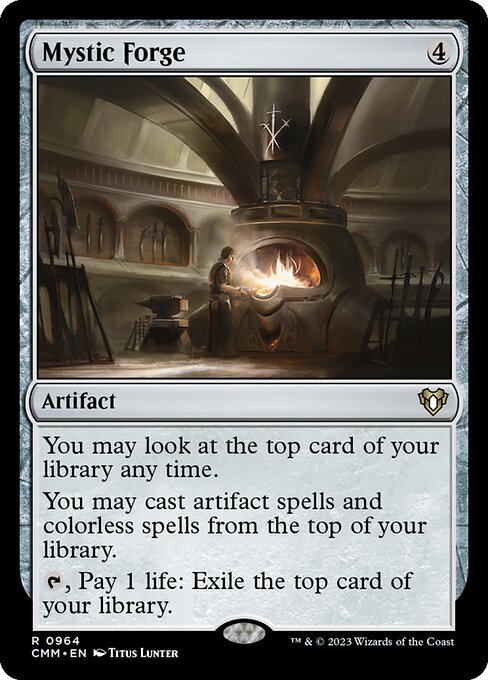
Mystic Forge
Top-deck card advantage
Excellent when most nonlands are artifacts or colorless spells you can cast from the top.
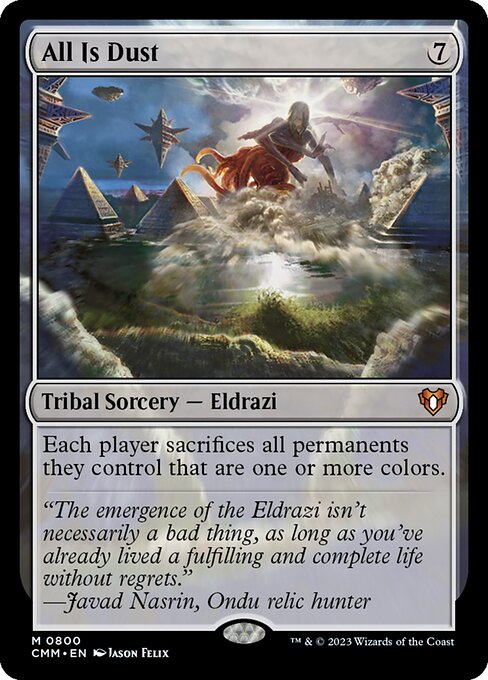
All Is Dust
Asymmetric sweeper
Clears colored permanents while often leaving your artifacts and colorless threats behind.
What counts as a colorless Commander staple?
Colorless Commander staples fall into two groups. True colorless decks, such as Eldrazi or artifact-commanders with no color identity, need cards that cast expensive spells, draw cards, and answer permanents without help from colored mana. Colored decks can also play many colorless cards, but they should be more selective because green ramp, blue draw, white removal, and black tutors often do those jobs more efficiently.
Use role, not reputation, as the test. Sol Ring changes opening hands. Forsaken Monument rewards a real colorless mana base. Mystic Forge is powerful in artifact-dense lists but mediocre if your top card is often a land or colored spell. A staple earns its slot by improving mana consistency, card flow, interaction, or closing speed.
The top tier: cards most true colorless decks should consider first
Mind Stone can be sacrificed to draw a card, while Hedron Archive can draw two for its separate activation cost. Thought Vessel does not have a draw ability. Its benefit is removing your maximum hand size, which matters only if the deck actually accumulates cards. Do not count all three rocks as card draw. The One Ring and Ugin, the Spirit Dragon serve different, more expensive jobs and should fit both your game plan and your table.
Top-tier staples and why they earn slots

Mind Stone
Early ramp that cycles later
One of the cleanest budget ramp pieces because it is useful on turn two and not dead on turn ten.
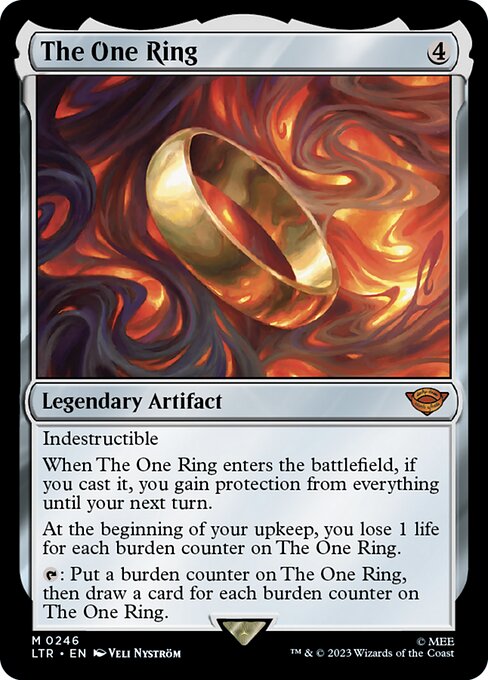
The One Ring
High-output draw engine
Excellent when your table accepts the power level and your deck can spend the cards quickly.
Ramp staples: build for turns two through five, not just huge turns
A high-curve colorless deck can reasonably test a larger acceleration package than a low-curve colored deck, but thirteen to seventeen ramp cards is a trial range rather than a format requirement. Check how many cost two or less. Thran Dynamo and Hedron Archive help bridge to expensive spells, but a hand full of four-mana rocks still needs earlier plays. Basalt Monolith is repeatable only after paying to untap it, so classify its initial three mana as a burst rather than assuming a fresh three every turn.
Ramp slot comparison: speed versus staying power
Cheap rocks fix early turns; larger rocks only belong when the deck immediately converts extra mana into real pressure.
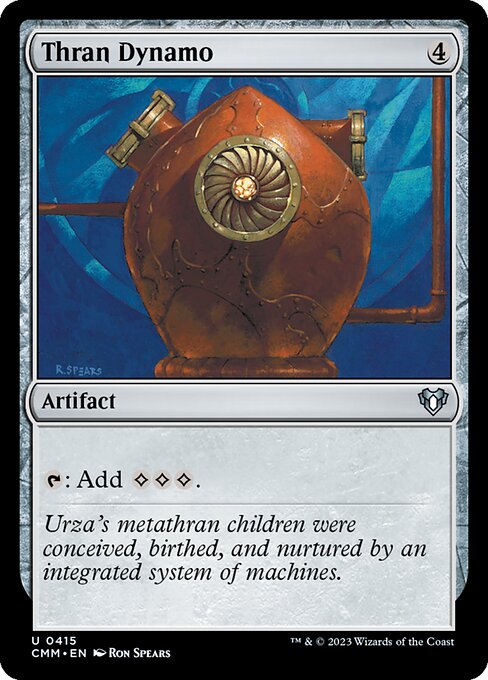
Thran Dynamo
High-output four mana rock
Best when three extra mana lets you cast a commander, sweeper, or Eldrazi ahead of schedule.

Worn Powerstone
Slower big-mana rock
Budget friendly, but entering tapped makes it poor when you need immediate mana.

Everflowing Chalice
Scalable ramp
Good early as a small rock and late as a mana sink.
Mana base staples: colorless lands should do more than tap for one
Colorless decks can play many utility lands, but too many non-mana or conditional lands ruin opening hands. Keep enough Wastes and untapped sources to cast early rocks. Eye of Ugin is not a mana source. Count it as a tutor or cost reducer, not as one of your lands that casts spells.
Useful land roles include acceleration lands like Ancient Tomb and Eldrazi Temple, draw lands like War Room and Bonders' Enclave, recursion lands like Buried Ruin, tutor lands like Sanctum of Ugin, graveyard hate like Scavenger Grounds, removal lands like Blast Zone or Strip Mine, and combat lands like Rogue's Passage. Each category earns a slot only if it supports your plan often enough.
Colorless land staples by job

Wastes
Basic colorless source
The reliable source that keeps your mana base honest.
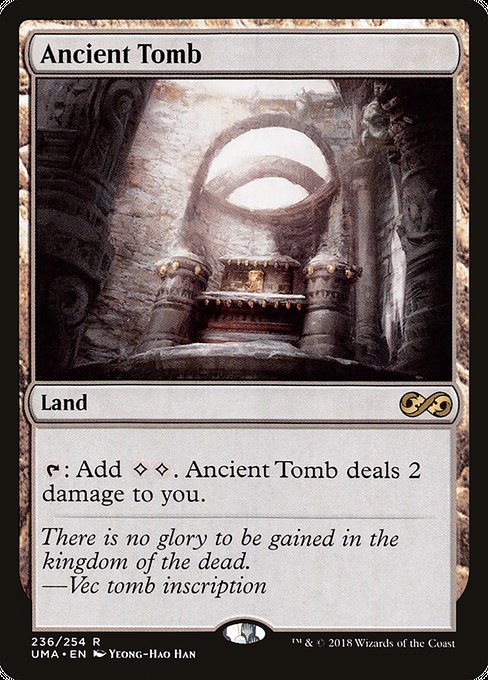
Ancient Tomb
Explosive land ramp
A premium upgrade, not a requirement. Best when early tempo matters.
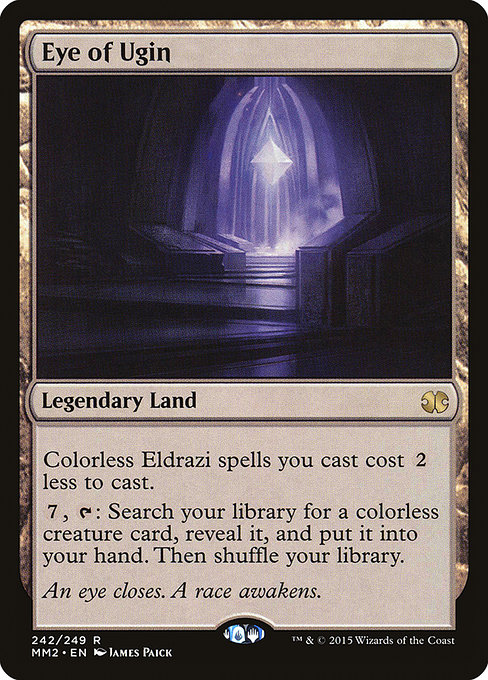
Eye of Ugin
Tutor and cost reducer
Powerful in Eldrazi shells, but never count it as a normal mana source.
Card advantage staples: colorless decks need engines, not one-shot optimism
If the commander does not provide card access, reserve several real draw effects before adding more threats. Endless Atlas needs three lands with the same name on the battlefield, not simply three basic lands. Wastes supports it; a pile of differently named utility lands may not. Mystic Forge lets you cast qualifying spells from the top, but a land on top still needs its separate paid exile ability or another way to move it. Memory Jar provides temporary access to seven cards, then its delayed trigger makes players discard the new hand and return their exiled hand. Staff of Nin is slower and belongs in games that allow its six-mana investment to pay off.
Colorless card advantage options

Endless Atlas
Basic-land draw engine
Choose it when your Wastes count is high enough to turn it on consistently.
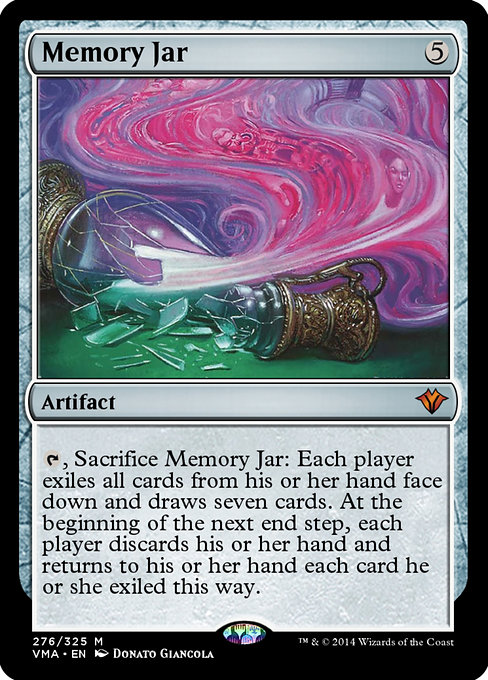
Memory Jar
Burst refill
Choose it for explosive artifact turns, not slow value.
Interaction and sweepers: how colorless decks answer the table
Colorless interaction is clunky but mandatory. Start with six to nine interaction pieces, mixing sweepers, exile effects, graveyard hate, and broad permanent removal. All Is Dust is the premium sweeper. Oblivion Stone and Nevinyrral's Disk are slower but answer permanent types colorless decks struggle with.
Removal and reset tools for colorless Commander

Meteor Golem
Creature-based removal
Pick it when your deck can recur, blink, copy, or sacrifice creatures; otherwise it is expensive removal.

Duplicant
Exile removal on a creature
Choose it when commanders, recursion, or indestructible creatures are common in your pod.
Finishers and threat packages: big does not automatically mean playable
The best finishers stabilize, remove something, draw cards, or threaten multiple players. Ulamog, the Ceaseless Hunger is premium because the exile happens on cast. Kozilek, the Great Distortion refills your hand and gives colorless decks stack interaction. Budget finishers such as Steel Hellkite, Cityscape Leveler, Meteor Golem, and Duplicant are lower ceiling but still affect the board.
Colorless finishers that do more than attack
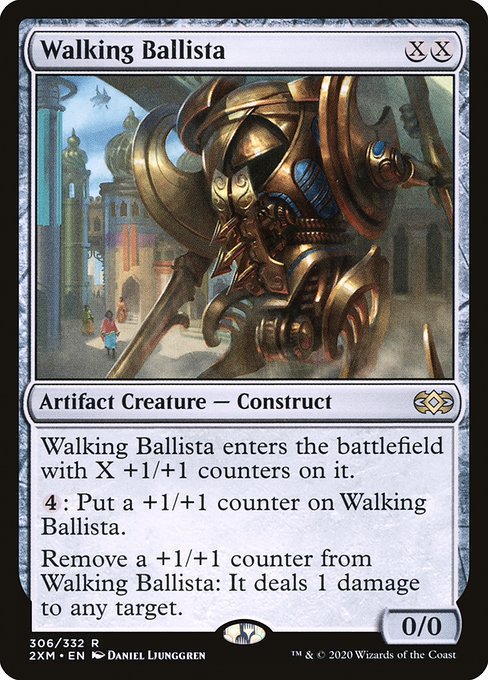
Walking Ballista
Scalable removal and win condition
Turns extra mana into damage and becomes excellent with big mana engines.
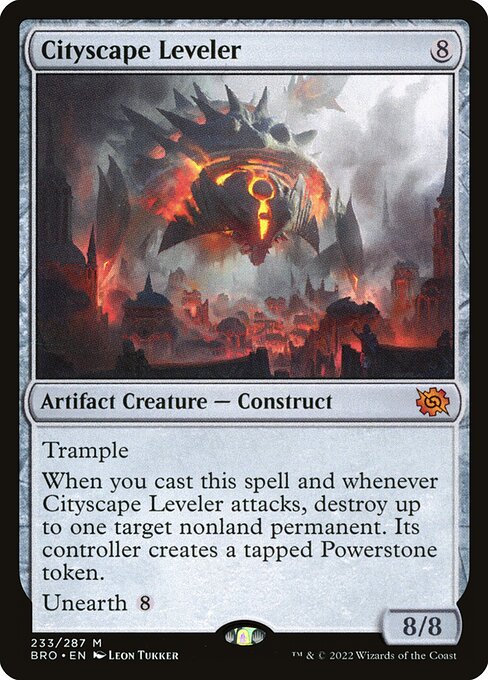
Cityscape Leveler
Repeatable pressure
Answers nonland permanents and still matters from the graveyard.
Commander choice changes which staples are actually best
Zhulodok, Void Gorger rewards casting colorless spells with mana value seven or greater from your hand. Its two cascade triggers are not a reason to cut every cheap card: early acceleration still gets the commander onto the battlefield. Kozilek, the Great Distortion instead benefits from retaining cards with different mana values to fuel its counter ability. Traxos, Scourge of Kroog values historic spells that untap it, while Liberator, Urza's Battlethopter lets you cast colorless spells and artifact spells as though they had flash. The commanders share a color identity, but not the same ideal curve.
Popular colorless commanders and the staples they reward
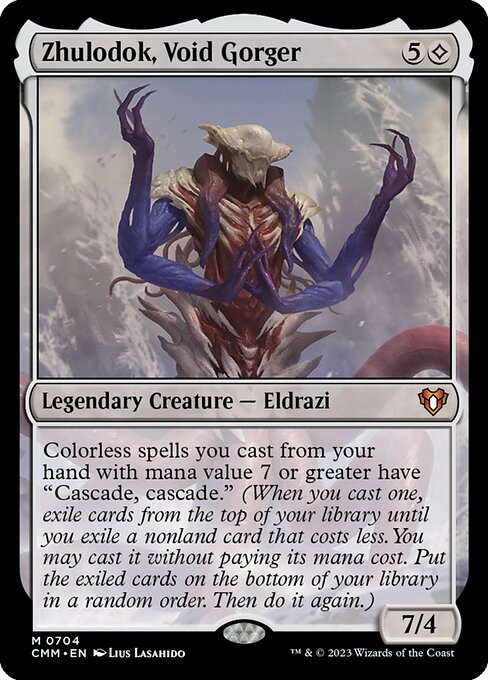
Zhulodok, Void Gorger
High-mana cascade commander
Add high-MV colorless spells; cut cheap filler that weakens cascade.
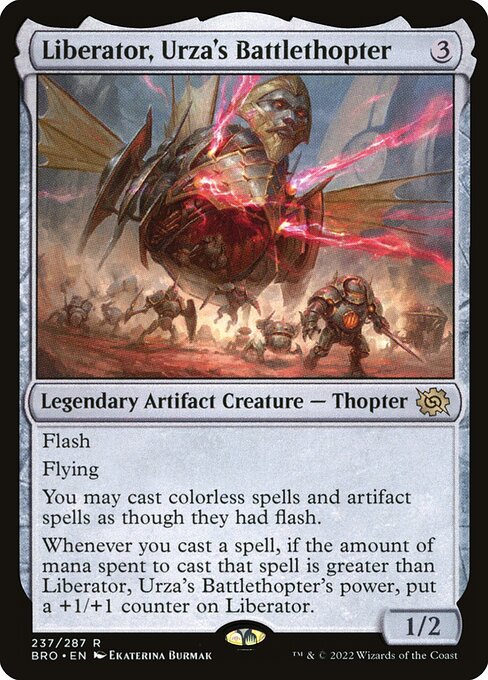
Liberator, Urza's Battlethopter
Flash artifact commander
Add cheap artifacts and mana sinks; cut sorcery-speed clunk.
Budget upgrades and expensive traps
Do not buy one premium land while leaving the deck short on draw, ramp, and removal. If Ancient Tomb is too expensive, play more two-mana rocks and lower the curve. If The One Ring is out of budget, use Endless Atlas, Staff of Nin, War Room, and Bonders' Enclave. If Ugin is too expensive, play Oblivion Stone or Nevinyrral's Disk. If premium Eldrazi are too expensive, use Steel Hellkite, Cityscape Leveler, Meteor Golem, and Duplicant.
Colorless staple decisions by deck need
| Deck need | Premium option | Budget option | Decision point |
|---|---|---|---|
| Early acceleration | Ancient Tomb | Mind Stone or Thought Vessel | Use rocks when budget matters more than explosive starts. |
| Raw card volume | The One Ring | Endless Atlas or Staff of Nin | Use slower engines if your pod is mid-power. |
| Board reset | Ugin, the Spirit Dragon | Oblivion Stone or Nevinyrral's Disk | Use artifacts when you need broad permanent coverage. |
| Top-end threat | Ulamog, the Ceaseless Hunger | Steel Hellkite or Cityscape Leveler | Use cheaper threats to keep the curve functional. |
| Top-deck setup | Sensei's Divining Top | Crystal Ball or extra draw land | Only pay for selection if your deck has top-deck engines. |
Sequencing examples: how staples change real games
Consider Wastes, Eldrazi Temple, Sol Ring, Mind Stone, Thran Dynamo, All Is Dust, and Ulamog, the Ceaseless Hunger as a hypothetical opening seven with Zhulodok in the command zone. Turn one, tap Wastes for Sol Ring, then tap Sol Ring for Mind Stone. On turn two, Eldrazi Temple makes one mana toward an artifact, so the two lands, Sol Ring, and Mind Stone provide five total. Four can cast Thran Dynamo. Once it resolves, it may tap immediately. You can keep that mana available, but three alone will not cast Zhulodok. With the same board on your next turn, the Temple can make two toward the colorless Eldrazi commander, giving enough to cast it. This line is strong because the opening hand contains several ramp cards, not because every colorless opening should produce that much mana.
For a slower example, use Wastes, Urza's Tower, War Room, Thought Vessel, Basalt Monolith, Duplicant, and another spell, with Kozilek, the Great Distortion in the command zone. Turn two can deploy Thought Vessel. Turn three, three lands plus the Vessel can cast Basalt Monolith. On the following turn, those same sources plus the Monolith produce seven mana if no new land is drawn. Kozilek costs ten, including two specifically colorless mana. Seven is not almost the same as ten: this hand still needs additional development. Basalt Monolith also does not untap during the untap step. If you spend its mana on Duplicant, rebuilding the burst takes an activation. Keep that recovery cost in mind when evaluating a speculative keep.
Ancient Tomb can cast Sol Ring on turn one, and the Ring can then cast Thought Vessel. Ancient Tomb and Sol Ring are tapped after those payments, while the newly resolved Thought Vessel is untapped and can still produce one colorless mana. On the next turn, playing Wastes yields six total mana from the two lands and two rocks. You could cast Liberator for three and retain three mana for an artifact later. Mystic Forge costs four, so casting both on that turn requires another resource. Walking Ballista also needs a positive X to survive without other support. These small accounting checks matter more than an idealized sequence that quietly reuses a tapped source.
Common mistakes when adding colorless staples
- Confusing generic mana with true colorless mana. {7} can be paid with anything; {C} cannot.
- Playing Arcane Signet in a true colorless deck. If your commander has no colors, Arcane Signet has no color to produce.
- Making Commander's Sphere-style assumptions. Cards that add mana of your commander's color identity do not work normally when that identity has no colors.
- Counting Eye of Ugin as a mana-producing land.
- Playing too many utility lands and not enough reliable sources.
- Buying premium upgrades before fixing ramp, draw, and interaction counts.
A practical starting package for most colorless decks
For a first draft, try a land-heavy opening configuration and enough cheap acceleration to bridge to your commander, then test it rather than treating a fixed ratio as a rule. A list with many eight-mana spells needs a different resource plan from a low-curve Traxos list. Count ramp, card access, interaction, and finishers separately, and mark cards that overlap. A land that draws cards still occupies a land slot; activating it may leave you short of the mana needed to deploy the cards you find.
Colored decks should be pickier. Sol Ring, Mind Stone, War Room, Walking Ballista, and some utility lands are broadly playable, but cards like Forsaken Monument, Eldrazi Temple, Eye of Ugin, Endless Atlas, and All Is Dust are best when your colored deck is actually built around colorless spells, artifacts, or Eldrazi. If a colored card does the same job more efficiently, use the colored card.
Build and save your colorless Commander deck
Create a free account to save your colorless Commander deck and keep tuning its mana, card access, and artifact support with Deckcipher.
Next steps for choosing your own staples
Goldfish opening sevens before buying upgrades. If too many hands have lands and eight-drops but no turn-two play, add cheap rocks or cut top end. If you make mana but run out of cards, add draw lands, sacrifice rocks, or engines. If you lose to one permanent type, change interaction instead of adding another huge threat.
The best colorless Commander staples are not a fixed package. They are the cards that let your commander function on time, recover after disruption, and convert big mana into a decisive advantage.
Check casting, cascade, and recovery separately
Colorless decks often mix three different incentives. An Eldrazi cast trigger rewards casting its spell, a battlefield trigger rewards a creature entering, and Zhulodok rewards a qualifying spell cast from hand. Reanimating Ulamog, the Ceaseless Hunger does not produce its cast trigger. A spell found through cascade is cast from exile, not from your hand, so it does not automatically receive another pair of cascade triggers from Zhulodok. A card can be powerful with one commander while missing another commander's central reward.
Before buying an expensive threat, write down the worst acceptable result. Cityscape Leveler destroys a nonland permanent when cast and when it attacks, while Meteor Golem destroys a nonland permanent an opponent controls when it enters. The former rewards casting and attacking; the latter can work with repeatable battlefield recursion. Neither should be called interchangeable with a giant creature that only attacks. If the deck cannot recover from a sweeper, replacing a redundant finisher with Buried Ruin or a genuine draw engine may do more than upgrading its largest threat.
| Decision | Useful check | Common trap |
|---|---|---|
| Need true colorless mana | Read the symbol on both cost and source | Treating colored mana as interchangeable with {C} |
| Need a second spell after ramp | Mark each source tapped after using it | Spending Sol Ring twice in an imagined turn |
| Want cascade value | Check mana value and the casting zone | Assuming spells cast from exile retrigger Zhulodok |
| Need lasting card access | Count actual draws or cast permissions | Calling Thought Vessel a draw engine |
Use the Mana Base Calculator to inspect the sources in your actual list, and the Mana Curve Analyzer to see where the expensive spells collect. Automated classifications can miss a commander-specific discount or the cost of untapping Basalt Monolith, so keep a short manual note beside those cards. Then build your deck. Create a free account to save the changes and return to the same list as you compare the curve, opening hands, and upgrade options.
FAQ
What are the most effective colorless Commander staples?
Sol Ring, Mind Stone, Thought Vessel, Forsaken Monument, Mystic Forge, War Room, All Is Dust, Walking Ballista, and a commander-specific finisher package are the usual starting points.
How many ramp cards should a colorless Commander deck play?
Test a larger ramp package when your commander and threats are expensive. Thirteen to seventeen pieces can be a starting experiment for that kind of list, not a requirement. Check the early costs, reliable land drops, and recovery after artifact removal before changing the total.
What is the difference between generic and colorless mana?
Generic costs, such as {7}, can be paid with any mana. Colorless costs, shown as {C}, require true colorless mana from sources such as Wastes, Sol Ring, Eldrazi Temple, or colorless-producing rocks.
Does Arcane Signet work in a colorless Commander deck?
Not the way it works in colored decks. Arcane Signet adds one mana of a color in your commander's color identity. A true colorless commander has no colors in its color identity, so Arcane Signet cannot produce mana.
Are Urza's Mine, Urza's Power Plant, and Urza's Tower worth playing in Commander?
They are playable as untapped colorless lands with upside, but singleton Commander makes assembling all three unreliable. Treat Tron as a bonus, not a plan.
Which colorless commanders change staple choices the most?
Zhulodok favors qualifying large colorless spells cast from hand. Kozilek values a useful spread of mana values in hand. Traxos rewards cheap historic spells, while Liberator rewards leaving mana open to cast artifacts and colorless spells on other turns.
What are good budget swaps for expensive colorless staples?
Swap The One Ring for Endless Atlas or Staff of Nin, Ugin for Oblivion Stone or Nevinyrral's Disk, Ancient Tomb for extra two-mana rocks, Sensei's Divining Top for cheaper selection or draw lands, and premium Eldrazi for Steel Hellkite, Cityscape Leveler, Meteor Golem, or Duplicant.
Should colored Commander decks play these colorless staples too?
Some should, especially Sol Ring, Mind Stone, Walking Ballista, and useful lands. More specialized cards like Forsaken Monument, Eldrazi Temple, Eye of Ugin, and Endless Atlas usually need a heavy artifact, Eldrazi, or true-colorless theme.