
Quick answer
Boros staples should connect red pressure and artifact interaction with white removal, card access, and protection. Boros Charm, Wear // Tear, Swords to Plowshares, and a commander-compatible draw engine are useful comparisons. Equipment, tokens, attack triggers, and artifact value need different support, so choose the combat and recovery plan before filling the list with expensive threats.
Choose what red-white is trying to attack with
Boros is the red-white color pair. It can support one equipped commander, a wide token army, attack-trigger creatures, artifacts, and several other proactive plans. The colors offer useful shared answers, but an Equipment package is not automatically correct for a token deck. A list that creates many small creatures may need repeated draw and a team payoff instead of another sword.
Start with the commander's normal turn. Does it draw from attacking, reward casting Equipment, create tokens, or multiply attack triggers? Then choose support that keeps that action available. A card that gives an entry trigger may do nothing for a cast-based engine. An extra-combat spell may add little when the creatures cannot untap, survive blocks, or attack the opponents who matter.
The familiar claim that Boros cannot draw or ramp is too broad to guide a modern list. It has conditional creature draw, artifact draw, temporary exile access, mana rocks, and attack-based development. The real task is choosing resources the deck can trigger at the right time. Keep some independence from combat so a stalled board or removed commander does not prevent every new card from functioning.
Boros candidates and their jobs
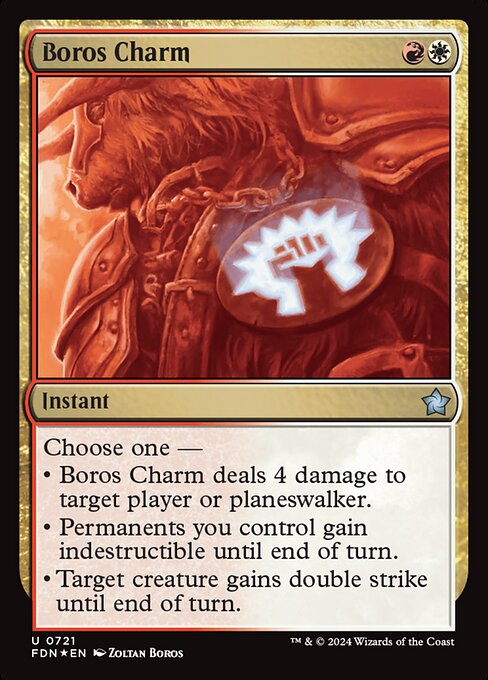
Boros Charm
Protection or reach
Offers permanent indestructibility, damage to a player or planeswalker, or double strike for a creature. The modes solve different problems.
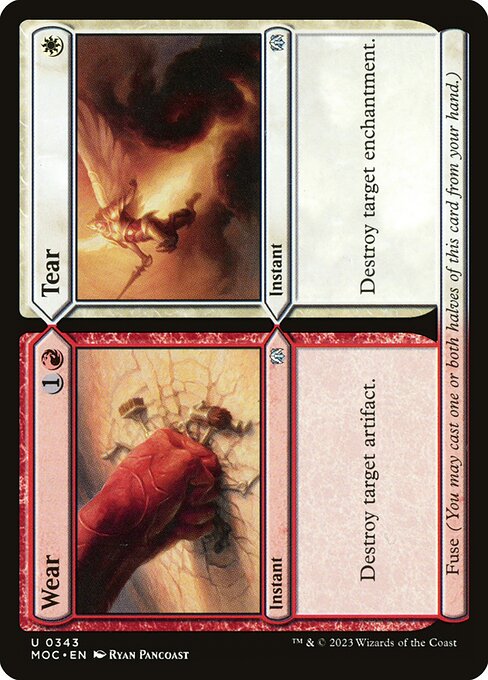
Wear // Tear
Artifact and enchantment coverage
Can answer either type, or use fuse from hand to cast both halves together. The combined payment and casting zone matter.

Sram, Senior Edificer
Cast-based card access
Draws when you cast an Aura, Equipment, or Vehicle spell. It does not draw from every artifact or every Equipment entry.
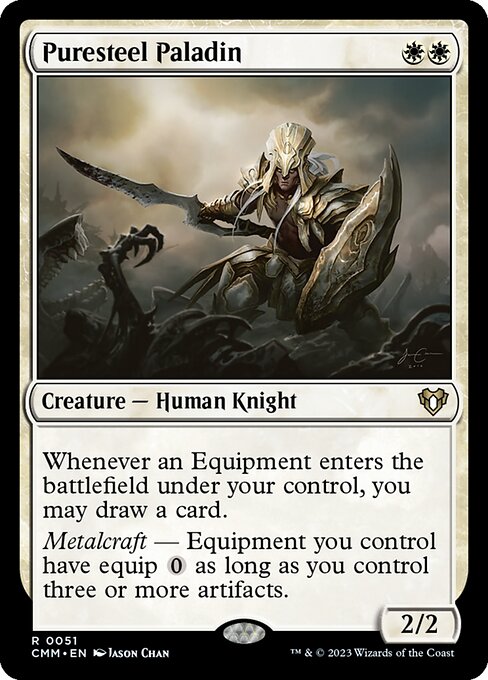
Puresteel Paladin
Equipment entry and equip support
Draws when Equipment enters under your control and can give your Equipment equip zero with metalcraft. The artifact count matters.

Sunforger
Instant toolbox
Its paid unattach ability can find and cast a qualifying red or white instant. It needs a bearer, mana, targets in the library, and a useful timing window.

Talisman of Conviction
Early mana
Makes colorless directly, or red or white while dealing one damage to you. Compare it with the input requirement of Boros Signet.
Use white removal and red artifact answers together
Swords to Plowshares exiles a creature efficiently and gives its controller life equal to its power. Path to Exile supplies a different compensation route through a possible tapped basic land. Both can solve an indestructible creature that a destroy spell misses, but neither answers a noncreature engine. Keep some coverage for artifacts and enchantments beside the creature answers.
Wear // Tear can cover an artifact or an enchantment. Its fuse option works when casting from hand and combines the halves through the appropriate payment. Abrade offers creature damage or artifact destruction, while Vandalblast can remove one opposing artifact or be overloaded for a larger reset. Choose the scale the deck needs. A token deck using its own artifact resources may appreciate a spell that leaves those resources alone.
Generous Gift can destroy any permanent and creates a replacement Elephant. Chaos Warp has a different broad-answer route and can produce a revealed replacement permanent. Those drawbacks are often acceptable against a card you cannot otherwise beat, but should not be ignored. Use Interaction Checker to see whether the list has several narrow creature answers and no way to remove the enchantment that stops its attacks.
Equipment draw needs the correct event
Sram, Senior Edificer draws from casting Aura, Equipment, and Vehicle spells. Putting an Equipment straight onto the battlefield does not trigger that casting ability. Puresteel Paladin instead draws from Equipment entering under your control, so it can reward an Equipment put onto the battlefield without casting. A commander or tutor that changes the casting sequence can therefore favor one engine over the other.
Stoneforge Mystic finds an Equipment on entering and puts it into hand. Its separate activated ability can put an Equipment from hand onto the battlefield. That does not attach it to a creature by itself, and it is not casting the Equipment spell. Count the mana and any equip payment after the Equipment arrives. A search effect that puts a card into hand is access, not an immediate fully equipped attacker.
Sigarda's Aid changes when you may cast Aura and Equipment spells and can attach an Equipment through its entry trigger. That trigger has a target, and the Equipment must be able to attach legally. It is a strong support card in an appropriate list, but still needs an Equipment and a useful creature. Keep enough of each so the hand does not contain several enablers with nothing to carry.
Tokens and attack triggers want different draw
Welcoming Vampire checks one or more other creatures with power two or less entering and triggers only once each turn. Tocasia's Welcome checks mana value three or less and also has a once-per-turn limit. Making a batch of small tokens can trigger either once, not once per token. A way to create a qualifying creature on other players' turns can provide further opportunities without requiring a large main-phase burst.
Professional Face-Breaker rewards one or more of your creatures dealing combat damage to a player with a Treasure. Connecting with several creatures to the same player from one event produces one trigger for that player, while connecting with different players can create several. The card also converts a Treasure into temporary access to the top card. That permission does not draw the card or pay its cost, so leave resources available if you intend to use it.
Reconnaissance-style combat support, evasion, and cheap removal can make attack-based draw more reliable, but the deck still needs a plan when combat is blocked. A token deck can use Skullclamp with expendable bodies, while an Equipment list can draw from casts or entries. Choose the trigger your ordinary cards supply. Do not count every conditional draw effect as an independent way to recover from an empty battlefield.
Pay for casting and attaching separately
Equipment normally has a casting cost and a separate equip activation cost. Casting the card does not automatically attach it. A hand may have enough mana to deploy the Equipment and not enough to move it onto a creature in time to attack. Puresteel Paladin can change equip costs when its artifact condition is met, but that condition is not guaranteed in an opening hand.
Moving Equipment also uses an ability with timing restrictions unless another effect changes them. The ordinary equip ability targets a creature you control and can normally be activated only at sorcery speed. An opponent can respond to the activation by removing the intended creature. Check what the commander changes rather than assuming every Equipment can be attached during combat because the deck is built around it.
A creature with shroud cannot be targeted by your equip ability. Hexproof is different because it stops opponents' targeting, not your own. Lightning Greaves can protect a creature and create an attachment-order problem when you want to move another Equipment onto it. Swiftfoot Boots has different costs and protection. The best choice depends on the sequence, not simply which card looks cheaper to equip.
Use mana that supports the first attack and the rebuild
Arcane Signet, Talisman of Conviction, and Boros Signet can accelerate development. The Signet needs one mana to activate before producing red plus white. The Talisman taps for one mana directly and deals one damage to you when making colored mana. Sol Ring supplies colorless mana and is excellent when the plan has generic costs, but cannot pay every colored cost alone. Include equip and protection costs when evaluating the turn.
Sword of the Animist can find a basic land tapped when the equipped creature attacks. The trigger comes from attacking, not from dealing combat damage, but the card still needs a creature and an equip payment. It is a different timing resource from a two-mana rock. A hand that cannot establish an attacker cannot treat the Sword as guaranteed early acceleration.
Battlefield Forge can produce either color at a life cost or colorless without that payment. Clifftop Retreat checks for a Mountain or Plains. A utility land can offer a late combat benefit while making an early double-white spell harder to cast. Use Mana Base Calculator to compare the actual source mix. A deck with many colorless artifacts can still need reliable colored mana for the commander and protection.
Sunforger is a package, not a single-card answer
Sunforger's activated ability requires red and white mana and unattaching it from a creature. It then searches for a red or white instant card with mana value four or less and allows casting that card without paying its mana cost. The Equipment also needs to have been attached in the first place. An ordinary equip cost belongs in the setup budget, and you may need to equip again before using the ability later.
Choose a small set of useful targets that the deck can cast normally too. Boros Charm can protect against destruction, while an appropriate targeted answer can remove a relevant threat. Drawing every target is not automatically bad if those cards remain useful, but the toolbox becomes weaker when its targets are narrow and stranded without Sunforger. A tutor package should improve flexibility rather than fill the deck with cards you never want to draw.
Split cards require particular care. Wear // Tear can be a qualifying card for the search, but fuse requires casting from hand. Finding it through Sunforger does not create permission to fuse it from the library. Choose a legal half through the relevant casting instruction. This is a reason to learn the actual sequence rather than treating the toolbox as a vague ability to obtain any combination of effects whenever you have two mana.
Protection and evasion need separate slots
Boros Charm can give your permanents indestructible for the turn through one mode. That does not prevent exile, sacrifice, bounce, or a toughness reduction that leaves a creature at zero toughness. Teferi's Protection and Clever Concealment use phasing instead, with different scope and costs. Phasing does not make the permanents leave and reenter, so it will not create new entry triggers for your Equipment engine.
Protection can preserve an attacker and still leave it unable to connect. Trample, flying, menace, or another evasion route can solve different blocking problems. Double strike increases potential damage but does not by itself make a blocked creature hit the player. If a blocker absorbs the attack and the creature has no trample, extra damage potential may not advance the commander-damage plan.
Hold the protection that matches the board and the threat. Spending all your mana to add a redundant Equipment can expose a heavily invested commander to an obvious answer. Refusing to develop any pressure because you always want protection available can also lose the initiative. Compare the resource already at risk with the value of the next addition. The best support makes a useful attack durable rather than postponing useful attacks indefinitely.
Choose a finish for one attacker or an army
A single-commander plan can use Equipment and evasion to build toward commander combat damage. That count is tracked separately for each commander, and ordinary life gain does not erase damage already recorded for it. Damage from other creatures does not become commander damage merely because the commander supplied their bonus. Make the actual route to each opponent clear before adding another damage multiplier.
A wide token board can prefer a team boost, evasion, or a damage payoff from creatures entering. Akroma's Will can be a strong combat tool when an existing army can use its modes, with both available if you control a commander. It does not create that army. A deck with only one threat and a deck with twenty tokens can use the card in different ways and need different recovery packages.
Attack-trigger commanders can benefit from extra combats, but creatures need to be able to attack again and survive the sequence. Aurelia, the Warleader includes an untap in its relevant first-attack trigger; other extra-combat effects may have different wording. Do not combine a generic extra-combat card with tapped creatures and assume the second combat repeats the first. Verify the exact card sequence before committing several slots to it.
Recover the engine after interaction
Sun Titan can return a permanent card with mana value three or less when it enters or attacks. That range can include an Equipment, draw engine, utility creature, or land. Sevinne's Reclamation offers another route for a similar permanent range with flashback. A larger threat outside that range needs a different recovery plan. Make a list of the real targets rather than calling any recursion card universal insurance.
Equipment usually remains on the battlefield when its creature dies, but that does not mean rebuilding is free. You still need another bearer and often another equip payment. Tokens cannot be returned later as creature cards after they leave the battlefield and cease to exist. A token list may need a repeatable producer, while an Equipment list may need cheap creatures and mana. Recovery should match what the deck actually loses.
Use a wipe sparingly when your own army is normally ahead. Blasphemous Act deals damage and can be cheap on a crowded board, but may erase the creatures that hold the whole Equipment plan together. A well-timed protection spell can preserve resources, yet it must match the reset. Retain enough draw and production that the deck can rebuild when the protection is absent or the wipe uses a different form of removal.
Make changes that improve ordinary combat turns
| Current problem | Comparison to test | What changes |
|---|---|---|
| Many Equipment, few carriers | A redundant expensive Equipment to a useful cheap creature | Less equipment ceiling, more functional attacks |
| Enough casting mana, not enough equip mana | A redundant payoff to acceleration or legal cost support | More setup reliability, fewer finishers |
| Draw needs a commander that keeps dying | A redundant payoff to compatible independent access | Less burst pressure, better rebuild |
| Creature-only answers miss an enchantment | An extra creature answer to Wear // Tear | Broader coverage with specific mode timing |
Save the original list and compare one role at a time. The Mana Curve Analyzer can expose too many expensive setup cards, but the printed curve will not fully describe equip costs. Keep those costs in a manual note. Compare current printing prices and the whole package before buying. A cheap bearer or a better colored source can fix more turns than another premium sword.
Frequently asked questions about Boros staples
Build your deck
Put these choices into a Commander list. Create a free account to save your deck and keep tuning it with Deckcipher.
FAQ
Does every Boros deck need Equipment?
No. Tokens, attack triggers, artifacts, and other plans can use red-white answers without a large Equipment package. Choose support for the commander's actual engine. An Equipment card needs a bearer and payment before it contributes to combat.
Does Sram draw when Stoneforge Mystic puts Equipment in play?
Not from that event alone. Sram rewards casting specific spell types. Stoneforge's activated ability puts Equipment onto the battlefield without casting it. Puresteel Paladin instead cares about Equipment entering, so it can reward that sequence.
Does Boros Charm stop exile wipes?
Its indestructible mode does not. Indestructible prevents destruction, not exile, sacrifice, bounce, or every toughness reduction. Choose protection suited to the effect or retain a recovery route. A mode that works against one reset is not universal board insurance.
Can Sunforger cast both halves of Wear // Tear?
Fuse requires casting from hand. Sunforger's search-and-cast instruction does not put the card into hand and therefore does not permit that fused casting. Choose a legal half through the instruction and account for the toolbox's setup and unattach costs.
Does double strike guarantee commander damage gets through?
No. Blocking and damage assignment still matter. A blocked attacker without trample may deal no combat damage to the defending player. Double strike increases the potential damage sequence but does not by itself provide evasion or bypass a blocker.
What should I fix before buying another finisher?
Check the creature-to-Equipment balance, early colored mana, attach costs, card access, and recovery after removal. If those roles fail, a more powerful finisher may remain stranded. Improve the normal attack and rebuild turns before increasing the ideal damage ceiling.
Build a Boros list that can attack again
Build your deck around the Equipment, token, or attack pattern you chose. Create a free account to save the list and compare the same version across the connected tools. Give each staple a job in deployment, the first useful attack, protection, or recovery. A strong red-white package creates more meaningful combat turns and keeps enough resources to take another one after opponents respond.