
Quick answer
Bant staples should use green development, white coverage, and blue access to support one clear engine. Noble Hierarch, Bant Charm, Brokers Charm, and cheap single-color answers are useful comparisons. Creature casting, defender entries, counters, and single-attacker combat reward different cards, so choose the commander before deciding what the staple package must do.
Use three colors without building three separate decks
Bant is green, white, and blue. It offers land ramp, card access, protection, and answers on both the stack and battlefield. The challenge is restraint. Importing every strong Selesnya, Azorius, and Simic card can leave a deck with plenty of resources and little room for its own theme. Begin with the event your commander rewards, then choose which color handles each supporting job.
A creature-cast commander wants enough creatures to keep its engine moving. A defender commander wants useful defenders. A counter commander needs repeatable counter placement. A single-attacker commander needs evasion and protection for one creature. Those lists can share lands and removal without sharing the same draw engines or finishers. A card that is broadly powerful may still be the least connected card in the final list.
Write a practical turn before making a shopping list. Perhaps turn two develops mana, turn three establishes the commander, and turn four produces value while leaving an answer available. Check the colored costs in that line. A three-color card with mana value three can be harder to deploy than a four-mana card with only one colored pip. The useful staple is the one that fits the turn, not merely the one with the longest list of modes.
Bant-specific cards and decision points
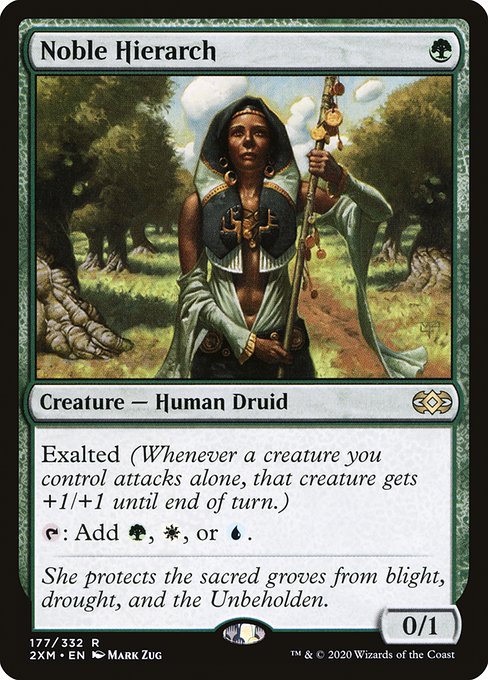
Noble Hierarch
Early fixing
Costs one green and can produce green, white, or blue. Exalted can support a lone attacker later. It normally waits a turn to tap and can be lost to a creature wipe.
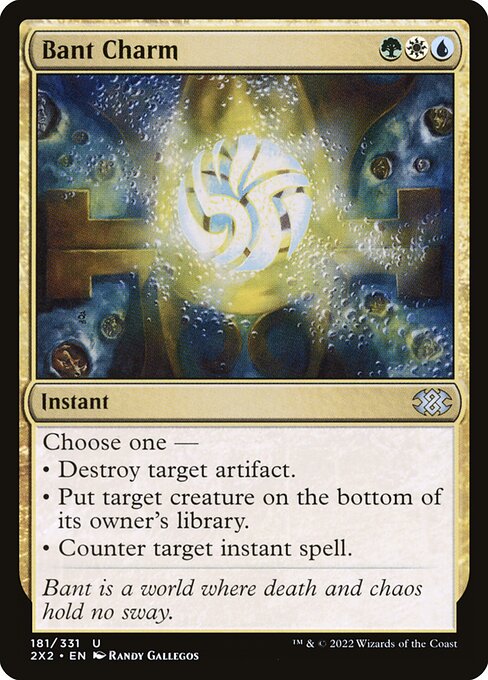
Bant Charm
Three distinct answers
Can destroy an artifact, put a creature on the bottom of its owner's library, or counter an instant. It does not counter a sorcery or enchantment spell merely because it is noncreature.

Brokers Charm
Draw or board interaction
Can draw two, destroy an enchantment, or use a pumped creature you control to damage an opposing creature or planeswalker. The damage mode needs your own creature and is not a symmetrical fight.
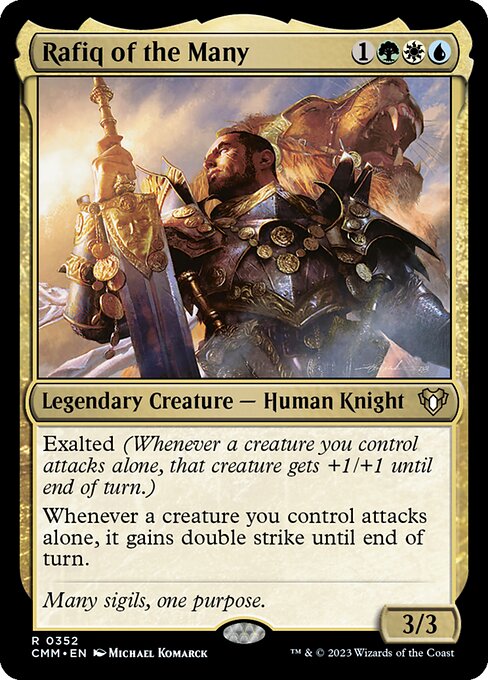
Rafiq of the Many
Single-attacker support
Rewards exactly one creature attacking through exalted and double strike. A wide token attack does not receive that same single-attacker package.
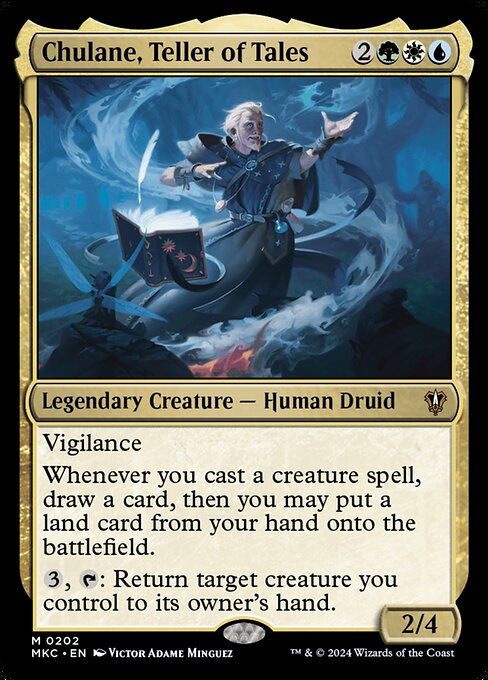
Chulane, Teller of Tales
Creature-cast engine
Creature casts draw a card and may put a land from hand onto the battlefield. Creatures entering without being cast do not trigger that ability.
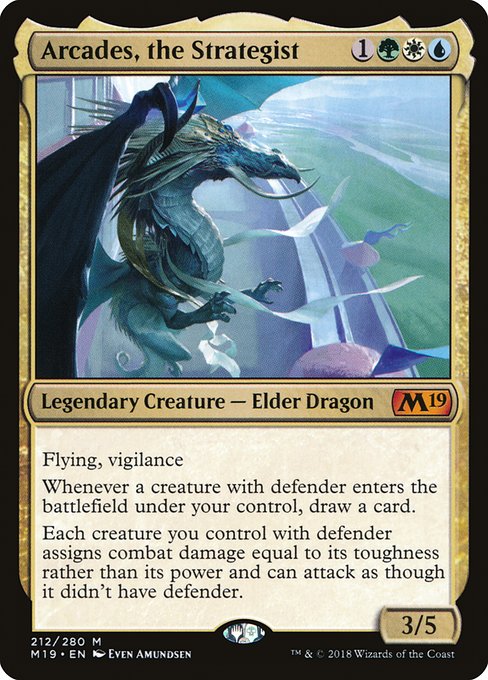
Arcades, the Strategist
Defender engine
Rewards defenders entering and lets your defenders attack and assign damage using toughness. Generic large-power creature payoffs can miss what the deck actually does.

Falco Spara, Pactweaver
Top-card access
Lets you look at the top and cast spells there with an additional counter-removal cost. You still pay other costs, and this is not permission to play a land from the top.

Derevi, Empyrial Tactician
Tap and untap support
Combat connections and its entry can tap or untap a permanent. Its command-zone activated ability puts it onto the battlefield rather than casting it.
Give green the early fixing job
Noble Hierarch can supply all three Bant colors and can contribute exalted later, but it is still a creature with a tap ability. Birds of Paradise is another color-fixing candidate with different combat relevance. Land ramp can provide a more resilient route after creature removal. Choose the mixture based on how much the commander values creature count, repeated casts, or permanent mana that survives a wipe.
Nature's Lore and Three Visits find Forest cards, including legal typed duals. The chosen land can provide another color if its types and abilities allow it, and its own entry condition determines whether it enters tapped. Farseek lists Plains, Island, Swamp, and Mountain and forces the chosen land tapped. Bant can use its Plains and Island access for fixing, including a dual that also has Forest. A plain basic Forest does not qualify for Farseek.
Include actual targets before treating a search spell as three-color fixing. A Forest-search effect cannot fetch an untapped white-blue land that lacks Forest. A hand that needs green to cast the ramp also needs an early green source before the fixing begins. Use Mana Base Calculator to inspect that starting requirement. A searchable land package improves the ramp only when the land types, entry conditions, and opening colors work together.
Choose answers that can be held alongside development
Swords to Plowshares gives efficient creature exile with a life drawback, while Beast Within or Generous Gift can destroy a broader permanent and supply a token. These single-color spells can be easier to hold up than a Charm needing all three colors. A broad answer is useful when it covers a real gap, but redundant broad answers can consume mana you intended for the commander.
Bant Charm covers an artifact, a creature, or an instant spell through different modes. The creature-bottom mode does not guarantee keeping a commander out of the command zone: the owner can use the relevant commander replacement choice for a move to hand or library. It is still an answer to the current battlefield threat. The instant-counter mode cannot replace a counter package that must also stop sorceries, artifacts, or creatures.
Brokers Charm can supply draw or remove an enchantment, giving it a different useful role. Its damage mode depends on a creature you control and uses that creature's power after the temporary increase. It does not make the opposing creature deal damage back as a fight would. That can preserve your creature, but removal of your damage source can undermine the line. Keep an independent answer when the deck needs to act from an empty battlefield.
Match the draw event to the commander
Chulane rewards casting creature spells. A blink effect may reuse an entry ability without creating another Chulane cast trigger. Guardian Project can instead reward qualifying nontoken entries, while Beast Whisperer follows creature casts. If the engine deliberately returns creatures to hand and recasts them, the cast package may be excellent. If it primarily exiles and returns them, entry-based access can fit better.
Arcades rewards defenders entering. Its creatures deal combat damage through toughness while their power may stay low. Garruk's Uprising does not become reliable merely because those defenders can hit hard in combat; it checks power. Welcoming Vampire can fit some small-power defenders but has a once-per-turn limit. Review the printed characteristics and exact trigger rather than converting combat damage potential into an imaginary power statistic.
A commander that already provides cards may need fewer additional draw engines. Use those slots for recovery, removal, or a payoff that turns the resources into a finish. Conversely, a commander focused on combat may need independent access after a wipe. Fact or Fiction can work without a creature, while a board-dependent draw spell may be stranded. Choose the stage where the list runs out of options rather than maximizing the headline draw count.
Counter support and blink can compete
Falco Spara can cast spells from the top by removing a counter from a creature as an additional cost and paying the other costs. The counter need not be a plus-one counter if the card's instruction simply says a counter. Spending a shield counter can therefore remove a defensive resource. Decide whether the spell accessed is worth losing that protection instead of treating every counter as spare currency.
Blinking a creature normally returns a new object without the counters it carried. That can be useful for an entry ability but costly for a creature that accumulated a large counter investment. A card such as Ephemerate may protect or reuse one creature while disrupting the counter plan on that creature. The deck should choose which engine matters most rather than assuming every Bant value interaction adds together without tension.
Hardened Scales, a counter-producing creature, and a top-card permission each fill different roles. A multiplier does not produce an initial counter by itself, and the permission does not pay the mana to cast the revealed spell. Build a line with the resources the hand actually contains. If several spells need a creature already carrying counters, retain some cards that create that starting position independently.
Make the attack pattern explicit
Rafiq supports a creature attacking alone. Exalted and the double-strike trigger need that attack condition, so sending an extra small creature can change the benefits dramatically. A token swarm can be a backup plan, but a team-pump package is not automatically the best use of slots in a deck whose normal finish invests in one attacker. Prioritize a legal path to damage and protection for the important creature.
Derevi rewards combat damage to a player from creatures you control and can generate several tap-or-untap opportunities from different connecting creatures. Those triggers can supply resource use or combat control, but need legal targets and useful permanents to untap. A mana source with no relevant off-turn use may create less value than the ideal sequence assumes. Its command-zone activation is not a cast and therefore does not produce cast-based rewards or require commander tax as a casting cost.
An Arcades army or another wide creature deck can instead use a suitable team payoff and protection. Choose whether the creatures are winning through power, toughness, commander damage, or repeated entry effects. That distinction changes which combat staple is useful. A large numerical bonus is less valuable if blockers, timing, or the wrong damage-assignment assumption still stop the attack.
Protect a developed board without abandoning recovery
Heroic Intervention can preserve permanents through targeted effects and destruction, but not every exile or sacrifice effect. Teferi's Protection and Clever Concealment use phasing with different scope and cost. Phasing does not create new entry triggers when permanents phase back in. A blink deck cannot count a phasing protection spell as another way to retrigger all its creatures.
Choose between protecting one engine and the whole board. Tamiyo's Safekeeping has a smaller cost for one permanent. A wide army may justify a broader spell. Leaving three mana unused to protect a minor creature can also slow the deck, so compare the resource exposed with the next development step. Protection is strongest when it preserves a useful position rather than postponing every useful play.
Eternal Witness can return a card to hand. Sun Titan can put a permanent with mana value three or less from the graveyard onto the battlefield when it enters or attacks. Those options recover different resources at different costs. A deck that relies on exile-and-return loops may still need recovery from an actual death or from a wipe that removed its draw engines. Keep a route back that does not require the commander already functioning.
Keep the mana base honest about colored pips
A three-color list can cast a green ramp spell early and still fail to make white and blue together for protection later. Count the sequence rather than only total source counts. Noble Hierarch can supply one of the three colors at a time, not all three simultaneously. A Signet activation also needs its mana input. Mark each source as tapped after using it so an imagined turn does not spend the same resource twice.
Spara's Headquarters supplies the three Bant colors and has basic land types, but it enters tapped. That can be valuable fixing and a searchable target while still costing tempo. Command Tower provides a different kind of source with no basic land types. Utility lands can give late value but may not cast early support. The right mix depends on the turns your commander and answers need, not on maximizing the number of special lands.
Mirari's Wake and Seedborn Muse can support expensive or repeated action, but cost five mana before they begin repaying the investment. Wake depends on lands being tapped for mana, while Muse does not itself give flash. Keep enough early development and actual mana sinks. A powerful later resource engine should improve an already functional list rather than stand in for the sources required to cast it.
Make cuts that preserve the chosen engine
| Deck pattern | Comparison to test | Tradeoff to acknowledge |
|---|---|---|
| Arcades has impressive toughness but weak power-based draw | A mismatched power-threshold engine to defender-compatible access | Less generic large-creature support, more actual triggers |
| Chulane list has many blink spells and few casts | A redundant blink enabler to a useful cheap creature | Less repeat entry value, more commander events |
| Rafiq attacks alone but draws team payoffs | A redundant anthem to evasion or protection | Less wide-board power, a clearer main attack |
| Falco spends counters faster than it makes them | A redundant multiplier to a real counter source | Lower ceiling, a repeatable permission cost |
These are diagnoses, not automatic swaps for every Bant deck. Keep the old version, choose one bottleneck, and compare ordinary hands after the change. Use Interaction Checker and Mana Curve Analyzer to inspect coverage and setup cost, while checking commander-specific conditions manually. Current printing prices vary. A reliable source or compatible cheap creature can improve more games than another premium generic engine.
Frequently asked questions about Bant staples
Build your deck
Put these choices into a Commander list. Create a free account to save your deck and keep tuning it with Deckcipher.
FAQ
Does Bant Charm counter every noncreature spell?
No. Its counter mode targets an instant spell. Its other modes destroy an artifact or put a creature on the bottom of its owner's library. It cannot replace a broad counter when the problem is a sorcery, creature spell, or another type outside its listed mode.
Does Brokers Charm make creatures fight?
Its damage mode temporarily increases your target creature's power, then has that creature deal damage to an opposing creature or planeswalker. It does not instruct the target to deal damage back as a fight would. Your creature and the relevant targets still need to support the legal sequence.
Does blinking a creature trigger Chulane?
Not simply from the blink. Chulane rewards casting a creature spell. Exiling and returning a creature creates an entry without casting it. Choose cast-based or entry-based draw according to the events your actual engine produces.
Can Falco Spara play a land from the top?
Its permission is to cast spells from the top with an additional counter-removal cost. Lands are played, not cast as spells, so that ability does not grant top-of-library land play. You still pay the spell's other costs and follow applicable timing.
Does Derevi's command-zone ability pay commander tax?
The activated ability puts Derevi onto the battlefield rather than casting it. Commander tax applies to casting the commander from the command zone, not that separate activation. The ability has its own printed payment and remains an activated ability that can be interacted with appropriately.
What is the main Bant deckbuilding trap?
Combining the best-looking cards from three colors without retaining enough support for the commander. A defender, counter, blink, and lone-attacker deck can share removal while needing different engines and finishes. Choose one main resource loop and use staples to keep it working.
Build Bant around the event you actually produce
Build your deck around creature casts, defenders, counters, or a defined combat pattern. Create a free account to save the list and compare that version with the connected tools. Name the first useful turn for every staple, including its colored costs and target conditions. Bant has enough options to cover its needs; the strongest package leaves enough room for the commander to give those options a purpose.