Necro Calculator
See the odds of finding a target and having a usable end-step continuation after Necropotence, Necrodominance or Necrologia.

Your deck
Import a public deck or paste a decklist. No account needed.
Load a deck containing Necropotence, Necrodominance or Necrologia to explore its end-step options.
How does the cEDH Necro calculator work?
Compare finding an end-step action with paying for it after Necropotence, Necrodominance or Necrologia. Supported flash enablers, tutors and Final Fortune can use instant mana assistance. Details sets colors, graveyard cards, sacrifices and mana to retain. Results measure access, not a probability of winning.
cEDH Necro timing, mana and calculations
Necropotence, Necrodominance and Necrologia use different timing
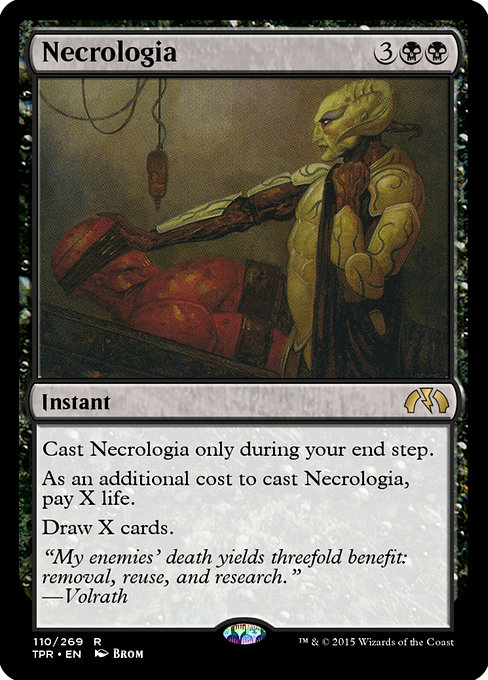
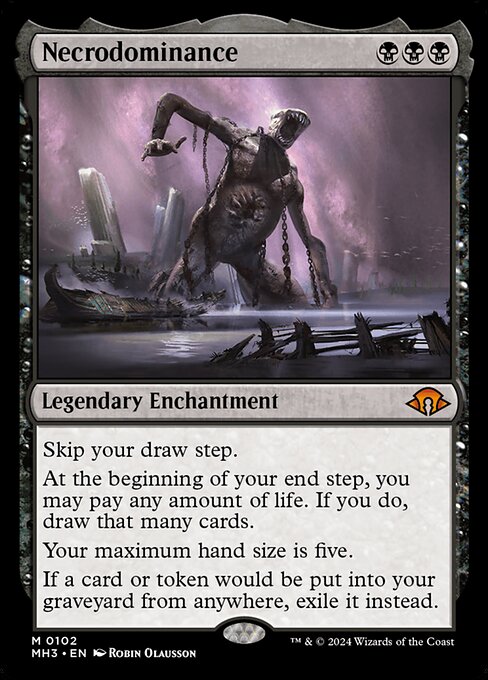
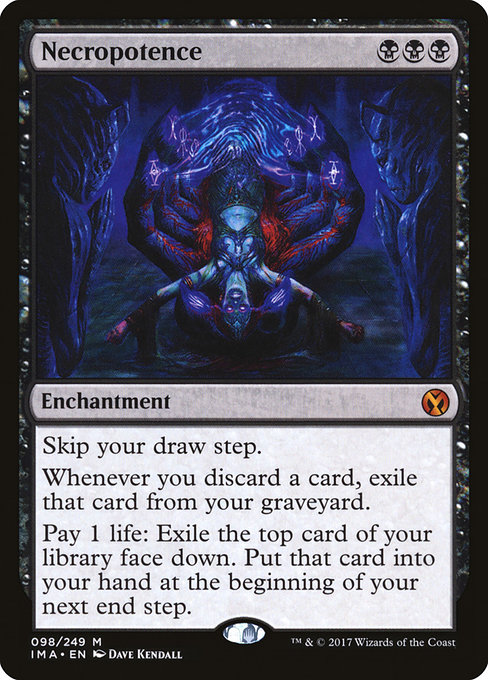
Necropotence exiles cards face down through life-paid activations. Delayed triggers put them into hand at the beginning of your next end step; these are not draws. Activations made during that end step wait for your next one. Necrodominance instead takes a life payment and draws when its beginning-of-end-step trigger resolves. Its five-card hand limit applies at cleanup, and its graveyard replacement affects rituals and sacrifices. Necrologia costs {3}{B}{B}, is cast only during your end step, and takes life as an additional casting cost.
Black rituals can fund an action before you have flash
Dark Ritual spends {B} and adds {B}{B}{B}. Cabal Ritual spends {1}{B} and adds three black, or five with threshold. Culling the Weak spends {B} and sacrifices a creature as an additional cost to add four black. Sacrifice spends {B}, sacrifices a creature and adds black equal to its mana value. A zero-mana-value creature supplies nothing through Sacrifice. These instants need starting mana and preserve their actual output colors. Black mana can pay Borne’s generic portion, but cannot replace its blue requirement.
Rain of Filth and sacrifice costs need an actual battlefield
Rain of Filth costs {B} and lets your current lands sacrifice themselves for {B} until end of turn. There is no tap cost, so tapped lands qualify. Enter other existing sacrificial lands, excluding battlefield Emergence Zone. The same land cannot fund Rain and Crop Rotation. Newly accessed lands do not count. Creature inputs describe existing permanents by mana value and token status. Each sacrifice consumes one permanent. Count its ordinary mana only once in starting mana.
Red rituals accelerate, but do not fix blue
Desperate Ritual and Pyretic Ritual each spend {1}{R} and produce {R}{R}{R}. Seething Song spends {2}{R} and produces five red. Splice is outside this model. They can pay generic costs or Final Fortune’s red requirement, but cannot manufacture blue. Manamorphose instead filters two mana into two chosen colors and draws a card; it is outside this calculated resource set.
Flash enablers grant different permissions
Borne Upon a Wind costs {1}{U}, grants spell casting this turn as though spells had flash, and must draw a card safely. High Fae Trickster costs {3}{U}, has flash and grants permission for all spells while present. Valley Floodcaller costs {2}{U} and grants only noncreature spell permission. Shimmer Myr costs {3} and grants artifact permission. Liberator, Urza's Battlethopter costs {3} and grants colorless and artifact permission. Restricted access does not make Thassa’s Oracle castable.
Existing mana sources and newly accessed rocks work differently
An existing Lotus Petal supplies one chosen color. An existing Lion’s Eye Diamond can supply three of one color before Necro cards arrive, discarding the old hand. Activating it afterward discards the new hand. An existing Skirge Familiar discards cards for black, consuming those cards. Newly accessed rocks need suitable flash permission first. Include existing mana once in Mana available; discard-based conversions and post-flash artifact sequences are not automatically calculated.
Crop Rotation needs Emergence Zone to remain in the library
Crop Rotation needs a sacrificial land, {G}, and Emergence Zone still in the library. Then pay {1}, tap and sacrifice Zone for flash permission. Zone cannot also tap for mana. Accessing Zone removes this searchable route. A battlefield Zone can activate directly; one in hand cannot ordinarily be played during the end step. Without an exact land count, Crop’s prerequisite remains a labeled assumption.
Snapback and Offer consume a separate blue pitch card
Cast Snapback using a separate blue hand card and a legal creature target. Retain priority and spend {U} on An Offer You Can't Refuse targeting Snapback. Offer creates two Treasures after spending that initial mana. The pitch cannot be Snapback or Offer used here, or the reserved action. Pitching another continuation consumes its copy. Simian Spirit Guide supplies red and Elvish Spirit Guide green; neither supplies initial blue. Resources are spent once per sequence.
How the probability calculation works
For direct targets, Find uses the hypergeometric probability 1 − C(N−K, X) / C(N, X), where N is library size, K is target copies and X is cards accessed. With four direct targets among 90 cards, accessing 20 finds at least one about 64.1% of the time. Crop and Zone need a dependent calculation: one of each among 10 cards, accessing 3 gives 7/30, approximately 23.33%. Usable checks sequences and resource consumption. Overlapping categories are counted once overall. Large resource populations use a seeded simulation, labeled with uncertainty in Details.
Set colors, locations, graveyard cards and a mana reserve
Total-only mana estimates suitable colors, spent once. Set colors to verify payments. Cabal checks threshold on resolution, before entering the graveyard. Earlier instants and sacrificed nontoken permanents can increase that count under Necropotence; Necrodominance exiles them instead. A sacrificed commander returned to the command zone does not remain as threshold fuel. Mana to keep after the action checks a generic reserve, not a combo’s colors or protection. Mark known cards outside the library to keep estimates possible.
End step and cleanup are separate windows
Mana empties as each step or phase ends. End-step mana therefore cannot be carried into cleanup. Discard triggers from Necropotence can open a cleanup priority window, but until-end-of-turn effects have already ended when that priority arrives. Borne or Rain cast earlier no longer applies there. Necrodominance’s graveyard replacement alone creates no such discard trigger. This calculator evaluates the end-step window before cleanup, not a cleanup escape loop. Demonic Consultation and Tainted Pact measure castable hand-access actions, not guaranteed retrieval; Final Fortune includes a delayed loss.
cEDH primers, sources and practical limits
Drake Sasser’s Shimmer Zur primer explains the ritual, flash enabler and artifact sequence through firsthand testing. It dates from 2023, so its decklist is historical. Evan Pierce’s RogSi guide discusses choosing between a refill and an immediate attempt. Rules here follow linked Oracle records and Wizards’ rules, effective September 25, 2026. Opposing interaction, stax, cost modifiers, post-flash rocks and complete win combos are outside the calculation. Compare general draw odds or explore Commander Tools.
Necro calculator FAQ
How much life should I pay?
Use the life slider to compare Find and Usable with your available mana. More cards do not guarantee a usable action. Enter current life in Details to leave at least 1 life, and budget separately for life-paid protection.
Does Usable line mean a probability of winning?
No. It measures a supported action with configured resources and any mana reserve. Restricted flash access may not cast your win condition. Opposing interaction and full combo execution are outside the model.
Why can accessing more cards reduce the Crop Rotation route?
Crop Rotation must reach your hand while Emergence Zone stays in the library. With one of each among 10 cards, accessing 3 gives 7/30, approximately 23.33%, before mana and battlefield checks. Accessing every card leaves no Zone to search for.
Does Borne Upon a Wind let me play a drawn land?
No. Borne grants spell-casting permission for the turn. It does not change ordinary land-play timing or allow abilities restricted to sorcery timing. Its mandatory extra draw also means an empty remaining library makes that continuation unsafe.
Can a Spirit Guide supply Offer’s initial blue mana?
No. Simian Spirit Guide supplies red and Elvish Spirit Guide green. The Snapback and Offer sequence needs initial blue mana before its Treasures exist. Generated mana retains its actual color even when starting colors are estimated.
What belongs in Mana available?
Enter mana spendable in this end step after paying for the selected source. For Necrologia, its casting cost is already paid. Include existing sources once. Main-phase floating mana does not automatically carry into the end step.
Can I use a private account deck or import without signing in?
Choose or import deck opens saved decks and imports. This browser restores your last selected account deck, or your latest updated deck. This does not publish it or change its visibility. Anonymous visitors can paste a decklist or import a supported public deck. Only Main Deck cards are analyzed.
Can newly drawn mana rocks start the end-step line?
Usually they need a suitable flash permission first. The calculator uses supported instants and Spirit Guides to pay for access. It does not assume a drawn Lotus Petal or mana rock is already on the battlefield.
Does Cabal Ritual always produce five mana after Necro?
No. Cabal Ritual needs seven cards in your graveyard when it resolves. Necropotence puts its accessed cards into hand, not the graveyard. Necrodominance prevents new graveyard cards while its replacement effect applies.
What does Mana to keep after the action check?
It requires unspent mana immediately after the action, using assistance beforehand from accessed or known cards. Later spells and Borne’s extra card are not modeled. This generic reserve does not verify a combo or its colored costs.