Ad Nauseam Calculator
Estimate nonland cards put into hand and life remaining for your deck, using a simplified life-budget model.
Your deck
Import a public deck or paste a decklist. No account needed.
Choose a deck to estimate its Ad Nauseam life budget. No results are shown until a deck is loaded.
Method and limitations
What does this calculator estimate?
The main results are average nonland cards put into hand and average life remaining under a simplified budget policy. Starting life defaults to 40 and target remaining life to 1. Change both to compare budgets. Lands are included in the shuffled pool but do not count as nonland cards. Mana-value averages, median, zero-cost share and maximum describe resolved cards only.
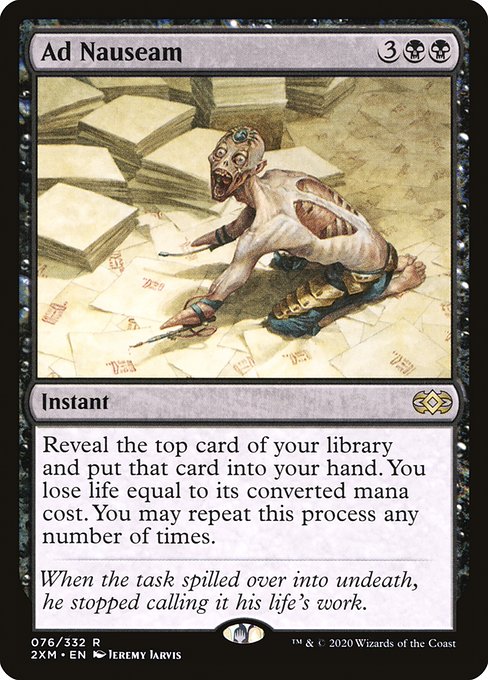
Ad Nauseam reveals a card, puts it into your hand and causes life loss equal to its mana value. You can choose to repeat after each reveal. These are not draws. The calculator does not estimate a probability of winning or model opponents, protection, casting your new spells, replacement effects, damage, or prevention of losing the game.
How are card orders sampled?
The shared deck calculator samples up to 4,096 seeded random orders without replacement. It stops before the first card that would exceed starting life minus target remaining life. The seed is fixed, so identical deck data and settings produce identical results in the deck editor and this page. If every card fits the budget, the outcome is computed directly.
This is a look-ahead budget estimate: in a real game you ordinarily do not know the next card and cannot take back a reveal. It does not give a safe stopping policy or a risk threshold. You may finish above the target because the next whole-card cost does not fit.
Which cards are modeled?
Main Deck quantities count individually. Commanders, partners in the command zone, sideboard, maybeboard and tokens are excluded. One Main Deck copy of Ad Nauseam is removed because it is resolving outside the library. Other copies remain. The tool does not remove seven opening cards or assume a 99-card library. It models the imported deck, not your current shuffled library; cards in hand, graveyard, exile and on the battlefield are not automatically subtracted.
If Ad Nauseam is absent, you can explicitly choose a hypothetical resolution. This uses the supplied Main Deck without inserting or removing a card. Your saved deck never changes when you calculate.
Mana values and unresolved cards
Printed mana values come from the existing Scryfall card resolver. X is zero outside the stack. Split cards use their combined mana value, and double-faced cards use the appropriate front-face mana value supplied by Scryfall. A spell-front modal card with a land back remains a nonland card here. Cost reductions and alternative casting costs do not change printed mana value.
Unknown cards are never treated as zero mana value. Outcomes remain unavailable until every modeled copy is resolved. The embedded calculator can also show adjusted deck costs when you set overrides; compare identical cost bases for parity. This standalone page uses printed costs.
Verify card text with Ad Nauseam on Scryfall and mana value, library and life rules in Wizards’ comprehensive rules.
Ad Nauseam calculator FAQ
Does more starting life always mean more cards?
It gives the modeled policy a larger budget. The same seeded sampling makes comparisons stable. Higher mana values consume that budget faster, while zero-mana-value cards cost no life. This does not account for life you need to spend on later spells.
Why can the average life remaining exceed my target?
Each card costs its entire mana value. The next card may not fit the remaining budget. For a hand-checkable example, three four-mana spells, starting life 12 and target 5 produce one nonland card and 8 life remaining under this model.
Do I need an account? Are my decks published?
No account is needed to import and calculate. An account lets you select saved Deckcipher decks across compatible tools. Saving asks for a name and confirms a private copy. Calculator inputs do not update saved decks or their visibility. Temporary settings are used only to restore an interrupted save, not stored as calculation history.