
Quick answer
A normal Treasure is a colorless artifact token with an activated ability that taps and sacrifices it to add one mana of any color.
What a Treasure token actually does
A normal Treasure is a colorless artifact token with an activated ability that taps and sacrifices it to add one mana of any color. It is a single-use mana source. It has no mana value beyond zero and does not have a color identity of its own that adds colors to your deck. A card may create a modified Treasure, so follow any stated exceptions.
You control three untapped Treasures and need two red mana for a spell. You can activate two Treasures for red and keep the third for later. Once sacrificed, the tokens cannot be used again unless a separate effect creates new ones. Showing three Treasure tokens beside your lands is not the same as having three extra permanent land drops.
Track available Treasure separately from recurring mana. A deck that spends all of its tokens on one large spell may have substantially less mana on the following turn.
The normal activation is a mana ability
The standard Treasure ability is a mana ability. It does not use the stack, and players do not respond to that activation itself. You can activate it while paying a spell cost when the rules allow mana abilities. Other triggered abilities caused by sacrificing or losing the artifact can still use the stack afterward.
An opponent cannot wait for you to activate an ordinary Treasure and then destroy that same token in response to prevent its mana. It has already been sacrificed as a cost. They can act before you begin the action when they have priority, or respond to a spell or separate trigger that uses the resulting mana.
When protecting a resource, distinguish the token from the payoff trigger. Preventing an artifact ability from being activated can matter before you use it, while countering a death or sacrifice trigger affects a different part of the exchange.
Summoning sickness usually does not stop a Treasure
A normal Treasure is not a creature, so summoning sickness does not prevent it from using its tap ability. If an effect makes it a creature, the restriction can apply to its tap ability unless you have controlled it continuously since the beginning of your most recent turn or it has haste. The token being an artifact does not exempt an animated creature.
A Treasure created this turn can normally help cast the next spell immediately. If March of the Machines makes it a creature, its zero mana value can also make it a 0/0 before other modifiers are considered. Animation effects create additional rules questions that ordinary Treasures avoid.
Check the exact animation effect before relying on newly created artifact creatures for mana. Some effects provide a fixed body, some derive power and toughness from mana value, and the timing of when the token became a creature may matter.
Creating Treasure is different from spending Treasure
A deck can reward artifact entries, artifact sacrifices, permanents leaving, or using mana to cast a spell. Those are separate events. Producing a Treasure can trigger an entry payoff without spending it. Sacrificing it later may trigger another payoff, but one token cannot pay two separate sacrifice costs.
With Mayhem Devil in play, sacrificing a Treasure can produce the Devil trigger in addition to mana. You do not sacrifice that same token again to a second outlet. With an artifact-entry reward, the useful moment was the token creation, which happened before its eventual sacrifice.
Map each payoff to the event it needs. This reveals whether the deck needs more producers, more repeatable spenders, or simply a reliable way to convert its existing stockpile into pressure.
Treasure production has conditions and timing costs
Professional Face-Breaker rewards creatures dealing combat damage to players, with a limit defined by each player damaged in that event. Big Score trades a card and mana for new cards and Treasures. Pitiless Plunderer needs other creatures you control to die. All three make Treasure, but their reliability depends on different board states.
A board of creatures with summoning sickness may not enable Face-Breaker immediately. Plunderer without another creature to sacrifice does not start a loop by itself. Big Score needs a card available to discard as an additional cost, so an empty hand is not enough even when you can pay its mana.
Choose producers that fit actions your commander encourages. A combat list can afford a different package from a sacrifice list, and a temporary burst should not be counted as though it were a repeatable engine.
Replacement effects change what is created
Academy Manufactor replaces the creation of a Clue, Food, or Treasure with the creation of one of each of those token kinds. It does not add Blood tokens and does not directly double every artifact token. Token multipliers can also modify creation events, with the applicable replacements chosen and applied under the replacement-effect rules.
A single ordinary Treasure creation with one Manufactor can become one Clue, one Food, and one Treasure. The other tokens have their own abilities and costs. The Food and Clue do not automatically tap for mana merely because they were created alongside a Treasure.
Treat mixed token production as access to several resources. A deck still needs a way to use the Clues, Foods, or artifact count meaningfully; otherwise the visible token pile can overstate the resources you can use this turn.
A burst of mana does not replace the whole mana base
Treasure can fix colors and accelerate a decisive turn, but relying on conditional production to make early land drops creates fragile opening hands. A Treasure maker that costs four mana does not help cast a three-mana commander when your hand contains two lands and no other development.
Compare an opening with three lands and a two-mana accelerator against two lands and an expensive Treasure payoff. The second hand might produce far more mana if everything works, yet fail to cast its first relevant spell. This is a sequencing problem rather than proof that the payoff card is weak.
Keep the lands and early development that let the deck reach its producers. Then decide how many late mana sources the repeatable Treasure engine can reasonably replace, using the games where opponents remove it as part of the evaluation.
Stockpiling Treasure changes the table assessment
A visible reserve of flexible mana can represent protection, a commander recast, or an unexpected finishing turn. It also makes mass artifact removal a real risk. Spending everything immediately exposes you to running out of options, while hoarding everything may mean you never turn the mana into an advantage.
If you have six Treasures and a useful card-draw spell, spending some to improve your hand may be safer than holding all six for a theoretical expensive topdeck. If an opponent is threatening a win, keeping one available for an answer can matter more than adding another permanent to the board.
Announce token counts clearly and update them after each creation and sacrifice. The strategic decision is how much flexibility to retain, not simply how high the pile can grow.
Cards worth comparing before you choose a package
Examples and the jobs they do
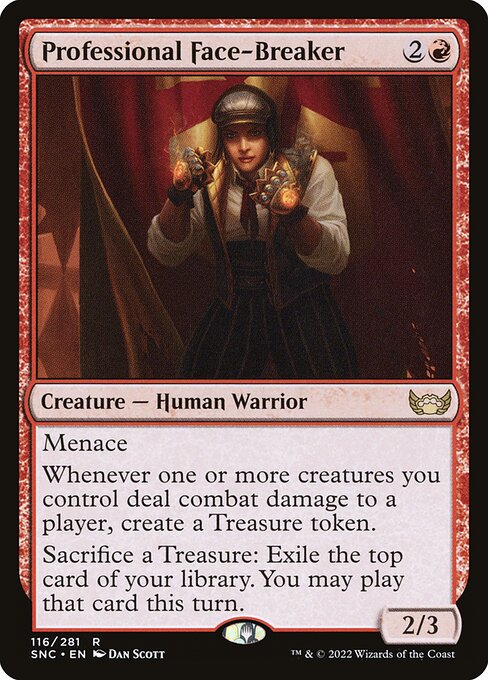
Professional Face-Breaker
Combat value
Face-Breaker connects combat damage with Treasure creation and lets you sacrifice a Treasure to exile the top card of your library for play that turn.
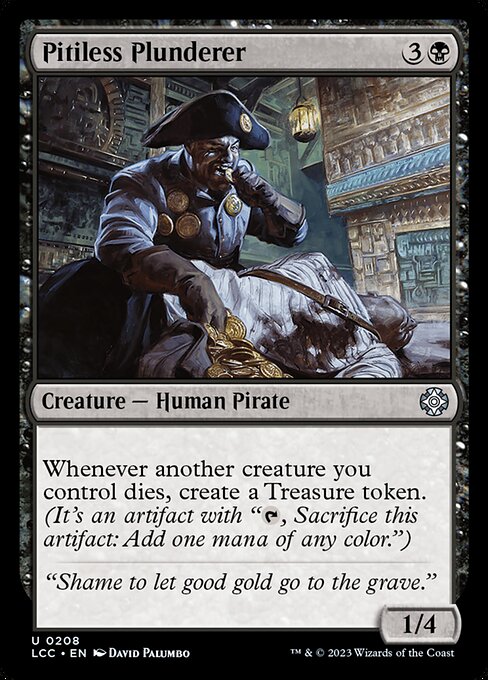
Pitiless Plunderer
Death engine
Plunderer creates Treasure when another creature you control dies.

Big Score
Burst and selection
Big Score requires a discard as an additional cost and provides cards plus two Treasures on resolution.
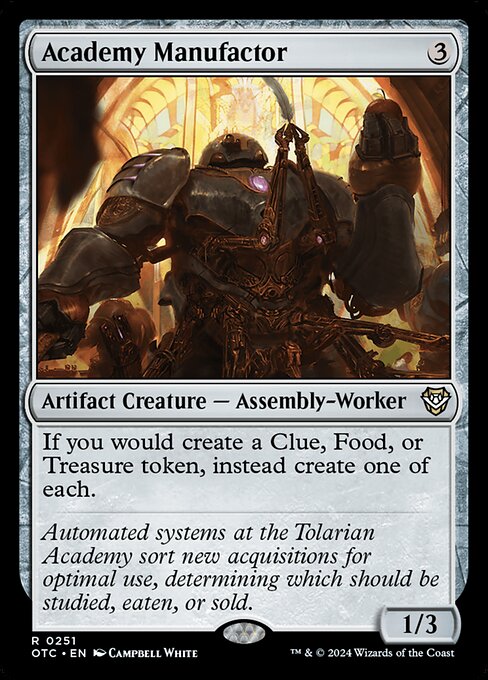
Academy Manufactor
Mixed resources
Manufactor converts qualifying Food, Clue, or Treasure creation into all three.
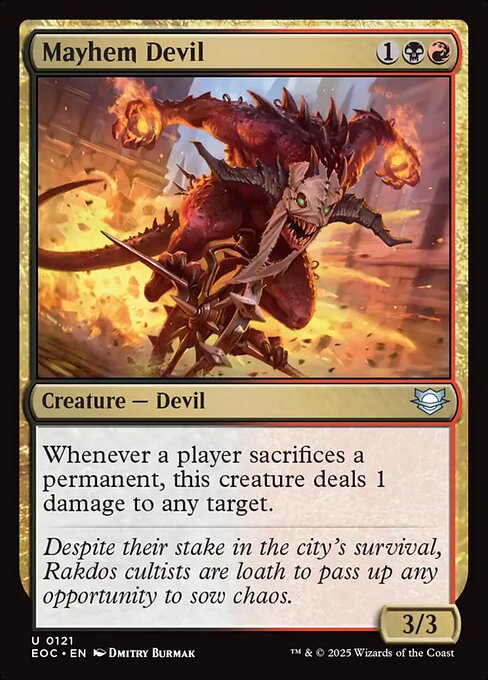
Mayhem Devil
Sacrifice pressure
Mayhem Devil triggers when a player sacrifices a permanent, making Treasure use part of a damage plan.
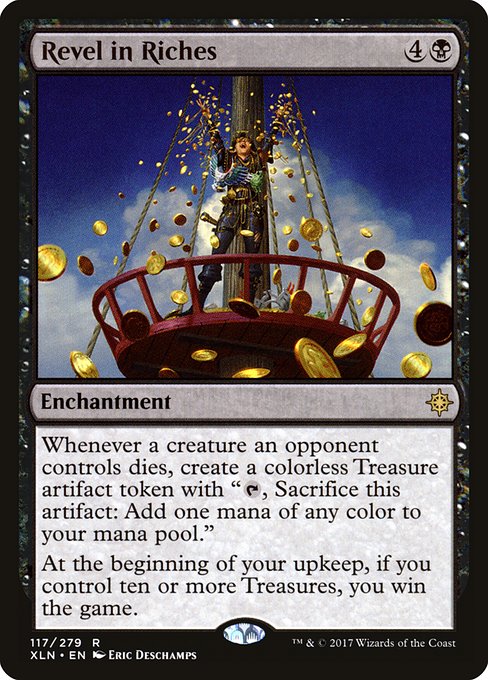
Revel in Riches
Alternative finish
Revel in Riches can reward opposing creature deaths with Treasure and has an upkeep condition tied to controlling ten or more Treasures.
Professional Face-Breaker
Small evasive attackers can turn into both mana access and another kind of card access. The exiled card has a deadline, you still pay applicable costs, and making several hits on one opponent is not the same as hitting several different players for the Treasure trigger.
Pitiless Plunderer
Creature tokens can qualify when they die, which makes a sacrifice deck a natural home for the ability. Its four-mana cost asks for a board or a follow-up action. Plunderer does not sacrifice creatures itself and does not reward its own death through that ability. Check all the other pieces before describing an interaction as repeatable or infinite.
Big Score
It can turn an expendable card into a flexible next turn without asking you to keep a creature alive. The discard has already happened if the spell is countered. It is a temporary burst, and treating it as an unconditional permanent ramp slot hides the cards and mana invested.
Academy Manufactor
The ability is a replacement effect, so the tokens enter as part of the modified creation event. It is not a universal token multiplier. Blood, Map, and other unrelated artifact tokens do not become a full set through this ability, and each resulting token still has its own use requirements.
Mayhem Devil
Its trigger is separate from the mana ability that paid for a spell. Targets and priority still matter for the damage trigger. The Devil does not cause your opponents to sacrifice things by itself, and it does not make a token available for two costs.
Revel in Riches
A reserve can become a visible alternate win attempt. The upkeep trigger has an intervening condition that must be satisfied at the appropriate times. Before upkeep, opponents can remove the enchantment to prevent its trigger. After the trigger is on the stack, removing the enchantment alone does not stop it; reducing your Treasure count below ten or countering the ability can.
Budget Treasure by the turn you will spend it
Make three columns for early development, burst mana, and repeatable production. An early accelerator helps cast the commander. A burst pays for one unusually expensive turn. A repeatable producer may cover several later turns if the condition keeps happening. Treasure cards can occupy any of those columns, but a card should not be counted in all of them without a real sequence. In particular, a four-mana producer cannot repair an opening hand that never reaches its fourth mana.
Then reserve mana for the turn after the big spell. Suppose you use four lands and four Treasures to cast an eight-mana threat. Your next untap may provide only four lands unless the threat or another surviving engine creates more resources. If that threat is removed, commander tax or another expensive follow-up can be out of reach. A less dramatic line that leaves two Treasures and casts a draw spell may produce a stronger recovery position. The correct line depends on pressure and interaction, not the size of the spell alone.
Put both versions into the deck builder and label the one-shot sources in your notes. Use the mana base calculator for the actual lands and colored requirements, while remembering that conditional combat production is a separate assumption. The Commander deckbuilding checklist helps keep draw and interaction visible when the mana package expands. Create a free account through My Decks to save the configuration you intend to bring to the table.
For a useful rules rehearsal, begin with a Treasure, a spell you want to cast, and Mayhem Devil on the battlefield. Activate the Treasure during the casting process and pay the spell costs correctly. The mana ability does not wait on the stack. After the spell is cast, handle the appropriate triggered ability in the normal order. Identify the target for Devil and give opponents a response window. This separates the unanswerable mana activation from the very answerable damage trigger.
Repeat the exercise with a permanent that prevents artifact activated abilities from being activated. Do not pretend that the stored Treasure remains ordinary available mana through that restriction. A large reserve can be shut off before you spend it. Also rehearse a mass artifact removal spell while you hold priority at a legal point. Sacrificing tokens may produce mana, but that mana normally empties as the step or phase ends, so floating it without a useful immediate action is not the same as saving the tokens.
Record the turn on which each Treasure maker first paid you back. A combat producer that regularly makes no tokens because it cannot attack safely belongs in a different category from one that consistently supports a spell. Keep the failed games in the notes, including those where the commander was answered. This is how you decide whether to trim an expensive producer, add an evasive attacker, or simply retain another land. Treasure should make the mana plan more flexible rather than disguising that it depends on one permanent surviving.
Protect the win trigger at the correct time
Revel in Riches has an upkeep trigger with a condition requiring ten or more Treasures. You need the condition when the ability would trigger and again when it resolves. Removing the enchantment before your upkeep can prevent the trigger from being created. Once that trigger is on the stack, removing the enchantment alone does not erase it. An opponent instead needs to affect the actual outcome, for example by reducing your Treasure count below ten before resolution or countering the triggered ability with an appropriate effect.
That distinction changes your own spending decision. If the trigger is waiting and you control exactly ten Treasures, using one for mana drops the count below the condition unless you create another before it resolves. A hypothetical protection spell paid entirely from lands preserves the count, while the same spell paid with a Treasure might prevent the win. Check the whole stack and any replacement Treasure creation rather than treating the ten-token threshold as a number you lock in when the upkeep begins. This is a rules exercise, not a claim that the enchantment wins through every available answer.
A decision table for the interaction
| Position | Correct result | What to check |
|---|---|---|
| Normal Treasure activation | Tap and sacrifice for colored mana | Mana ability does not use the stack |
| New Treasure creature | Tap ability normally restricted | Haste or sufficient continuous control matters |
| Specific colorless requirement | Normal Treasure cannot supply it | Colorless is not a color |
| Revel upkeep trigger exists | Removing enchantment alone is insufficient | Treasure count must still satisfy the condition |
Frequently asked questions
Build your deck
Put these choices into a Commander list. Create a free account to save your deck and keep tuning it with Deckcipher.
FAQ
Can I use a Treasure the turn it is created?
Normally yes. A standard Treasure is a noncreature artifact, so summoning sickness does not stop its tap ability. If another effect has made it a creature, check continuous control since your turn began or haste before using a tap symbol in its cost.
Can an opponent destroy a Treasure in response to its mana ability?
The ordinary Treasure mana ability does not use the stack. Sacrifice is part of its cost, so the token is gone when the mana is produced. An opponent needs to act at an earlier legal opportunity or respond to another spell or triggered ability.
Does a Treasure count as a land?
No. It is an artifact token. It can provide one mana and then goes away, but it does not count toward effects that require controlling lands. Land drops, land types, and the number of permanent land sources remain separate considerations.
Can a Treasure make colorless mana?
The normal wording says one mana of any color. Colorless is not a color, so this ability cannot supply a colorless mana symbol requirement. It can pay generic costs with colored mana. Read any modified token ability separately.
Can one Treasure pay for two sacrifice abilities?
No. Once you sacrifice the token to pay one cost, it is no longer available to pay another. Separate abilities can trigger from that one sacrifice, but that does not mean you paid two activated ability costs with the same permanent.
Does Academy Manufactor create Blood tokens too?
No. Its replacement applies to creating Clues, Foods, or Treasures and produces those three kinds. Blood is outside that list. Cards with broad artifact or token synergies may still care about Blood separately, but Manufactor does not convert it through this ability.
Can I use Treasure mana after the turn ends?
Unspent mana normally empties as each step and phase ends. A Treasure you leave unactivated remains on the battlefield, but mana already produced does not stay indefinitely without a specific effect allowing it. Decide when you need the mana before sacrificing.
How many lands can Treasure replace?
There is no universal exchange rate. Check when the deck first creates Treasure, whether that requires combat or another permanent, and what happens after removal. Early land drops that cast the producers are doing a different job from a late stockpile of temporary mana.