
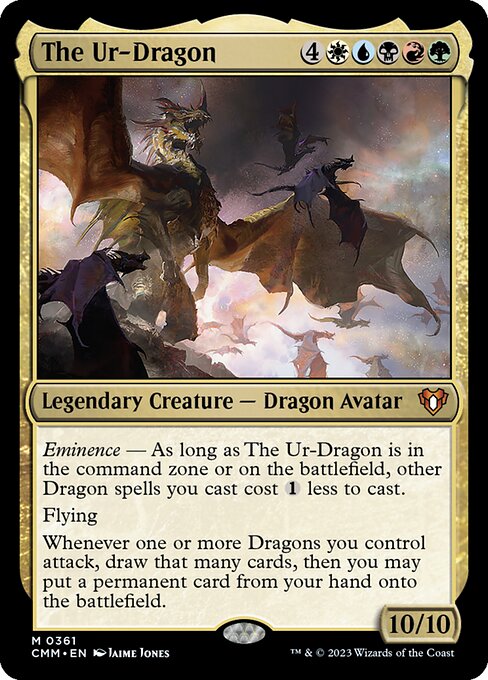
The best The Ur-Dragon upgrades usually are not more seven-mana Dragons. Start with five-color mana, two-mana ramp, Dragon cost reducers, repeatable card draw, haste, protection, and interaction. Once the deck can cast its spells reliably, upgrade the Dragon package with cards that create immediate value, damage, mana, extra combats, or board protection.
Audit your Dragon deck before you buy more Dragons
Run your Ur-Dragon list through the Deckcipher audit to see mana, ramp, draw, interaction, and bracket pressure side by side.
Upgrade The Ur-Dragon by role, not by hype
The Ur-Dragon is powerful because eminence makes every Dragon cheaper and the attack trigger turns a board of Dragons into cards and value. The deck's actual problem is rarely a lack of big Dragons, it is consistency: five-color mana, too many expensive threats, not enough early ramp, weak draw, and clunky cards that do not affect the board fast enough. Fix mana, ramp, and draw first, then upgrade the Dragon package.
Why The Ur-Dragon is powerful
The Ur-Dragon does two jobs at once. Its eminence ability discounts your other Dragon spells the moment it is in the command zone, so you are already getting a rate discount before it ever resolves. Once it is on the battlefield and attacking alongside other Dragons, its trigger turns combat into card advantage and extra permanents instead of just damage. That combination is why the deck can go from a slow start to a runaway board in a single good turn, and why the commander itself is the engine, not just a big flying finisher.
That same design is also why the deck can feel clunky. Every Dragon wants five colors of mana, most of the payoffs cost five mana or more, and a hand full of expensive Dragons with no way to cast them on curve is a common complaint in this archetype. The fix is almost never "add a bigger Dragon." It is fixing the mana, adding early plays, and making sure the deck can actually reach the turns where The Ur-Dragon's attack trigger takes over.
In practice, most Ur-Dragon games are won one of three ways: a wide board of Dragons swings for a lethal alpha strike once haste and pump effects are online, the attack trigger and Dragon ETB effects grind out enough card and mana advantage that no other deck at the table can keep up, or a couple of Dragon payoffs turn combat damage into direct damage that closes the game outright. None of those plans need every Dragon in the deck to cost seven mana. They need the deck to reliably get two or three Dragons into play and attacking, which is exactly what the upgrade order below is built around.
The Ur-Dragon upgrade priority
- Fix the mana base.
- Add early ramp.
- Add Dragon cost reducers.
- Add draw and card advantage.
- Add haste and damage payoffs.
- Add protection.
- Add flexible interaction.
- Upgrade expensive Dragons last.
Recommended deck structure
Use these as ranges to adjust from, not a fixed list. Curve matters more than raw Dragon count. A deck full of seven-mana Dragons and nothing to do before turn six will lose to a deck with half as many Dragons but a real early game.
Ur-Dragon deck structure ranges
| Category | Typical count | Notes |
|---|---|---|
| Lands | 36-38 | Adjust up if your ramp count is low or your curve is high |
| Ramp and fixing | 12-16 | Five colors need more fixing than a two-color deck |
| Card draw and advantage | 8-12 | Keeps the deck from running out of Dragons to play |
| Interaction | 8-10 | Answers threats before they take over the board |
| Board wipes | 2-4 | A safety valve when the deck falls behind |
| Protection | 3-6 | Keeps The Ur-Dragon and key Dragons alive |
| Dragon and payoff package | Enough to stay on theme without going top-heavy | Quality over raw Dragon count |
Mana base guide
Five-color mana is the single biggest consistency problem in this deck, so build it in tiers instead of grabbing whatever dual lands you already own. At the budget tier, Exotic Orchard, Path of Ancestry, and typed tapped lands like Unclaimed Territory or Secluded Courtyard fix colors cheaply since almost everything you cast shares the Dragon type. Haven of the Spirit Dragon is a slower fixer, but it doubles as reach in the late game. At the premium tier, triomes, shocklands, and fetches speed up your fixing considerably, and Cavern of Souls protects your Dragons from counterspells even though it does not tap for colored mana. Check current prices before treating any of these as automatically budget, since land prices move more than most people expect.
Check your mana base before buying more lands
See your land count and colored sources side by side before you decide which fixing lands are actually worth the upgrade.
Ramp and cost reducers
Green ramp does double duty in this deck because it fixes colors while it accelerates. Farseek, Nature's Lore, Three Visits, and Skyshroud Claim all fetch nonbasic lands, which is much better fixing than a plain basic-fetching ramp spell in a five-color shell. Cultivate and Kodama's Reach trade a card for two lands, which is slower but keeps your hand size stable.
Dragon-specific ramp is where this deck pulls ahead of a generic five-color pile. Dragon's Hoard fixes and ramps while it slowly refunds itself as your Dragons attack. Herald's Horn and Urza's Incubator both make Dragons cheaper on top of eminence, which stacks fast once you have three or four Dragon cost reducers online. Dragonspeaker Shaman and Dragonlord's Servant do a similar job from a creature body, and Scaled Nurturer and Rivaz of the Claw turn your Dragons into extra mana once they are on the battlefield. Do not skip generic mana dorks either: Bloom Tender, Faeburrow Elder, and Birds of Paradise all fix colors from turn one or two, which this deck needs more than almost any other archetype.
Card draw and card advantage
A deck full of five- and six-mana Dragons empties your hand fast, and this is the role budget builds skip most often. Kindred Discovery set to Dragons is one of the best typal payoffs available, drawing a card every time a Dragon of yours enters or attacks, which lines up perfectly with how often this deck is doing both. Zendikar Resurgent doubles your mana and draws a card off every land, which is a premium pick if your budget allows it. On a tighter budget, plain black draw like Night's Whisper or Read the Bones refills your hand for almost nothing, since black is in the deck's color identity anyway. The goal is not to draw the most cards possible, it is to make sure you are never sitting with an empty hand after a board wipe clears your Dragons away.
Protection matters just as much once you have real threats to protect. Cheap equipment like Swiftfoot Boots or Lightning Greaves keeps The Ur-Dragon alive against targeted removal while giving it haste the turn it lands, which matters a lot given how much of this deck's value comes from attacking. Do not treat protection as optional just because your Dragons look big, a two-mana removal spell does not care how many toughness a Dragon has if it exiles or bounces it outright.
Best Dragon staples
Not every expensive Dragon deserves a slot. The best payoffs either protect themselves, generate value the moment they land, or turn combat into more resources. Judge each one by its job, not by how big it looks on the card.
Core Dragon payoffs
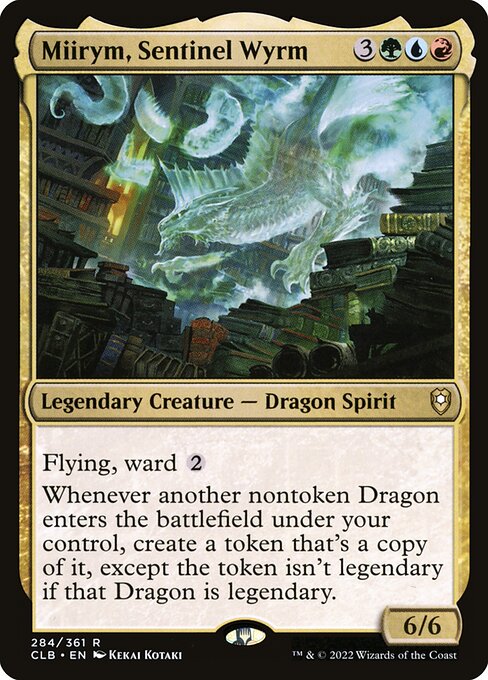
Miirym, Sentinel Wyrm
Copies a Dragon you control on entry
Copying your best Dragon on the spot doubles an attack trigger, a damage trigger, or an ETB effect, which makes it one of the highest-impact Dragons in the deck for its cost.
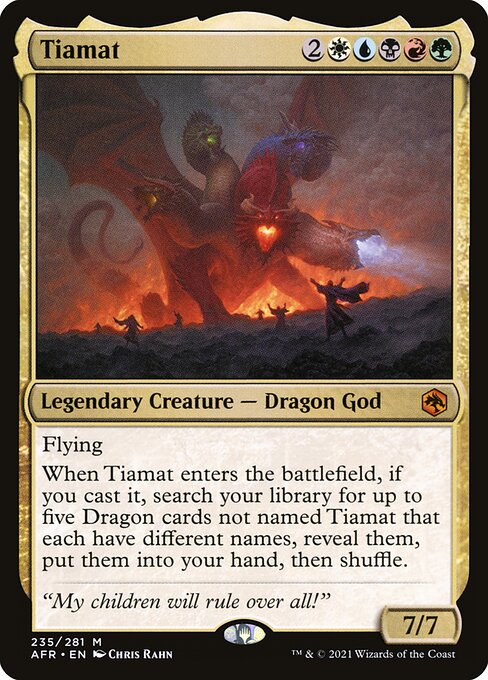
Tiamat
Finds up to five different Dragons on attack
A flying attack trigger that can put multiple Dragons directly onto the battlefield is exactly the kind of explosive turn this deck is built around, though it wants a body of mana behind it first.
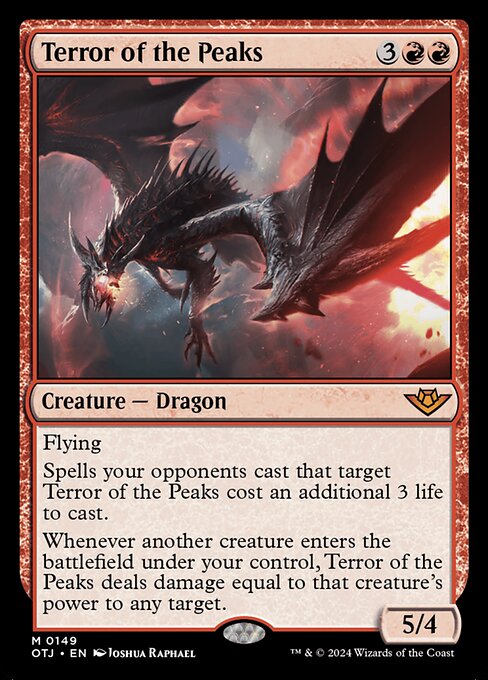
Terror of the Peaks
Pings opponents whenever a big creature enters
Every Dragon that lands after this one turns into a small removal spell or reach, which punishes opposing boards without costing you a card.
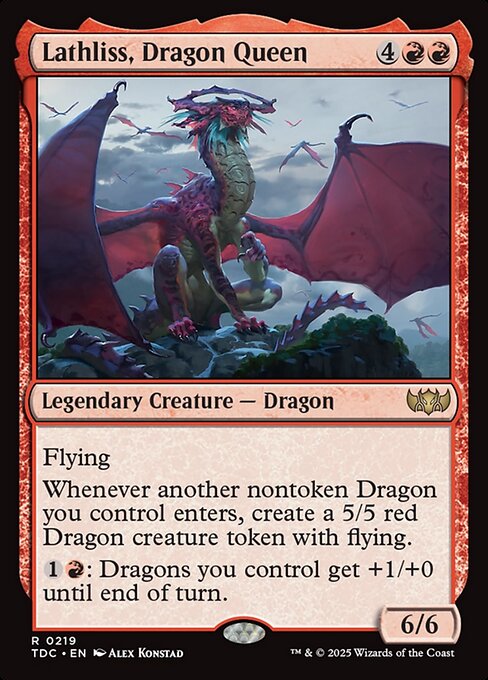
Lathliss, Dragon Queen
Makes Dragon tokens and pumps the team
A steady stream of 5/5 flying Dragon tokens plus a team-wide buff gives the deck a way to keep pressuring the board even after a wipe clears your other threats.
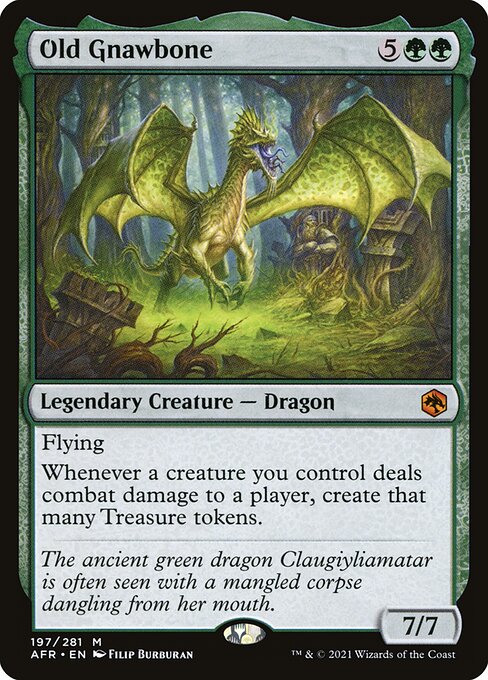
Old Gnawbone
Makes Treasures whenever your Dragons attack
A single attack step can produce enough Treasures to cast your next Dragon a turn early, which keeps the mana snowballing instead of stalling.
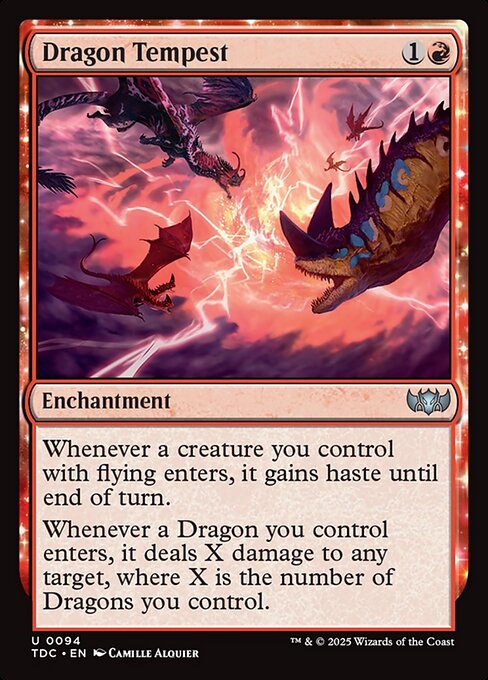
Dragon Tempest
Gives Dragons haste and drains on entry
Haste turns your newest Dragon into an immediate attacker instead of a sitting duck, and the life drain on top adds up fast once several Dragons are landing in the same turn.
Round out the package based on what your deck actually needs. Scourge of Valkas and Utvara Hellkite add more attack-trigger value, Atarka, World Render closes games in a hurry once the board is wide, and Klauth, Unrivaled Ancient turns your land drops into a slow card advantage engine. The five-color Ancient Copper Dragon, Ancient Silver Dragon, Ancient Gold Dragon, and Ancient Brass Dragon cycle each does a different job, drawing cards, protecting the board, or generating value, so pick the ones that cover a gap your list already has instead of running all four. Dragonlord Dromoka and Hellkite Courser add stability, and Sarkhan, Soul Aflame offers a flexible planeswalker line if you want extra removal or another Dragon-shaped body. Newer support from Tarkir: Dragonstorm like Ureni of the Unwritten, Dracogenesis, and Twinflame Tyrant are worth checking against current EDHREC and Moxfield data before you buy in, since Dragon typal support is still growing and prices on new cards move quickly.
Budget swaps
A budget swap should replace the job a card does, not just its name. Some of these are close functional matches, others only cover part of what the expensive card does, so treat the table as a starting point, not a guaranteed 1:1 replacement.
Budget swaps for expensive Ur-Dragon staples
| Expensive card | Budget swap | Role | What you lose | When the swap is good |
|---|---|---|---|---|
| Cavern of Souls | Unclaimed Territory or Secluded Courtyard | Typal color fixing | Counterspell protection for your Dragons | Your deck needs fixing more than it needs protection from counterspells |
| Ancient Copper Dragon | Ganax, Astral Hunter or Savage Ventmaw | Attack-triggered value | The exact card draw effect | You need a cheaper attack payoff more than a draw engine |
| Old Gnawbone | Savage Ventmaw or a Treasure-focused ramp piece | Mana acceleration off combat | Some raw Treasure output | You want a cheaper mana engine that still rewards attacking |
| Terror of the Peaks | Scourge of Valkas, Warstorm Surge, or Where Ancients Tread | Damage on creature entry | Coverage against small creatures | You mainly want reach and removal against big threats, not chip damage |
| Rhystic Study | Temur Ascendancy, Garruk's Uprising, or Elemental Bond | Card advantage | Passive draw when you are not the one attacking | Your Dragons are already landing and attacking most turns |
| Demonic Tutor or Vampiric Tutor | Sarkhan's Triumph, Shared Summons, or Time of Need | Finding a specific card | Speed and unconditional access to any card | You mainly need to find a creature or a Dragon, not any card in the deck |
| Teferi's Protection | Heroic Intervention, Unbreakable Formation, or Boros Charm | Board protection | Protection against removal aimed at you, not just your board | Your colors match and you mainly need to survive a board wipe or a bad combat |
| Cyclonic Rift | Crux of Fate or Blasphemous Act | A one-sided reset | The one-sidedness, these hit your own Dragons too | You need a flexible removal package more than a one-sided sweeper |
Cards to cut
- Too many seven-plus-mana Dragons that do nothing the turn they land.
- Big vanilla flyers with no attack trigger, no ETB, and no protection.
- Narrow pump spells that only matter in combat and do nothing otherwise.
- Too many tapped lands once the rest of the mana base is tuned.
- Clunky three-mana rocks when a two-mana signet or talisman is available.
- Win-more enchantments that only help once you are already ahead.
- Off-theme cards that do not ramp, draw, protect, remove, or win.
- Too many expensive "cool Dragons" and not enough early setup.
Bracket and Game Changer impact
The Ur-Dragon is not automatically cEDH, and it is not automatically casual either. Where it lands depends on the rest of the ninety-nine cards around it. A slower build with fair ramp and a normal curve plays like a strong casual or tuned Bracket 3 deck. Add Ancient Tomb, Rhystic Study, Smothering Tithe, The One Ring, or Cyclonic Rift, and the deck's bracket pressure goes up regardless of how many Dragons are actually in the ninety-nine. If your list includes premium tutors, fast mana, or several Game Changers, mention them before the game the same way you would in any other deck. Read the full breakdown in Commander Game Changers Explained if you want the full picture on how these cards affect table expectations.
Sample upgrade paths
Budget consistency package
- Typal fixing lands and a handful of budget triomes or tapped duals
- Green ramp that fetches nonbasics: Farseek, Nature's Lore, Cultivate, Kodama's Reach
- A small Dragon cost reducer package: Herald's Horn or Dragon's Hoard
- Cheap card draw that does not need Dragons in play
- A couple of efficient removal spells and one board wipe
Mid-power Dragon staples package
- Faster, less tapped mana base with a few real dual lands
- Mana dorks alongside land ramp for redundancy
- Two or three Dragon cost reducers running at once
- Repeatable draw engines like an Ancient Dragon or a combat-based draw payoff
- A protection piece or two, plus flexible removal in multiple colors
Premium no-budget package
- Premium fixing: shocklands, fetches, and Cavern of Souls
- Fast mana and mana dorks stacked on top of land ramp
- A full Dragon cost reducer suite alongside efficient tutors
- Free or near-free interaction and board protection
- Top-end Dragons chosen for immediate impact, not just size
Audit your Dragon deck before buying more Dragons
Deckcipher can help you check your Ur-Dragon deck's mana, ramp, draw, interaction, Game Changers, price drivers, and cards to review before game night.
FAQ
Is The Ur-Dragon still good in Commander?
Yes. Eminence discounts every Dragon you cast, and the attack trigger converts a board of Dragons into cards and value, which keeps the deck relevant even as new Dragon support keeps releasing.
Is The Ur-Dragon beginner friendly?
It is approachable but not the simplest first Commander deck, mainly because five-color mana takes more work to build than a two or three color deck. A clean mana base makes the rest of the deck feel much easier to play.
How many lands should The Ur-Dragon run?
Most Ur-Dragon decks want around 36 to 38 lands, with the exact number shifting based on your ramp count and how high your curve sits.
How much ramp does The Ur-Dragon need?
Plan for around 12 to 16 ramp and fixing pieces, since five colors need more mana support than a typical two-color Commander deck.
What are the best budget upgrades for The Ur-Dragon?
Start with typal fixing lands, green ramp that fetches nonbasics, a Dragon cost reducer like Herald's Horn, and a few efficient removal spells before spending on expensive Dragons.
What expensive Ur-Dragon cards have good budget swaps?
Cavern of Souls, Ancient Copper Dragon, Old Gnawbone, and Rhystic Study all have role-based budget swaps, though none of them are exact one-to-one replacements. Check the budget swaps table above for specifics.
What cards should I cut from The Ur-Dragon?
Cut top-heavy Dragons with no immediate impact, vanilla flyers, narrow pump spells, and any card that does not ramp, draw, protect, remove, or push toward winning.
Is The Ur-Dragon high power?
It can be, but it is not automatically high power. A slower, fair build plays like a strong casual or Bracket 3 deck, while a build with fast mana, tutors, and several Game Changers can push into Bracket 4.
Is The Ur-Dragon better than Miirym or Ureni?
They solve different problems. The Ur-Dragon is the most explosive payoff once it is online, while Miirym and Ureni-style commanders tend to be more budget-friendly and easier to keep on curve. Choose based on how much you want to invest in a five-color mana base.
What is the biggest mistake in Ur-Dragon deckbuilding?
Buying expensive Dragons before the mana base and ramp are solid. A deck that cannot reliably cast five colors of mana will underperform no matter how strong its top end looks on paper.
Conclusion
The Ur-Dragon rewards patience more than raw card quality. Fix the mana base, add real ramp, layer in Dragon cost reducers, and keep the draw and interaction counts healthy, and the deck will start winning games on the strength of its attack trigger alone. Expensive Dragons are the reward for a consistent deck, not the fix for an inconsistent one. Build the boring parts first, then let the Dragons do the rest.