
Quick answer
A Saga can reward patience or careful counter timing. Its chapters trigger when lore totals cross the relevant numbers; removing a counter does not itself repeat a chapter, and pending chapters affect the normal final sacrifice.
A Saga follows lore counters rather than a separate turn timer
A Saga is an enchantment with chapter abilities represented by Roman numerals. Lore counters track its progress. A normal Saga enters with a lore counter, causing the appropriate first chapter to trigger. That counter placement is an entry replacement effect, while the resulting chapter ability is a triggered ability on the stack. The two events should not be described as one unanswerable resolution.
Casting Binding the Old Gods first creates an enchantment spell on the stack. If it resolves and enters normally, it receives its starting lore counter and its first chapter triggers. You choose the required target as the trigger is put onto the stack. Players can respond to that trigger before its destruction happens.
A Saga may supply value immediately, but the later chapters require time or additional counter manipulation. Compare the first chapter and the full sequence separately when judging how useful it is after a difficult opening.
The normal lore counter arrives as your precombat main phase begins
As your precombat main phase begins, you put a lore counter on each Saga you control that has chapter abilities. This is a turn-based action that does not use the stack. It is not an upkeep trigger. The chapter abilities that result do use the stack, and players can respond after they are placed there.
On the turn after Binding the Old Gods enters, you draw for the turn and then begin the precombat main phase. The Saga receives its next lore counter before you can take an ordinary action in that main phase. Its second chapter trigger can then search for a Forest card and put it onto the battlefield tapped when it resolves.
If you want to remove a lore counter before the normal advance, act during an earlier legal priority window, such as your upkeep or draw step. Saying you will respond to the turn-based counter placement in the main phase is not the correct sequence.
Putting several counters can trigger several chapters
A chapter triggers when adding lore counters crosses its chapter number. Moving from zero lore counters to three can therefore trigger the first, second, and third chapters when applicable. Moving from two to three triggers the third, not every earlier chapter again. The starting count and the number being crossed determine the result.
If several chapter abilities you control trigger together, you put them on the stack in an order you choose, and the last one placed resolves first. That can change targets and resources available for the later resolutions. Do not assume the printed Roman-numeral order automatically determines stack order when one event crosses several chapters.
Before using a counter multiplier, list which thresholds the placement crosses. A plan that depends on resolving a particular chapter last should account for the other waiting chapter abilities and the normal response windows between them.
Proliferate advances an existing Saga by one
Proliferate can choose a Saga that already has a lore counter and add another lore counter. It does not target that Saga and does not start a new counter type where none exists. If the placement crosses a chapter number, the corresponding chapter can trigger after the resolving effect finishes. Other kinds of counters on that Saga also increase if present.
A Saga at one lore counter can advance to two through one proliferate action and produce its second chapter. You do not wait for your next main phase for that chapter to occur. During your next precombat main phase, the normal counter can then advance it again, assuming it remains a Saga with the relevant chapter abilities.
This can compress a slow resource into an earlier result, but it can also move a useful Saga toward being sacrificed sooner. Decide whether you want the next chapter now or want more time to prepare a later effect.
The final chapter does not cause an immediate sacrifice on placement
A Saga with enough lore counters to meet its final chapter number is sacrificed as a state-based action only when it is not the source of a chapter ability that has triggered and not yet left the stack. This lets the chapter abilities finish. The sacrifice is not an additional cost paid merely for placing the final lore counter.
When The Eldest Reborn reaches its third chapter, choose its graveyard target and put the ability on the stack. The Saga remains while that chapter is waiting. After its pending chapter abilities have left the stack, check the counter total and the final chapter number before applying the sacrifice rule.
This window can matter for counter removal or other effects. It is not permission to interrupt the middle of a resolving chapter, and it does not make the Saga safe from an opponent removing it before another useful event.
Removing lore counters can repeat a useful threshold
A counter-removal effect can lower a Saga total so a later placement crosses a chapter number again. Removing counters does not itself reverse the already resolved effects or trigger chapters on the way down. The later upward crossing is what creates another appropriate chapter ability. You need the removal effect, its costs, and legal timing.
With a two-counter Saga, removing one lore counter can let the next ordinary placement move it from one to two again. With a final chapter on the stack, lowering the total sufficiently can change whether the Saga meets the sacrifice condition after the chapter leaves the stack. The exact ability and remaining total matter.
This creates a resource engine only when the repeated chapter is useful and the counter manipulation is affordable. Do not include several narrow manipulators just to preserve a Saga whose ordinary full sequence was already adequate for the deck.
Read ahead and transforming Sagas need their own instructions
Read ahead lets you choose a starting chapter number and causes the Saga to enter with that many lore counters. Its rules skip the earlier chapters rather than giving every crossed chapter as an ordinary zero-to-many placement would. A Saga that exiles itself and returns transformed also follows that specific chapter instruction rather than the normal idea of simply remaining as an enchantment.
Do not apply a general counter-doubling example to a read-ahead entry without accounting for read ahead. Likewise, when a chapter returns a transformed card, check whether it returns tapped, who controls it, and what the new face actually is. A returned permanent is normally a new object rather than the old Saga retaining every counter and attachment.
Read the exact card before choosing recursion or blink support. Some Sagas are excellent to repeat from their first chapter, while others reward skipping to a particular result or becoming a different permanent.
Saga payoffs reward precise events
Tom Bombadil rewards resolution of a final chapter, with a once-per-turn limit on that ability. Narci, Fable Singer rewards final-chapter resolution with life loss and gain, and separately rewards you sacrificing an enchantment with a draw. These events are related but not interchangeable. A countered final chapter did not resolve, while an ordinary Saga sacrifice can still be an enchantment sacrifice.
Destroying a Saga is not the same action as its controller sacrificing it. A deck cannot count Narci sacrifice reward merely because an enchantment was destroyed. Similarly, putting a lore counter on a Saga is not automatically resolving a final chapter. Follow the event wording when counting the engine output.
Choose payoffs that match the way your Sagas actually leave and advance. A list with many blink effects, a list with sacrifice loops, and a list with normal gradual chapters may need different support despite sharing the Saga theme.
Cards worth comparing before you choose a package
Examples and the jobs they do
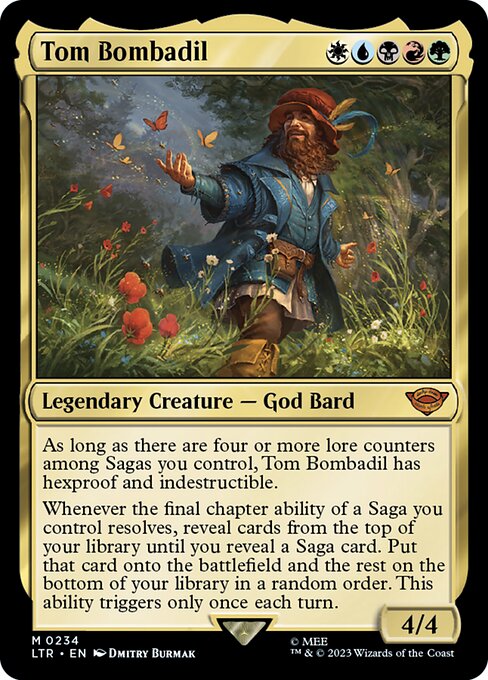
Tom Bombadil
Saga replacement
Tom can gain hexproof and indestructible when the lore counter total across your Sagas reaches the stated threshold.
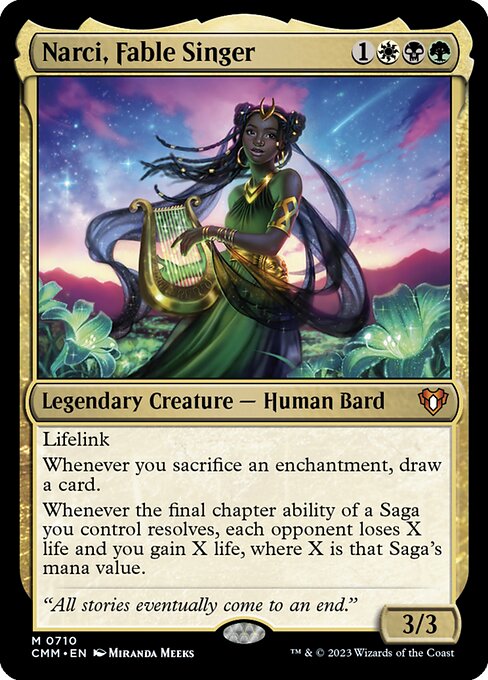
Narci, Fable Singer
Sacrifice and life pressure
Narci draws when you sacrifice an enchantment and has a separate life-loss reward when a Saga final chapter resolves.
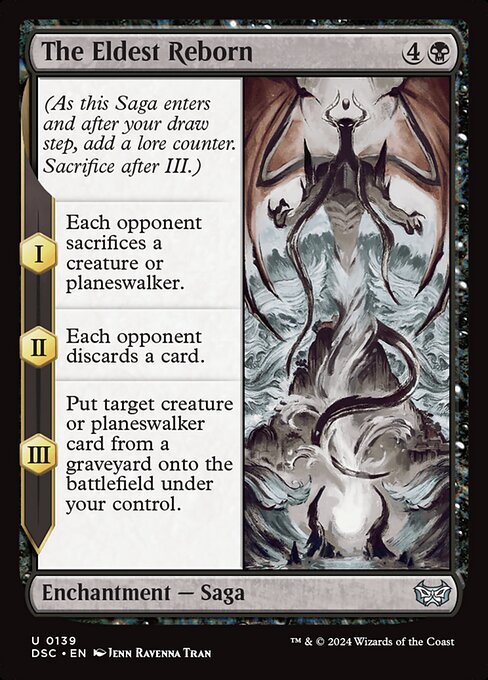
The Eldest Reborn
Gradual disruption and return
The Eldest Reborn progresses from opposing sacrifice to opposing discard to a targeted creature or planeswalker return from a graveyard.
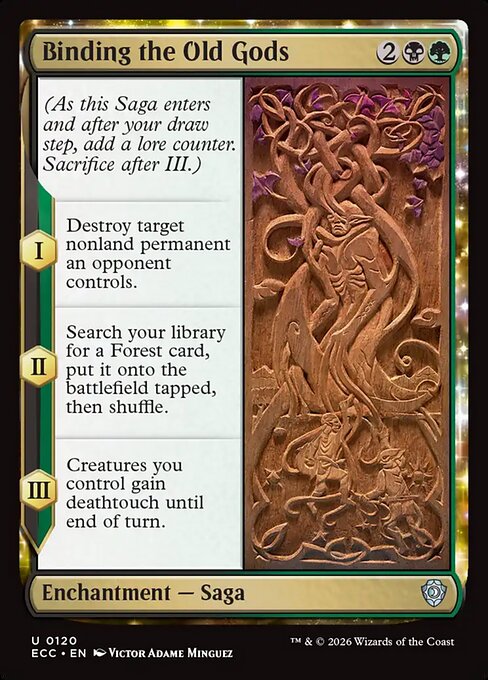
Binding the Old Gods
Removal and land development
Binding begins with targeted nonland destruction, later searches for a Forest card, then gives your creatures deathtouch for the turn.

Hex Parasite
Flexible counter removal
Hex Parasite can remove up to a chosen number of counters from a target permanent through its activated ability.
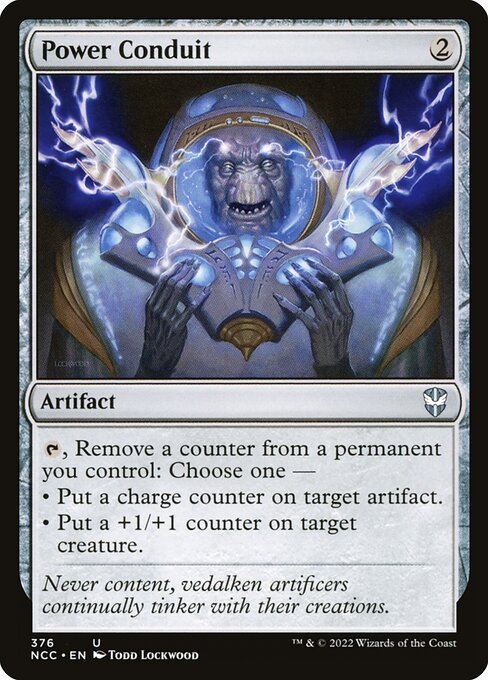
Power Conduit
Repeatable counter transfer plan
Power Conduit taps and removes a counter from a permanent you control as costs, then places the selected counter type on a legal target through the chosen mode.
Tom Bombadil
His final-chapter reward can reveal and put another Saga onto the battlefield. The reward triggers only once each turn. He does not protect your entire enchantment board, and a large lore total is not itself a completed win condition.
Narci, Fable Singer
Normal Saga progression can connect those events without pretending they are one trigger. Destruction is not sacrifice. Keep the final-chapter trigger and any later sacrifice draw separate, with the appropriate response windows and life totals.
The Eldest Reborn
Its value develops over several distinct chapter resolutions. The opponent chooses the sacrifice in the first chapter, while you choose the graveyard target for the last. A single label such as removal does not describe every stage.
Binding the Old Gods
The Forest instruction is not limited to a basic Forest. The searched land enters tapped. Consider when that mana arrives, and do not evaluate the whole Saga as though removal and ramp happen in the same initial resolution.
Hex Parasite
That can lower lore totals when you want a later placement to cross a chapter again. Its activation has a variable cost and a Phyrexian black component. Its color identity is not colorless merely because the creature mana cost is generic.
Power Conduit
It can turn lore maintenance into another resource. It normally removes one counter per activation and must be usable and untapped. The target and chosen mode still matter; the artifact does not move an arbitrary number of lore counters for free.
Rehearse a chapter sequence before adding more support
Begin with Binding the Old Gods at one lore counter and a creature board you could realistically control. Advance it normally into the second chapter and put the Forest search onto the stack. Resolve it and mark the searched land tapped. Now compare a version where you proliferated before the turn began. The land can arrive at a different point, and the normal precombat placement may move the Saga toward its third chapter sooner. These are timing choices with different mana and combat consequences.
For counter removal, start with The Eldest Reborn at two lore counters, Power Conduit untapped, and a legal target for its chosen mode. Remove one lore counter as part of activating Conduit, then finish resolving that ability before advancing to the next step. At the next precombat main phase, the normal lore placement returns the Saga to two and creates the second chapter again. You have repeated a threshold, not rewound the first chapter or reversed an opponent's earlier discard.
Then try the final-chapter window. Place the third chapter on the stack and choose its graveyard target. If you can legally lower the Saga's lore total before the chapter finishes, calculate whether it still meets the final-number sacrifice condition afterward. If another chapter ability from the same Saga is still waiting, that also matters to the state-based check. Keep each pending ability visible rather than sacrificing the Saga merely because the die first displayed three.
Use the deck builder to sort Sagas by the chapter you most want to repeat. Compare the surrounding draw, ramp, and interaction in the Commander deckbuilding checklist. The mana base calculator is especially useful for a five-color Tom Bombadil project, where a handful of attractive colorless utility lands can interfere with casting the commander. Create a free account through My Decks to save the exact version and the sequences you intend to try.
Finally, test the list with no Saga on the battlefield. A counter manipulator should have another useful job, or the deck should have enough reliable Saga access to justify accepting that weak position. Note whether a game was lost before the first Saga, because the chapters took too long, or because there was no finish after the value engine began. Those are separate problems. Replacing another early spell with an elaborate payoff will not repair a hand that cannot reach its first meaningful chapter.
Use current rules when comparing older discussions of Saga counter multipliers. The 2026 rules make the entry lore counters an intrinsic replacement effect, so Doubling Season can double the lore counters a Saga enters with. That is distinct from the ordinary precombat turn-based placement. Read ahead also has a same-turn exception: a chapter cannot trigger during the turn that Saga entered unless its current lore count exactly matches that chapter number. Apply that exception to later counter placements during the entry turn too, rather than only to the initial choice. From a later turn onward, ordinary threshold-crossing behavior applies. This can make an entry-turn proliferate or a doubled entry behave differently from a simple example using an ordinary Saga.
A decision table for the interaction
| Position | Correct result | What to check |
|---|---|---|
| Saga enters normally | Receives starting lore counter | Chapter trigger uses the stack |
| Precombat main phase begins | Ordinary lore counter is placed | Placement does not use the stack |
| Several thresholds crossed | Each relevant chapter can trigger | Controller orders simultaneous triggers |
| Final chapter waiting | Saga normally remains | Check sacrifice only under the full state-based condition |
| Lore counter removed | Progress decreases | Chapters trigger from later upward crossings |
Frequently asked questions
Build your deck
Put these choices into a Commander list. Create a free account to save your deck and keep tuning it with Deckcipher.
FAQ
When do Sagas get their normal counter?
As your precombat main phase begins, not during upkeep. The counter placement is a turn-based action that does not use the stack. The resulting chapter abilities do use the stack and can be answered before their effects resolve.
Does proliferate trigger a chapter immediately?
Adding the lore counter can cross a chapter threshold. The chapter ability triggers and waits to be placed on the stack at the appropriate time after the current resolving effect finishes. It does not resolve in the middle of the proliferate instruction.
Can I remove a lore counter to repeat a chapter?
Yes, if a later counter placement crosses that chapter number again. Removing the counter itself does not undo or repeat the chapter. You need a legal removal effect, enough resources to use it, and the correct timing.
Is a Saga sacrificed as soon as it gets the last counter?
Not while it is the source of a chapter ability that has triggered and not yet left the stack. Apply the Saga state-based sacrifice rule after the relevant pending abilities have left the stack and its counter total still meets the condition.
Does destroying a Saga stop its chapter already on the stack?
Usually the existing triggered ability remains independent of its source. It still needs any targets to remain legal. Removing the Saga can prevent future chapters, but it does not automatically counter a chapter that already triggered.
Does read ahead give all the earlier chapters too?
No. Read ahead has specific rules for entering at a chosen chapter and skipping earlier chapters. Do not treat that entry as an ordinary Saga receiving multiple counters without the read-ahead exception. The exact keyword changes the outcome.
Can Tom Bombadil trigger several times in one turn?
His final-chapter reward says it triggers only once each turn. Resolving another final chapter that turn does not bypass that limit. Planning chapter resolutions on different players turns can be relevant when you have legal ways to advance Sagas then.
Do Saga decks need dedicated counter manipulation?
Only when repeating or accelerating chapters improves the plan enough to justify the slots. Ordinary Saga progression can already provide useful value. Too many narrow manipulators can leave a hand unable to begin because it contains no worthwhile Saga to support.