
Quick answer
The Role limit applies separately to each player controlling the Auras on one permanent. Extra Roles can create enchantment events, but you do not keep every Role bonus you create on the same creature.
Roles are predefined Aura enchantment tokens
Role tokens are enchantments with the Aura subtype and enchant creature. Each named Role has a defined package of effects. They are permanents attached to creatures, rather than counters on those creatures. Removing an Aura and removing a counter are different actions, and effects that care about enchantments can see a Role entering or going to the graveyard.
A Royal Role gives its enchanted creature a power and toughness bonus and ward, while a Cursed Role sets a creature's base power and toughness to 1/1. The visible name of the Role matters. A generic marker saying Role without the specific type can hide which ability the creature has.
Use the matching token or write the Role name and effect clearly. The mechanic is much easier to follow when the table can distinguish a Royal defensive piece from a Cursed shrinking effect.
One controller cannot keep several Roles on the same permanent
If a permanent has multiple Roles attached that the same player controls, the state-based Role rule keeps the most recent one and puts the others into their owners' graveyards. Different players can each control a Role attached to the same creature. This restriction is about the controller of the Auras, not simply the controller of the creature.
You control a Royal Role attached to a creature and later attach a Monster Role you also control to it. The older Royal Role goes away when state-based actions are checked. If an opponent controls a Cursed Role on that creature, it is not removed merely because you added your own Role.
Plan around replacing your own Role rather than stacking every named bonus. The replacement can still create enchantment-entry and graveyard events, which may be part of an enchantress or sacrifice plan.
Token Auras enter attached without being cast
A spell or ability that creates a Role attached to a creature puts that Aura token directly onto the battlefield. It is not an Aura spell being cast. Whether the effect targets depends on the spell or ability creating it. The resulting Aura must still be legally attached, including restrictions such as protection.
Ellivere creates a Virtuous Role attached to another target creature you control, so her ability targets. A different instruction without a target uses different targeting rules. The fact that the result is an Aura does not mean a token was cast from your hand or that it triggers abilities requiring an enchantment spell to be cast.
Separate cast triggers from entry triggers in the deck. Role production can be excellent for enchantments entering while failing to support a payoff whose exact wording requires casting enchantment spells.
The named Roles have distinct strategic jobs
Monster and Young Hero Roles both support combat, but they do it differently. Monster provides a bonus and trample. Young Hero can place a +1/+1 counter on an attacking creature with sufficiently low toughness. Sorcerer supports attack selection with scry, while Royal provides a bonus and ward. Their value depends on the creature and the timing.
A creature with a large body but no way through blockers may want Monster more than Young Hero. A small evasive attacker can use an attack trigger consistently but may not need trample. A creature protected by Royal still needs a legal response to an untargeted sweeper, which ward does not answer.
Choose the Role for the combat step you expect, rather than counting every Role as the same amount of extra power. Trigger conditions and evasion can matter more than the printed bonus.
Cursed changes the base rather than erasing everything
A Cursed Role sets the enchanted creature's base power and toughness to 1/1. Other applicable bonuses, counters, and effects can still modify the final numbers under the normal layer rules. It does not automatically remove abilities. A large creature carrying equipment or counters may therefore remain much larger than 1/1.
A creature with three +1/+1 counters and no other modifiers has a 1/1 base under Cursed and receives the counters afterward, making it 4/4. Existing flying, deathtouch, or triggered abilities are still there unless another effect removes them. The Role is not equivalent to a spell that strips all text.
Use Cursed to answer the part of a creature that its actual effect changes. If the threatening part is a static ability or a combo trigger, shrinking the body may not solve the problem.
Wicked and Virtuous require their own text
Wicked provides a combat bonus and causes each opponent to lose life when that Aura goes to the graveyard from the battlefield. Virtuous, associated with Ellivere, scales a creature using the enchantments you control. These effects make a Role relevant beyond a simple temporary combat trick.
Replacing your own Wicked Role can cause its graveyard trigger, even though the enchanted creature remains. A Virtuous Role can shrink if enchantments leave your battlefield. Do not record its bonus as a permanent number that stays fixed after the enchantment count changes.
These Roles can support very different finishes. One emphasizes repeatable Aura entries and departures, while another rewards building an enchantment board and connecting in combat.
Removal can answer the creature or the Aura
Destroying a creature normally leaves its attached Auras unable to remain legally attached, causing them to go to the graveyard. Removing just the Role leaves the creature but changes its bonuses and abilities. Protection from the relevant qualities can make an Aura attachment illegal, while hexproof and shroud primarily restrict targeting rather than all existing Auras.
If a Royal Role is already attached, giving the creature hexproof does not make that Aura fall off. If the creature gains protection from enchantments, that is a different restriction and can remove attached enchantment Auras through state-based actions. Evaluate the exact protection wording.
Decide whether the engine is the creature, the Role, or a separate enchantment payoff. An efficient Aura answer can be enough for one threat while doing little against a commander that will create another Role next turn.
Roles support enchantment plans without replacing fundamentals
A deck can use Roles to supply enchantment entries, improve attackers, or create repeatable graveyard triggers. It still needs actual creatures to carry the Auras and a way to recover if the creature board is swept. Too many cards that only improve an enchanted creature can leave the deck without a useful early body.
Imagine drawing a Role producer, two enchantment payoffs, and no creature you can legally enchant. The cards may be strong together later but do not begin the game. Conversely, ordinary creatures that generate value on entry can remain helpful after the Aura disappears.
Keep enough independent creatures and cards that function with an empty battlefield. When choosing an upgrade, prefer a card that helps both the enchantment theme and a turn when your commander is unavailable.
Cards worth comparing before you choose a package
Examples and the jobs they do
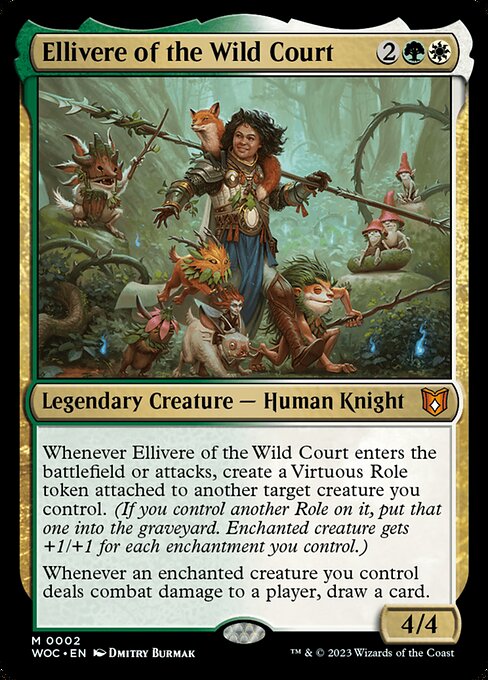
Ellivere of the Wild Court
Virtuous engine
Ellivere creates a Virtuous Role attached to another target creature you control when she enters or attacks.

Spellbook Vendor
Repeated Sorcerer Roles
Vendor can offer a one-mana payment at the beginning of combat on your turn.

Lord Skitter's Blessing
Wicked support
This enchantment creates a Wicked Role attached to a target creature you control when it enters and can provide an additional card at the beginning of your draw step if you control an enchanted creature.
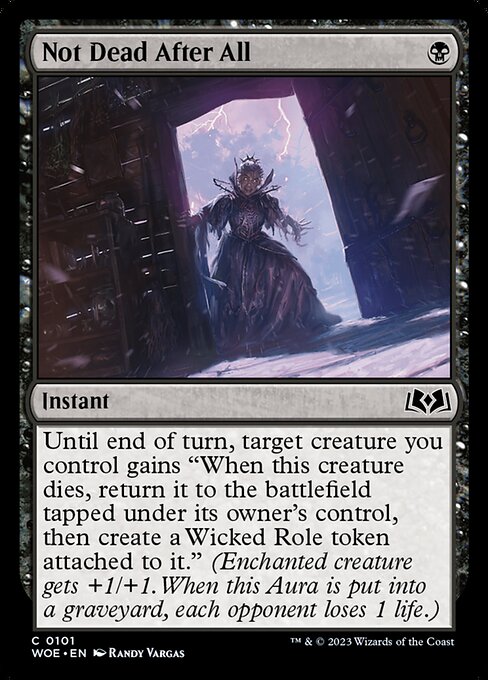
Not Dead After All
Return with a Role
This instant can give a creature a death-triggered return with a Wicked Role attached.

Royal Treatment
Protection and Royal Role
Royal Treatment gives a target creature you control hexproof for the turn and creates a Royal Role attached to it.

Twisted Fealty
Temporary control and Wicked Role
Twisted Fealty temporarily gains control of a target creature, untaps it, and grants haste.
Ellivere of the Wild Court
Her combat-damage reward for enchanted creatures turns successful attacks into card draw. She cannot attach that Role to herself through the ability because it says another. The deck needs other creatures and ways for them to deal combat damage, rather than just a large enchantment count.
Spellbook Vendor
Paying triggers a separate ability that creates a Sorcerer Role attached to a target creature you control, including Vendor itself. It offers recurring support from an early creature. The payment competes with developing your turn. A Sorcerer Role supplies a power-and-toughness bonus and an attack scry ability. Replacing a Role you already control on that creature does not let you stack the old bonus indefinitely.
Lord Skitter's Blessing
It connects the Aura theme with a continuing resource. The draw-step condition and life loss matter. The Role itself does not guarantee the creature remains enchanted through removal or a sweeper.
Not Dead After All
It can protect an important creature from a qualifying death while leaving an enchantment behind. It does not answer exile or bounce by making the creature die. You must have the effect in place before the relevant death, and the returned creature is a new object.
Royal Treatment
It combines an immediate targeted answer with an Aura that can persist. Hexproof does not stop every board wipe, and the older Role you control on that creature may be replaced. Consider which ongoing bonus you lose when using it as protection.
Twisted Fealty
Separately, it creates a Wicked Role attached to up to one target creature, which can be a different creature. The card can support aggressive or sacrifice-oriented sequences. The control change ends as stated, while ownership of the creature does not change. Combining repeatable untapping or sacrifice pieces requires checking every step rather than assuming the Role alone creates a loop.
Match the Role to the attack you need
Start with the creatures that can carry a Role profitably. Ellivere wants other creatures that can connect, while a defensive Royal Role can protect a useful engine from targeted interaction. Young Hero needs the relevant toughness condition at the attack trigger, and Monster provides a way through blockers. These are different jobs. A deck with many Role makers but too few early creatures can spend turns holding Auras that do not have a useful place to go.
Then distinguish enchantment entry from enchantment casting. Token Roles enter directly, so an entry payoff can see them while a cast-only payoff does not. A list built from generic enchantress recommendations can miss this distinction. Read every draw engine and count the events your actual cards produce. An ordinary enchantment spell may support both types of payoff, while a repeated Role maker may support only one. That difference should influence the package before you choose the final protection or combat slots.
Mark the intended recipient and event in the deck builder. Create a free account through My Decks to save a version with those notes. Review early colors in the mana base calculator, and use the Commander deckbuilding checklist to keep independent creatures and rebuilding tools in the list. A Role engine should improve your ordinary turns instead of needing a fully assembled enchantment battlefield before any card becomes useful.
For the first rehearsal, attach a Royal Role you control to one creature, then create a Monster Role you control attached to the same creature. Apply the Role state-based action and remove the older Role. The creature does not retain Royal ward simply because it once had it. Repeat with an opposing Cursed Role still attached. Because the Roles have different controllers, the one-per-controller restriction does not remove that Cursed Aura. Now calculate the final creature size from base-setting effects, bonuses, and counters.
For a second exercise, replace a Wicked Role and put its graveyard trigger on the stack. Keep the creature on the battlefield. This shows that the life-loss trigger depends on the Aura moving to the graveyard rather than the creature dying. Compare that with bouncing the Aura instead of putting it into the graveyard. Follow the actual zone movement, and remember that a token outside the battlefield cannot be treated as a reusable card in hand.
Finally, test the deck after a creature sweeper. Attached Roles do not stay waiting on an empty battlefield for a later creature. Choose which cards help you rebuild from that position: a cheap body, an independent enchantment, or a draw engine that can restart without an existing attacker. If every remaining card asks for a creature already carrying an Aura, the list may need fewer conditional rewards. Keep notes on the setup that was missing rather than counting the number of enchantment-themed cards left in your hand.
Token multipliers do not create a second target
If an effect doubles a Role created attached to a targeted creature, the replacement changes how many tokens are created. It does not give the original ability another target or allow you to divide the new Roles among different creatures. With Ellivere, the resulting Roles are attached to the creature her ability targeted. The Role state-based rule then prevents you from retaining several Roles you control attached to that same permanent.
That sequence can still matter for enchantment entries and departures. Creating extra Role tokens may trigger entry payoffs even if the Role restriction subsequently removes all but one. However, it is not a way to keep a doubled Virtuous bonus on the same attacker indefinitely. Count the events that actually happened and the Auras that remain as separate questions. For an enchantment-count payoff, calculate using the surviving battlefield rather than the number of tokens created earlier in the resolution. A token multiplier belongs when those real events support the list, not because doubling a name sounds like doubling the final creature size.
A decision table for the interaction
| Position | Correct result | What to check |
|---|---|---|
| Two Roles with same controller | Only most recent remains under the Role rule | Do not stack every bonus |
| Roles with different controllers | May coexist | Creature controller alone does not decide |
| Cursed Role | Sets base power and toughness | Counters and other modifiers still apply |
| Role token enters | Enchantment entry event | No enchantment spell was cast |
Frequently asked questions
Build your deck
Put these choices into a Commander list. Create a free account to save your deck and keep tuning it with Deckcipher.
FAQ
Can I put two Roles on the same creature?
Roles controlled by different players can coexist. If multiple Roles controlled by the same player are attached to one permanent, the relevant state-based action removes all but the most recent. A deck cannot simply stack every Role bonus it controls onto one creature.
Are Roles counters?
No. They are Aura enchantment tokens attached to creatures. They can be destroyed or affected as enchantments, and leaving the battlefield can trigger appropriate abilities. A +1/+1 counter is a marker on the permanent, distinct from an Aura permanent, even when a Role creates the counter.
Does creating a Role count as casting an enchantment?
No. The token is created directly on the battlefield. It can trigger effects that care about enchantments entering, but not an ability that specifically requires you to cast an enchantment spell. Read the payoff wording before counting Role makers as support.
Does a Cursed Role remove abilities?
No. It sets base power and toughness to 1/1. Counters and other applicable modifiers can still change the final size, and the creature keeps its abilities unless another effect removes them. Shrinking a combo creature may leave the dangerous ability intact.
Does hexproof remove a Role already attached?
No. Hexproof restricts opponents targeting the creature. It does not normally remove existing Auras. Protection can create a different attachment restriction, so a creature gaining relevant protection may cause an Aura to become illegally attached and go to the graveyard.
Can Ellivere enchant herself with her trigger?
No. Her trigger says another target creature you control. You need another legal creature for that attachment. Other effects can potentially enchant Ellivere, but her own Role-creation ability does not choose her as its target.
What happens to a Role when its creature dies?
The Aura is no longer legally attached and goes to its owner's graveyard as a state-based action. Because the Role is a token, it then ceases to exist under the token rules. Appropriate graveyard or enchantment-departure triggers can still occur.
Does replacing a Wicked Role cause its loss-of-life trigger?
Yes, if that Wicked Role goes from the battlefield to the graveyard through the Role state-based action, its relevant trigger can occur. That is separate from the creature dying, and the trigger must still be placed and resolved correctly.