
Quick answer
Start with a legal pair and a clear job for each commander. Partners share the deck’s color access, while their cast histories, combat-damage totals, and battlefield roles remain separate.
Choose a legal pairing before building the 98
Partner abilities change Commander deck construction before the game begins. Ordinary partner permits two eligible legendary cards as commanders when both have that exact ability. Other variants have their own requirements. Sharing a theme, color, creature type, or story relationship does not provide permission to start two cards in the command zone.
Tymna the Weaver and Thrasios, Triton Hero both have ordinary partner, so they can form a pair. Pir, Imaginative Rascal instead has partner with Toothy, Imaginary Friend. That specific permission is not a wildcard that lets Pir replace Tymna in any ordinary partner pairing.
Select the actual card printings and read the current ability text before choosing supporting cards. An app showing two commander slots is a convenience, not proof that any two selected legendary cards are a legal combination. Validate the pairing first, then build its strategy.
Two commanders still mean exactly 100 cards
A partner deck contains exactly 100 cards including its two commanders. Both begin in the command zone, leaving 98 other cards in the starting deck. The second commander does not increase the total to 101. Singleton restrictions and other normal Commander construction rules continue to apply to the list.
A draft with 99 cards in the library plus Tymna and Thrasios contains 101 cards. Remove one library card to reach the ordinary total. Neither commander is a free extra slot outside the deck in the way a legal companion can begin outside the game.
Count the list after choosing the pair and after every import. Export formats sometimes separate commander headers from the main deck, making a mistaken extra card easy to overlook. Keep the two commanders in their intended section rather than also leaving duplicate copies in the main list.
Color identity combines both commanders
The pair's combined color identities determine the deck's available colors. Tymna contributes white and black while Thrasios contributes green and blue, producing a four-color identity without red. A supporting card must fit inside that combined identity. You do not assign half the deck to one commander and half to the other.
Rograkh, Son of Rohgahh contributes red and Silas Renn, Seeker Adept contributes blue and black. Together they support a blue-black-red deck. A green card remains outside their identity even if a Treasure can produce green mana, because producing a color and having permission to include a card are separate questions.
Build the mana base for the spells you actually intend to cast early. Four legal colors do not mean every opening land should make a different one at random. Use the <a href="/blog/how-to-build-a-commander-mana-base/">Commander mana-base guide</a> to map early color requirements before adding expensive or colorless utility lands.
Commander tax is tracked separately
Each commander has its own history of casts from the command zone. Casting one does not increase the other's commander tax. The additional generic cost applies to that particular card based on its own previous command-zone casts. A cast from hand is not a new command-zone cast for increasing that history.
Cast Tymna once for her normal cost, then let her return to the command zone after removal. Her next command-zone cast normally adds two generic. Thrasios can still be cast for his printed green-blue cost if he has never been cast from that zone. Paying Tymna's tax did not make Thrasios cost four.
Keep separate cast counters or notes for each card. Cheap partners can be strategically useful after the more expensive engine becomes costly, but their cost histories never merge into one shared tax total. A plan to recast both must budget each card's actual current cost.
Commander damage also belongs to individual cards
The commander combat-damage loss condition tracks damage from the same commander, not the combined damage of the pair. Damage dealt by Tymna and damage dealt by Thrasios remain separate totals for each opponent. Ordinary noncombat damage is not commander damage merely because the source is one of your commanders.
An opponent who has taken twelve combat damage from Rograkh and nine from Silas has taken twenty-one total from your commanders, but not twenty-one from either same commander. That total alone does not satisfy the commander-damage loss condition. Either card can still finish its own separate count later.
This matters when building a combat finish. Splitting enhancements and attacks between partners can slow a commander-damage plan even while reducing life totals effectively. Choose whether one partner is the main combat threat or whether the pair serves an entirely different route to winning.
Partner with includes a separate library-search trigger
Partner with a named card permits the matching named commander pairing and also supplies an entry trigger. The trigger targets a player who may search their library for the named counterpart, reveal it, put it into hand, and shuffle. It searches the library, not the command zone, graveyard, or any zone that happens to contain the matching card.
When Pir and Toothy are your commanders and both start in the command zone, Pir entering does not pull Toothy out of that zone into hand through the library-search trigger. You still cast Toothy through an available permission. In a different legal deck with Toothy in the library, Pir's entry can help access it.
The trigger can target a player other than yourself. That does not waive color identity or let you reach into that player's command zone. Think through where the named card actually is before representing the ability as an automatic tutor for a commander.
The current named partner families are distinct
Current rules distinguish ordinary partner, partner with a name, and partner followed by a matching named family. The named families include Character select, Father & son, Friends forever, and Survivors. Two cards need the matching variant required by the rules. The word partner appearing somewhere in both descriptions is not enough.
A Friends forever card does not gain permission to pair with an ordinary partner simply because both can lead two-commander decks in other contexts. Similarly, choose a Background and Doctor's companion use their own specific requirements. A matching family is a construction permission with a boundary, not a universal invitation.
Use the actual rules text when a newer card introduces an unfamiliar pairing label. A deck can look coherent in colors and strategy while still failing the partner requirement. Catching that error before choosing 98 supporting cards saves more work than repairing the list after importing it.
No partner combination creates a third commander
The partner rules do not allow more than two commanders. If a legendary card has more than one partner ability, you choose which permission to use when designating the commanders; you do not chain them together to build a command-zone team of three or four. The rules explicitly preserve the two-commander ceiling.
A card with choose a Background cannot use that permission to attach a third command-zone Background after you already designated two ordinary partner commanders. Backgrounds can still be legal cards in the main deck when their color identity fits, but that is different from designating another commander.
For the separate enchantment pairing, use the <a href="/blog/backgrounds-in-commander-rules-and-deckbuilding/">Background rules guide</a>. Keep the number of commander cards, the legal pairing permission, and the number of main-deck support cards as three separate checks.
Choose complementary jobs instead of collecting colors
A partner pair is most useful when each card supports a clear plan. One might supply card access while the other converts excess mana into more resources. Another pair might provide a cheap creature and access to an artifact-recursion engine. More available colors increase options, but they also make it easier to lose a coherent deck identity.
Tymna rewards dealing combat damage to different opponents during the turn, while Thrasios turns four mana into a scry followed by land or card access. A list leaning on Tymna needs credible combat connections, and a list leaning on Thrasios needs enough mana to use the activation without abandoning interaction. Merely selecting both does not supply either package.
Write a sentence describing how the deck spends its first few turns and how it eventually wins. If the two commanders require incompatible support cards, reconsider the pair or designate one as optional utility. A second available card is strongest when it solves a real problem in the primary plan.
Review removal, recovery, and the mana left afterward
Partners increase access to command-zone resources, but do not make every opening hand functional. You can still keep too few lands, overload on expensive engines, or spend every turn recasting commanders without advancing. Plan a useful play when one commander is removed and a second play when both are unavailable.
If the opening sequence casts Thrasios on turn two and Tymna on turn three, ask what creatures can already attack safely, whether the lands provide the needed colors, and what mana remains for protection. A hand with both commanders accessible but no credible development can be weaker than a hand that casts only one and deploys efficient support.
Compare the deck with and without the most expensive partner activation or recast. That exposes whether the rest of the list can function. Partner is a construction tool that grants access; lands, interaction, draw, and a finishing plan still have to occupy real slots in the 98.
Cards worth comparing before you choose a package
Examples and the jobs they do
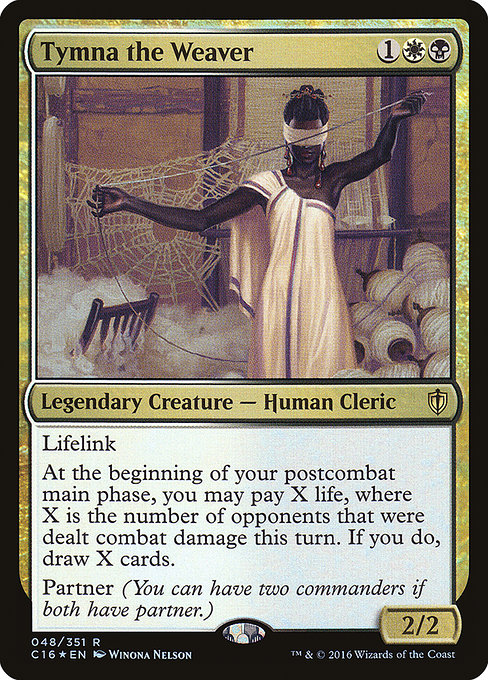
Tymna the Weaver
Combat-based card access
Tymna converts opponents damaged in combat into a postcombat opportunity to pay life and draw.
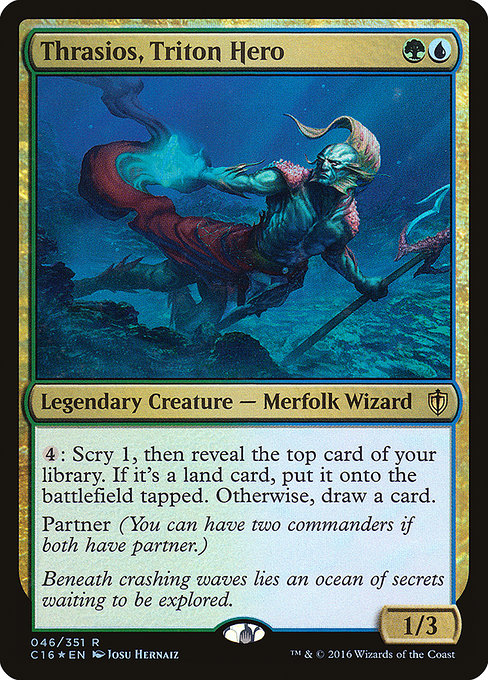
Thrasios, Triton Hero
A repeatable mana outlet
Thrasios spends four mana to scry and then reveal the top card.

Rograkh, Son of Rohgahh
A cheap creature with a real tax history
Rograkh has ordinary partner and a zero printed mana cost.

Silas Renn, Seeker Adept
Combat-gated artifact access
Silas targets an artifact card in your graveyard after dealing combat damage to a player.
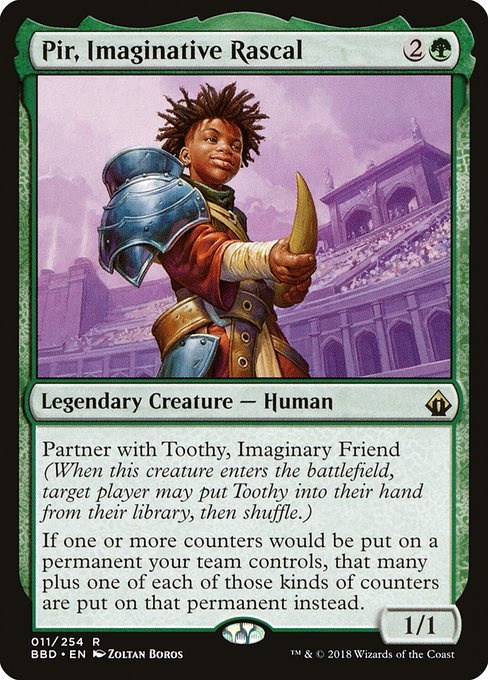
Pir, Imaginative Rascal
A named partner and counter modifier
Pir pairs specifically with Toothy through partner with.

Toothy, Imaginary Friend
Draw growth and a departure reward
Toothy receives a +1/+1 counter when you draw and draws based on its counters when it leaves.
Tymna the Weaver
Its count is opponents dealt combat damage this turn, rather than simply the number of attacking creatures. Multiple creatures hitting one opponent do not each add another opponent. The ability happens at each of your postcombat main phases. The combat damage can come from your broader board, so build attacks that connect without unnecessarily trading away the engine itself.
Thrasios, Triton Hero
A revealed land goes onto the battlefield tapped; another card is drawn. This is an activated ability rather than casting the revealed land or spell. The activation requires mana each time and gives a conditional result. It is useful access in a developed game, but should not be counted as a guaranteed turn-two ramp spell merely because the commander costs two.
Rograkh, Son of Rohgahh
Its first ordinary cast can therefore require no mana, while later command-zone casts can still acquire commander tax. Its printed combat keywords do not give its base body positive power. Choose support that actually uses the accessible body or its combat abilities. A zero-mana commander is not automatically an attacker dealing commander damage without another effect increasing its power.
Silas Renn, Seeker Adept
The permission allows casting that card for the turn, rather than returning it directly to the battlefield or waiving its cost. The artifact still needs an applicable casting time and its costs paid. A successful attack provides access, but the deck must preserve enough mana and a suitable target to turn that access into a useful play.
Pir, Imaginative Rascal
Its counter ability changes counters that would be put on a permanent your team controls, adding one of each relevant kind to that event. It is not a generic extra card for every counter placed. In an ordinary multiplayer free-for-all, keep the team wording tied to the actual rules rather than assuming every temporary political ally receives the benefit. The counter engine still needs suitable permanents and events.
Toothy, Imaginary Friend
Leaving includes more than dying, so a bounce or exile event can still produce its departure trigger. The trigger uses the appropriate information about the departed permanent. Counters from the old object do not automatically return when Toothy reenters. A blink can produce a new creature while the old departure trigger remains on the stack, creating a meaningful ordering decision for later draw triggers.
Practice a separate-tax turn and a realistic support plan
You have cast Tymna from the command zone once and Thrasios twice. Both are now back in that zone. Tymna normally costs her printed one generic, white, and black plus two generic tax. Thrasios normally costs green-blue plus four generic tax. Neither card uses the sum of three previous casts across the pair.
Suppose your available mana can recast Tymna and leave an answer available, but cannot recast Thrasios and activate him. Choosing Tymna can be reasonable if attackers already threaten different opponents. Choosing another support card can be better if your battlefield has no safe attack. Separate tax records identify the options; they do not dictate an automatic recast.
Next check the supporting list. A Tymna deck with only large creatures may fail to connect before the table develops blockers. A Thrasios deck without spare mana may spend turns displaying an unused ability. Make the commander plan visible in the actual curve instead of expecting either card to repair every weak opening.
Use <a href="/deck-builder?guest=1">Deckcipher's deck builder</a> to select the pair, compare the 98 supporting cards, and create an account to save the result. Keep one clear reason for each commander and one distinct reason for every supporting package.
A decision table for the interaction
| Position | Correct result | What to check |
|---|---|---|
| Two ordinary partners | 100 cards including both | Usually 98 supporting cards |
| Different command-zone cast histories | Separate tax for each | Do not merge previous casts |
| Damage from both commanders | Separate special-loss totals | Same commander must reach 21 |
| Named partner family | Match that exact family | Not interchangeable with ordinary partner |
Frequently asked questions
Build your deck
Put these choices into a Commander list. Create a free account to save your deck and keep tuning it with Deckcipher.
FAQ
Does a partner deck have 101 cards?
No. It has exactly 100 including both commanders, normally leaving 98 other cards. Check imports that put commanders in a separate section without removing extra main-deck copies or the extra card from a former single-commander list.
Do both commanders need the same colors?
No. Their combined color identities determine the deck's allowed colors. Both still need to form a legal pairing through the applicable partner permission. Matching colors alone does not permit an otherwise illegal pair.
Does casting one increase the other’s tax?
No. Each card tracks its own command-zone cast history. Casting Tymna several times does not increase an uncast Thrasios's tax. Keep individual records when removal sends the partners back at different times.
Can commander damage from both be added together?
Not for the twenty-one damage loss condition. Track combat damage from each same commander separately for each opponent. Ordinary life-total damage still accumulates normally, so the distinction changes the special loss condition rather than erasing damage.
Can Pir pair with any ordinary partner?
No. Pir has partner with Toothy, which is a specific matching permission. Ordinary partner, named partner families, Background pairing, and Doctor's companion cannot be freely mixed just because they can each enable two commanders.
Does partner with find the card in the command zone?
Its entry trigger searches a targeted player's library for the named card. It does not move the counterpart out of the command zone. When both partners begin there, you still need to cast them through an appropriate permission.
Can I add a Background as a third commander?
No. Partner combinations never grant more than two commanders. A Background can be a main-deck card when otherwise legal, but designating it as a commander needs the separate choose-a-Background permission and still fits within two.
Does choosing partners automatically make a deck competitive?
No. The pair establishes access and colors. The actual list, interaction, mana, win conditions, sequencing, and intended table determine its performance. Avoid presenting a famous pairing as a substitute for a focused deckbuilding plan.