
Quick answer
Monarch works best as card access that your deck can contest. Plan ways to regain the crown, keep its end-step draw separate from upkeep payoffs, and evaluate each court’s actual timing.
The crown is a player designation, not a permanent
Monarch is a designation held by one player. A game begins without a monarch until an effect instructs somebody to become one. Once introduced, its inherent abilities continue independently of the card that introduced it. A crown token is a reminder, not an artifact an opponent can destroy to switch the mechanic off.
Queen Marchesa can enter, make you monarch, and later leave the battlefield. You remain monarch until another player becomes monarch or another applicable game rule changes the holder. Removing Marchesa stops her future creature abilities; it does not by itself transfer the crown or cancel its ordinary draw reward.
This persistence makes monarch attractive as ongoing card access, but also commits the table to a new combat incentive. The question is not only whether the entry card is efficient. Ask whether your deck can regain the designation after an evasive opponent takes it.
The inherent draw triggers on the monarch’s own end step
At the beginning of the monarch's end step, that player draws a card through an inherent triggered ability. It is not a draw during every player's end step. The ability goes on the stack, so ordinary responses can happen before it resolves. Its controller is the player who was monarch when that trigger happened.
Become monarch during your main phase and retain it until your end step begins. The draw trigger goes on the stack. If an opponent then resolves an effect making themselves monarch, your already-triggered ability still normally draws you a card. The new monarch does not inherit your existing draw trigger merely by taking the designation.
Become monarch only after your end step has already begun and the beginning-of-step event has passed, and you do not retroactively create that step's draw trigger. Timing an activated crown effect before the step begins can therefore produce a different result from activating it after another end-step ability is already waiting.
Combat damage transfers the crown through triggers
Whenever a creature deals combat damage to the monarch, its controller becomes monarch through an inherent trigger. Attacking alone is insufficient, and damage to a planeswalker or battle is not damage to the player. Noncombat damage does not use this transfer rule. A small evasive creature can qualify as effectively as a much larger attacker.
Two creatures dealing combat damage to the monarch can each create a monarch-transfer trigger. This differs from initiative's wording for one or more creatures controlled by a player. Repeated triggers making the same player monarch do not award extra inherent draw triggers immediately; the ordinary draw is tied to that player's end step.
Protection, damage prevention, blockers, and removal before damage can keep a transfer event from happening. Once a transfer trigger exists, removing its attacking creature does not normally erase that trigger. Plan the defensive action before the event you need to prevent.
A direct become-monarch effect bypasses combat
A card instructing you to become monarch does not require a successful attack. A new entry effect can reclaim the crown even when the current holder has an intimidating board. Becoming monarch again while already monarch does not itself produce another inherent card draw, because there is no generic draw-whenever-you-become-monarch rule.
An opponent takes the crown during their combat. On your turn, a new Court of Grace enters and its entry trigger makes you monarch. You did not need to damage that opponent to recover the designation. If you instead played the Court while already monarch, its ordinary entry instruction would not give an extra immediate crown draw.
Include a reasonable mixture of ways to introduce or reclaim monarch if your deck depends on enhanced court rewards. A list with one crown source and no credible attacks can lose its engine for several rotations. Repeated entry access reduces that risk, but still consumes mana and cards.
Court of Grace checks its upgrade during resolution
Court of Grace has an upkeep trigger that normally creates a 1/1 flying Spirit, or a 4/4 flying Angel instead if you are monarch. Its trigger begins with your upkeep and does not require you to be monarch simply to trigger. The relevant monarch check selects the result when the ability resolves. That differs from an intervening-if trigger.
If an opponent is monarch as your upkeep begins, the Court still triggers. An effect making you monarch before that trigger resolves can upgrade the result to an Angel. Conversely, if you lose monarch before resolution, the trigger normally creates the Spirit instead. The enchantment does not generate tokens on every opponent's upkeep.
A token body can defend the crown later, but upkeep production cannot rewind an earlier combat that already stole it. Read the exact court you are considering. Shared naming does not guarantee every card has the same timing, target requirements, or condition structure.
Keeper and Marchesa use intervening conditions
Keeper of Keys begins its upkeep ability with a condition that you are monarch. Queen Marchesa begins hers with a condition that an opponent is monarch. These intervening-if conditions must be true when the ability would trigger and again when it resolves. A late change cannot create an ability that never triggered at the beginning of upkeep.
Begin your upkeep without being monarch while controlling Keeper. Its conditional ability does not trigger, so becoming monarch later in that upkeep cannot rescue that missed event. Marchesa can instead trigger because an opponent holds the crown, but taking it back before her ability resolves can prevent its Assassin creation when that condition is checked again.
Sequence a reclaim effect around the reward that matters. Sometimes an Assassin is worth keeping the opponent as monarch until its trigger resolves; sometimes recovering the crown immediately is safer. Avoid treating every phrase mentioning monarch as an identical yes-or-no check at one universal time.
Palace Jailer’s exile follows the crown, not its body
Palace Jailer has separate entry triggers: one makes you monarch and another exiles a target creature an opponent controls until an opponent becomes monarch. The creature's return is tied to that stated event, rather than to Jailer leaving the battlefield. Destroying Jailer is therefore not the normal way to end its already-created exile duration.
You exile an opponent's creature and later lose Jailer to removal while retaining the crown. The exiled creature normally stays exiled. When an opponent later becomes monarch, the specified duration ends and the creature returns. Taking the crown back afterward does not automatically exile that creature again without a new appropriate effect.
This can make Jailer a risky answer when another opponent has an easy combat connection. Its value is not merely the removal plus a draw: the table can influence how long the removal lasts. Choose an exile target with that visible political and combat vulnerability in mind.
Aragorn rewards becoming monarch before his attack ability resolves
Aragorn, King of Gondor becomes monarch on entry and has an attack trigger that can stop a selected creature from blocking. If you are monarch, it instead stops creatures from blocking that turn. The upgraded effect is checked during resolution. It can transform a combat, but the crown still needs to be in your possession at the relevant moment.
His ability allows up to one target. Choosing no target avoids tying the trigger to a creature that could become illegal before resolution. If you choose a target and that sole target becomes illegal, the ability can fail to resolve even though you hoped to receive the broader monarch effect. Optional targeting is a real decision, not decorative wording.
Making creatures unable to block does not protect your attackers from removal, combat damage in every possible situation, or a counterattack afterward. Aragorn's vigilance helps preserve a blocker, but you still need a plan for the opponent who survives and can reclaim the crown on the next turn.
Monarch and initiative can coexist without sharing rewards
One player can hold both designations, or different players can hold them. A combat connection against a player holding both can generate separate transfer triggers. Monarch's recurring reward belongs to the holder's end step; initiative's recurring venture belongs to the holder's upkeep. Extra upkeep steps do not themselves create extra monarch end steps.
A deck that gains additional upkeeps may get extra triggers from its own Courts and from initiative while receiving no additional inherent monarch draw until an appropriate end step begins. A Court's token production is the enchantment's ability, not a feature every monarch gets for holding the crown.
Keep separate reminder cards if both mechanics appear. The <a href="/blog/the-initiative-and-undercity-in-commander/">initiative and Undercity guide</a> explains personal dungeon progress and why a transfer can have a different immediate reward from becoming monarch.
Build for access to the crown, not permanent ownership
Monarch is reliable only to the extent that your list can defend or reclaim it. Flying creatures, menace, vigilance, instant-speed interaction, and token production can all contribute. Spending every resource on an impenetrable defense can also leave your deck unable to finish a game. The draw is a resource engine, not the complete win condition.
A reactive Marchesa list may let the crown circulate while conserving answers, then use a new entry effect to recover it. A combat-focused Aragorn list may want the designation before a decisive attack. Those are different plans even though both cards introduce monarch. Copying every court into either list can crowd the curve and weaken early turns.
Build from the actual mana demands in the <a href="/blog/how-to-build-a-commander-mana-base/">Commander mana-base guide</a>. A deck cannot defend an engine it cannot cast on time. Reserve enough interaction and independent card access that losing the crown does not turn the rest of the hand into spectators.
Cards worth comparing before you choose a package
Examples and the jobs they do
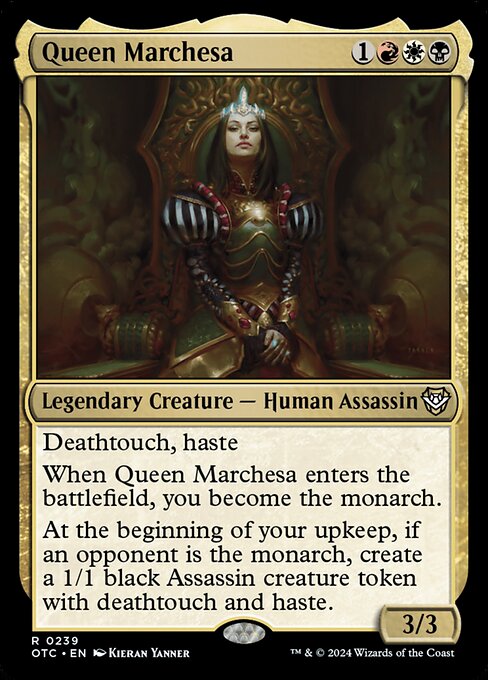
Queen Marchesa
Crown access with a recovery body
Marchesa combines a monarch entry trigger with deathtouch and haste.

Palace Jailer
Removal with a contestable duration
Jailer exiles an opposing creature until an opponent becomes monarch.

Throne of the High City
Crown access from a land slot
Throne taps for colorless and can be sacrificed with its activated cost to make you monarch.

Court of Grace
Upkeep bodies and a monarch upgrade
Court introduces monarch and then produces flying bodies on your upkeep.

Keeper of Keys
A conditional finishing window
Keeper introduces monarch and can make your creatures unblockable for a turn.

Aragorn, King of Gondor
Combat access with vigilance
Aragorn provides monarch on entry and a powerful attack-based blocking restriction.
Queen Marchesa
Her upkeep ability can create an Assassin if an opponent is monarch, giving a possible way to contest the crown. The condition must remain true through the trigger resolving. The Assassin is not automatically unblockable and cannot be assumed to reclaim anything. Its deathtouch pressures blockers, while haste permits an immediate attack when the turn reaches combat.
Palace Jailer
Its two entry abilities are separate triggers under your control, so their order and responses can matter. Removing Jailer later does not itself satisfy the return condition. If the duration-ending event has already occurred before the relevant exile instruction can begin, the normal until-event rules matter. Avoid shortcuts that pretend the target must always spend time in exile regardless of what happened on the stack.
Throne of the High City
The activation asks for four mana, its tap, and sacrificing the land. Its normal mana ability does not supply colored fixing. Using the crown ability consumes the land itself as well as the other payment. This can be reasonable late, but it is a meaningful development cost when you still need colored sources and land drops.
Court of Grace
Being monarch when the upkeep ability resolves changes the Spirit into an Angel. The default token remains available when the enhancement condition is absent. The enchantment supplies no creature at the moment its entry trigger makes you monarch. An exposed board can therefore lose the crown before its first token arrives, despite the card being a defensive engine in later turns.
Keeper of Keys
Its intervening condition requires being monarch at the beginning of your upkeep and when the trigger resolves. Reclaiming later cannot create a missed trigger. This asks you to protect the crown through an entire rotation or reacquire it before upkeep begins. Compare that delay with a finisher that provides immediate access when drawn into a contested battlefield.
Aragorn, King of Gondor
The attack trigger offers an optional target and upgrades while you are monarch. Vigilance and lifelink can make a successful attack less costly to your defensive position. His color identity differs from Marchesa's. Build the appropriate legal list instead of assuming two crown-focused legendary creatures always fit into the same deck.
Practice an end-step draw and a Court upgrade
You are monarch when your end step begins, so the inherent draw trigger goes on the stack. Another player responds with an effect making themselves monarch. After that resolves, your existing draw trigger can still resolve for you. They do not draw from that old trigger, and they do not receive a new ordinary monarch trigger in your end step.
On your next upkeep, you control Court of Grace while that opponent remains monarch. The Court triggers anyway. If you can legally resolve a become-monarch effect before its upkeep trigger resolves, the Court can produce an Angel instead of a Spirit. Keeper of Keys would not provide the same opportunity if you were not monarch when upkeep began.
Now compare the cost of reclaiming with the next attack you expect. Paying for a crown activation might leave no mana for an answer, while keeping the Spirit and preserving interaction might be safer. Correct rules establish the choices; the board determines which choice protects the most useful resources.
Try both approaches in <a href="/deck-builder?guest=1">Deckcipher's deck builder</a>. Create an account to save the list, mark each crown source and reliable attacker, and make one clear cut for every Court or monarch creature added. A focused plan is easier to tune than a pile of cards sharing a crown symbol.
A decision table for the interaction
| Position | Correct result | What to check |
|---|---|---|
| End step begins while you hold crown | Your draw trigger is created | Later transfer does not change its controller |
| Court of Grace upkeep | Always triggers on your upkeep | Monarch selects upgraded result at resolution |
| Keeper upkeep without crown | No conditional trigger | Reclaiming later cannot create it |
| Jailer leaves after exile | Exile normally continues | An opponent becoming monarch ends it |
Frequently asked questions
Build your deck
Put these choices into a Commander list. Create a free account to save your deck and keep tuning it with Deckcipher.
FAQ
Do I draw during every player’s end step?
No. The inherent draw triggers at the beginning of the monarch's own end step. Other cards can have their own end-step abilities, but those do not change the ordinary crown rule for every player.
Does killing the card that introduced monarch remove it?
No. Monarch is a designation with source-free inherent triggers. Removing Marchesa, a Court, or another original source does not itself remove the crown. It can stop separate future abilities from that permanent.
Can I become monarch without attacking?
Yes. Resolve an effect that instructs you to become monarch. That route can reclaim the designation through a blocked battlefield. Becoming monarch while already monarch does not itself create an extra inherent draw.
Who draws if I lose the crown after the draw trigger?
The existing trigger is controlled by the player who was monarch when it triggered and normally still draws that player a card. Transferring the designation afterward does not transfer the already-created ability.
Does noncombat damage steal the crown?
Not through the inherent transfer rule. A creature must deal combat damage to the monarch. Damage to only a planeswalker or battle is also different. A separate card could instruct a player to become monarch through its own effect.
Does Palace Jailer return the creature when Jailer dies?
Its normal duration ends when an opponent becomes monarch, not simply when Jailer leaves. Preserve that exact duration when evaluating it as removal. A later recovery of the crown does not automatically repeat the old exile.
Do all upkeep monarch rewards check at the same time?
No. Court of Grace triggers regardless of holding monarch and selects its upgraded result during resolution. Keeper of Keys has an intervening condition that must be true both at triggering and resolution. Read the exact ability.
Can one player hold monarch and initiative?
Yes. Track them separately because their inherent triggers and recurring reward steps differ. A qualifying combat connection can generate triggers for both, but personal dungeon progress does not become part of the monarch rules.