
Quick answer
MDFCs let one card serve different turns. Count the land option honestly, read the selected face’s timing, and check the front face when searches or zone changes ask what the card is.
A modal double-faced card gives a choice, not two resources
A modal double-faced card, usually shortened to MDFC, has two faces you can choose between when playing it through an appropriate permission. Many Commander examples offer a spell on one face and a land on the other. It is still one physical card. Playing its land face does not leave the spell face in your hand as a second resource.
Bala Ged Recovery can return a target card from your graveyard to your hand, or the same card can be played as the tapped green-producing Bala Ged Sanctuary. If you use Sanctuary for an early land drop, Recovery is not also available to cast from that battlefield card. You chose a role for the current object.
Evaluate the value of having either option available before making the choice. Flexibility can reduce awkward draws, but does not mean the deck gained both a land and a recursion spell simultaneously. The opportunity cost remains visible in every hand containing the card.
Casting a face and playing a land use different permissions
When casting an MDFC, choose the face to cast before placing the spell on the stack and evaluate that face. A land face is played as a land rather than cast as a spell. It needs an available land play, the appropriate timing or permission, and compliance with effects restricting land plays. A spell face follows its own casting rules.
You can cast Sejiri Shelter after you have already used your ordinary land play, because casting the instant is not another land play. You cannot play Sejiri Glacier as a second land merely because the other face is an instant. Playing the land also does not trigger a reward for casting an instant.
Read permission verbs carefully. An instruction allowing you to cast a card does not normally let you play its land face. A permission to play a specific card can cover a legal land play or a legal spell cast, but still does not erase timing, cost, or land-limit restrictions without saying so.
Front-face characteristics govern most other zones
Outside the battlefield and stack, an MDFC normally has only its front face’s characteristics. Bala Ged Recovery is therefore a sorcery card in your graveyard and library even if you last used it as Sanctuary on the battlefield. The card does not remember its previous land face as its default identity in every later zone.
A spell searching your library for an ordinary land card does not normally find Bala Ged Recovery merely because the back can be played as a land. A spell returning a sorcery card from your graveyard can evaluate its front face. The search or target instruction still needs its own appropriate wording and conditions.
Separate characteristic checks from permissions that let you choose a face to play. A graveyard effect saying you may play lands from there can provide access to a suitable MDFC land face under the play rules, even though an ordinary search for a land card sees the front face. Those are different operations.
Mana value depends on the zone and selected face
For an MDFC on the stack or battlefield, use the face that is up to determine the relevant characteristics, including its mana value. In the ordinary other zones, use the front face. A land face without a mana cost normally has mana value zero on the battlefield. This differs from the special mana-value rules for many nonmodal transforming cards.
Bala Ged Recovery has mana value three as a sorcery card in your library, graveyard, or as that spell on the stack. Bala Ged Sanctuary on the battlefield has mana value zero. Tangled Florahedron has mana value two when cast as the creature, while Tangled Vale is the land face with no mana cost.
Do not add the values of the two faces or permanently label the entire card a zero-value land. A spell that cares about a spell’s mana value, a graveyard target, and a permanent on the battlefield can legitimately obtain different answers for the same physical card at different times.
Both faces contribute to Commander color identity
Commander color identity includes the back face as an explicit exception to the usual front-face rule outside the battlefield. You cannot ignore an off-color back face simply by promising never to play it. This construction rule is separate from which colors the currently face-up permanent has on the battlefield.
Barkchannel Pathway produces green while Tidechannel Pathway produces blue, so the card has green-blue color identity. It cannot be included in an ordinary mono-green commander deck just because you would always choose Barkchannel. In a legal green-blue deck, you choose the useful land face as you play it.
Review both faces before importing a new MDFC into a deck with a narrow identity. The same principle matters for legendary MDFC commanders with distinct faces: being able to cast one face does not by itself prove the supporting deck has the right construction identity.
Pathways choose a color when they enter
A land-land MDFC such as Barkchannel Pathway offers two land faces. It is not an ordinary dual land that taps for either color after being played. Once you play one face, that permanent has that face’s printed mana ability. These Pathway faces enter untapped under their own text, but the color commitment can matter for later draws.
With an opening hand needing green first and blue second, playing Barkchannel on turn one supplies green but does not let that same permanent make blue on turn two. A second suitable source must supply the blue, or another effect must change the available abilities. Turning the physical card over without an applicable instruction is not a normal mana action.
Plan the next turn before choosing. A flexible choice at entry can be strong while still demanding better sequencing than a land that keeps both colors available. Include Pathways in color-source analysis with that commitment visible rather than assuming every face is simultaneously active.
Blink returns the front by default, with important consequences
An effect putting a double-faced card onto the battlefield from another zone normally returns it with the front face up. It does not ordinarily offer the play-a-face choice because you are not playing the card. If that MDFC’s front face is not a permanent card, it cannot enter through that instruction and stays in its current zone.
An effect exiling Bala Ged Sanctuary and then returning that card to the battlefield can leave it exiled, because the front is the sorcery Bala Ged Recovery. Exiling Tangled Vale and returning it normally instead returns the front-face creature Tangled Florahedron. The exact exile-and-return wording still matters to the sequence.
This distinction makes casual advice to blink any MDFC for its other side unreliable. Identify whether the front is a legal permanent and whether the actual effect changes the default face. Preserve the specific example instead of importing rules from a transforming creature that behaves differently.
Returning a land to hand restores a later choice
A land-face MDFC returned to your hand is again a card with the front face’s ordinary hand characteristics, and can later be played through an appropriate face permission. That can let an early land become a later spell. The return is not automatically free: a bounce land, activated ability, or spell providing it has its own costs and timing.
Return Bala Ged Sanctuary to hand through a legal effect. On a later appropriate main phase, you can cast Recovery for two generic and one green to retrieve a target card. You no longer have that Sanctuary as a mana source, so the remaining lands must actually pay for the spell and any further play you are planning.
A bounce package should earn its slots beyond occasional flexibility. Returning a useful land can delay development, especially if the effect itself enters tapped or consumes mana. Keep the land you gave up and the normal land-play limit in the turn sequence.
Land-capable count is useful without double counting
For deckbuilding, an MDFC with a land face is land-capable, but its speed and colors still matter. A tapped land face is not the same early source as an untapped basic. The spell face may be useful late, but a hand needing its land cannot also reserve it as the only answer to a threat.
A list with thirty-five ordinary lands and three spell-land MDFCs has thirty-eight land-capable cards, not thirty-eight ordinary untapped sources plus three independent spells. If you replace an ordinary spell with an MDFC, the land-capable count rises. Replacing an ordinary land keeps that count stable while changing the mix of speed and spell flexibility.
Use the <a href="/blog/how-to-build-a-commander-mana-base/">Commander mana-base guide</a> to inspect the actual opening requirements. There is no universal rule that every MDFC counts as half a land. Record which face you normally expect to play in the hands your deck keeps.
Choose useful fronts and keep current rules separate from old shortcuts
An MDFC is strongest when both options address real problems in the list. A protection spell with a land back can preserve an important creature or rescue a land-light hand. A recursion spell can recover a key engine or become an early source. An inefficient front that rarely matters may not justify another tapped land in an already slow mana base.
Current rules distinguish modal from nonmodal double-faced cards and permit some modal designs to have transform or convert abilities. Do not use the outdated blanket claim that every MDFC can never transform. The familiar examples here still do not grant a free action to flip between their faces simply because both are printed on the card.
For cascade or discover, evaluate the actual permission and the relevant face rather than assuming the land back makes the card invisible to every spell check. The <a href="/blog/discover-in-commander-rules-and-interactions/">discover guide</a> explains why an allowed free cast still needs to satisfy its own resulting-spell requirements.
Cards worth comparing before you choose a package
Examples and the jobs they do
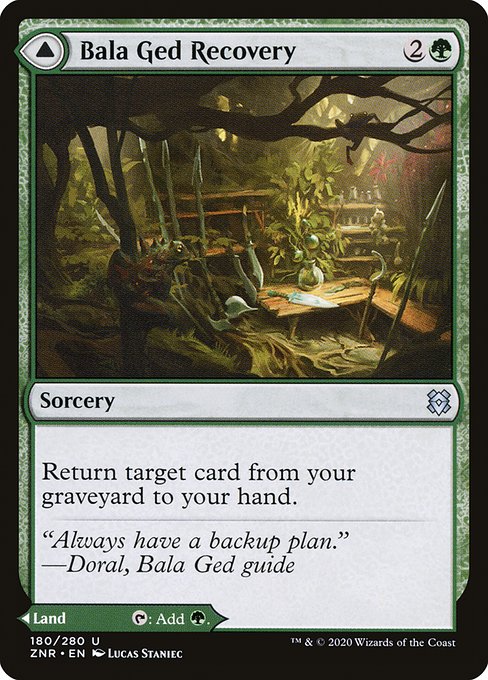
Bala Ged Recovery
Recursion or a tapped green source
Recovery returns a target card from your graveyard to hand.
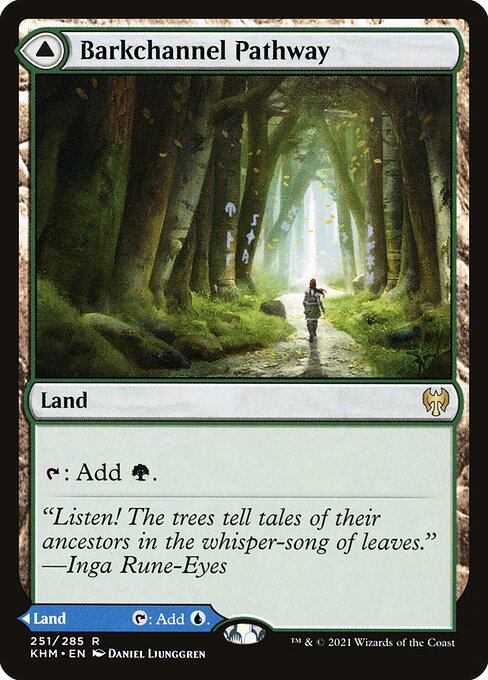
Barkchannel Pathway
An untapped color choice
Pathway lets you choose green-producing Barkchannel or blue-producing Tidechannel.
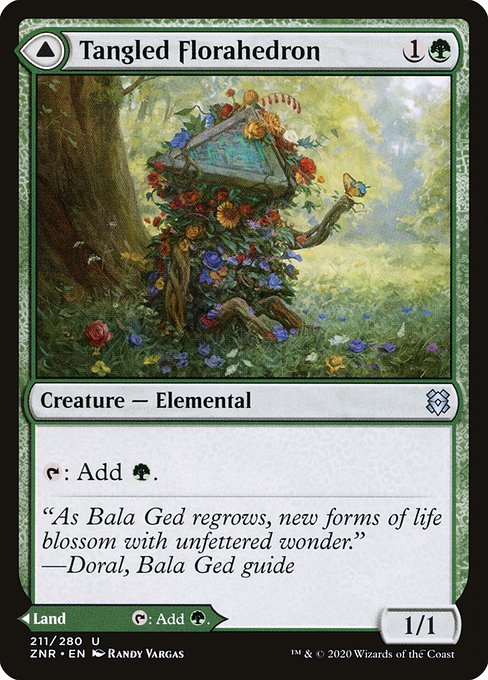
Tangled Florahedron
A mana creature or tapped land
Florahedron can be cast for one generic and one green as a creature that taps for green.
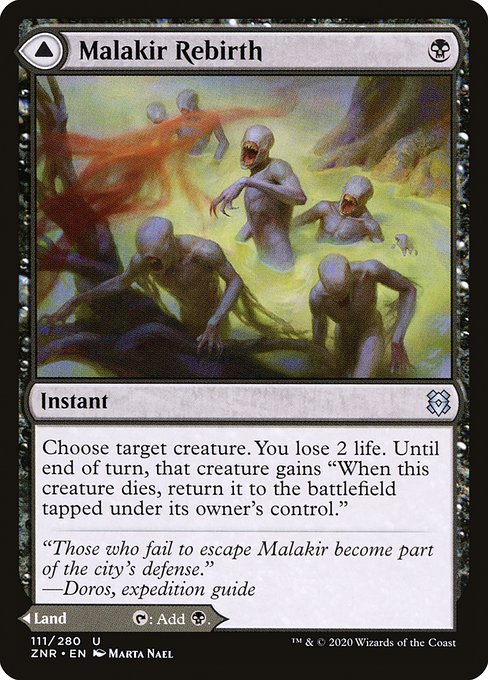
Malakir Rebirth
A temporary death-return ability
Rebirth targets a creature, has you lose two life, and grants the creature a death-return trigger until end of turn.
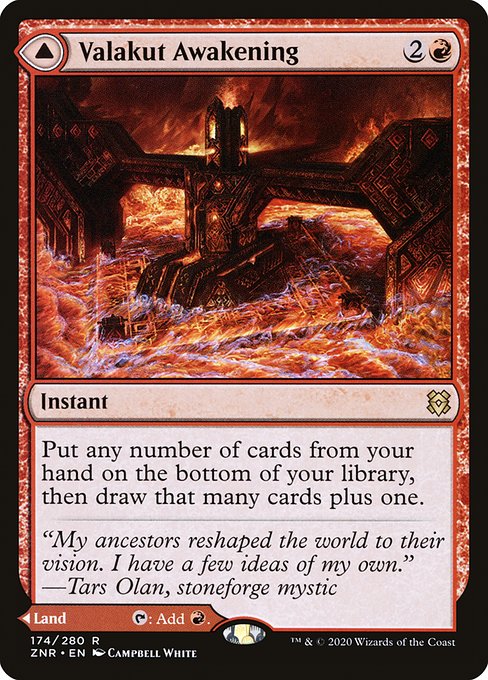
Valakut Awakening
Hand replacement or red land
Awakening puts any number of cards from your hand on the bottom of your library and draws that many plus one.

Sejiri Shelter
Color protection or white land
Shelter gives a target creature you control protection from the chosen color until end of turn.
Bala Ged Recovery
Its Sanctuary back enters tapped and produces green. That front-face targeting is broad, but the card is not a basic Forest and does not automatically fit land-search instructions. The recursion costs three mana and requires a legal graveyard target. Use it when recovering the chosen resource matters enough to give up the land mode for that card.
Barkchannel Pathway
After playing the chosen face, its printed mana ability supplies that one color. Both faces contribute to the green-blue Commander identity. Count the early flexibility without pretending it stays a two-color dual. A hand requiring a particular double-colored spell later may need a different source choice now.
Tangled Florahedron
Tangled Vale instead uses a land play and enters tapped. The creature is a different kind of resource from a land, including its vulnerability to creature removal. A newly cast Florahedron normally cannot use its tap-symbol ability immediately without haste. Playing the land back also does not immediately yield mana because that face enters tapped.
Malakir Rebirth
The returned creature enters tapped under its owner’s control. Exile or bounce is not death and does not satisfy that granted trigger. For a commander, moving the card out of the graveyard to the command zone can prevent the return ability from finding it. Keeping it in the graveyard can allow the granted trigger to return it, depending on the actual sequence and other effects.
Valakut Awakening
Those cards are not discarded, which matters for discard and graveyard payoffs. Its Stoneforge back is a tapped red source. Casting the instant itself uses a card from hand. Putting no additional cards on the bottom and drawing one normally replaces that spell card rather than creating a guaranteed net extra card in hand.
Sejiri Shelter
Its Glacier back is a tapped white source. The protection choice and the legal target matter to the spell mode. Protection has specific effects rather than universal immunity. It does not stop every untargeted sweeper, and its interaction with colored Auras or blocking can matter when choosing the color.
Practice an opening hand with a spell-land
Your opening hand has a Forest, Bala Ged Recovery, and several three-mana plays. Playing Recovery as Sanctuary on turn two leaves that land tapped, so the Forest alone remains available that turn. On turn three, the two lands normally provide two mana unless you drew another source. The spell-land improved land access without guaranteeing every planned three-mana play.
Later, an effect returns Sanctuary to your hand while you already control enough other sources. Recovery is now available to cast in an appropriate main phase, but you gave up the Sanctuary mana source. Check whether you can both pay three for Recovery and cast the recovered card. Access to a card is not the same as having the mana for both actions.
For a second test, put Tangled Florahedron into the same opening slot. Casting the creature on turn two normally leaves its mana ability unavailable that turn, but can accelerate a later turn if it survives. Playing Tangled Vale instead produces a tapped land. The two modes face different removal and sequencing costs even though both can eventually provide green.
Compare these exact choices in <a href="/deck-builder?guest=1">Deckcipher’s deck builder</a> and create an account to save the versions. Record ordinary land count, land-capable count, and the actual early untapped sources instead of relying on one combined number to explain every hand.
A decision table for the interaction
| Position | Correct result | What to check |
|---|---|---|
| Cast spell face | Evaluate that spell face | Land-play limit is a separate issue |
| Play land face | Use a legal land play | No spell was cast |
| Card in graveyard | Normally front-face characteristics | Specific play permission is a different operation |
| Blink land back with sorcery front | Normal return cannot put sorcery on battlefield | Can remain exiled |
| Pathway on battlefield | Chosen face supplies its printed color | Not both mana abilities at once |
Frequently asked questions
Build your deck
Put these choices into a Commander list. Create a free account to save your deck and keep tuning it with Deckcipher.
FAQ
Does one MDFC count as two cards in the deck?
No. It is one physical card occupying one slot. A spell-land can increase flexibility, but playing its land face does not leave a separate spell in your hand. Keep deck size and land-capable counts separate.
Can I play the land face after using my land drop?
Not without another available land play or appropriate permission. The instant or sorcery front does not turn playing its land back into casting a spell. Casting the spell face can still be legal after a land play if the spell’s own rules allow it.
Is Bala Ged Recovery a land card in my graveyard?
Its ordinary graveyard characteristics are the front-face sorcery. Specific permissions allowing land plays from that zone can offer a different operation, but an ordinary check for a land card does not simply use its last battlefield face.
Can a mono-green deck include Barkchannel Pathway?
Not under ordinary color-identity rules. The blue-producing back contributes blue to its identity. Promising to use only the green front does not remove that construction requirement.
Can I turn a Pathway over whenever I need the other color?
Not as a free ordinary action. Choose the land face when playing it and use that permanent’s actual abilities. Another effect or a return to hand followed by a new legal play can change the situation, but printing two faces does not itself grant a flip action.
What happens if a Sanctuary is blinked?
A normal exile-and-return effect attempts to return the front face. Bala Ged Recovery is a sorcery, so that ordinary battlefield-return instruction cannot put it there and the card can remain exiled. Tangled Vale differs because its front is a creature permanent.
Should I count every spell-land as half a land?
There is no universal fraction that captures every deck. Count land-capable cards, then inspect tapped entry, colors, ordinary lands, and which mode the opening hand actually needs. Avoid counting the same card as two resources available simultaneously.
Do MDFCs always have mana value zero?
No. Use the relevant face on the stack or battlefield and normally the front face elsewhere. Recovery has mana value three as its sorcery front; Sanctuary on the battlefield has no mana cost and normally mana value zero.