
The simple rule: cut price, not function
The best way to lower a Commander deck's price without losing power is to replace expensive cards by role. Do not just cut the priciest cards. First identify what each card does: ramp, card draw, removal, protection, tutoring, mana fixing, or win condition. Then replace the most expensive nonessential versions with cheaper cards that keep the same job, starting with luxury printings, premium lands, overkill staples, and expensive cards that are not central to the deck's plan.
A deck can lose a lot of price without losing much power if the swaps preserve its structure. Keep the same amount of ramp. Keep the same amount of card draw. Keep enough removal. Preserve your color fixing. Keep the win conditions intact. Replace premium staples with role-equivalent budget cards, and cut expensive upgrades that were never really supporting the commander's actual strategy in the first place.
- Keep the same ramp count
- Keep the same card draw count
- Keep enough removal
- Preserve color fixing
- Keep the win conditions intact
- Replace premium staples with role-equivalent budget cards
- Cut expensive upgrades that do not support the commander's actual strategy
- Cut premium printings, foils, showcases, and special versions first
- Cut expensive cards that are not central to the deck's plan
- Turn premium lands into cheaper fixing
- Replace generic expensive staples with role-based alternatives
- Turn tutors into redundancy or slower tutors
- Turn fast mana into fair ramp
- Turn expensive protection into cheaper interaction
- Cut win-more cards that do not help the deck function
Deckcipher price-cut score
A good cut saves money without damaging the deck's role balance. A bad cut saves money but removes the card that made the deck function. Weigh a swap against all six of those factors before you commit to it, not just the price savings on their own.
Step 1: Find what is making the deck expensive
Most Commander deck prices are driven by a small number of expensive cards. The fastest way to lower the price is to sort the deck by card price and identify which cards are actually responsible for the total, instead of guessing.
- Premium Commander staples
- Fast mana and mana rocks with a high buy-in
- Tutors
- High-end protection and removal spells
- Expensive mana bases
- Original printings, foils, and special treatments
- Reserved List cards
- Universally popular mythics
- Recently hyped cards
- Cards with low supply
- Cards that are powerful in multiple formats
Step 2: Separate core cards from luxury cards
Not every expensive card has the same importance. Some expensive cards are core to the strategy. Others are generic upgrades that happen to be expensive because they are efficient and widely played, not because your specific deck needs them.
Core cards are the pieces a deck is actually built around: commander-specific combo pieces, unique synergy engines, and win conditions with no clean replacement. Luxury cards are the generic upgrades layered on top: premium tutors, premium fast mana, expensive generic draw engines, expensive lands, and expensive protection spells that were included mostly because they are considered staples.
What to cut first
| Card type | Cut first? | Why |
|---|---|---|
| Foil or special printing | Yes | Same card function, a cheaper version exists |
| Expensive land upgrade | Often | Cheaper fixing may preserve most of the function |
| Generic premium staple | Often | Usually replaceable by role |
| Commander-specific engine | Be careful | May be central to the deck's plan |
| Combo piece | Be careful | May change your win condition entirely |
| Tutor | Usually | Can become a slower tutor or added redundancy |
| Fast mana | Usually | Can become fair ramp in casual decks |
Step 3: Replace expensive cards by role
The main rule is to replace the job, not the card name. Card draw engine, ramp, tutor, protection, removal, mana fixing, recursion, and win condition are the roles that matter. A cheaper card does not need to be identical. It needs to keep the deck's plan working.
Expensive card draw engines: what to play instead
Card draw is one of the easiest places to save money because most decks can use strategy-specific draw instead of a generic premium engine. Sylvan Library is a good example: it lets you look at extra cards off the top of your library every turn and keep them for life, which is exactly the kind of flexible, color-light selection that keeps demand high across almost every green deck.
Sylvan Library swap
Sylvan Library offers repeatable top-of-library selection for a life cost. Budget swaps usually trade that flexibility for a green engine that draws off a specific part of your gameplan instead.
Sylvan Library
Top-of-library selection
Shows the top three cards each draw step and lets you keep extras for life. Expensive because it fits almost any green deck.
Soul of the Harvest
Creature-count draw
Draws a card whenever a creature enters under your control. Excellent in creature-heavy green decks, weaker in low-creature-count shells.
Return of the Wildspeaker
One-shot creature-count draw
A cheap burst of cards based on creatures you control, playable at instant speed. No long-term engine, but reliable value on demand.
Greater Good
Sacrifice-fueled draw
Turns a big creature into several cards. Strong in decks that already want to sacrifice or blink their own creatures.
Necropotence is the other classic example of an expensive value engine: it converts life into a steady stream of extra cards for the rest of the game. Budget black decks can rebuild a version of that plan with cheap sacrifice-based draw instead of one premium enchantment.
Necropotence swap
Necropotence trades life for a card every turn as long as you keep casting spells. Budget black decks can get a similar life-for-cards exchange from cheap sacrifice payoffs instead.
Necropotence
Life-for-cards engine
Exchanges life for cards at the start of your turn, refilling your hand fast. Expensive because it can single-handedly win a long game.
Village Rites
One-mana sacrifice draw
Sacrifice a creature for two cards at instant speed. Best when you already have expendable bodies or a creature about to die anyway.
Deadly Dispute
Sacrifice draw plus Treasure
Sacrifice an artifact, creature, or enchantment for two cards and a Treasure. Extremely efficient in decks that already make fodder.
Expensive ramp and fast mana: what to play instead
Fast mana is powerful, but casual Commander decks can usually preserve consistency with cheaper two-mana rocks instead of one expensive accelerant. Mana Vault is a clean example: it produces three colorless mana a turn early for two mana, at the cost of paying it back or taking damage later. Spreading that same acceleration across a couple of cheap rocks gets a budget deck close to the same speed for a fraction of the cost. A short note on legality: a handful of former fast-mana staples are banned in Commander outright, so they are not part of this comparison at all, only cards you can still legally buy and play matter here.
Mana Vault swap
Mana Vault front-loads mana at a real cost later in the turn. On a budget, a couple of plain two-mana rocks usually get a deck to its plays almost as fast without the drawback.
Mana Vault
Explosive early mana
Adds three colorless mana for two mana, but costs you mana or life to keep around. A powerful, old, low-supply staple.
Arcane Signet
Two-mana rock
Taps for any color in your commander's identity. About as close to plug-and-play ramp as Commander has.
Thought Vessel
Two-mana rock with no hand size limit
Ramps for two mana and removes your maximum hand size, which is a nice bonus in card-draw-heavy decks.
Liquimetal Torque
Two-mana rock with a late upside
Ramps early and can turn a permanent into an artifact later, which occasionally doubles as removal or combo fuel.
Green land-based ramp is another cheap way to build acceleration without leaning on a single expensive card. These cards ramp and fix mana at the same time, which is often worth more to a budget deck than raw speed.
Cheap land ramp that fits any green deck
Farseek
Land ramp with fixing
Fetches a nonbasic land, including dual lands, straight to the battlefield. Excellent early fixing for a low cost.
Nature's Lore
Land ramp with fixing
Fetches any Forest, including nonbasic Forests, so it fixes just as well as it ramps in the right manabase.
Wayfarer's Bauble
Colorless land ramp
Fetches any basic land for two mana. Slower than a one-mana dork, but it fits any color identity.
Burnished Hart
Repeatable land ramp
Fetches two basics over its lifetime, once when it enters and again when you sacrifice it. Good long-game value.
Expensive tutors: use redundancy instead
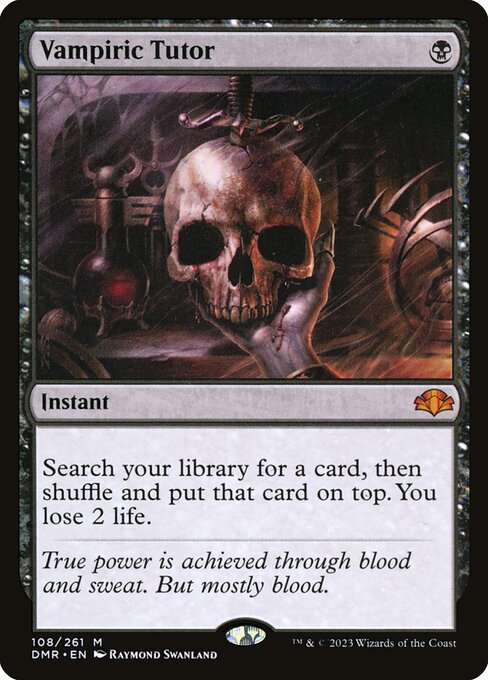
Tutors are powerful because they turn one card into the best card in your deck at the moment you need it. Vampiric Tutor is a great example: one mana at instant speed, any card in your deck goes to the top of your library. Budget decks can reduce price here by using slower tutors, narrower tutors, or by adding extra copies of the effect instead of one perfect tutor.
Vampiric Tutor swap
Vampiric Tutor finds any card in the deck for one mana at instant speed, you just have to wait until your next draw step to actually get it. Budget tutors usually add a color restriction or a slower delivery in exchange for a much lower price.
Vampiric Tutor
Unrestricted instant-speed tutor
Puts any card from your library on top for one mana at instant speed. As efficient as tutoring gets in Commander.
Final Parting
Double tutor to hand and graveyard
Searches your library for two cards, one to hand and one to the graveyard. Slower and sorcery speed, but very flexible in the right shell.
Sidisi's Faithful
Creature-based tutor
A cheap black creature that tutors a card to the top of your library when it dies. Slower, but it comes with a body attached.
Expensive protection and removal: cheaper ways to stay alive
Premium free interaction is expensive because it lets you protect your board or answer a threat without spending mana at the worst possible moment. Force of Will is the clearest example: pitch a blue card and thirteen life to counter almost anything for free. Budget decks can still hold up interaction, they just have to pay mana for it instead of getting it for free.
Force of Will swap
Force of Will offers a free counter at a steep alternate cost. Budget interaction trades that free cost for a low, predictable mana cost you can plan around instead.
Force of Will
Free alternate-cost counterspell
Counters any spell by pitching a blue card and paying life, no mana required. Expensive because it is a Legacy and Commander staple at once.
Dispel
One-mana counter for instants
Narrow but extremely cheap. Great at stopping a removal spell or counterspell aimed at your own plays.
Spell Pierce
One-mana tax counter
Counters a noncreature spell unless the caster pays extra. Best early, weaker once opponents have plenty of mana up.
Stubborn Denial
One-mana counter with upside
Counters a noncreature spell for one mana, or anything if you control a creature with power four or greater.
Solitude is a different kind of expensive answer: free premium removal instead of free protection. It evokes for the cost of pitching a white card and exiles a creature with upside attached. Budget decks can still answer the same kinds of threats with classic, unconditional removal that just costs mana instead.
Solitude swap
Solitude offers instant-speed, free exile removal on a body. Cheap unconditional removal spells trade the free cost and the extra body for a low, reliable mana cost.
Solitude
Free exile removal
Evokes for a pitched white card to exile a creature and gain life. Expensive because it is efficient, flexible, and colorless to cast normally too.
Swords to Plowshares
One-mana exile removal
Exiles any creature for one mana, giving its controller life equal to its power. About as efficient as removal gets.
Beast Within
Universal permanent removal
Destroys any nonland permanent, giving its controller a 3/3 Beast. Hits things unconditional removal usually cannot touch.
Generous Gift
Universal permanent removal
Destroys any nonland permanent and gives its controller a token creature instead of a specific Beast. Flexible and cheap.
If your deck leans on a one-sided reset instead of proactive removal, the Cyclonic Rift budget alternatives guide breaks down cheaper combat fogs and role-specific bounce by exactly what your table tends to need.
Expensive mana bases: where most decks can save money
Mana bases often hide a huge amount of a deck's total cost. Original ABUR duals like Volcanic Island, Underground Sea, Tundra, and Badlands, plus modern utility lands like Cavern of Souls, add up fast, and many casual Commander decks can become much cheaper by replacing premium lands with budget fixing, basics, and a bit more ramp.
- Command Tower taps for any color in your commander's identity and costs next to nothing
- Path of Ancestry taps for any color in your commander's identity and scries when it enters
- Exotic Orchard taps for any color your opponents' lands can produce, which is strong at a full table
- Basics are free fixing if your deck's color requirements are not too demanding
- Signets and Talismans double as ramp and fixing in one card
Save money on printings and versions
Before touching a single card's function, check whether you are even paying for the cheapest legal printing. The same card can carry very different prices depending on whether it is a foil, a showcase frame, a set-specific treatment, or a reprint from a Commander precon or Secret Lair. Switching to the plainest available printing changes nothing about how the card plays.
- Switch foil, showcase, and special-treatment cards to the cheapest legal printing of the same card
- Check whether a card has since been reprinted in a Commander precon, Commander Masters-style set, or supplemental product
- Recently reprinted staples often drop in price for a while, which is a good window to pick them up
- A cosmetic upgrade never changes a card's function, so it is always safe to downgrade the printing first
Cheap cuts that do not lower power much
Some price cuts barely touch the deck's power level at all. These are usually the best first places to look before you touch anything closer to the deck's core synergy.
Price-cut moves ranked by power loss
| Price-cut move | Power loss | Best for | Warning |
|---|---|---|---|
| Switch to the cheapest legal printing | None | Any deck | Check condition and language preferences first |
| Cut foil or showcase versions | None | Collector-heavy builds | Only affects the card's appearance |
| Replace premium lands | Low to medium | Casual decks | Avoid stacking too many tapped lands |
| Replace generic draw staples | Low if the role is preserved | Synergy decks | Match the replacement draw to your strategy |
| Replace tutors with redundancy | Low to medium | Casual decks | Loses some consistency |
| Replace fast mana with fair ramp | Medium | Casual tables | The deck will play a turn or two slower |
| Cut a core combo piece | High | Combo decks only | Avoid unless you are changing the whole strategy |
What not to cut if you want to keep power
Some cuts save money but damage the deck's function more than the savings are worth. Be careful about cutting too aggressively from any of these categories, even when they look like an easy way to trim the total price.
- Lands, especially untapped sources
- Ramp
- Card draw
- Removal
- Color fixing
- Commander-specific engines
- Win conditions
- Protection for commander-dependent decks
- Graveyard hate, if your meta actually uses graveyards
- Redundancy for the deck's main plan
Use the Deckcipher deck price calculator
Guessing which cards are driving up your deck's price wastes time. Paste your list into the Deckcipher deck price calculator to see exactly which cards are responsible for the total, then work through them from most expensive to least.
Find the cards making your deck expensive
Paste your Commander deck into the Deckcipher deck price calculator to see which cards are driving the total cost. Start with the biggest price spikes, then decide whether each card is core, replaceable, or just a luxury upgrade.
Compare cheaper cards by role
Once you know which cards are increasing your deck's price, the next step is finding a cheaper card that fills the same role. That is exactly what Commander Budget Alternatives is built for: compare replacement options by role, color identity, and deck function before you spend money on the swap.
Replace expensive cards by role
After you find the cards increasing your deck's price, use Commander Budget Alternatives to compare cheaper cards that fill the same role in your deck.
Common mistakes when lowering a Commander deck's price
- Cutting expensive cards without replacing their role
- Cutting lands just to lower the deck's total price
- Replacing premium lands with too many tapped lands
- Removing card draw and then wondering why the deck runs out of gas
- Replacing tutors without adding any redundancy
- Keeping expensive staples that do not actually support the commander's plan
- Buying cheap cards just because they are cheap
- Ignoring current prices and recent reprints
- Removing interaction instead of expensive luxury cards
- Replacing fast mana without checking how it affects the curve
- Cutting win conditions and leaving the deck unable to close games
Final price-cut checklist
Before you buy or cut a single card, run the deck through these questions.
- Which five to ten cards create most of the deck's price?
- Is each expensive card core or luxury?
- What role does each expensive card actually perform?
- Can a cheaper card perform the same job?
- Does the swap hurt ramp, draw, removal, protection, or mana fixing?
- Does the swap change the mana curve?
- Does the swap make the deck slower than the table it plays at?
- Can I switch to a cheaper printing instead of cutting the card entirely?
- Can I replace a tutor with redundancy instead?
- Can I replace premium lands without ruining color fixing?
- Should I test the deck before buying the expensive version of a card?
- Sort the deck by price
- Switch premium printings first
- Protect core synergy pieces
- Replace generic expensive staples by role
- Lower mana base cost carefully
- Keep ramp, draw, removal, and win conditions intact
- Use the Deckcipher tools to check price and alternatives
- Test the deck before buying upgrades
FAQ
How do I lower a Commander deck's price without making it weaker?
Replace expensive cards by role instead of cutting them randomly. Keep the same amount of ramp, card draw, removal, protection, mana fixing, and win conditions, then use cheaper cards that perform similar jobs.
What should I cut first from an expensive Commander deck?
Start with premium printings, foils, special versions, expensive lands, and generic staples that are not central to the deck's plan. Avoid cutting core synergy pieces before you have found a real replacement for the role.
Are expensive Commander staples always necessary?
No. Expensive staples are often efficient and flexible, but many casual decks can use cheaper cards that fit their strategy better. A synergy-based budget card can outperform a generic expensive staple in the right deck.
How can I tell which cards are making my Commander deck expensive?
Use a deck price calculator to sort your list by card price. Usually a small number of cards create most of the total cost, so start by reviewing those cards one at a time instead of the whole list.
Should I cut expensive lands first?
Expensive lands are often a good place to save money, but be careful. Replacing every premium land with a tapped land can make the deck much slower. Use budget fixing, basics, ramp, and enough untapped sources.
Can budget alternatives be as powerful as expensive cards?
Sometimes, but not always. Budget alternatives are usually slower, narrower, or more synergy-dependent. The goal is not to copy the expensive card perfectly, it is to preserve the deck's function for less money.
Is it better to replace tutors or expensive win conditions?
Usually replace tutors first unless the tutor is essential to the deck. A win condition may be core to the strategy, while a tutor can often become a slower tutor, more card draw, or extra redundancy.
How much power do I lose by replacing fast mana?
It depends on the table. In high-power games, replacing fast mana can be a big downgrade. In casual Commander, replacing fast mana with fair ramp often lowers price and salt without ruining the deck.
Conclusion
Lowering a Commander deck's price is not about cutting power blindly. It is about preserving the deck's structure while replacing expensive versions of effects with cheaper role-fillers. Start by finding the cards that drive the total price, then decide which ones are core and which ones are luxury upgrades. Keep your ramp, draw, removal, protection, mana fixing, and win conditions intact. Replace premium staples by function, lower mana base costs carefully, and switch special printings to cheaper versions before cutting anything important. The best budget Commander deck is not the cheapest pile of cards, it is the deck that keeps its plan working without overspending.