
Quick answer
Treat Food as a choice between life and other fuel. Its built-in life gain costs mana, a tap, and a sacrifice. Spending Food for recursion or another ability does not also gain that life.
Food is an artifact with a paid life-gain ability
A normal Food is a colorless artifact token with an ability that costs two mana, tapping it, and sacrificing it to gain 3 life. It is a resource you may choose to spend, rather than a life-gain event simply because it entered. The artifact subtype Food can also appear on nontoken cards, whose other characteristics and abilities still matter.
You create three Foods with a spell and remain at the same life total unless another effect says otherwise. Gaining 9 life from their normal abilities would require six mana and three separate activations. The tokens can remain unspent while you use mana for a blocker or hold up an answer.
Count the creation, the activation costs, and the eventual life gain separately. This makes it easier to see whether a payoff is rewarding the event your deck actually produces.
The activation uses the stack
The ordinary Food's ability is not a mana ability. You announce the activation and put the gain-life ability on the stack, then complete the activation by paying two mana, tapping the Food, and sacrificing it. No player can respond in the middle of that process. After activation is complete, players can respond before the life arrives. The token is already gone, so it cannot be removed in response to undo the cost.
If you are at 2 life and activate a Food, an opponent can respond with damage that eliminates you before the gain-life ability resolves. Conversely, destroying a Food after you announce the ability is not a valid way to stop that ability because sacrifice already removed the permanent.
When life is urgent, account for the response window. A Food is not the same protection as life you already have, and using your last two mana can leave you without another answer.
Summoning sickness matters when Food becomes a creature
Ordinary Food is not a creature and can normally use its tap ability immediately. A Food that is also a creature cannot use a tap-symbol ability unless you have controlled it continuously since the beginning of your most recent turn or it has haste. Being an artifact does not remove that creature restriction.
An effect that turns newly created Foods into creatures may stop their normal tap activation that turn. A different effect that lets you sacrifice a Food without tapping it can still work if its own conditions are met. Read which permanent supplies the ability and what its cost actually contains.
Do not assume animation is a free upgrade to the engine. It provides attackers and blockers, but can change which removal works and whether newly created resources are immediately spendable.
Food can pay costs that do not gain life
Some cards instruct you to sacrifice Food as a cost or as part of another effect. Doing so does not also activate the Food normal ability. You get the result specified by the action you took, while separate triggered abilities may reward a Food or artifact being sacrificed.
Samwise Gamgee can sacrifice three Foods to return a historic card from your graveyard to your hand. Those three Foods do not also grant 9 life. Sam, Loyal Attendant reduces the activation cost of Food abilities, but it does not reduce every unrelated ability that happens to sacrifice a Food.
Identify the spender before evaluating the token count. A Food deck built around recursion may want many cheap creation events and very little mana spent on the built-in life-gain ability.
Forage uses a choice of costs
Forage means exiling three cards from your graveyard or sacrificing a Food. The card performing the action tells you what you receive for doing so. One Food can satisfy that option once, and the alternative graveyard payment competes with your recursion plans. The choice is part of evaluating the current resources.
If your graveyard contains the creature you hope to reanimate, exiling three cards indiscriminately can weaken the next turn. Sacrificing an expendable Food may preserve the graveyard. If the Food pile is the resource you need for a different payoff, the graveyard option can be preferable.
Look beyond whether you can pay. Compare the two resources you would lose and the next card you intend to cast. The cheaper-looking choice can be expensive when it consumes your recovery plan.
Life gain needs a reason to matter beyond the total
Food can protect a slower engine from combat pressure, but paying mana for life without developing the board can leave you further behind. A life-gain payoff, an artifact sacrifice payoff, or a commander that converts Food into cards can make the same activation advance a plan instead of merely postponing a loss.
With a repeatable payoff rewarding each life-gain event, three separate Food activations can matter differently from gaining 9 life at once. With a payoff that counts the amount gained, the arithmetic changes. Use the actual wording rather than treating every life-gain reward as interchangeable.
Keep enough early blockers and interaction that Food is an option rather than your only defense. A high total does not answer a combo, commander damage, poison, or a board you cannot profitably attack through.
Replacement effects create different token packages
Academy Manufactor can replace Food creation with a Food, Clue, and Treasure for each qualifying token. Those additional artifacts offer card access and mana access, but each still requires the rules of its own token type. A token multiplier changes quantities rather than converting all those resources into life immediately.
Creating one Food with one Manufactor gives you the three corresponding token kinds. Sacrificing the Treasure can contribute one mana toward a Food activation, yet that still leaves another mana needed unless a cost reducer applies. The Clue remains a separate optional draw.
Choose replacement effects when your deck can use more than one resulting resource. Otherwise the engine may produce a visually impressive battlefield while you remain short on the specific mana or cards your next action requires.
A Food deck needs an actual ending
A sustainable Food engine can accumulate artifacts and life while the opponents improve their hands. Decide how it turns that stability into a win. Combat with a token payoff, repeated sacrifice damage, or a clearly defined combo are distinct plans that ask for different support and table expectations.
If your finish animates Food, spending all of the tokens for life can erase your attack. If your finish consumes Foods to return key cards, excessive animation cards may be unnecessary. If a loop is intentional, explain its pieces and interruptions rather than implying that any two Food cards are automatically infinite.
Make room for the finish by cutting redundant payoffs before cutting early development. The deck should still have a sensible turn when its commander is unavailable, and its strongest interaction should be understandable to the other players.
Cards worth comparing before you choose a package
Examples and the jobs they do
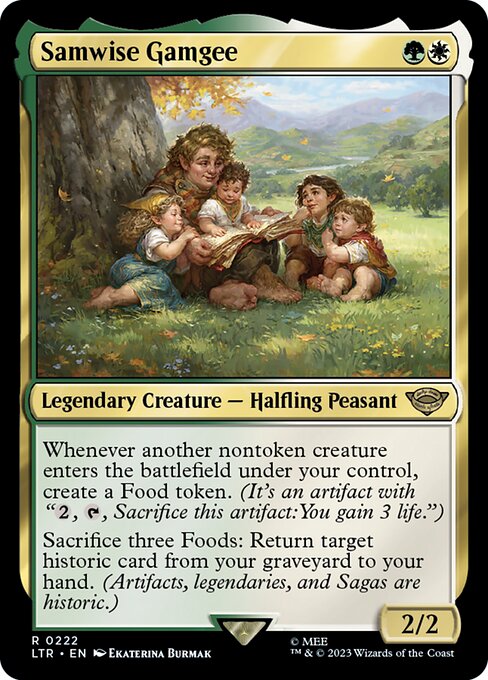
Samwise Gamgee
Creature-entry engine
Samwise creates Food when another nontoken creature enters under your control and can convert three Foods into a historic card from your graveyard to your hand.

Sam, Loyal Attendant
Cost reduction
Sam creates Food at the beginning of combat on your turn and makes activated abilities of Foods you control cost one less generic mana.
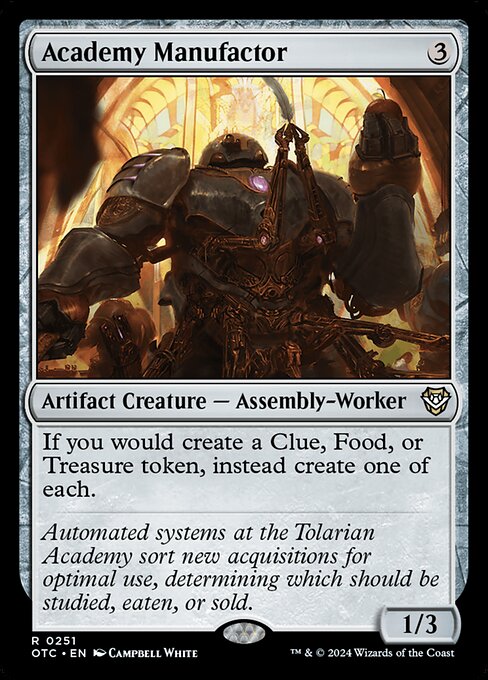
Academy Manufactor
Artifact diversity
Manufactor can turn one Food creation into a Food, Clue, and Treasure.

Gilded Goose
Early Food and fixing
Goose creates a Food on entry and can tap and sacrifice a Food to add one mana of any color.
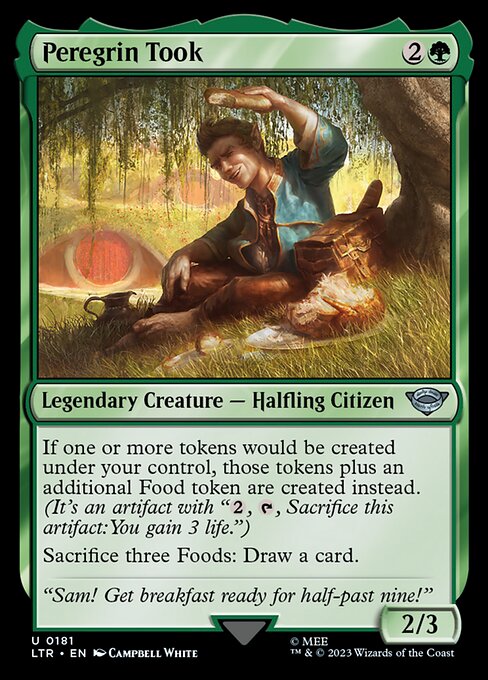
Peregrin Took
Food expansion
Peregrin can add an extra Food to a token creation event and can sacrifice three Foods to draw a card.

Night of the Sweets' Revenge
Mana and combat
This enchantment gives Foods an additional tap-for-green ability and can later convert its presence into a creature power boost through its activated sacrifice ability.
Samwise Gamgee
The two abilities tie creature development to a later recursion resource. Nontoken matters for the creation trigger. His recursion ability has no tap symbol, so a newly controlled Samwise can activate it immediately if you have three Foods and a legal target.
Sam, Loyal Attendant
The reduction makes ordinary Food activation cheaper while leaving its tap and sacrifice requirements intact. The reduction is not permission to activate a tapped Food, and it does not automatically discount an ability on a different permanent that asks you to sacrifice Food.
Academy Manufactor
A deck supporting artifacts entering or leaving can benefit from every part, while other decks may chiefly want the additional mana and future draw. Blood tokens and unrelated token kinds do not qualify. Keep the three resources distinct instead of using one combined die that hides which abilities are available.
Gilded Goose
It provides a way for Food to become mana through an ability other than the token's built-in life gain. The creature is subject to summoning sickness for its tap abilities, and spending the initial Food on mana means that Food is no longer available to gain life or pay a different cost.
Peregrin Took
The design rewards a steady supply of tokens and gives the Food pile a card-access role. Its draw ability is a separate action from activating the Foods. You do not receive their normal life gain when you sacrifice them to pay that cost.
Night of the Sweets' Revenge
A Food reserve can therefore contribute mana without being consumed immediately. Foods made into creatures still face tap-symbol restrictions from summoning sickness. The attack payoff needs creatures that can actually connect, so artifact count alone does not guarantee a finishing combat.
Decide whether Food is defense or fuel
A Food list should identify the resource it is protecting. If the main goal is life gain, you need a reason spending mana on life advances the game. If Food is recursion fuel for Samwise, the important threshold may be three available Foods rather than the amount of life they could gain. If the deck uses forage, the graveyard alternative changes which Foods you should retain. Treat these as competing uses of the same inventory, not several benefits you receive automatically from every token.
Consider a board with Samwise, three Foods, and a useful historic card in the graveyard. Returning that card consumes the three Foods but does not require tapping Samwise. You can use the ability even on the turn he entered if all other requirements are met. If instead you use one Food for life first, you drop below the three-Food cost. The smaller defensive action may be necessary, but it has given up immediate recursion. Sequence based on the problem you need to solve.
Use the deck builder to mark the intended spender beside each Food maker, then create a free account through My Decks to save the list. Check colored costs with the mana base calculator, since token production does not automatically provide mana. The Commander deckbuilding checklist is a useful reminder to retain ordinary draw and removal while adding a themed resource package.
Rehearse a Food activation at a low life total with an opponent able to respond. Announce the activation and put the ability on the stack, then pay its full costs to complete the activation. Players can respond only after that process finishes. The life has not arrived yet. Then resolve an imagined damage spell above it and check the result before moving to the Food's ability. This is why a Food marker is not equivalent to an immediate increase on your life counter. Use the same exercise at a safe life total to see when spending the mana early merely limits your other options.
Now add an animation effect. Separate Foods controlled since your turn began from those created this turn. For each creature Food, check whether it can use a tap-symbol ability or attack. Compare that with sacrificing a Food through an ability that does not tap the Food. The distinction matters in a deck using Night of the Sweets' Revenge because its granted mana ability has a tap symbol even though it does not consume the token.
After a game, note whether Food prevented a loss, paid an important cost, or sat unused while your hand and battlefield fell behind. These are more useful observations than the largest number of tokens the deck created. If Foods routinely remain unused because you cannot afford activations, a cost reducer or a different spender might be appropriate. If the deck lacks producers, adding another expensive reward will not fix that. Change the part of the engine that failed, and keep the proposed cut tied to its original job.
Cost reduction applies to the ability actually being activated
Sam, Loyal Attendant reduces the generic activation cost of abilities of Foods you control. With his reduction, an ordinary Food's ability costing two generic mana can cost one generic mana, while its tap and sacrifice components remain. If a separate creature has an ability that sacrifices Food, that is an ability of the creature, not an ability of a Food merely because Food appears in its cost. The reduction does not automatically apply.
Compare two actual spenders. Samwise Gamgee can sacrifice three Foods without tapping himself to return a historic card to hand. Gilded Goose taps itself and sacrifices a Food to make one mana of any color. A Goose you just gained control of normally cannot use that tap ability without haste, while a newly controlled Samwise can use his untapped-symbol-free recursion ability if you can pay and choose a legal target. The Food token age is not the only timing question. Identify which permanent has the tap symbol and which resource is being consumed before deciding whether a freshly assembled engine works this turn.
A decision table for the interaction
| Position | Correct result | What to check |
|---|---|---|
| Create a normal Food | An artifact enters | No inherent immediate life gain |
| Normal Food activation | Pay two, tap, sacrifice, gain 3 on resolution | Animated creatures can face tap restrictions |
| Samwise recursion | Sacrifice three Foods, return historic card to hand | Samwise does not tap for this ability |
| Forage | Exile three graveyard cards or sacrifice Food | Preserve the resource your next action needs |
Frequently asked questions
Build your deck
Put these choices into a Commander list. Create a free account to save your deck and keep tuning it with Deckcipher.
FAQ
Does making a Food gain life?
No. Creating Food puts an artifact onto the battlefield. Its normal life-gain ability requires two mana, tapping, and sacrificing the token, then must resolve. Other cards can add a life-gain trigger to the creation event, but that is a separate ability.
Can I activate a Food the turn it enters?
Normally yes because a standard Food is a noncreature artifact. If it is also a creature, its tap symbol can be restricted by summoning sickness. Another ability that sacrifices Food without tapping it follows its own costs and timing.
Does sacrificing Food to Samwise also gain life?
No. You are paying Samwise's ability cost, rather than activating each Food's ability. The Foods are gone after that payment, so they cannot be used again. Separate sacrifice triggers can still occur if another card has the appropriate wording.
Can an opponent respond before I gain life?
Yes. The ordinary Food gain-life ability uses the stack. Its costs have already been paid, but an opponent can respond to the ability before it resolves. This matters when you are close to losing to damage or another effect.
Are all Foods tokens?
No. Food is an artifact subtype that can appear on nontoken cards as well. A specific card may have other types and abilities, so do not assume that every permanent with Food has exactly the characteristics of a standard Food token.
Does Food count as ramp?
Only when you have a way to convert it into mana or another resource that advances development. The normal Food's ability gains life and does not produce mana. A deck relying on Gilded Goose or another converter needs that converter present and usable.
Can forage use a Food instead of graveyard cards?
Yes, forage offers the stated choice between exiling three cards from your graveyard and sacrificing a Food. Choose based on the resources you want to preserve. You do not also gain the Food normal life benefit from paying that cost.
Can a Food deck win without infinite combos?
Yes. Food can sustain creature pressure, artifact animation, recursion, or repeated sacrifice payoffs. Select a finish that fits the cards producing Food. Explain the plan in the pregame discussion so the expected pace and any intentional loops are clear.