
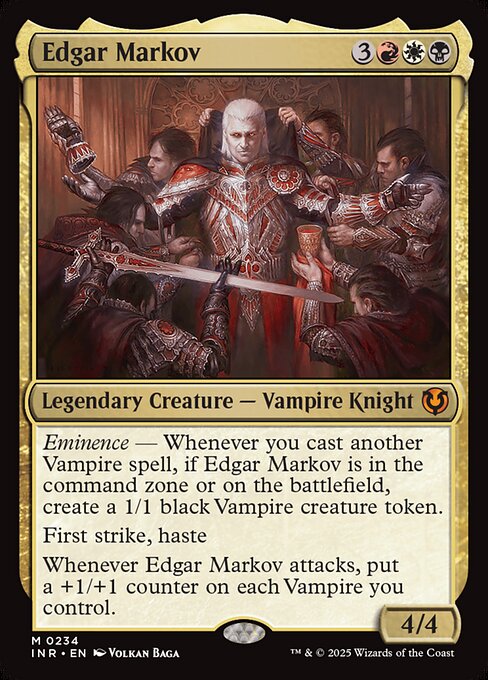
The best Edgar Markov upgrades usually make the deck cheaper, faster, and harder to wipe out. Start with one- and two-mana Vampires, Vampire lords, token payoffs, card draw that rewards small creatures, protection, and efficient interaction. Upgrade expensive staples last, because Edgar already gives you free material every time you cast a Vampire.
Audit your Vampire deck before you buy more staples
Run your Edgar Markov list through the Deckcipher audit to see mana, ramp, draw, interaction, and bracket pressure side by side.
Upgrade Edgar Markov by lowering the curve, not raising it
Edgar Markov is strong because eminence creates extra Vampire tokens before Edgar is even cast, so the deck rewards casting cheap Vampires early instead of waiting to play one big threat. The most common mistake is jamming expensive Vampires that do nothing the turn they land. Lower the curve, add lords and drain payoffs, keep the hand full, and protect the board, then upgrade the top end.
Why Edgar Markov is powerful
Edgar's eminence ability makes a 1/1 lifelink, haste Vampire token every time you cast a Vampire spell, and it works from the command zone before Edgar ever hits the battlefield. That means your very first Vampire of the game is already generating extra bodies, and by the time Edgar is actually on the battlefield giving your Vampires +1/+1 and first strike, you can already have a small army waiting to swing. Few commanders reward a low curve as directly as Edgar does, because every cheap Vampire is doing double duty as a card and a token generator.
That token generation is also why the deck often plays above a normal casual precon, even in a stock build. A wide board of free 1/1 lifelink haste tokens is already a real clock, and Vampire tribal payoffs turn that token stream into card draw, life drain, or a lord-boosted alpha strike. The deck's ceiling comes from consistency, not from any single expensive card, which is exactly why the upgrade path below leans on cheap Vampires and payoffs before premium staples.
In practice, most Edgar games end one of three ways: a wide board of pumped Vampires swings for lethal once a lord or two is online, a repeatable drain effect grinds opponents out over several turns while your lifelink tokens keep the total climbing, or a wrath-recovery spell like Patriarch's Bidding turns a board wipe into a second, even bigger attack. None of those plans need a top end full of six-mana Vampires. They need a steady stream of cheap threats and a payoff or two to turn that stream into pressure, which is exactly what the priority order below builds toward.
Edgar Markov upgrade priority
- Lower the curve.
- Add cheap Vampires.
- Add lords and anthem effects.
- Add card draw and token draw.
- Add aristocrat and drain payoffs.
- Add board protection.
- Add efficient removal.
- Fix the Mardu mana base.
- Add premium staples last.
Recommended deck structure
Use these as ranges to adjust from, not a fixed list. Edgar wants many cheap Vampire casts backed by payoffs, not a handful of expensive haymakers.
Edgar Markov deck structure ranges
| Category | Typical count | Notes |
|---|---|---|
| Lands | 34-37 | A lower curve lets this deck run slightly fewer lands than a five-color deck |
| Ramp | 8-10 | Enough to smooth draws, not the deck's main plan |
| Card draw and advantage | 8-12 | Keeps the hand full once the board is wide |
| Interaction | 8-10 | Answers threats before they take over the board |
| Board wipes | 1-3 | Edgar's board is an asset, so wipes are more of a last resort than a plan |
| Protection | 3-6 | Keeps Edgar and key payoffs alive through removal and wipes |
| Vampire package | High enough to trigger eminence consistently | Prioritize one- and two-mana Vampires over expensive ones |
| Lords, drain, and payoffs | Enough to turn tokens into real pressure | This is where the deck actually wins |
Best cheap Vampires
Every cheap Vampire in this deck is a token generator first and a card second, so prioritize ones that also do something useful on their own. Knight of the Ebon Legion grows into a real threat on its own for one mana, Vampire of the Dire Moon trades with almost anything small, and Indulgent Aristocrat turns your token stream into a sacrifice outlet with upside. Gifted Aetherborn is an efficient deathtouch lifelink blocker, and Bloodghast keeps coming back from the graveyard, which pairs well with sacrifice outlets, though check its current price before assuming it is a cheap include.
Round out the low end with card-neutral or card-positive Vampires. Dusk Legion Zealot and Voldaren Epicure replace themselves while still counting as a Vampire cast for eminence. Changeling Outcast is every creature type, including Vampire, and gets in for early evasive damage. Viscera Seer is a free sacrifice outlet for your aristocrat payoffs, and Welcoming Vampire turns your first few creatures each turn into cards, which matters a lot once tokens start flooding the board.
Lords, damage, and aristocrat payoffs
This is where the deck actually wins. Cordial Vampire, Captivating Vampire, Legion Lieutenant, and Stromkirk Captain all pump the team, and a lord that also draws a card or steals a creature is worth prioritizing over one that only adds stats. Shared Animosity turns a wide board into a game-ending attack out of nowhere, and Drana, Liberator of Malakir adds evasive damage and more tokens at once.
Aristocrat and drain payoffs

Blood Artist
Drains a point of life whenever a creature dies
Every trade, sacrifice, or board wipe becomes a small life swing in your favor, which adds up fast with a wide token board.
Cruel Celebrant
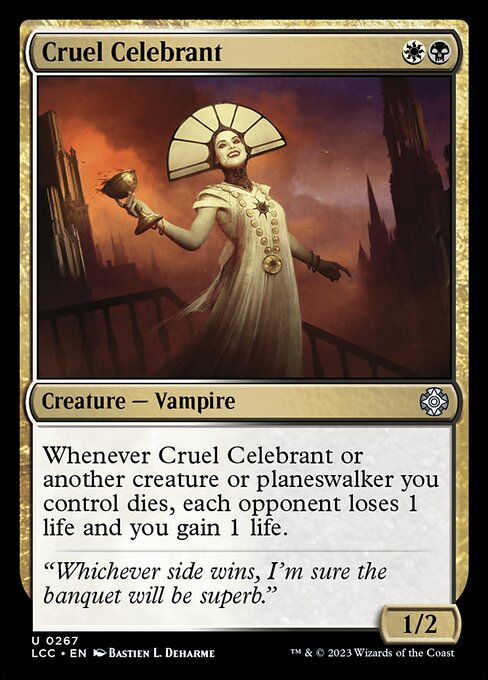
Drains a point of life for each creature or planeswalker that dies
A near-identical effect to Blood Artist on a body, which means running both is rarely redundant since each death can trigger both at once.

Zulaport Cutthroat
Drains life whenever any of your creatures dies
Punishes board wipes and removal aimed at your own tokens, which turns a bad situation into a life-total swing instead of a total blank.
Impact Tremors
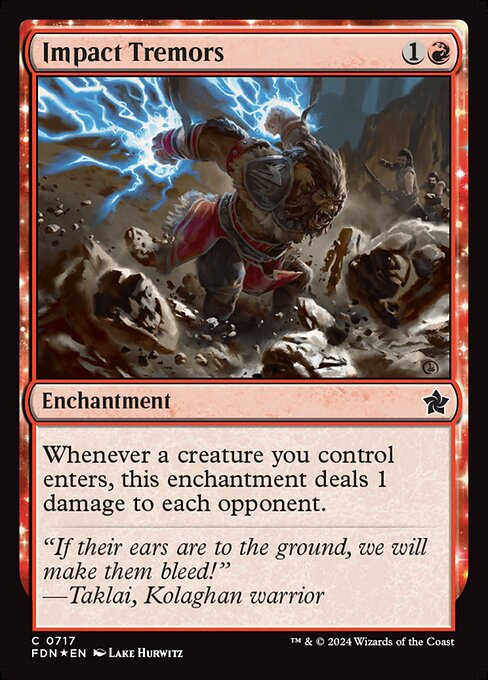
Deals damage whenever a creature enters
Every token Edgar makes chips away at every opponent at once, which scales especially well with anthem effects that make more tokens.
The highest ceiling in the archetype comes from combining a repeatable drain effect with a lifegain trigger. Vito, Thorn of the Dusk Rose and Sanguine Bond both drain opponents whenever you gain life, and pairing either with Exquisite Blood creates a genuine two-card infinite drain combo once your board is already gaining life from lifelink tokens. Bloodletter of Aclazotz pushes the same plan further with repeatable sacrifice-driven damage. Treat this package as an optional bracket-raising addition rather than a required piece, since a casual pod may not want to see an infinite combo out of a Vampire tribal deck.
Card draw for Edgar
This deck empties its hand fast because so many cards are one- and two-mana Vampires. Skullclamp turns every 1-toughness token Edgar makes into two cards the moment it dies, which is one of the most efficient draw engines available to any token deck. Welcoming Vampire, Tocasia's Welcome, and Idol of Oblivion all draw off token and creature volume specifically, which fits this deck better than generic draw does.
For flat card advantage, Champion of Dusk converts your whole Vampire count into cards in one shot, while Night's Whisper, Sign in Blood, and Read the Bones are cheap, unconditional black draw spells that fit any budget. Village Rites and Deadly Dispute turn a token you were going to lose anyway into cards or Treasure, which is close to free value in this shell. Phyrexian Arena, Necropotence, and Black Market Connections are the premium tier, and Necropotence in particular is a real bracket signal, so treat it as an upgrade for a higher-power table rather than a default include.
Protection and recovery
Edgar's board is an asset, which makes board wipes the deck's biggest threat, not removal aimed at one creature. Boros Charm, Flawless Maneuver, and Unbreakable Formation all save your board from a wipe for a reasonable cost. Teferi's Protection and Akroma's Will do the same job at a premium price point, and Clever Concealment is a cheaper option worth checking against current pricing.
If your board does get wiped, Patriarch's Bidding and Living Death can bring back your whole Vampire graveyard at once, turning a disaster into a second wide board. On the offensive side, Austere Command is flexible enough to clear a problem board without necessarily hitting your own small creatures, depending on the mode you choose.
Mardu mana base and ramp
Edgar's Mardu colors need to reliably cast one- and two-mana black and white Vampires on time more than they need to hit five colors of value. Command Tower and Path of Ancestry are cheap defaults, Secluded Courtyard and Unclaimed Territory fix colors cleanly since almost your whole deck shares the Vampire type, and Nomad Outpost and Savai Triome fix all three colors at once. Exotic Orchard is a solid budget rounding-out piece, and Cavern of Souls protects your Vampires from countermagic once your budget allows it. Shocklands, fetches, check lands, pain lands, and slow lands all speed up the mana further, but check current prices before assuming any specific land is still cheap.
Ramp matters less here than in a five-color deck, but it still smooths draws. Sol Ring and Arcane Signet are the default two picks, Fellwar Stone and the Mardu talismans and signets round out the rock package, and Chromatic Lantern is worth adding only if your fixing is genuinely thin. Herald's Horn and Vanquisher's Banner both discount and refill on Vampire casts, which stacks well with a deck this focused on one creature type. Remember that the real acceleration in this deck is Knight of the Ebon Legion-style low-curve efficiency, not mana rocks.
Budget swaps
A budget swap should replace the job a card does, not just its name. Some of these are close functional matches, others only cover part of what the expensive card does, so treat the table as a starting point, not a guaranteed 1:1 replacement.
Budget swaps for expensive Edgar Markov staples
| Expensive card | Budget swap | Role | What you lose | When the swap is good |
|---|---|---|---|---|
| Cavern of Souls | Unclaimed Territory or Secluded Courtyard | Typal color fixing | Counterspell protection for your Vampires | Your deck needs fixing more than protection from counterspells |
| Bloodletter of Aclazotz | Vito, Thorn of the Dusk Rose or Sanguine Bond | Lifegain-to-drain conversion | The repeatable sacrifice-driven damage mode | You want the drain plan without building toward a full combo package |
| Teferi's Protection | Boros Charm, Unbreakable Formation, or Clever Concealment | Board protection | Protection against removal aimed at you, not just your board | Your colors match and you mainly need to survive a wipe or a bad combat |
| Demonic Tutor or Vampiric Tutor | Wishclaw Talisman, Profane Tutor, or Diabolic Tutor | Finding a specific card | Speed, and Wishclaw Talisman lets an opponent copy the tutor | You mainly need to find a key payoff, not any card at instant speed |
| Anointed Procession | Mirkwood Bats, Impact Tremors, or another token payoff | Doubling every token you make | The raw token-doubling effect itself | You want more value from tokens without paying a premium for a doubler |
| Necropotence | Night's Whisper, Read the Bones, or Plumb the Forbidden | Massive one-shot card advantage | Raw card volume in a single turn | You want steady refills without the bracket pressure of Necropotence |
| Shared Animosity | Rally the Ranks, Stensia Masquerade, or Vanquisher's Banner | A one-sided alpha strike enabler | The exact stacking, per-attacker power boost | You want a cheaper way to close games with a wide board, not an exact copy |
Cards to cut
- Expensive Vampires that do not immediately affect the board the turn they land.
- Big lifelink bodies with no synergy beyond their own stats.
- Too many six-plus-mana spells competing for the same late-game turns.
- Narrow auras and equipment that do nothing if the creature wearing them dies.
- Clunky tapped lands once the rest of the mana base is tuned for speed.
- Overcosted removal when a cheaper answer exists in the same colors.
- Win-more cards that only help once the board is already winning.
- Non-Vampires that do not draw, protect, drain, ramp, or help close the game.
Bracket and Game Changer impact
Edgar Markov can feel oppressive at a casual table even in a fairly stock build, because eminence is free value that a table cannot easily interact with before it starts. That alone does not make the deck cEDH, but it does mean Edgar often plays above a normal casual precon's power level by default. Add fast mana, premium tutors, Necropotence, Skullclamp, an Exquisite Blood combo line, Teferi's Protection, free interaction, or premium mana, and the deck's bracket pressure climbs quickly regardless of how casual the rest of the ninety-nine looks. Read Commander Game Changers Explained for the full picture on how these cards shift table expectations, and mention any Game Changers or combo pieces before the game the same way you would with any other deck.
Audit your Vampire deck before buying more staples
Deckcipher can help you check your Edgar Markov deck's mana, ramp, draw, interaction, Game Changers, price drivers, and cards to review before you spend money on upgrades.
FAQ
Is Edgar Markov still good in Commander?
Yes. Eminence generates free Vampire tokens from the command zone, and a lord-and-drain package turns that token stream into real pressure, which keeps the deck effective even in a fairly stock build.
Is Edgar Markov beginner friendly?
It is approachable once the mana base is solid, since Mardu is only three colors. The deckbuilding skill it teaches well is curving out with cheap creatures instead of chasing expensive haymakers.
Is Edgar Markov too strong for casual Commander?
It can be, depending on the build. A stock, low-curve token deck already plays above many casual precons, and adding fast mana, tutors, or a drain combo pushes it further. Mention your deck's speed and any combo pieces before the game.
How many lands should Edgar Markov run?
Most Edgar Markov decks run around 34 to 37 lands. The lower curve compared to a five-color deck lets it get away with slightly fewer lands than average.
How many Vampires should Edgar Markov play?
Enough to trigger eminence consistently every game, which usually means prioritizing one- and two-mana Vampires over a handful of expensive ones. Quality and curve matter more than hitting a specific Vampire count.
What are the best Edgar Markov budget upgrades?
Start with cheap Vampires that do something on their own, a couple of lords, Blood Artist-style drain effects, and typal fixing lands before spending on expensive staples.
What expensive Edgar Markov staples have budget swaps?
Cavern of Souls, Bloodletter of Aclazotz, Teferi's Protection, and premium tutors all have role-based budget swaps, though none are exact one-to-one replacements. Check the budget swaps table above for specifics.
What cards should I cut from Edgar Markov?
Cut expensive Vampires with no immediate impact, big vanilla lifelink bodies, narrow auras and equipment, and any card that does not draw, protect, drain, ramp, or help close the game.
Is Edgar Markov better as aggro or aristocrats?
Both plans work and often overlap. A faster build leans on lords and an alpha strike, while an aristocrats build leans on sacrifice outlets and drain payoffs. Most successful lists blend both instead of picking one exclusively.
What bracket is Edgar Markov?
A stock, low-curve build without fast mana or combo pieces usually plays like a strong Bracket 2 or Bracket 3 deck. Adding premium tutors, fast mana, or a drain combo like Exquisite Blood pushes it toward Bracket 4.
Conclusion
Edgar Markov rewards a deck that curves out instead of one that waits. Fill the bottom of the curve with Vampires that do something on their own, back them up with lords and drain payoffs, keep the hand full, and protect the board from wipes. Expensive staples are a reward for a deck that already functions, not a fix for one that does not. Build the cheap end first, and the tokens will do the rest.