
Quick answer
Discover offers a free cast or a card for later. Its inclusive number and hand fallback differ from cascade, while the source determines when the action happens and whether blinking or recasting can repeat it.
Discover uses an inclusive mana-value limit
To discover a number, exile cards from the top of your library until you exile a nonland card with mana value no greater than that number. You may cast that card without paying its mana cost if the resulting spell also passes the limit. If you do not cast it, put it into your hand. Put the other exiled cards on the bottom in a random order.
Discover 3 can find a three-mana card, while a cascade from a three-mana spell normally looks below three. The inclusive threshold is one difference. The hand fallback is another. Once you find the qualifying card, you do not reject it and continue searching for a more exciting reveal.
Look at the full range of eligible hits when building the deck. A large discover number can still find an inexpensive support spell, and that may be a useful result rather than a failed attempt to find a bomb.
The found card and the spell you cast are separate checks
First determine whether the card in exile qualifies. Then check the mana value of the spell you would actually cast. Cards with alternate faces, adventures, or split halves need those separate evaluations because the characteristics of a card outside the stack can differ from the spell you choose. The resulting spell cannot exceed the discover number.
Finding a card through a cheap front face does not automatically permit an expensive spell on its reverse face. Discover also offers casting a spell, not playing a land. A land face is not a bonus land play supplied by the mechanic. If the available cast is illegal or undesirable, use the stated hand fallback.
Review unusual cards before a game. Mark which discover thresholds can find them and which choices are legal afterward. This saves time and prevents a mistaken free cast from deciding a complicated turn.
Free casting still follows costs and restrictions
Casting without paying a mana cost is an alternative payment method. You cannot combine it with a different alternative cost, though optional additional costs can be chosen and mandatory additional costs still have to be paid. An X in the mana cost is normally zero when cast this way unless another applicable rule or effect determines it.
A spell requiring a sacrifice as an additional cost cannot be cast if you have nothing legal to sacrifice. A spell with a target needs an appropriate target. A restriction forbidding casting from exile can prevent the offered cast even though discover grants unusual timing permission for a creature or sorcery.
The mechanic provides access, not an exception to every rule. Classify cards by whether they are useful when found on an ordinary board, rather than evaluating all eligible spells as free value in every situation.
Putting the card into hand preserves timing choices
If you do not cast the discovered card, it goes into your hand. This can preserve a counterspell for a later opponent action, keep removal until there is a better target, or retain a land face for a later legal land play when the card supports one. Taking the card does not cast it or trigger rewards for casting from exile.
A discovered counterspell may have no appropriate target during an otherwise empty stack. Putting it into hand is still a meaningful result. When you cast it later from hand, pay its normal appropriate costs and follow its ordinary timing and restrictions. The discover event did not create a lasting free-cast permission for that card in hand.
This fallback makes reactive cards less awkward than in many cascade lists, but it is not automatically equal to taking the free spell. You traded immediate mana advantage for the flexibility of a future card.
The source decides when discover happens
Discover is an action within a spell or ability, not a universal cast trigger attached to every card mentioning it. Trumpeting Carnosaur discovers when its entry ability resolves. Geological Appraiser has an entry trigger with a cast condition. Pantlaza supplies an optional Dinosaur-entry instruction. You must read the source to know when the table can interact.
Blinking Carnosaur can create another entry trigger without casting it again. Blinking Appraiser does not satisfy the condition that you cast that new object. Countering a creature spell before it enters can prevent its entry trigger entirely, while destroying a creature after the trigger exists normally leaves the trigger on the stack.
A deck built around recasting, blinking, or reanimation needs sources matching that action. A card merely sharing the word discover does not guarantee it belongs in the same engine.
Pantlaza rewards the qualifying creature and an optional once-per-turn choice
Pantlaza or another Dinosaur entering under your control can offer discover based on that creature's toughness. You may do this only once each turn. The optional action is the important limit: several relevant entry triggers can occur, and you can decline an earlier opportunity to wait for a better one. Once you take the permitted discover, later opportunities that turn cannot bypass the limit.
If a small Dinosaur enters before a larger one, you can decline the smaller discover and consider the later trigger. That choice carries risk: the planned larger entry might be countered or otherwise fail. Toughness changes before resolution and the relevant last known information can also matter to the value used, so check the actual game state.
Do not evaluate Pantlaza using only the most expensive Dinosaur in the deck. Count the ordinary qualifying entries you can cast and consider when an earlier modest hit is more valuable than waiting for an ideal one.
Extra discover effects and exile-cast rewards are distinct
Curator of Sun's Creation can trigger from discovering and instruct another discover for the same value, with a once-per-turn limit on its own ability. That is a new discover action, not permission to continue past the first card from the old one. Quintorius Kand instead rewards spells cast from exile, so the hand fallback does not supply that particular cast event.
Resolve the original discover completely before placing waiting triggers on the stack as appropriate. A card cast during that resolution remains a spell on the stack and can be answered afterward. If additional discover actions or cast rewards have triggered, arrange and resolve them in a clear legal order.
Keep a separate physical area for each current exile process. Do not shuffle cards from one discover into the bottom while another group is still unresolved or mix a card that went to hand back into the exiled leftovers.
More spells still need to lead to a finish
A discover deck can build a resource advantage through useful free spells, yet spend long turns without presenting a way to win. The package needs early mana, good low-value hits, and an actual payoff for the developed board. Filling every slot with another discover chain can make the deck harder to track while weakening its interaction and recovery.
A two-mana ramp spell can be excellent early and acceptable as a later discover hit. Removing every cheap ramp spell to improve average reveal size may prevent the deck from reaching its expensive sources. Conversely, too many narrow tricks can leave the free casts unable to affect an ordinary board.
Decide whether the deck wants creature pressure, spell payoffs, or a particular combination. Then choose sources and hits that support that route, and disclose intentional deterministic loops in the pregame conversation.
Cards worth comparing before you choose a package
Examples and the jobs they do
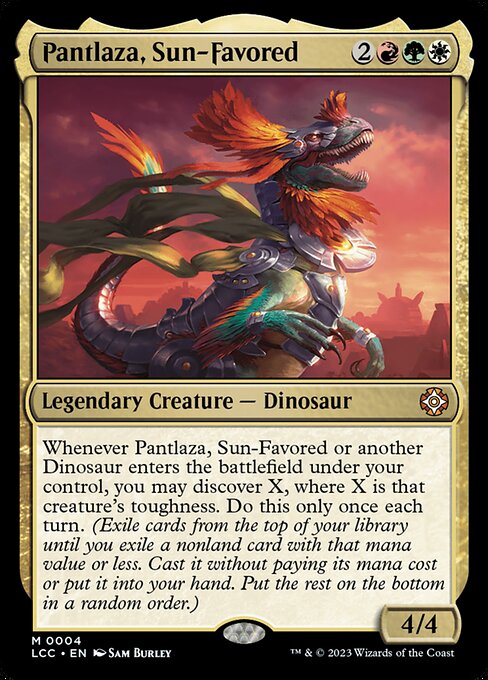
Pantlaza, Sun-Favored
Dinosaur engine
Pantlaza offers a toughness-based discover when it or another Dinosaur enters under your control.
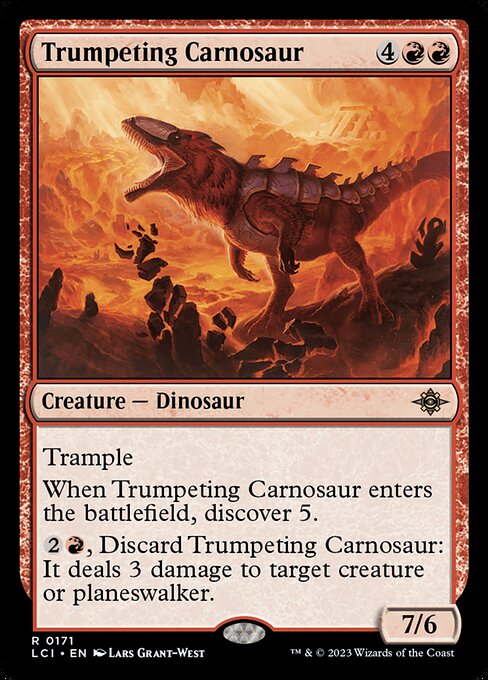
Trumpeting Carnosaur
Entry value and discard answer
Carnosaur has an entry discover 5 ability and a separate discard ability that deals damage to a target creature or planeswalker.
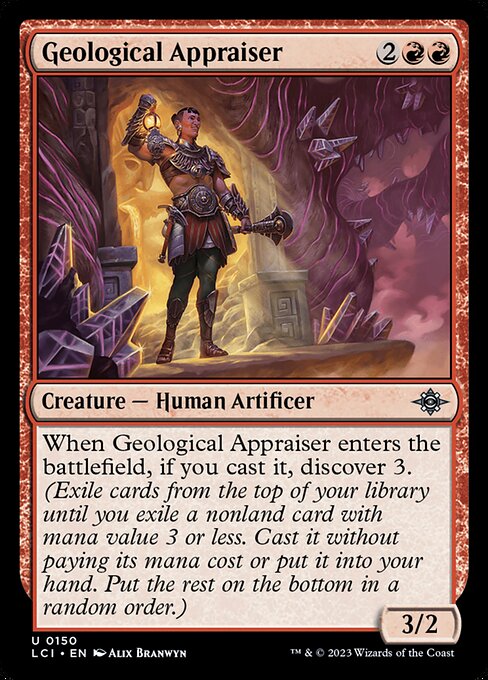
Geological Appraiser
Cast-conditioned discover
Appraiser can discover 3 from its entry trigger if you cast it.

Curator of Sun's Creation
Additional discover action
Curator can reward a discover event with another discover of the same value.
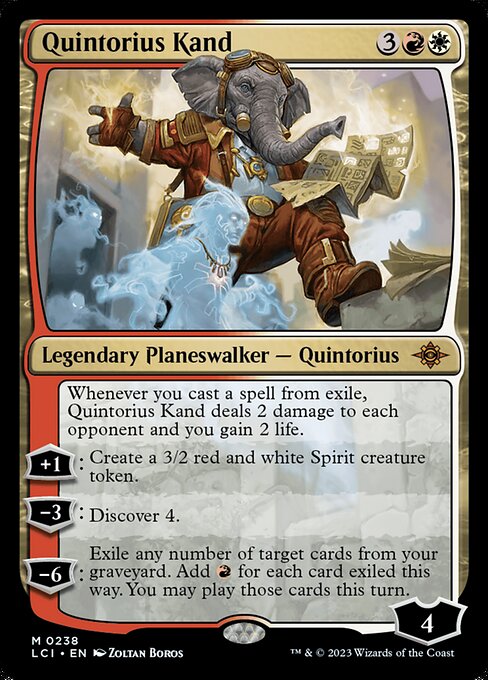
Quintorius Kand
Exile-cast payoff
Quintorius has a loyalty ability that discovers and separately rewards casting spells from exile with damage to opponents and life gain.

Hit the Mother Lode
Large single event
This spell discovers 10 and can create tapped Treasures based on the difference between ten and the discovered card mana value.
Pantlaza, Sun-Favored
Its optional once-per-turn action lets you consider whether to take an early result or wait. Declining a trigger does not guarantee a later Dinosaur arrives. Keep legal early plays and do not rely on the single largest toughness in the deck as the normal outcome.
Trumpeting Carnosaur
These provide different uses in different positions. Discarding it to its own damage ability does not make it enter and does not discover. Reanimation or blinking can support the entry ability, but those require separate cards and legal sequences.
Geological Appraiser
The condition distinguishes it from an unconditional entry-discover creature. Putting it directly onto the battlefield or blinking it normally does not satisfy that cast condition for the new object. Choose it for the actual method your deck uses.
Curator of Sun's Creation
Its own once-per-turn limit prevents every later discover that turn from repeating the bonus indefinitely. It is a support permanent rather than a starting discover source. A hand full of rewards and no way to discover still needs another action to begin.
Quintorius Kand
It can connect a spell chain to visible pressure. Putting a discovered card into hand is not casting it from exile. The planeswalker is not ordinarily eligible as your commander merely because it is a legendary card.
Hit the Mother Lode
The discovered card can be the one you cast or the one put into hand. The Treasures enter tapped, so their normal tap ability is not immediately available without another effect. Count their timing separately from the free spell and the spell's substantial mana investment.
Test the hit quality without changing the reveal
Lay out a plausible Pantlaza turn with enough actual mana to cast the Dinosaur you intend to use. Put the entry trigger on the stack and decide whether to take the offered discover. Exile cards in order until the first eligible nonland card appears. Keep that result even if it is a small ramp spell. Choosing a more exciting card from deeper in the library would hide the construction question you need to answer.
For each result, record three things: could you legally cast it, was casting it useful, and was taking it into hand preferable? A removal spell without a worthwhile target can still be a useful future card. A ramp spell may be a perfectly good hit if it lets you reach the next expensive source. A protection trick with no relevant permanent or threat might be less suitable. Evaluate those results by the turn they occur, not by the maximum mana value printed on the source.
Now remove Pantlaza before the planned Dinosaur arrives. The other creature can still enter, but Pantlaza is absent to supply its trigger. Keep playing with that actual position. A list containing independent draw and creatures with useful entry effects can recover differently from one whose entire hand relies on the commander. If you need to add resilience, compare another self-contained creature or draw spell before adding another expensive reveal payoff.
Use the deck builder to separate early development from discover rewards and ordinary useful hits. Review the Commander deckbuilding checklist so the reveal package does not remove every answer. The mana base calculator can check the colored requirements that let you reach the first source, while conditional discover hits remain a separate assumption. Create a free account through My Decks to save the version and your observations.
Practice one chain aloud before the game. Announce the source, the discover number, the found card, the cast-or-hand decision, and the group placed on the bottom. Then handle new triggers and the resulting spell. Efficient tracking does not mean skipping response windows. It means making each object easy to identify so the table can answer the important part without stopping to reconstruct which pile belongs to which effect.
A blink effect can make Pantlaza leave and return as a new object. That new object has its own once-per-turn restriction and can offer another discover from its own entry even if the previous Pantlaza already used its opportunity. This differs from merely causing another Dinosaur to enter while the same Pantlaza remains. Keep the source change visible and check the complete blink effect, including when it returns the creature. An effect returning a creature at the next end step does not supply the same timing as an immediate blink. Repeated resets can also change the deck's intended power and should be part of its pregame description.
A decision table for the interaction
| Position | Correct result | What to check |
|---|---|---|
| Discover 3 finds mana value3 | Qualifies | The threshold is inclusive |
| Choose not to cast the hit | Put it into hand | No lasting free-cast permission in hand |
| Blink Appraiser | Cast condition not met normally | Do not copy a Carnosaur sequence blindly |
| Take a Pantlaza discover | Uses its allowed once-per-turn action | Declining earlier was a different choice |
Frequently asked questions
Build your deck
Put these choices into a Commander list. Create a free account to save your deck and keep tuning it with Deckcipher.
FAQ
Can discover find a card with the exact stated mana value?
Yes. Discover uses that number or less. Cascade ordinarily uses a strict lower-than comparison with its source spell. Apply the correct threshold rather than treating the mechanics as interchangeable because both exile cards and offer a cast.
Can I skip a weak hit and keep revealing?
No. Stop at the first qualifying nonland card. You may cast it if allowed or put it into hand, but you do not restart the process to seek a better card. The remaining exiled cards go to the bottom in a random order.
Can I keep a discovered counterspell for later?
Yes. If you do not cast the found card, discover puts it into your hand. You can later cast it under the normal applicable rules and costs. It does not remain a free spell just because it originally came from discover.
Does discovering count as casting from exile automatically?
No. A card actually cast through discover is cast from exile. A card put into hand was not cast at that point. Rewards for discovering and rewards for casting from exile care about different events.
Does blinking Geological Appraiser discover again?
Normally its new entry does not satisfy the condition that you cast it. Trumpeting Carnosaur has a differently worded entry trigger. Read the source rather than assuming every discover creature works with the same blink package.
Can I take several Pantlaza discovers in one turn?
The card allows the specified optional discover only once each turn. You can decline an earlier opportunity and consider a later one, but once you take the allowed action, additional qualifying entries do not remove that limit.
Can opponents counter the free spell?
Yes. Finish resolving the discover instruction, then normal priority windows allow responses to the spell on the stack. Its mana cost was not paid, but it is still a spell and is not automatically uncounterable.
Do the Treasures from Hit the Mother Lode work immediately?
They enter tapped. A normal Treasure needs to tap as part of its mana ability, so these cannot normally provide that mana immediately without a separate way to untap them. They are a later resource, not an automatic refund this moment.