
Quick answer
Connive filters cards and may grow a permanent. Choose the discard after drawing, distinguish a nonland reward from hand size, and check whether the effect still resolves when a creature leaves.
Connive draws first and discards afterward
To have a permanent connive, its controller draws a card and then discards a card. If a nonland card is discarded this way, that player puts a +1/+1 counter on the conniving permanent. The draw and discard are instructions during resolution, rather than a discard paid before drawing. That distinction changes what information you have when choosing the card to discard.
With an ordinary connive, you see the new card before choosing among the cards available in your hand. Discarding a land keeps the selection benefit without the ordinary counter reward. Discarding a nonland can provide both selection and growth. You do not get an extra counter merely because the drawn card was a nonland if you actually discarded a land.
Evaluate the hand improvement and the creature growth separately. The best discard can be an excess land even when that means forgoing a counter on the current board.
Connive is usually selection rather than net cards
An ordinary connive draws one card and discards one, so it normally leaves your hand with the same number of cards. It can improve quality, place a useful card in the graveyard, and grow a creature, but it is not an unconditional increase in hand size. Those benefits matter without needing to relabel the exchange as drawing an extra card.
A hand containing an uncastable expensive spell may become more useful after connive finds a land or cheap answer. Conversely, a deck with no cards in hand can draw and then discard the newly drawn card through the ordinary instructions. Connive does not require a discard card up front as a cost in the same way a Blood activation does.
Keep independent card advantage in the list. Repeated filtering can find the right cards while still leaving you without enough total resources after the table trades with your board.
Connive a number is one larger action
Connive N instructs the controller to draw N cards, discard N cards, and then put counters on the permanent equal to the number of nonlands discarded that way. It is not simply N separate ordinary connive actions. All the draws precede the discards in that instruction, which can make the selection more informed.
Connive 3 can let you see three new cards before choosing the three discards, and discarding two nonlands gives two +1/+1 counters. A payoff for discarding one or more cards must be read against the actual discard event rather than assuming it triggers once for each card. A payoff for each draw follows its own wording.
If a permanent would connive zero, the rules do not create a connive event. Do not claim a zero-sized action triggers every reward for conniving when the mechanic specifically excludes that case.
Raffine needs a legal attacking target
Raffine triggers when you attack and targets an attacking creature to connive based on the number of attacking creatures. The target is chosen when the trigger is placed on the stack. An opponent can answer that target before resolution. If the ability has no remaining legal target, it does not resolve and you do not receive that targeted connive.
Attacking with several creatures does not let you distribute the connive counters freely among them. One selected attacking creature performs the stated action. Additional creatures entering tapped and attacking after the initial declaration can affect some later game-state counts, but do not retroactively create another whenever-you-attack event.
Use a target you can reasonably preserve when the selection matters more than enlarging a particular threat. The target choice, the attack count, and the need to survive the return attack are separate combat decisions.
Ledger Shredder cares about the second spell, not every later spell
Ledger Shredder connives when a player casts their second spell each turn. Each player has their own spell count within that turn. A countered spell was still cast and contributes to the count, while a token entering without being cast does not. Copying a spell onto the stack is normally not casting another spell either.
A player casting their second spell can trigger Shredder, but their third spell does not create the same trigger again merely because it is also after the first. Another player can later cast their own second spell that turn and create another qualifying event. Follow who cast each spell instead of keeping one unexplained table-wide number.
The card rewards a table where several spells are cast, but the ability is not a guarantee of a connive during every player turn. Keep that actual condition in mind when comparing it with immediate card access.
A source leaving and a target becoming illegal are different
Connive can use last known information when the permanent instructed to connive is no longer on the battlefield. You can still perform the draw-and-discard instructions for the appropriate controller, though counters cannot be put onto an absent permanent. This differs from an entire targeted ability failing to resolve because its only target became illegal.
Removing Ledger Shredder while its own triggered ability waits does not normally erase that untargeted ability. It can still perform the connive process using the applicable information. Removing the attacking creature targeted by Raffine can instead leave Raffine's ability with no legal target and prevent its resolution.
Ask two questions before announcing the result: is the effect itself still resolving, and is the permanent available for counters? Collapsing those into simply the creature died can produce the wrong answer.
Convoke and reflexive triggers add their own timing
Lethal Scheme destroys a target creature or planeswalker and then has each creature that convoked it connive. The spell must resolve to perform those instructions. If its only target is illegal, the later connives do not rescue the spell. If the legal target survives because it is indestructible, the spell can still continue to its later instruction.
Obscura Interceptor enters and connives, then uses a separate when-it-connives-this-way trigger to offer returning up to one target spell to hand. The target for that later trigger is chosen when that trigger is put onto the stack, rather than being chosen in advance as part of the initial creature spell.
Take time to identify which object is on the stack. A useful connive package can contain a spell, an entry trigger, and a later reflexive trigger, each with its own conditions and response opportunities.
Discard support should match the cards you actually want to lose
A graveyard strategy can use connive to place a creature where it is useful, while a combat deck can prefer nonlands that supply counters and improve an attack. Toluz can reward discard through its own exile-and-return plan, and Faerie Vandal can reward a second card drawn. These cards care about different parts of the action.
Toluz does not simply say every discarded card returns immediately. Its triggered exile and death abilities need to be followed in order. Faerie Vandal does not require discarding a nonland to receive its own second-draw trigger. Read the actual event rather than counting all draw-and-discard payoffs as one interchangeable package.
Do not remove every normal draw spell to fit more discard rewards. The deck needs castable early plays and enough cards to make its selection choices meaningful after opponents answer the commander.
Cards worth comparing before you choose a package
Examples and the jobs they do
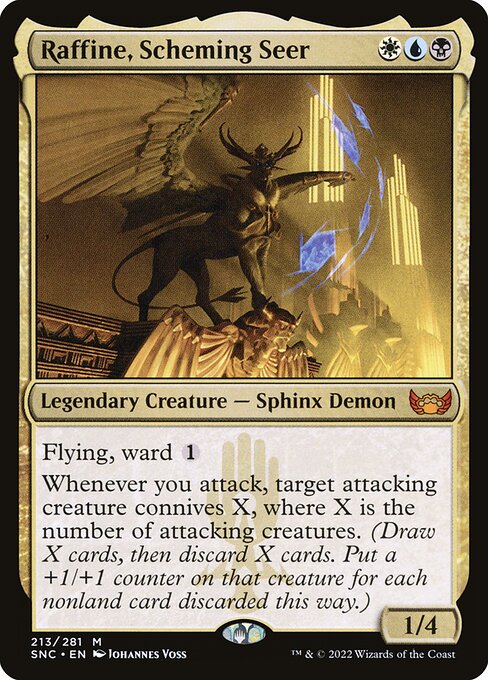
Raffine, Scheming Seer
Attack-based selection
Raffine uses a targeted attacking creature for a larger connive based on the attacking board.
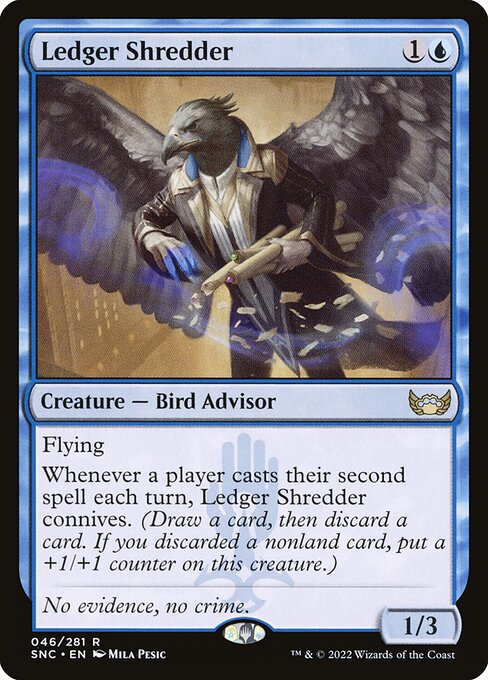
Ledger Shredder
Second-spell trigger
Shredder supplies a flying body and a connive when a player casts their second spell each turn.
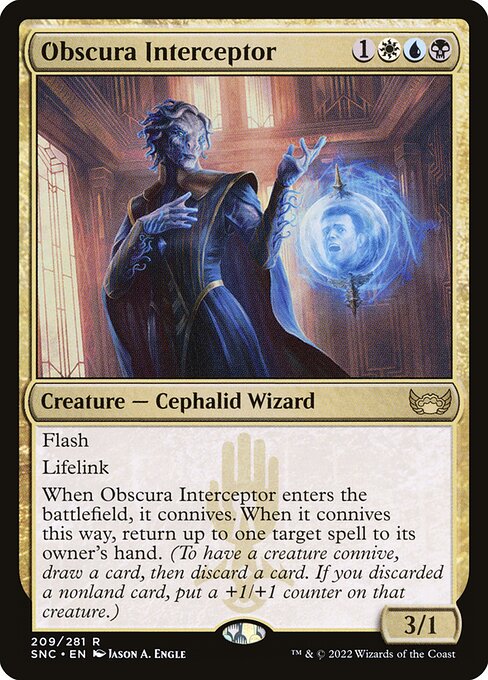
Obscura Interceptor
Reactive entry play
Interceptor can enter at flash timing, connive, and then use its resulting trigger to return a target spell to hand.

Lethal Scheme
Removal and creature selection
Scheme has convoke and can have the creatures that convoked it connive after its destruction instruction.

Toluz, Clever Conductor
Discard storage
Toluz connives on entry, can exile cards you discard from your graveyard through its trigger, and can return cards exiled with it when it dies.

Faerie Vandal
Second-draw support
Vandal rewards drawing your second card each turn with a counter on itself.
Raffine, Scheming Seer
The commander connects a creature attack to hand selection and possible counters. The target must remain legal. Protecting a large attack and preserving the right recipient can matter more than adding another creature that only looks good when the commander is already safe.
Ledger Shredder
It can gain value from opponents' ordinary sequences as well as yours. Spell counts are tracked per player and per turn. Third spells, copies not cast, and uncast tokens are not substitutes for the exact event.
Obscura Interceptor
The draw and discard happen before the later target choice. Returning a spell is not the same action as countering it. Its owner may recast it later, and cast triggers already on the stack remain separate.
Lethal Scheme
It joins an answer with selection and possible growth across contributing creatures. Use an actually legal target. If all targets become illegal the spell does not resolve, while a legal indestructible target can survive without preventing the later instructions.
Toluz, Clever Conductor
The abilities form a separate resource plan. Its hybrid symbols still contribute their colors to Commander color identity under current rules. Paying only blue mana does not make the card legal in a mono-blue deck.
Faerie Vandal
A connive draw can satisfy that condition even if the discard is a land. The card does not itself grant connive. It is a complementary draw-event payoff and should be evaluated by when the deck actually reaches a second draw.
Track the event before evaluating the reward
Start with Ledger Shredder and Faerie Vandal on your battlefield after your normal draw for the turn. Cast two spells that do not themselves draw cards. The second-spell event can trigger Shredder. When its connive resolves, that draw is your second card drawn for the turn, so Vandal can trigger. If you discard a land, Shredder does not receive the ordinary connive counter, but the completed second draw still happened. The two payoffs are checking different facts.
Repeat with a nonland discard and compare the counters after all waiting triggers resolve. Then repeat with Shredder removed before its connive trigger resolves. The existing untargeted ability can still draw and discard using the appropriate information, though the absent Shredder cannot receive a counter. This is a useful contrast with a Raffine trigger whose only targeted attacker has become illegal. Do not carry the result from one case into the other without checking the target structure.
For a Raffine hand, count a plausible attack rather than placing every creature in the deck onto the board. Choose one attacking target and work through the full connive number. Keep the cards drawn and discarded in their actual zones. If you are setting up recursion, name the later spell and the mana needed to use that graveyard card. A discard is only helpful setup when the remaining list can actually convert it into a future action.
Use the deck builder to separate filtering from net card advantage and from counters payoffs. The Commander deckbuilding checklist helps preserve independent draw and interaction while the package grows. Check early colored costs with the mana base calculator, particularly for a commander needing three different colors. Create a free account through My Decks to save the list and the specific tradeoffs you are testing.
After a game, record which discard improved the next action, which creature actually used its counters, and whether the hand ran out of total cards. These observations can point in different directions. More connive may improve selection but fail to repair quantity. More combat payoffs may increase damage but weaken recovery. Make the next edit match the resource that was missing rather than adding another card simply because it rewards drawing or discarding.
When Lethal Scheme instructs several contributing creatures to connive, handle the individual connive actions according to the rules rather than drawing the combined number first and discarding only after seeing everything. That is different from a single creature conniving a number. You can choose the applicable order among your creatures, but the actions remain distinct. Newly controlled creatures can also help pay a convoke cost because convoke does not activate their own tap-symbol abilities. That payment rule does not mean they can use their normal tap abilities or attack without satisfying the relevant creature restrictions.
A decision table for the interaction
| Position | Correct result | What to check |
|---|---|---|
| Discard a land to connive | Selection without the ordinary counter | Other draw or discard triggers can still matter |
| Connive 3, discard two nonlands | Two counters when possible | The number of nonlands discarded matters |
| Shredder source leaves | Existing untargeted ability can still resolve | No counters on an absent permanent |
| Raffine only target becomes illegal | Targeted ability does not resolve | Different from source removal alone |
Frequently asked questions
Build your deck
Put these choices into a Commander list. Create a free account to save your deck and keep tuning it with Deckcipher.
FAQ
Do I discard before seeing the connive draw?
No. The ordinary action draws and then discards. You choose the discard using the hand available at that point. That differs from an activation such as Blood where discarding is part of paying a cost before the later draw.
Does discarding a land give a counter?
Not through the ordinary connive counter instruction. A nonland discard supplies that reward. Discarding a land can still improve your hand, and other cards may reward the draw or discard through their own abilities.
Does connive increase hand size?
Normally one draw and one discard leave the number unchanged. Connive N normally draws N and discards N. Selection, graveyard setup, and growth can still be valuable, but independent sources of net cards remain useful in the deck.
Does every spell after the first trigger Ledger Shredder?
No. Its trigger is the second spell a player casts each turn. Track each player separately. A spell can count even if countered later, while an ordinary spell copy that was not cast does not count as another cast.
What if the creature leaves before conniving?
An effect that still resolves can use last known information to perform the appropriate connive process, though an absent permanent cannot receive counters. A targeted ability with no legal target can instead fail to resolve. Check the source rather than applying one answer to both cases.
Can Raffine put counters on several attackers?
Its attack trigger targets one attacking creature to connive the appropriate number. The resulting counters go on that conniving creature when possible. Attacking with more creatures does not itself turn the instruction into freely divided counters.
Does an indestructible target stop Lethal Scheme connives?
If the target remains legal, failing to destroy it because of indestructible does not by itself prevent the spell from continuing. That differs from having no legal target, which can stop the spell from resolving at all.
Is Toluz mono-blue if I pay blue for its hybrid symbols?
No. Commander color identity considers the actual relevant symbols, including the alternatives in hybrid symbols. The amount and colors of mana you happened to spend do not rewrite the card's identity for deck construction.