
Quick answer
Use this archive to find the current Reality Fracture Commander reviews and to place releases in context. Each review should identify its actual set, date, card pool, and deckbuilding purpose. A historical recommendation is a starting point to recheck, rather than a permanent shopping instruction.
Start with the review that matches your question
This archive is dated October 25, 2026. Reality Fracture, released October 2, is the latest main expansion already released at this date. The available detailed review entries below cover its general Commander additions, budget candidates, and new commander projects. The release timeline supplies context for earlier sets; it does not claim that a full standalone review has been published for every product in that timeline.
Choose the general Reality Fracture review when you already have a deck and want cards with clear roles. Choose the budget Reality Fracture review when delivered cost and small upgrades are the constraint. Choose the new Reality Fracture commander comparison when you want a fresh project rather than a change to an existing list.
These are different questions. A strong new commander may require rebuilding most of a deck, while one flexible support spell can improve a list without changing its identity. A cheap card may still be an unnecessary purchase if the deck already performs that job. Read the conclusion through the problem you are trying to solve, and keep the original list available so a recommendation leads to a named change.
| Detailed review | Use it for | Keep in mind |
|---|---|---|
| Reality Fracture Commander cards | An upgrade to a deck you already play | Match the card role to the named cut |
| Budget Reality Fracture cards | A small package within a spending limit | Check complete delivered prices |
| New Reality Fracture commanders | Choosing the next deck project | Compare setup and recovery before buying support |
A release timeline is not a legality list
A set release date tells you when the product arrived. It does not answer every legality question for every card inside it. Main expansions, accompanying Commander releases, special reprint sheets, promotional printings, and digital additions can appear around the same release window. Their cards do not automatically share identical format permissions. A particular card can also be restricted by a format banned list regardless of the date printed beside its set.
| Release | Tabletop release context | How to use the entry |
|---|---|---|
| Reality Fracture | October 2, 2026 | Current detailed Commander reviews linked above |
| Secrets of Strixhaven | April 24, 2026 | Earlier main-set and associated-product context |
| Lorwyn Eclipsed | January 23, 2026 | Earlier main-set and associated-product context |
| Edge of Eternities | August 1, 2025 | Older main-set context |
| Tarkir: Dragonstorm | April 11, 2025 | Older main-set context |
| Magic: The Gathering Foundations | November 15, 2024 | Earlier release, distinct from later Foundations Commander decks |
The timeline intentionally does not pretend to be a complete list of every release. Universes Beyond products, Commander-only products, and smaller supplemental releases also matter to Commander. When evaluating one of those cards, identify its actual product and legal card record instead of assuming the main-expansion timeline includes it. A dated, limited catalog is more useful than a list that silently mixes preview announcements, release dates, and unrelated printings.
Reality Fracture: separate the main set and its companions
Reality Fracture uses FRA for the main set and FRC for the associated Commander release. Its digital Alchemy pool is another distinction. The general review here concentrates on new tabletop main-set designs with identifiable jobs, including Geist of Saint Thalia, Pia, Aether Ascetic, Vraska, Soul of Stone, and several more expensive or specialized options. It treats the reprinted slow lands as reprints rather than newly invented designs.
The budget entry asks a narrower question: which common or uncommon candidates are worth comparing with existing support slots? It explains conditional costs such as Countersculpt's behold requirement and the difference between returning a spell with Fatehold Charm and permanently removing it. It does not promise a price that remains true in every currency or every week. A card can be a useful candidate while still exceeding your particular checkout limit.
The commander entry compares the actual play patterns. Vraska produces artifact creatures from noncreature casts, while Pia offers enchantment access and the two Ghaltas reward different combat resources. Those are not interchangeable lists. A review organized by role helps you avoid purchasing support for a name before choosing which version of that character you actually intend to use as commander.
Secrets of Strixhaven changed an existing Saga interaction
Secrets of Strixhaven released April 24, 2026. Its main set uses SOS, its Commander cards use SOC, and its Mystical Archive uses SOA. The release also changed a concrete Commander interaction involving older cards: Sagas now have an intrinsic ability responsible for entering with lore counters. Under those current rules, Doubling Season can double the lore counters a Saga enters with. An older discussion saying the initial lore counter is never doubled is out of date.
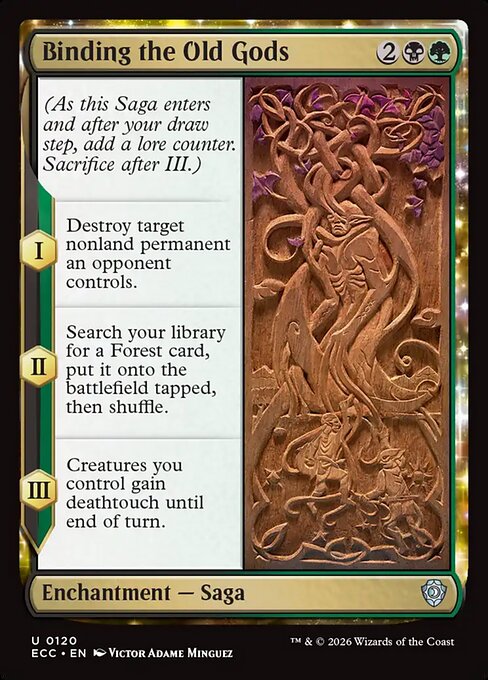
Binding the Old Gods supplies a useful example. The four-mana Saga, which was also reprinted in Lorwyn Eclipsed Commander, normally enters with one lore counter and triggers its destruction chapter. If you already control Doubling Season, it can enter with two lore counters instead. For this ordinary Saga without read ahead, both the first and second chapter thresholds are crossed, so you get the destruction trigger and the Forest-search trigger. You choose their stack order and the required targets at the appropriate time.
That does not make every later lore counter double automatically. The normal counter placed as your precombat main phase begins is a turn-based action rather than the same entry effect. Read-ahead Sagas also have a same-turn exact-counter exception, so the ordinary Binding example should not be applied blindly to them. These are actual rules differences that an archive needs to preserve when a card is recommended again after a reprint.
Compare the old Saga with Reality Fracture Pia, Aether Ascetic. Pia costs two generic and one green and can offer a discard for an enchantment search to hand on entry. In a deck with a commander whose color identity includes black and green, Pia can play in the 99 and find Binding. Pia as a mono-green commander cannot include that black-green Saga. The search does not cast it or put it directly onto the battlefield. Casting Pia and then Binding requires seven mana across those actions before other modifications, plus the chosen discard. The new card improves access to the old effect; it is not the same as a three-mana replacement for the Saga's full sequence.
Lorwyn Eclipsed and the difference between a new card and a new printing
Lorwyn Eclipsed released January 23, 2026. A main release and its associated Commander products can both reintroduce existing cards alongside new designs. Finding a familiar card in a 2026 product does not make its underlying ability a new mechanic. That matters when a review says new commanders or new cards: a reprinted legendary creature may be a new opportunity to obtain the card without being a newly designed commander.
A reprint can still deserve an upgrade recommendation. It may be easier to find, offer a preferred treatment, or fit a purchase plan differently. But its rules evaluation should be based on the card itself. If you already own a functional printing, buying another version does not improve the deck merely because the newer set is currently being discussed. Separate a collection preference from a performance change so the budget remains understandable.
For a deck with a creature-type theme, evaluate the early curve, recovery, and interaction before adding every matching type from a release. A newly available payoff can be exciting while making an opening hand slower. An older support creature that draws a card or fixes mana may still be more useful. The archive should help you compare those tradeoffs across time, rather than encourage the assumption that the newest set always replaces the oldest useful cards.
Tarkir: Dragonstorm versus Reality Fracture planeswalkers
Tarkir: Dragonstorm released April 11, 2025. Ugin, Eye of the Storms costs seven generic mana and has a cast trigger that can exile a permanent with one or more colors. It also rewards later colorless spell casts with a similar exile opportunity. Those are different reasons to choose the card from simply wanting a planeswalker that supplies cards over time. It does not answer an ordinary colorless permanent with those colored-permanent instructions.
Reality Fracture The Theorist, Jace Beleren costs two generic and two blue and draws for its controller at the beginning of each opponent's draw step. That is a cheaper, blue-specific continuing card engine, rather than Ugin's colorless-cast exile plan. In a mono-blue deck both may be legal, but their ordinary turns differ: one asks for four mana and survival through opposing turns, while the other asks for seven mana and can provide an immediate cast-trigger interaction. Do not rank them as interchangeable generic planeswalker slots.
Here is a concrete stack difference. You cast Ugin and choose an opposing colored permanent for the cast trigger. An opponent uses a spell such as Fatehold Charm to return the Ugin spell to hand while that trigger is waiting. The cast trigger remains separate and can still exile its legal target. By contrast, countering a creature spell before it enters can prevent that creature entry ability entirely. The review should name which event creates the value rather than saying both cards do something when played.
Ugin also has a zero-loyalty-cost ability adding three colorless mana. That does not repay the original seven-mana investment by itself, and colorless does not satisfy a specific blue symbol in another spell's cost. The Theorist does not supply that mana ability. Compare the actual resource you need and the other cards in the package, rather than choosing solely by release date or the planeswalker type line.
Foundations offers a different seven-mana creature engine
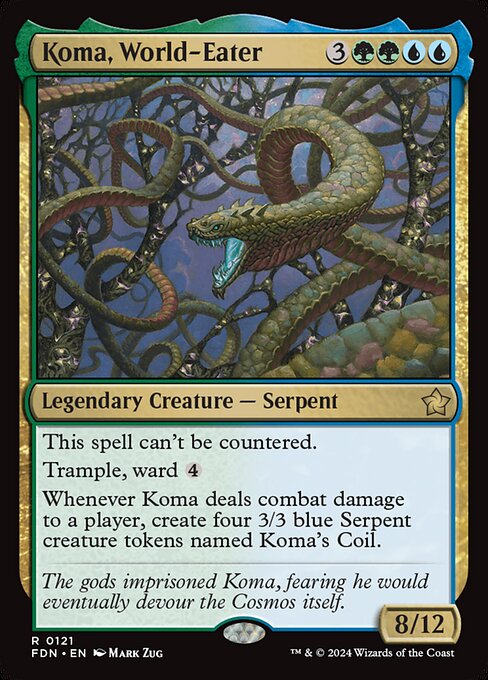
Magic: The Gathering Foundations released November 15, 2024. Koma, World-Eater costs three generic, two green, and two blue. The 8/12 Serpent cannot be countered as a spell, has trample and ward four, and makes four 3/3 Serpents when it deals combat damage to a player. Its token production therefore asks for a successful combat connection. Resolving Koma and producing its full reward are different milestones.
Reality Fracture Verdant Kraken also costs seven mana, but its payment is four generic and three green. It produces a 3/3 Forest Tentacle land creature at each player's upkeep while it remains present. It does not need to connect in combat for that production. The tokens can later provide green mana, but their creature status means summoning sickness can restrict their tap ability. A newly created land creature is not the same as an ordinary untapped noncreature land.
In a legal green-blue deck, compare the board you expect after one table rotation. Koma may create no tokens if it cannot attack safely or has not yet connected, while Kraken may have created tokens through several upkeeps. If Koma connects, its four bodies arrive in one event. Neither outcome is guaranteed because opponents can interact. A mono-green deck has an additional simple restriction: Koma's blue identity excludes it, while Kraken can fit. Equal total mana value does not mean equal color demands or equal access.
The older card also has a different defensive package. An ordinary counterspell cannot counter Koma, though other applicable instructions on that countering spell can still happen. Ward taxes relevant opposing targeting after Koma is a permanent; it does not stop untargeted sweepers. Kraken does not inherit those defenses merely because it is a large token-producing creature. A recommendation should preserve the exact trigger and protection that made the card useful in the first place.
How to read a card recommendation across several sets
Begin with a functional comparison. If you need a creature answer, write down which threats the current card can target, what it costs, and which permanent types it misses. Then read the proposed replacement against those same questions. A modal new spell may have a higher ceiling but require a second color, an existing creature, or an additional cost. Those conditions can make it less reliable in the turn that matters.
Next compare setup and recovery. A permanent engine can supply value repeatedly if it survives, while a spell may provide one immediate result without exposing a permanent. Neither pattern is universally better. A list that already depends heavily on its commander may prefer another independent spell, while one that needs a lasting mana sink may want the engine. The archive is most useful when it preserves why a recommendation belonged in a particular kind of deck.
Finally choose the cut. Replacing another payoff preserves the early structure differently from removing a land or a draw spell. If the new card requires support the deck does not currently contain, include those extra changes in the proposal. One new rare plus six enablers is a package, not a single-card upgrade. Compare the delivered cost and the total deck-space cost before treating the original recommendation as affordable.
Rules traps that can change an older review
Small wording differences can determine whether a card works with a new commander. Casting a spell is different from putting a permanent directly onto the battlefield. A copy of a spell is normally not cast unless the effect specifically says to cast it. Creating an Aura token is not casting an enchantment spell. A card rewarding entries and a card rewarding casts may look similar in a broad category while supporting completely different engines.
The current Reality Fracture reviews provide concrete examples. Vraska creates Treasure creatures whose tap abilities face creature timing restrictions. Hall of Echoes changes into a copy without entering again. The blue Samut supplies split second, which limits certain responses but does not erase triggered abilities or say the spell cannot be countered. Those details are more useful to preserve than a generic statement that a card is powerful.
If the comprehensive rules, Oracle text, or a relevant format rule changes after an older review, follow the current rules for play. A publication date is not a permanent warranty. Keep a note of the exact interaction you are checking, especially for modified costs, copy effects, alternate casting permissions, and once-per-object abilities. An updated conclusion should explain which rule or card detail changed, rather than merely replacing one ranking with another.
Examples to follow between the reviews

Geist of Saint Thalia
Compare actual savings
Follow a cost reducer from a general recommendation into your own spell sequence. Count generic reductions on the spells you can actually cast, then compare that result with the development and draw you would remove to make space.

Pia, Aether Ascetic
Separate selection from draw
Use an enchantment search recommendation to identify the card you need and the mana still required to cast it. A creature-entry tutor can support several strategies, but searching alone does not supply every resource an opening hand lacks.

Hall of Echoes
Read the changed object
A utility-land recommendation should include the cost of losing a colored source and the actual result of copying. Changing characteristics does not make the land enter again, so preserve that limitation when applying the idea to an older creature engine.
Binding the Old Gods
2026 Saga rules example
Its Lorwyn Eclipsed Commander reprint provides a concrete link between an older design, new tutor access, and the updated entry-counter interaction.

Ugin, Eye of the Storms
Cast-trigger interaction
Compare its colorless seven-mana package and surviving cast trigger with the four-mana blue engine in the current set.
Koma, World-Eater
Combat-trigger engine
Compare a successful combat connection and its four Serpents with the separate upkeep-driven land creatures from Verdant Kraken.
Make a review useful without rebuilding everything
Choose one problem after reading a review and propose a small change. For example, a generic-heavy noncreature deck might compare Geist with an older reducer, while an artifact-token deck might test whether a combat finisher improves an attack it can realistically assemble. Keep the old version and write the condition you expect the new card to improve. That makes it possible to distinguish an actual improvement from the excitement of trying a new release.
Use Deckcipher's deck builder to assemble the comparison and create a free account from My Decks to save it. Check the broader list with the Commander deckbuilding checklist. If a new choice adds several colored requirements or displaces a colored land, inspect the opening turns with the mana base calculator before assuming the old mana package still fits.
During games, record a concrete observation. Was the new spell castable when needed? Did its extra mode matter? Did the card you cut provide a missing function? A dramatic win with a new finisher can coexist with several awkward opening hands, and one early removal spell is not enough to condemn an engine. Keep the sequence and the tradeoff visible. The next useful edit should follow from what happened, not from a requirement to keep buying every new set.
Set review archive questions
Build your deck
Put these choices into a Commander list. Create a free account to save your deck and keep tuning it with Deckcipher.
FAQ
Which detailed reviews are available in this archive?
The linked detailed entries cover Reality Fracture Commander additions, budget candidates, and new commanders. The timeline gives context for older releases. It does not claim that every product listed already has a separate full review on Deckcipher.
Does latest set mean the same thing forever?
No. Here it is explicitly Reality Fracture as of October 25, 2026. A later release needs its own dated scope. Preserve the set name when saving a recommendation so a page title using latest does not make an older card analysis ambiguous.
Are Commander cards from a set automatically Standard legal?
No. An associated Commander product can have a different legal card pool from the main expansion. Reprints may have other existing permissions, and format banned lists still matter. Identify the card and the relevant format rather than relying on a shared release name.
Does a reprint count as a new commander?
It can be newly available in a product without being a newly designed card. A review of new commanders should distinguish those cases. A reprinted legend may still be an excellent project, especially if you already own the support cards it needs.
Should I replace old staples every time a set arrives?
No. Replace a card when a candidate improves a named function at a cost your deck can support. Commander ordinarily retains older cards rather than rotating with each main release. Release age does not establish that the existing card has stopped doing its job.
Why can an older recommendation need a fresh rules check?
Current Oracle text, format rules, and other cards can change the relevant interaction. Costs, copy permissions, targeting, and casting from unusual zones deserve particular care. A review date provides context; the current rules determine what happens in a game.
How should I compare budget recommendations from different years?
Compare the delivered price of the actual printing now, not an old isolated quote. Include currency, shipping, condition, and the complete package. Also consider whether a card you already own performs the needed role well enough to avoid another purchase.