
Quick answer
To investigate is to create a Clue token.
Investigate creates a resource with a later cost
To investigate is to create a Clue token. A normal Clue is a colorless artifact with an activated ability that costs two mana and sacrifices it to draw a card. The token is not the card itself. You first obtain the option and then decide whether spending mana on that option is the best use of the turn.
Casting a spell that investigates can leave you with an artifact but no additional card in hand yet. If you spend all of your mana on that spell, the Clue may wait until another turn. That delay is important when comparing the card to an effect that draws immediately on resolution.
Count pending Clue draws separately from cards already in hand. A deck with ten Clues and no available mana has a reserve, but may still struggle to answer something happening right now.
Sacrificing a Clue uses the stack
The normal Clue draw ability is not a mana ability. You pay the two mana and sacrifice the token as costs, then the draw ability waits on the stack. Players can respond before it resolves. The sacrificed Clue is already gone, so destroying the same token afterward is not a way to stop the draw.
An opponent can counter the activated ability with a suitable effect, even though ordinary spell-only countermagic does not target it. If they instead remove a permanent that rewards artifact sacrifice, existing triggers may still resolve. Identify whether the answer targets the resource, the activated ability, or the payoff.
Leave enough mana for the whole exchange. Holding a Clue does not mean you can use it for free while also paying for every other interaction in your hand.
Noncreature artifacts avoid summoning sickness
An ordinary Clue has no tap symbol in its built-in draw cost, and it is not a creature. You can generally activate its draw ability immediately after it enters if you can pay two mana and have an appropriate opportunity to activate abilities. Animation can add creature restrictions to other abilities granted to it, but does not automatically stop its normal sacrifice ability.
A freshly created Clue can be sacrificed to its own draw ability even if an effect has animated it, because that ability does not use a tap or untap symbol in its cost. A newly animated Clue asked to tap for a different granted ability is a different situation.
Read the actual cost rather than assuming every artifact token behaves like a Treasure. Clues, Foods, and Bloods use distinct abilities, and the presence of a tap symbol changes some interactions.
Creating a Clue and sacrificing an artifact reward different cards
Tireless Tracker cares about your lands entering and later rewards sacrificing Clues. Other cards may reward any artifact entering, any artifact sacrifice, or artifact count. A Clue package can therefore support a deck even before every token is converted into a card. The relevant event must still match the payoff text.
With Tracker present, sacrificing a Clue to another outlet can still trigger Tracker because its ability cares about a Clue being sacrificed, not specifically activating the built-in draw ability. You do not draw from the Clue merely because another outlet sacrificed it. You receive the effect you actually activated.
Write down which payoffs work on creation and which work on spending. This prevents a deck from including many sacrifice rewards but too few ways to make expendable artifacts.
A Clue engine needs mana throughput
Repeated investigate effects can produce more Clues than the deck has time or mana to use. That is not automatically a problem if artifact count is the point, but it is a problem when the list depends on converting every token into cards. Mana production and cost reductions determine how quickly the reserve becomes usable.
With six mana available and three Clues, drawing three cards consumes all six mana through their normal abilities. Keeping an answer available may mean drawing only one or two. If one of those cards is a land, normal land-play limits still determine whether you can use it this turn.
Use the token pile as optional spending. An end step before your turn can be an efficient time to use leftover mana, while main-phase activation may be right when you need to find a land drop or a specific answer.
Academy Manufactor changes investigate outcomes
Academy Manufactor can replace creating a Clue with creating a Clue, Food, and Treasure. The extra artifacts give you more choices, but they are not extra Clues. The Treasure can contribute mana toward a Clue activation, while Food provides a separate ability and artifact resource. Each token type keeps its own rules.
One investigate event with a single Manufactor can leave three artifacts instead of one. If you spend the Treasure, you have one mana toward the two-mana Clue activation, not an automatically free draw. A token doubler may change the quantities further, and replacement effects must be applied correctly.
Choose the mixed-resource engine when the surrounding list can exploit several artifact types. Merely creating more objects can increase tracking work without improving the deck immediate ability to cast its spells.
Animation creates a second use for the reserve
A mass animation effect can turn an unspent Clue pile into attackers. That plan competes with sacrificing those same Clues for cards. Once a token becomes a creature, summoning sickness, creature removal, and blocking rules matter. The animation effect determines the body and the duration.
Rise and Shine can target a noncreature artifact you control, while its overload option can affect a broader board. Cyberdrive Awakener provides a temporary way to turn noncreature artifacts into flying creatures. A Clue created after the relevant effect resolves may not be included in the same way, depending on the effect.
Do not assume every Clue is safe to spend as soon as possible. If the deck wins through an artifact army, preserving part of the reserve can be worth more than one additional card now.
Interaction should match the engine that is actually dangerous
Removing a repeatable investigator before a land or creature event can limit future Clue production. Removing artifact payoffs may leave a large pile that can still draw cards, but no longer threaten a quick finish. Sweeping artifacts attacks the stored reserve directly. These answers have different strategic effects.
If Tireless Tracker has already produced Clues, killing Tracker does not erase those tokens or their normal abilities. If an opponent is about to animate a dozen artifacts, waiting until the artifacts are creatures may expose them to a creature sweeper but also give the opponent a chance to protect the board.
Choose the answer based on what is about to happen, rather than treating every artifact deck as the same problem. A pile of future draws asks a different question from an immediate evasive attack.
Cards worth comparing before you choose a package
Examples and the jobs they do

Tireless Tracker
Land-based investigation
Tracker makes land entries relevant to a continuing Clue engine and grows when you sacrifice Clues.
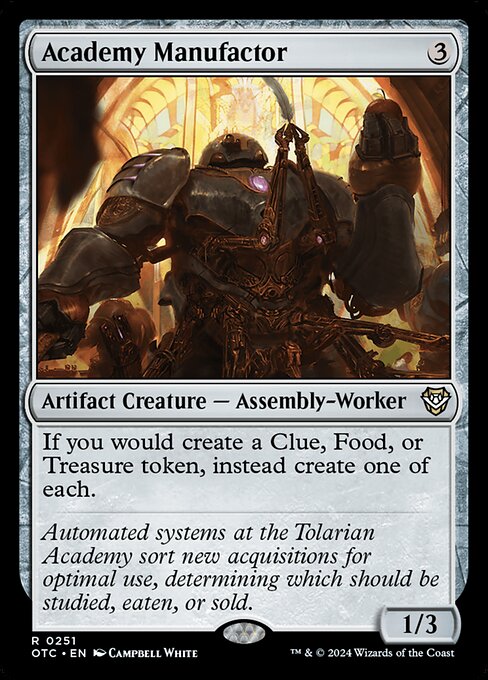
Academy Manufactor
Resource expansion
Manufactor replaces qualifying Clue, Food, or Treasure creation with a collection containing all three.

Erdwal Illuminator
Investigate support
Illuminator can reward the first time you investigate each turn with another investigate instruction.
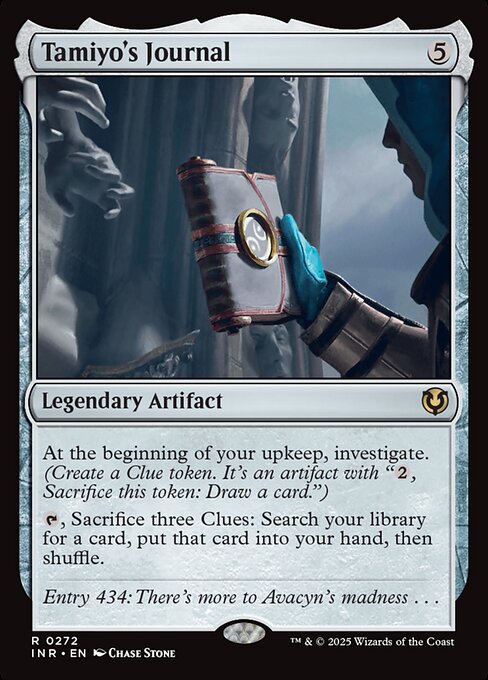
Tamiyo's Journal
Stored selection
Journal can supply Clues over time and can tap and sacrifice three Clues to search your library through its activated ability.
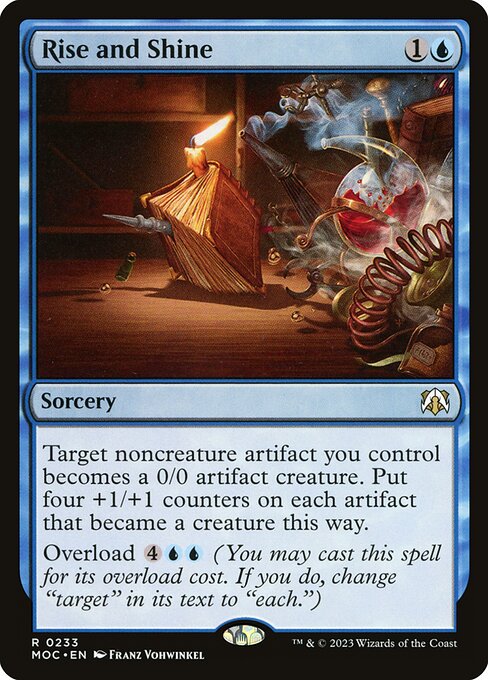
Rise and Shine
Artifact conversion
Rise and Shine can turn a target noncreature artifact you control into a creature and place counters on it, with overload providing a wider conversion plan.

Cyberdrive Awakener
Temporary finisher
Awakener gives your other artifact creatures flying and turns noncreature artifacts you control into artifact creatures for the turn when its entry ability resolves.
Tireless Tracker
It rewards ordinary land development while preserving the option to spend mana on cards later. The creature needs to be present for its own triggers to occur. Extra Clues do not compensate for missing the lands that cast your other spells, and the draw costs remain part of the deck mana demand.
Academy Manufactor
Investigate therefore becomes a broader artifact engine while still giving you a normal Clue to use. It does not draw cards by itself. The resulting reserve needs ways to become mana, life, attacks, or other payoffs, and broad artifact removal can attack all three token kinds together.
Erdwal Illuminator
A deck able to investigate on opponents turns can use the timing more effectively than one that only creates tokens in its own main phase. It does not duplicate every investigate event indiscriminately. Check the first-time limit and remember that the additional investigation is another event whose interaction with replacement effects must be resolved normally.
Tamiyo's Journal
It offers a use for tokens beyond paying two mana for each draw. Sacrificing Clues to the Journal ability does not also activate their individual draw abilities. The artifact costs substantial mana to deploy and asks you to accumulate a reserve before its search is available.
Rise and Shine
An artifact-token deck can use stored material as a threat rather than just spending it for resources. Animation makes creature rules relevant. Newly controlled artifacts may not be able to attack, and a creature removal effect can now interact with a resource that previously avoided it.
Cyberdrive Awakener
A Clue reserve can become meaningful evasive pressure. The effect is temporary, the creature itself costs six mana, and artifacts still need to satisfy attack restrictions. A newly created pile does not automatically attack immediately just because it was animated.
Give the Clue pile a spending plan
Choose whether Clues are chiefly future cards, artifact material, or a combat reserve. A deck can use more than one role, but the priorities should be clear. If drawing is the main purpose, repeated investigations need sufficient spare mana. If artifact count is the purpose, spending every token immediately may weaken the payoff. If animation is the finish, hold enough material for a meaningful attack rather than relying on a theoretical pile you already sacrificed in earlier turns.
A useful hypothetical turn begins with five mana, two Clues, and an interaction spell costing two mana. Drawing twice consumes four mana and leaves the answer unavailable. Drawing once costs two and leaves three, preserving the response. Keeping both Clues might be best when you already have the cards needed for the next turn. There is no automatic rule to activate them only at end step. If you need to find a land or play a newly drawn sorcery now, using one during your main phase can be correct.
Create those alternatives in the deck builder and save them with a free account through My Decks. Check your colored sources with the mana base calculator, especially if several utility lands offer attractive artifact abilities. Revisit the Commander deckbuilding checklist after adding investigators. A future draw reserve does not excuse cutting every spell that immediately improves an empty hand.
Practice the difference between sacrificing a Clue to itself and sacrificing it to Tamiyo's Journal. The first costs two mana and draws one card after resolution. The second uses the Journal's own activated ability and requires three Clues for a search. Put the payments and results on separate lines. If Tireless Tracker is present, identify its appropriate sacrifice triggers, but do not add individual Clue draws to the Journal line. The tokens were spent once, for the cost you actually chose.
Next, rehearse a removal spell aimed at the recurring investigator after several Clues already exist. Remove the source but leave the tokens. The ability to draw from those tokens remains. Contrast that with mass artifact removal, which attacks the stored reserve directly. This tells you whether your protection should defend one creature, whether you need a rebuilding spell, or whether using some Clues before a suspected wipe is the sensible trade.
For animation, record when each artifact entered under your control. A token that became a creature this turn may still attack if you controlled that permanent continuously since your turn began, while a newly created token usually cannot without haste. Do not collapse those two groups into one die when planning attacks. That small tracking habit prevents a finisher from appearing stronger in rehearsal than it will be in a real game. After playing, note unused Clues and the reason they remained unused, rather than merely recording how many you created.
Distinguish the temporary animation from static flying
Rise and Shine requires a noncreature artifact you control as its ordinary target. It cannot simply animate any artifact on the battlefield. Its overload option changes the relevant targeting instruction according to overload, so read the complete resulting effect before making a wider attack plan. Tamiyo's Journal also has a tap symbol in its search cost in addition to sacrificing three Clues. An untapped usable Journal is part of that line, not just the tokens.
Cyberdrive Awakener separates two effects. Its entry trigger temporarily animates the noncreature artifacts included by that resolving effect. Its other ability supplies flying to your other artifact creatures while the Awakener is on the battlefield. If an opponent removes Awakener after the entry trigger has resolved, those artifacts remain animated until the stated duration ends, but they lose the flying granted by its static ability. An attack that relied on evasion can therefore change substantially even though the bodies remain. Count the blockers again before declaring attackers rather than assuming the entire temporary effect either stays or disappears together.
A decision table for the interaction
| Position | Correct result | What to check |
|---|---|---|
| Investigate | Create a Clue | Does not itself draw |
| Normal Clue activation | Pay two and sacrifice to draw | Ability uses the stack |
| Sacrifice to Journal | Tap Journal and sacrifice three Clues for search | Does not also activate each Clue |
| Awakener removed after animation | Animation lasts for its stated duration | Static flying can disappear |
Frequently asked questions
Build your deck
Put these choices into a Commander list. Create a free account to save your deck and keep tuning it with Deckcipher.
FAQ
Does investigate draw a card immediately?
No. Investigate creates a Clue. Its standard ability draws a card only after you pay two mana, sacrifice it, and resolve the ability. Another card might also draw as part of its effect, but that is separate from the meaning of investigate.
Can a Clue be used the turn it enters?
Normally yes, if you can pay its activation cost. The standard ability has no tap symbol, so even making the Clue a creature does not impose a summoning-sickness restriction on that particular sacrifice ability. Other granted abilities may work differently.
Can I respond to someone sacrificing a Clue?
You can respond to the normal draw ability after its costs are paid. The Clue is already sacrificed, so destroying it is no longer possible. A suitable effect can counter the activated ability or respond to related triggers before they resolve.
Does sacrificing a Clue to another outlet also draw a card?
No. You receive the effect of the ability whose cost you paid. Sacrificing it to a different outlet can trigger cards that care about Clues or artifacts being sacrificed, but it does not also activate the token built-in draw ability.
Is a Clue colored or a land?
An ordinary Clue is a colorless artifact token. It is not a land and has mana value zero. A card can modify token characteristics or animate it, so check any specific effect rather than applying creature or land rules automatically.
Does Academy Manufactor replace every artifact token?
No. It specifically modifies creation of Clues, Foods, and Treasures. Other artifact token kinds are not included merely because they are artifacts. Mixed token engines need to distinguish which events actually match its wording.
Should I crack every Clue before my turn?
Spend leftover mana when the extra card is useful, but consider what you give up. You may need mana for interaction, artifact count for a payoff, or tokens for an animation finish. A pile of optional draws is valuable because you can choose the timing.
How many Clue payoffs should a deck play?
Begin with a reliable way to investigate and enough mana to use the tokens. Then add payoffs that remain useful at the expected token volume. An exact universal count would hide the difference between a landfall investigator, a combat investigator, and a dedicated artifact-combo engine.