

Quick answer
A budget aristocrats deck needs three inputs working together: creatures you can afford to lose, an outlet that sacrifices them on useful terms, and a payoff for the resulting events. Elas il-Kor supplies part of the payoff from the command zone, while draw and recursion keep the material coming.
Give every part of the engine a defined job
Aristocrats decks turn their own creatures into resources through sacrifice and death triggers. A creature dying is not enough by itself; the deck needs a result worth the card and mana invested. The basic structure is material, outlet, and payoff. Card access and recovery then keep those parts available after the first exchange rather than leaving you with one empty board and a few life loss triggers.
Elas il-Kor, Sadistic Pilgrim is a practical white black commander for this plan. Another creature entering under your control gains you a life, while another creature you control dying makes each opponent lose a life. The commander also has deathtouch, which can matter to defense. Its engine abilities do not include a free sacrifice outlet or a card draw instruction, so the list must supply those jobs.
That command zone payoff can reduce the number of redundant drain creatures you need in early hands. It does not mean every remaining slot should be fodder. A board full of creatures without an outlet may be unable to choose when they die. An outlet without material does little. Several payoffs without either input can leave your hand looking synergistic while having no useful sequence.
Begin with inexpensive pieces that work in ordinary combinations, then choose whether compact loops belong in the deck. A low financial total does not guarantee a slow or relaxed game. The budget tools can help compare role replacements, but your intended finish and the table's expectations should decide which combinations you include.
Use creatures that leave useful material behind
Doomed Traveler replaces itself with a flying Spirit token when it dies. Hunted Witness instead leaves a lifelink Soldier through its death trigger. Those bodies provide more than one useful creature event over time, which can help Elas and other payoffs. The replacement token arrives after the relevant trigger resolves, not while the original sacrifice cost is still being paid.
That timing prevents spending future material too early. You cannot sacrifice the Witness and its not yet created Soldier as two creatures for the same cost. First complete the sacrifice event, handle the trigger normally, and receive the new token. It can then be used for another legal action. If a spell is resolving, you do not interrupt it halfway through to resolve the death trigger and spend the replacement.
Tokens can die when they move from the battlefield to the graveyard, even though they later cease to exist. They can therefore trigger appropriate creature death payoffs. They are not creature cards available for ordinary graveyard recursion afterward. A deck using many tokens should not count those dead tokens as a future reanimation supply.
Choose material with useful secondary traits. A flying replacement can pressure a planeswalker or block a flyer, while a lifelink replacement can help stabilize life in combat. Neither benefit changes the basic cost of supplying a creature to the engine. A list that spends too much on elaborate fodder can run out of mana before it has an outlet and payoff in play.
Free outlets and paid outlets change the turn
Viscera Seer sacrifices a creature to scry one without requiring mana or tapping. That lets you choose a death event at a useful time when you have priority and improve future draws. Scry is selection, not drawing a new card. A long sacrifice sequence can organize the top of the library without replenishing an empty hand unless another card supplies draw.
Carrion Feeder also has an activation without mana or tapping, adding a counter to itself from each sacrificed creature. It cannot block. A growing Feeder can become an attacker while leaving your defensive body count lower than it looks. Its power does not automatically convert into tablewide damage; you need a route through blockers or the death payoffs to do that work.
A paid outlet may provide a stronger individual result but limits the number of sacrifices you can afford. Tap costs can impose another limit even when you have plenty of mana. Label those constraints in the deck rather than counting every sacrifice card as an interchangeable free outlet. A hand expecting five activations may fail with an outlet that can be used only once before untapping.
Sacrifice is a cost when written before a colon or as an additional casting cost. Opponents respond after that cost has been paid, so removing the outlet afterward does not return the creature. A sacrifice instruction during resolution is different and may give opponents a response opportunity before the sacrifice happens. Read the exact card to know which material is already committed.
Drain creatures have different recipients and triggers
Zulaport Cutthroat rewards its own death or another creature you control dying, causing each opponent to lose life while you gain life. Blood Artist sees a broader set of creature deaths but uses a target player for its life loss trigger. The two cards can both support aristocrats without having identical scope. An opponent's creature dying can matter differently to them.
Cruel Celebrant includes qualifying creatures and planeswalkers you control and affects each opponent with its life loss. Elas's death ability says another creature, so Elas does not give you that particular trigger from its own death. These distinctions matter in a wipe and when you sacrifice the last payoff. Resolve the events from the actual text instead of multiplying every death by an assumed identical set of triggers.
Targets matter for Blood Artist. A player with a relevant targeting restriction may not be a legal recipient for your trigger. Effects that do not target opponents can have a different interaction. A large number of potential triggers is not permission to ignore target legality. Announce targets clearly when the sequence can end the game.
Extra payoff copies can accelerate a finite engine, but they do not solve missing material. One creature dying with Elas and Zulaport can produce separate effects from each card, while a second drain creature doing nothing on an empty board produces none. Add redundancy after the engine can operate, and preserve enough draw that losing one payoff does not leave you with several turns of unproductive sacrifices.
| Engine piece | Example job | Common counting mistake |
|---|---|---|
| Material | Doomed Traveler supplies a later replacement | Counting the future token before its trigger resolves |
| Outlet | Viscera Seer chooses a death and scries | Treating scry as drawing cards |
| Command zone payoff | Elas drains from another creature dying | Counting Elas's own death for that ability |
| Targeted payoff | Blood Artist selects a player | Assuming every opponent loses life from one trigger |
| Recurring material | Reassembling Skeleton returns for a cost | Calling repeated paid returns free or infinite |
Draw enough cards without forgetting life and costs
Village Rites sacrifices a creature as an additional casting cost and draws two cards on resolution. It can convert expendable material into access while your payoffs reward the death. You still lose the creature if the draw spell is countered. Do not also sacrifice that same creature to Viscera Seer for another cost; each object can be sacrificed only once from that battlefield position.
Plumb the Forbidden can sacrifice any number of creatures as an additional cost and create copies through its associated trigger. The original spell and copies each provide their stated draw and life loss when they resolve. The copies are not separately cast spells. This can produce a substantial hand, but a low life total and interaction with the trigger or spells can change how safe the sequence is.
The sacrificed creatures may also trigger Elas, Zulaport, or replacement bodies. Those are distinct triggers with their own ordering and targets. Do not compress the whole sequence into gain enough life so the loss never matters without checking which objects resolve first. State based actions can make a player lose before a later life gain trigger has a chance to help.
Keep at least some draw that remains useful when your board has been removed. A sacrifice draw spell needs a creature, so several such spells can all be weak after a wipe. The deck building checklist helps inspect how many access cards rely on an already assembled engine. An unconditional refill may have a lower ceiling and still provide the recovery turn the deck needs.
Recursion should recover resources, not pretend costs vanish
Reassembling Skeleton can return from the graveyard to the battlefield tapped through its paid activated ability. It is not being cast, and the return costs mana each time. Combined with Elas and a free outlet, it can provide repeatable entries and deaths, but each cycle still needs another payment. A finite mana supply means a finite number of cycles unless another specific engine changes that.
Returning tapped does not prevent sacrificing it to an outlet that does not require it untapped. It does prevent using it as an untapped blocker or for a cost that specifically needs an untapped creature. Read the action you want to use. A recurring body can be excellent material while still being unavailable for a different role until it untaps.
Victimize can exchange a battlefield creature for two targeted creature cards already in your graveyard as the spell resolves. You choose those targets when casting. A creature still on the battlefield cannot be selected as a graveyard target on the assumption that the spell will sacrifice it later. The returned creatures enter tapped, which can matter when the next opponent attacks.
Graveyard hate can remove the supply you expected to reuse. Keep enough cards and creatures that the deck can begin again from hand rather than assuming every dead permanent is a permanent resource. Recursion is a route to resilience, not immunity to exile or a reason to spend the entire opening hand before seeing which answers opponents hold.
A compact aristocrats package to price first

Doomed Traveler
Replaceable body
Its later Spirit can supply evasion or another sacrifice after the trigger resolves.
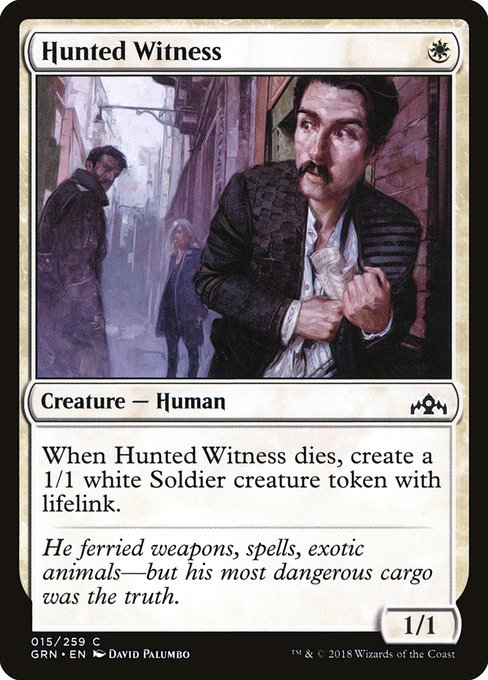
Hunted Witness
Replaceable body
The lifelink Soldier is useful material but does not exist during the original sacrifice cost.

Viscera Seer
Free selection outlet
Lets you choose the death event while needing another card for actual draw.

Zulaport Cutthroat
Tablewide payoff
Counts its own or your other qualifying creature deaths.

Blood Artist
Broader targeted payoff
Different death scope and one player target make it distinct from tablewide drains.

Reassembling Skeleton
Paid recurrence
A useful repeatable body whose mana cost must be funded every cycle.
Play a small complete engine before adding more pieces
An ordinary opening can cast a cheap fodder creature, then Elas when the white and black mana are available, and an outlet when you can preserve a useful sequence. Once Elas, Viscera Seer, and Hunted Witness are present, sacrificing the Witness can create a death payoff and a later Soldier replacement. You can then choose whether to keep the Soldier as material or sacrifice it through another legal activation.
The Soldier's entry can provide Elas's life gain, while its later death can provide another death payoff. Those benefits require the commander to be relevant at the corresponding events. They are not an infinite loop because the Soldier does not itself create another Witness or Soldier when it dies. After the finite material is gone, the engine needs another producer or paid recursion.
Now remove the outlet before that sequence begins. You may still have creatures and payoffs, but no way to choose the death timing. Remove Elas instead and the sacrifice can still scry without the same life loss result. Test those missing piece boards rather than only the ideal state with several drain creatures. This tells you which role needs redundancy.
Keep enough mana for an answer or a recovery play. A cheap engine can encourage deploying every creature quickly, but a wipe can punish that concentration. Sometimes preserving one replacement body or draw spell is more useful than adding one extra point of drain now. The deck's strength comes from repeatable resource decisions, not simply the maximum number of triggers you can announce in an uncontested turn.
Cover opposing engines and choose your combo boundary
White black gives access to interaction beyond the creature theme. Include answers to artifacts, enchantments, graveyards, and creatures according to the games you expect. Your ability to drain through a stalled combat does not stop an opponent from winning through a different engine. The interaction checker helps reveal whether the removal package actually covers more than one kind of threat.
A sacrifice outlet can preserve value when opponents use targeted exile and you have priority, but it does not make every answer irrelevant. A resolving effect may remove creatures before you can act again, and restrictions can prevent the activation you hoped to use. An exile wipe does not create the same death events as destruction. Keep the specific answer in view.
Decide whether the deck includes deterministic loops. A recurring creature plus a mana producer and payoff can sometimes form one, but each line needs its actual costs and requirements verified. Do not accidentally add an altar or cost reduction package solely as a mana upgrade without checking the combinations it creates. A budget cart can still assemble a compact fast finish.
Describe that choice in the pregame conversation. A finite value list and a tutor heavy combo list can share many cards while creating different games. The rule zero guide helps turn that distinction into a useful description. Financial cost is one constraint, while intended speed, resilience, and win pattern are separate decisions.
Spend the next part of the budget on the failed role
If the deck repeatedly has payoffs but no outlet, another drain creature is not the upgrade it needs. If it produces deaths but runs out of cards, improve access. If it has cards but cannot afford Skeleton returns and interaction in the same turn, review the mana and curve. Name the recurring failure before comparing the most exciting cards.
Make substitutions honestly. A paid outlet can preserve the sacrifice role while reducing the number of activations available. A one time draw spell can replace a recurring engine while giving up long game reuse. A cheap fodder creature can replace a larger threat while losing combat pressure. Those are useful tradeoffs when they preserve the turn sequence you actually intend to play.
Price current printings, shipping, and owned cards rather than promising a universal deck total. Save an initial list before buying and test hands that contain only two of the three engine roles. A functional budget deck should make ordinary development plays while searching for the missing role, not sit idle until every named card appears together.
Build your deck and create a free account to save the engine map and its next revision. Record the creatures supplying material, the legal outlets, the payoffs, and the draw that sustains them. That makes each small purchase address a visible bottleneck instead of turning a focused aristocrats plan into a collection of individually attractive death triggers.
Budget Aristocrats questions
Build your deck
Put these choices into a Commander list. Create a free account to save your deck and keep tuning it with Deckcipher.
FAQ
What are the three essential engine roles?
Material you can sacrifice, an outlet that performs the sacrifice on useful terms, and a payoff for the events. Draw, mana, and recursion keep those roles operating. Several payoff creatures alone do not form a functioning engine when no creature can be sacrificed.
Does Elas trigger from its own death?
Its death ability says another creature you control. Elas does not provide that trigger for its own death. Other cards such as Zulaport Cutthroat have different wording, so a wipe must be evaluated from each actual ability rather than treating all drains identically.
Are sacrifice costs paid before opponents respond?
When sacrifice is an activation cost or an additional casting cost, it is paid before opponents receive the normal chance to respond to that object. A sacrifice instruction during resolution is different. Read where the instruction appears on the card.
Is Reassembling Skeleton an infinite loop?
Not by itself with a free outlet and Elas. Each return has a mana cost, so the cycle is limited by available mana unless another specific engine supplies a legal repeatable resource. Verify all costs and payoffs before calling a combination unlimited.
Do tokens trigger death abilities?
They can when they move from the battlefield to the graveyard and satisfy the trigger. They later cease to exist and are not ordinary creature cards you can return from the graveyard. A replacement token also waits for its own trigger to resolve before it exists.
What should a budget upgrade prioritize?
The role that repeatedly fails in real turns: material, outlet, payoff, draw, mana, or interaction. Compare actual printings and shipping. A premium drain creature is a poor first purchase when the deck consistently lacks a legal outlet or enough cards to continue.