
Quick answer
Selesnya staples work best when green development and white interaction support the same board plan. Aura Shards, Swords to Plowshares, Nature's Lore, Rite of Harmony, and a suitable protection spell are useful comparisons. Token, enchantment, and counter decks need different draw engines and payoffs, so identify the repeated action your commander rewards before filling the list.
Choose a green-white engine before its multipliers
Selesnya is the green-white color pair. It can develop mana, create creatures, protect permanents, and answer a wide range of opposing cards. Its decks can focus on tokens, enchantments, counters, creature value, Equipment, or lifegain. The familiar image of a large creature army is only one option. A staple should help the engine you chose rather than pull the deck toward a generic green-white board.
The common trap is adding multipliers before the deck can produce anything worth multiplying. A token doubler does little without token creation. A counter doubler needs actual counters. A large anthem does not draw cards or rebuild after a wipe. Start with the resource flow: mana to cast the commander, cards that trigger it, access to more cards, interaction, and a finish. Add the strongest multiplier only after those pieces function together.
Green and white overlap in artifact and enchantment removal, but they differ in other roles. White can supply efficient creature exile, while green can provide early land ramp. Creature and enchantment engines can offer card access through different events. Assign those roles across the whole list rather than adding a complete mono-green package and a complete mono-white package. The commander still needs enough dedicated support to make the deck distinct.
Selesnya candidates with different jobs

Aura Shards
Repeatable permanent answers
A creature entering under your control can trigger an optional artifact-or-enchantment destruction effect. It needs creatures and does not itself make them.

Rite of Harmony
Burst card access
For the turn, creatures and enchantments entering under your control can draw cards. Sequence it before the relevant entries and retain mana for the follow-up.
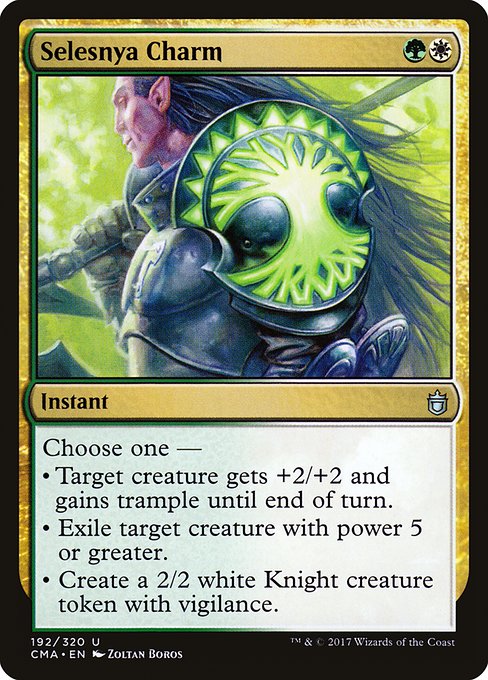
Selesnya Charm
Flexible combat interaction
Offers a creature pump and trample, exile for a creature with power five or greater, or a vigilant Knight token. Its removal mode is conditional.

March of the Multitudes
Token production
An instant with convoke that creates X white Soldier tokens with lifelink. Casting it still requires accounting for its colored cost and X.
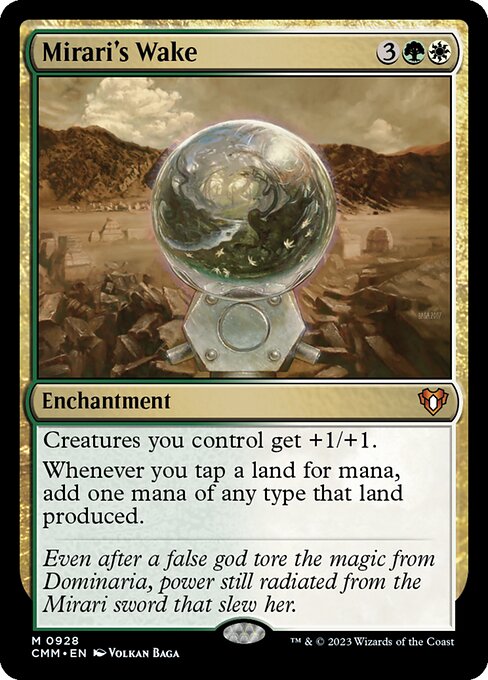
Mirari's Wake
Later mana and board support
Boosts your creatures and adds mana when you tap lands. It is a five-mana engine, not early acceleration for an opening hand.
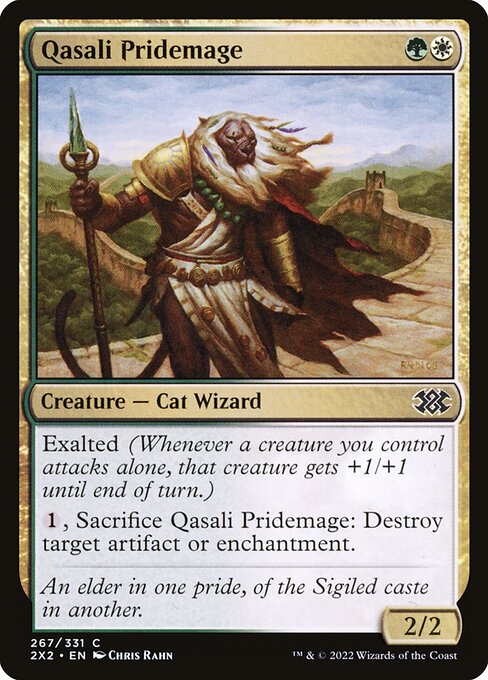
Qasali Pridemage
Creature-based answer
Can be sacrificed with an activation payment to destroy an artifact or enchantment. Its body and exalted ability can matter before you spend it.
Let green solve early development
Nature's Lore and Three Visits can find a Forest card, including a dual land with the Forest subtype. They do not force it tapped, although the chosen land may have its own entry condition. Farseek can find a Plains, Island, Swamp, or Mountain and puts the land onto the battlefield tapped. In Selesnya, that includes a Plains or an appropriate Plains-Forest dual, but not a plain basic Forest. Count targets before adding the spells.
Cultivate and Kodama's Reach provide a basic to the battlefield tapped and another to hand. They are useful for land-drop continuity and colors, but need three mana before they help. Sakura-Tribe Elder can fit creature synergies and convert into a tapped basic land through its sacrifice ability. Cheap mana creatures offer another route, with vulnerability to creature removal. The best mix depends on how early the commander needs to arrive and how the deck rebuilds.
Trostani, Selesnya's Voice costs two green and two white. Three lands plus Sol Ring cannot pay that cost by themselves because the Ring's mana is colorless. A colored accelerator may be more relevant than a larger total of generic mana. Use Mana Base Calculator to compare early white and green sources with the actual spells you intend to cast. Fixing is part of acceleration when the commander has demanding pips.
Give tokens a reliable source of cards
Welcoming Vampire checks for one or more other creatures with power two or less entering under your control and triggers only once each turn. Tocasia's Welcome checks mana value three or less and also has a once-per-turn limit. A batch of ten tokens does not produce ten draws from either. Creating a qualifying creature on another player's turn can create a new opportunity because it is a different turn.
Rite of Harmony works differently. Its temporary permission rewards each relevant creature or enchantment entry during the turn, so a planned token-making spell can provide several draw triggers. You must cast Rite before those entries and still have a way to produce them. Casting it after making the tokens does not retroactively draw cards. Its flashback gives another use later, with a different mana requirement that should be part of the comparison.
Shamanic Revelation draws based on the creatures you control and can provide life through its ferocious clause. It depends on having a board at resolution. Skullclamp can convert expendable creatures into repeated cards but needs mana to equip and creatures that die. Keep some independent access if your draw package otherwise disappears with the army. A token deck needs more than a high token count; it needs a way to replace resources when opponents interact.
Enchantress cards care about different events
Sythis, Harvest's Hand rewards casting an enchantment spell with life and a card. Enchantress's Presence also triggers from casting enchantment spells. An enchantment token entering does not count as casting a spell, and an enchantment put directly onto the battlefield may miss those cast triggers. The fact that the resulting permanent is an enchantment does not make the events equivalent.
Setessan Champion instead uses constellation when an enchantment enters under your control. It can reward an enchantment put onto the battlefield without being cast. That difference can make one draw engine better for your commander than another. An enchantment creature cast normally may satisfy both kinds of engine through separate events, but the deck must actually contain enough appropriate cards to justify them.
An enchantress deck can use enchantments as mana, removal, and payoffs, yet should avoid adding an enchantment merely to increase the count. A low-impact Aura that draws one card from an engine is still a low-impact Aura if the engine is absent. Include cards that advance the plan independently or create a valuable interaction with several pieces. Retain enough protection and recovery that a single removal spell does not shut down the entire hand.
Use white for creatures and green for broader gaps
Swords to Plowshares can exile a creature efficiently, with life granted to its controller. Path to Exile offers a similar result with the possibility of a tapped basic land for that player. Neither handles a noncreature enchantment or artifact. Generous Gift and Beast Within can destroy any permanent and leave a token. The broader spell can be worth more mana when it covers a gap your cheap creature answers cannot touch.
Aura Shards can turn repeated creature entries into repeated optional artifact or enchantment destruction. It still needs a creature to enter and a legal target for the chosen trigger. It does not directly answer creatures merely because the creature is the largest threat. Qasali Pridemage and Knight of Autumn can supply creature-based interaction that fits recursion or blink. Choose them for the support the deck actually provides rather than assuming a body is always better than an instant.
Selesnya Charm gives several options in one slot, but each has a clear limit. The exile mode requires a creature with power five or greater. The token mode creates a particular body rather than a full army. The pump mode can help combat but is not blanket protection. Use Interaction Checker to review which threats the package can answer after they resolve, and keep the conditional requirements visible beside the count.
Protection should preserve the cards that matter
Heroic Intervention gives your permanents hexproof and indestructible for the turn. It can protect a developed board from destruction but not a nontargeting exile sweeper. Teferi's Protection phases your permanents out for its duration and also changes what can happen to you. Phasing does not make them leave and reenter, so it does not produce a fresh set of entry triggers. These are different answers to different forms of disruption.
Clever Concealment can phase out your nonland permanents and can use convoke. It leaves lands outside that protection. Tamiyo's Safekeeping focuses on one permanent with a smaller cost. A deck built around one indispensable commander may prefer the cheap single-target option, while a token deck may need a way to keep the army. Do not choose protection solely by how many words appear on the card.
Leaving mana open also changes development. If you delay every producer to protect one small token, the deck may never establish pressure. If you tap out to add a redundant multiplier when the board is already valuable, you may lose far more than you gain. Compare the extra resource with what is already exposed. Protection should help a strong turn become durable, not prevent the deck from taking a useful turn at all.
Counters and tokens are different kinds of growth
Hardened Scales changes how many plus-one counters are placed on a creature you control when one or more would be placed. It does not create a counter event on its own. Conclave Mentor offers a related counter-increase role on a creature and has another ability when it dies. Both need a deck that actually places counters. An ordinary anthem that gives a power-and-toughness bonus does not place counters just because the creature becomes larger.
Anointed Procession changes token creation, not plus-one counters. Doubling Season can affect both categories, but remains a substantial setup investment and still needs events to modify. Choose a multiplier that follows the deck's normal action. A token deck with only incidental counters may not need a separate counter package. A counter deck with few token makers may prefer another enabler or protection spell over a token doubler.
Populate creates a token copy of a creature token you control. It does not copy an arbitrary nontoken creature and does not copy counters or Equipment attached to the chosen token. Trostani can make populate useful when you have a worthwhile creature token, but a hand without one cannot convert the ability into a new large creature. Build enough producers and decide whether the deck wants many small tokens or a few valuable ones.
Turn a board into a finish, not more setup
Overwhelming Stampede rewards an existing board and the greatest power among creatures you control. Craterhoof Behemoth itself has haste. Its entry trigger gives your creatures trample and a power-and-toughness bonus based on your creature count, but does not give the rest of the team haste. Akroma's Will can provide evasion, double strike, and protection-related benefits through its modes, with access to both when you control a commander. Each option wants an army or threat already present.
Mirari's Wake is a resource engine and a creature bonus, not an automatic finish. Its extra mana depends on lands you tap for mana after it is available. A five-mana enchantment can be strong in a deck that uses the next turn's resources, but weak when the hand contains no follow-up or the table threatens to win first. Do not call later mana doubling a replacement for the early lands and ramp needed to cast it.
Choose how the deck ends a normal game. Tokens may need a team pump or evasion. An Aura commander may focus on commander damage. A lifegain deck may use life as a resource or support a separate payoff. Lifegain alone does not reduce opponents' life totals or remove their libraries. If the deck becomes hard to kill but cannot close, add a compatible finish rather than another defensive multiplier.
Recursion can rebuild the right part of the engine
Eternal Witness returns a card from your graveyard to hand when it enters. Sun Titan returns a permanent card with mana value three or less when it enters or attacks. The first is broader by card type but requires recasting; the second puts a restricted permanent directly onto the battlefield. A deck full of useful small engines can value Sun Titan differently from one whose key pieces cost five or six.
Sevinne's Reclamation can recover a permanent with mana value three or less and has flashback. When cast from your graveyard, you may copy it during its resolution rather than through a separate copy trigger. It cannot return every expensive payoff or any arbitrary instant. A recovery slot should match the resources you expect to lose. If an exile wipe removed the key cards, ordinary graveyard recursion will not retrieve them. Keep enough independent draw and producers that recovery is possible even when the obvious graveyard line is unavailable.
Test a hand after removing the commander from the imagined board. Can it make tokens, draw a card, or present a threat without perfect setup? If every card is a multiplier or a protection effect, the deck may have concentrated too much value in one permanent. A modest producer or unconditional resource card can improve those ordinary hands more than a second premium enchantment.
Make swaps that solve a specific failure
| Observed problem | Comparison to test | Tradeoff |
|---|---|---|
| Many token multipliers, few producers | A redundant doubler to March of the Multitudes | Less multiplication, an actual resource source |
| A token burst empties the hand | A redundant anthem to Rite of Harmony | Requires timing and follow-up rather than passive power |
| Creature answers miss engines | An extra creature-only answer to Aura Shards | Needs creature entries and does not cover every permanent type |
| Counter payoffs appear without counters | A disconnected payoff to a compatible enabler | Less ceiling, a more functional sequence |
Use these comparisons as questions for your actual list, not automatic purchases. Save the previous version, change a small package, and record which bottleneck the change addresses. Pricing varies by printing, so compare what the package costs now. A reliable source, draw engine, or producer can matter more than a premium multiplier when the deck still struggles to start.
Frequently asked questions about Selesnya staples
Build your deck
Put these choices into a Commander list. Create a free account to save your deck and keep tuning it with Deckcipher.
FAQ
Does every Selesnya deck need token doublers?
No. Token doublers need token-producing effects and time to benefit from them. Enchantress, counter, and Aura decks may have better uses for those slots. Even a token deck can need another producer or draw engine before it needs another multiplier.
Does Sythis draw from an enchantment token entering?
Not merely from entering. Sythis triggers when you cast an enchantment spell. An enchantment token is not cast. A constellation engine such as Setessan Champion cares about enchantments entering instead, so its support requirements differ. Check which event your commander and engines actually reward.
Does populate copy plus-one counters?
No. Populate creates a token copy using the chosen creature token's copiable values. Counters, attached Equipment, and most temporary bonuses are not part of those values. It also requires a creature token you control; an ordinary nontoken creature is not a populate choice.
Can Selesnya Charm exile any commander?
Only if the creature meets its power-five-or-greater restriction and is a legal target. Being a commander does not bypass that condition. The other modes are a pump effect or a Knight token. Keep broader creature answers if small but dangerous commanders are a recurring problem.
Is Mirari's Wake early ramp?
No. It costs five mana and improves later output from lands you tap. It can be a strong resource engine, but cannot replace the early sources needed to cast it. A deck with slow opening hands may need cheaper acceleration or better lands before a mana doubler.
What is the main green-white deckbuilding trap?
Adding too many setup pieces and multipliers while leaving too little production, card access, or finishing power. A board can be large and still unable to attack profitably. Keep the links between development, draw, protection, and a compatible finish visible throughout the list.
Build a Selesnya package around real triggers
Build your deck with the token, enchantment, counter, or creature plan you chose. Create a free account to save the list and return to the same version as you compare mana, curve, and interaction. For each staple, name the event it needs and the problem it solves. Green-white becomes more consistent when the normal cards supply those events, rather than when the list simply contains more powerful multipliers.