
Quick answer
The best precon removal upgrade answers a threat the stock package misses at a cost you can hold open. Compare target types, instant or sorcery timing, destroy versus exile, and any material given to an opponent. Use named stock cuts rather than adding duplicate staples. Keep graveyard interaction and board wipes in the comparison because another creature answer cannot cover every problem.
Find the missing answer before increasing the count
A precon can have several removal spells and still struggle to answer a particular deck. Creature destruction does not remove an enchantment engine. Artifact removal does not counter a spell that is about to win. A board wipe that clears creatures can leave the graveyard ready for the next reanimation spell. Start by naming the threat that mattered, then identify the point at which an answer could have changed the game.
Also distinguish a missing answer from an answer you could not afford. Holding a four-mana instant while spending your turn on a five-mana creature leaves a different problem from drawing no relevant interaction at all. A cheaper replacement can make it possible to develop and respond in the same turn. However, lowering the cost can lose exile, additional targets, or a broader range of legal targets. Record both sides of that exchange.
Open the exact product in the Commander precon finder and copy your current list into the deck builder. Keep a stock version beside the revision. Buckle Up, for example, already includes Generous Gift and Swords to Plowshares. Calling All Angels already includes Swords too. Those are useful cards to understand, rather than absent upgrades to buy again for the same deck.
Compare coverage, timing, and the result
| Answer | What it can address | What you still need to consider |
|---|---|---|
| Generous Gift | Any target permanent | Destroys; its controller creates a 3/3 Elephant |
| Get Lost | Target creature, enchantment, or planeswalker | Does not target artifacts or lands; gives two Maps |
| Resculpt | Target artifact or creature | Exiles; gives a 4/4 Elemental |
| Infernal Grasp | Target creature | Destroys and causes two life loss on resolution |
| Feed the Swarm | Creature or enchantment an opponent controls | Sorcery; life loss equals the target permanent’s mana value |
| Negate | Target noncreature spell on the stack | Cannot remove a permanent already on the battlefield |
| Soul-Guide Lantern | Graveyard cards through separate abilities | One entry target or later opposing graveyard sweep; drawing is another choice |
A list of target types is only the first filter. Destroying a creature and exiling it can produce different death triggers and recovery options. Giving away a token can change combat immediately. A spell that costs life can be excellent early and unavailable as a safe play when you are nearly dead. Decide which limitation the deck can afford rather than assuming the most flexible wording wins every comparison.
Read the timing line too. An instant can normally be used when you have priority, including during another player’s turn. A sorcery usually needs your main phase with an empty stack. Holding up an instant can threaten an answer through several turns, but you still need to leave its mana available. A sorcery answer may be efficient while failing to stop a permanent that enters and wins during an opponent’s turn.
Calling All Angels: exchange life gain for a wider target range
Calling All Angels contains Invoke the Divine, a three-mana instant that destroys an artifact or enchantment and gains you four life. Generous Gift is absent from that stock list. Replacing the former with the latter keeps the same printed mana cost and lets the slot address any permanent, including a creature or planeswalker. This is a coverage change rather than a curve reduction.
The new spell gives the target’s controller a 3/3 green Elephant instead of gaining you life. Against a permanent producing a large advantage, that may be a reasonable exchange. Against an ordinary creature, turning it into another blocker might leave your attack in a similar position. The gift is part of evaluating the target, particularly when your own life total is low or another opponent can use that body immediately.
Generous Gift still destroys. Targeting an indestructible permanent does not remove it through this instruction. If the spell resolves with that legal target, the controller still creates the Elephant. If its only target becomes illegal before resolution, the spell does not resolve and does not create the token. These are distinct outcomes, so do not treat the token as dependent on successful destruction.
The stock deck already has other answers, including Swords to Plowshares and Austere Command. Keep those surrounding roles in mind. A general-purpose instant does not replace every cheap creature answer or every sweeper. Giada’s mana also cannot help cast Generous Gift: her white mana is restricted to Angel spells. You need ordinary mana sources available for this response even when your commander is untapped.
Buckle Up: decide whether the cheaper spell loses something you need
Stock Buckle Up contains Crush Contraband, a four-mana instant that can exile an artifact, an enchantment, or one of each using both modes. Disenchant is absent and costs two mana to destroy a target artifact or enchantment. Replacing Crush with Disenchant makes it easier to cast an artifact on your own turn while retaining mana for a response. It gives up exile and the possibility of answering two permanents with one card.
That is a meaningful cost in a deck facing indestructible artifacts or graveyard recursion. Disenchant cannot destroy an indestructible permanent. Even when it destroys an ordinary artifact successfully, that card may remain available to an opponent’s recursion. Crush can exile the relevant permanent instead. Keep the larger spell if those situations repeatedly outweigh the benefit of leaving only two mana open.
When choosing both Crush modes, you need an appropriate target for each. The spell is not two arbitrary artifact removals or two arbitrary enchantment removals. If one target becomes illegal while the other remains legal, it can still resolve and affect the legal one. That flexibility is different from a single-target spell becoming entirely invalid. Read the actual modes when deciding what you are losing through the swap.
Do not add Generous Gift to stock Buckle Up as if it were missing. The precon already has a copy. The relevant question is whether another removal slot should be cheaper, have different target coverage, or exile instead of destroy. Your artifact plan also makes indiscriminate artifact wipes costly. A removal upgrade should help you survive without repeatedly clearing the resources your own deck needs to function.
Undead Unleashed: cover artifact creatures without abandoning enchantment removal
Undead Unleashed contains Go for the Throat, a two-mana instant that destroys a nonartifact creature. Infernal Grasp is absent and offers the same mana cost to destroy a target creature without that nonartifact restriction, followed by losing two life. That can be useful when artifact creatures are a common threat. It does not add artifact removal in general; a noncreature artifact is still outside Grasp’s target range.
The life loss is part of the spell’s resolution, not an extra casting payment. You can cast Grasp without paying that life up front, but resolving it at a dangerously low total can make you lose the game. It also destroys rather than exiles. If the target is indestructible and remains legal, it survives the destruction instruction while you still lose two life. If the only target is illegal on resolution, the spell does not resolve, including its life loss.
The same stock precon already contains Feed the Swarm. Keep its distinct role visible: it can destroy a creature or enchantment an opponent controls, at sorcery timing, and you lose life equal to that permanent’s mana value. This is a valuable coverage option in a mono-black or black-heavy package that might otherwise struggle with enchantments. It is not a new card absent from Undead Unleashed, and it cannot target your own permanent.
Life loss deserves attention in a Zombie list with other cards that use life. Spending two here and more through draw engines can reduce the time you have to turn the board into a win. That does not make the spell bad; it makes the surrounding list relevant. Keep the nonartifact restriction if it rarely matters and the life payment repeatedly does, or make the swap when the actual targets justify it.
Understand what the replacement token buys the opponent
Resculpt costs two mana, exiles a target artifact or creature, and gives its controller a 4/4 blue and red Elemental token. Blue decks can use it to answer resolved threats that a counterspell missed. It can exile an indestructible artifact or creature because exile is not destruction. It cannot answer an enchantment that is neither an artifact nor a creature, and its 4/4 can be a substantial attacker at a slower table.
Get Lost costs two mana and destroys a target creature, enchantment, or planeswalker. It does not target artifacts or lands. The target’s controller creates two Map tokens. Each Map offers a later sorcery-speed explore activation for one mana, a tap, and sacrificing that token, targeting a creature its controller controls. The Maps are not immediate draws, but they are useful material and can support artifact-related strategies.
These compensation effects are reasons to think about who receives them, not reasons to refuse every such answer. Removing a player’s decisive engine can be worth a token or future exploration. Using the same spell on a low-impact permanent may help that player more than it slows them. The target’s controller can differ from its owner, so use the actual controller when applying the compensation instruction.
Keep a graveyard answer that works when you need it
Creature removal often sends a threat to the zone a reanimation deck wants to use. A small graveyard interaction slot can therefore do a job that the next destroy spell cannot. Soul-Guide Lantern costs one mana. When it enters, its triggered ability targets one card in a graveyard to exile. That entry trigger is a single-card answer, not a sweep of every graveyard.
Its tap-and-sacrifice ability exiles each opponent’s graveyard without targeting those players or individual cards. This leaves your own graveyard alone, which can matter in Zombies and other recursion decks. You must activate at a useful time and let the ability resolve. An opponent can respond, so holding Lantern does not make every graveyard line impossible. It does make the available interaction visible and forces the actual timing question.
The separate draw ability costs one mana, a tap, and sacrificing Lantern. You cannot sacrifice the same Lantern to both abilities. If you use it to draw, you gave up the later opposing-graveyard sweep from that copy. As an ordinary noncreature artifact, Lantern can normally activate a tap ability immediately after entering; creature animation can change the relevant tap restriction. The entry trigger and activated abilities also occupy their own places on the stack.
Counterspells and removal cover different moments
Negate counters a target noncreature spell. It can stop many enchantment or artifact spells before they resolve, but it cannot counter a creature spell merely because that creature has an important triggered ability. Once a permanent is on the battlefield, Negate cannot remove it. Decide whether the list needs help before resolution, afterward, or both. A counterspell is interaction, but it is not a universal substitute for a permanent answer.
Removing the source of a triggered ability usually does not remove that ability from the stack. If an artifact enters and its trigger is already waiting to resolve, destroying the artifact may stop future triggers while leaving the current one intact. This explains some games where a player had removal and still could not prevent an effect. Identify the exact spell or ability that threatens the game, then choose an answer with the right permission.
Choose a sweeper with your own rebuild in mind
Austere Command costs six mana and chooses two modes from artifacts, enchantments, creatures with mana value three or less, and creatures with mana value four or greater. You can choose both creature modes to destroy creatures across those ranges, or choose other combinations. Choosing artifacts and enchantments does not also clear creatures unless those creatures have one of those card types. Your own permanents are affected by the chosen categories too.
Farewell offers one or more exile modes for artifacts, creatures, enchantments, and graveyards. Those modes can remove resources that ordinary destruction leaves recoverable. As of the February 9, 2026 bracket update, Farewell is a Game Changer. The current optional bracket guidance excludes Game Changers from Brackets 1 and 2. Do not describe adding Farewell as an automatically bracket-neutral upgrade just because some precons have included it.
A powerful wipe can also work against your plan. Clearing artifacts can remove Buckle Up’s setup; exiling graveyards can remove Undead Unleashed’s recovery resources. Compare the board after the spell, the cards still in your hand, and which player can rebuild first. The best wipe for a particular precon is the one that addresses the threats you face while leaving a realistic way for your deck to resume playing.
Removal candidates and their limits

Generous Gift
Broad white answer
Destroys any target permanent and gives its controller an Elephant. Indestructible still matters.
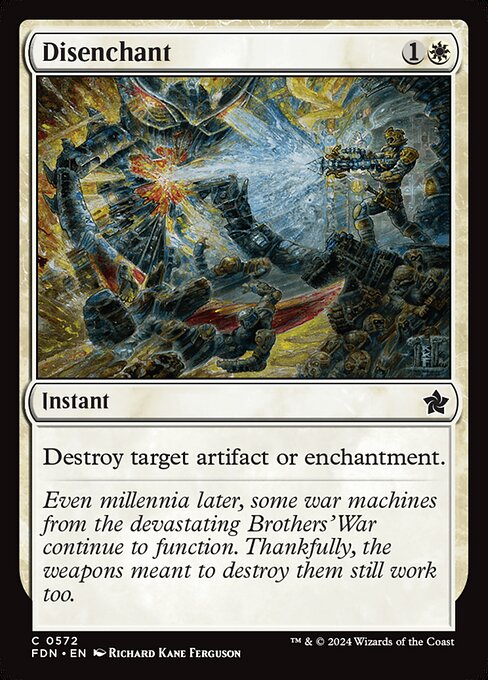
Disenchant
Lower-cost narrow response
Destroys one artifact or enchantment. It gives up Crush Contraband’s exile and possible second target.

Infernal Grasp
Creature coverage
Can target artifact creatures too, but life loss and destruction remain limits.

Resculpt
Blue exile option
Exiles an artifact or creature while leaving a 4/4 Elemental behind.
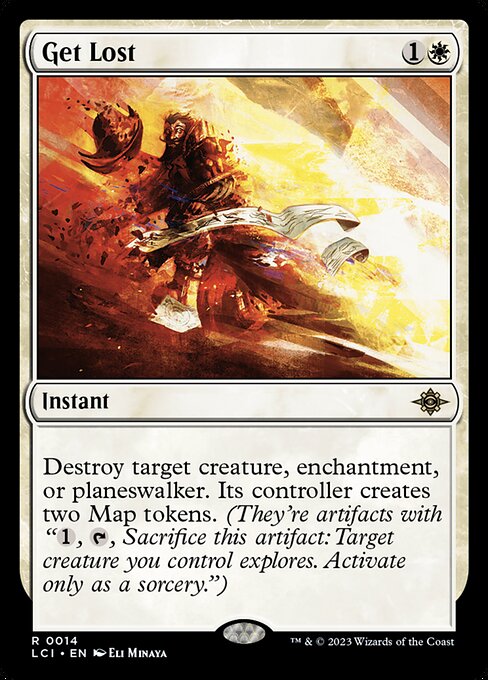
Get Lost
Creature, enchantment, or planeswalker
Gives two Maps and does not target artifacts or lands.

Soul-Guide Lantern
Graveyard timing
Entry exiles one target card; sacrificing to sweep opposing graveyards is separate from sacrificing to draw.
Test whether the answers leave room to develop
Try a few turns where you cast a threat and retain mana for your chosen answer. Note which colors are available and what that answer can legally target. Then compare the same position using the cut card. This tests the benefit of a lower cost directly. It is more useful than increasing a removal count while leaving every spell too expensive to cast beside the deck’s normal development.
Create a free account and save the stock and revised lists in My Decks. Use the Commander deck audit to review the whole package, then return to actual game notes. Did the new coverage matter? Was the compensation dangerous? Did a life-loss spell become unsafe? Those answers identify the next change and keep the upgrade tied to the games you play.
Build your deck
Put these choices into a Commander list. Create a free account to save your deck and keep tuning it with Deckcipher.
FAQ
What removal should I upgrade first in a precon?
Replace a slot that repeatedly misses the threats you face or costs too much to hold open. Name the cut and addition, then compare target coverage and consequences. Another creature answer will not fix a missing enchantment or graveyard answer.
Is Generous Gift always better than narrow removal?
No. It covers any permanent but costs three mana, destroys rather than exiles, and gives away a 3/3. A cheaper narrow answer can be better for a known threat. Several precons already include Gift, so check before buying another copy.
Does Infernal Grasp require paying two life to cast?
No. Its life loss happens during resolution. An indestructible legal target survives destruction while you still lose two life. If its only target becomes illegal before resolution, the spell does not resolve and you do not lose that life.
Can I draw with Soul-Guide Lantern and exile opposing graveyards too?
Not through both activated abilities of the same copy. Each requires sacrificing Lantern, so you choose which ability to activate. Its separate entry trigger exiles one targeted graveyard card and can happen before that later choice.
Is Farewell a simple upgrade for every precon?
No. Its modes can exile your own engines and recovery resources, and it is currently a Game Changer under the optional bracket guidance. Compare both the intended table and your ability to rebuild after the chosen modes.
How do I know whether a cheaper removal spell helped?
Record turns where the lower cost lets you develop while holding an answer, and turns where the lost exile or target coverage matters. Compare those real situations with the stock card rather than treating mana cost alone as proof of improvement.